A French Word to Live By
How to Conjugate Refluer in French
/ʁə.fly.e/
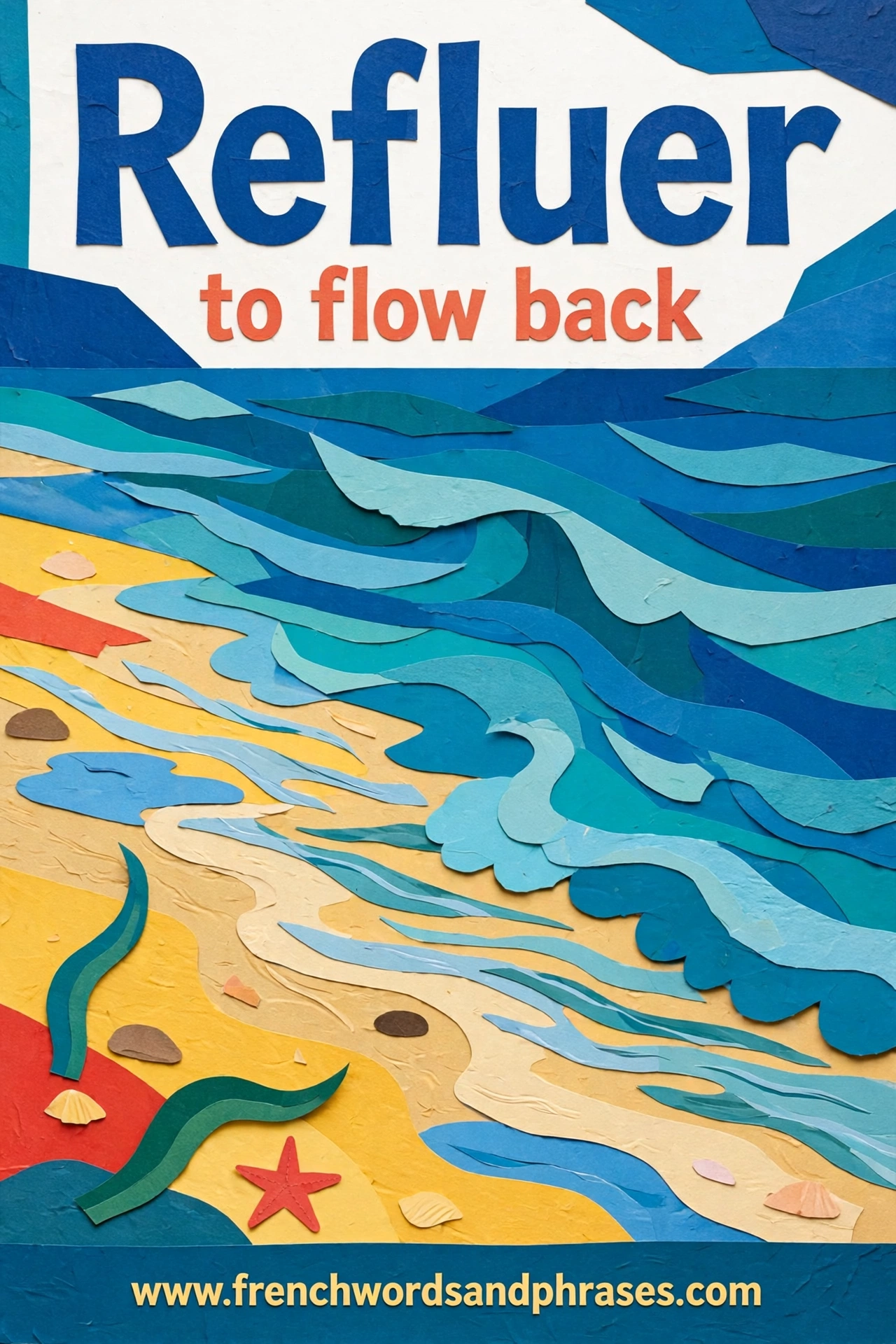
Refluer means to flow back — to ebb, to surge in reverse, whether it is the tide going out or a crowd streaming back the way it came.
The tide sliding off the sand towards the open sea, ten thousand supporters pouring back out of a stadium, blood rushing back from a limb — refluer is the verb of the return current: everything that flowed in now flows back.
In this guide, you’ll learn how to conjugate refluer in all the major French tenses and moods. Explore complete conjugation tables, French examples, English translations, and practice quizzes.
Understanding the French Verb Refluer
Refluer is a regular French verb belonging to the first group of verbs, those ending in-er.
It means to flow back. It is the technical verb of tides and hydraulics, the journalist’s verb for crowds leaving stadiums, stations and squares, and a medical verb for blood and other fluids returning. Its mirror image affluer (to stream in) appears in the same reports — crowds affluent in the morning and refluent at night.
Verb classification: First group (-er)
Auxiliary verb: Avoir
Past participle: reflué
Present participle: refluant
English equivalents: To flow back, to ebb, to surge back; la marée reflue — the tide is going out; l’eau reflue vers le large — the water flows back to the open sea; la foule reflue vers la sortie — the crowd streams back towards the exit; le sang reflue — the blood flows back.
One important detail: refluer is a perfectly regular -er verb built on flux, the Latin word for a flow — the same root as un reflux (an ebb, or heartburn in medicine) and affluer, its exact opposite, to flow in. Watch the direction of its partners: water reflue vers the sea or dans the harbour, and crowds refluent vers the exits — the movement is always back towards where things came from.
Experience the Word
Refluer is the verb of the tide turning — the moment the water, the crowd or the blood stops arriving and starts going home.
Imagine the final whistle in a great stadium. For two hours the crowd affluait, pressed shoulder to shoulder; now the gates open and the whole mass reflue — slowly, in rivers of people, down the ramps and towards the station, until the bowl stands empty.
Nothing has been pushed or carried. The crowd has flowed back — reflué, like a tide that has decided to leave.
How to Conjugate Refluer: Complete French Conjugation Guide
Let’s explore every major conjugation of refluer, beginning with the indicative mood.
How to Conjugate Refluer in the Indicative Mood
The indicative mood is used to express facts, observations, actions, and events.
How to Conjugate Refluer in the Present Tense (Présent)
Used for actions happening now, habitual actions, and general truths.
| Subject | Conjugation |
|---|---|
| je | reflue |
| tu | reflues |
| il / elle | reflue |
| nous | refluons |
| vous | refluez |
| ils / elles | refluent |
Example
À marée basse, l’eau reflue vers le large.
At low tide, the water flows back towards the open sea.
Quick Quiz 1
Complete the sentence:
À marée basse, les eaux ______ vers le large.
Reveal the answer
refluent
À marée basse, les eaux refluent vers le large.
At low tide, the waters flow back to the open sea.
How to Conjugate Refluer in the Passé Composé
Used for completed actions in the past. Refluer takes the auxiliary verb avoir.
| Subject | Conjugation |
|---|---|
| j’ | ai reflué |
| tu | as reflué |
| il / elle | a reflué |
| nous | avons reflué |
| vous | avez reflué |
| ils / elles | ont reflué |
Example
La foule a reflué vers les sorties après le match.
The crowd surged back towards the exits after the match.
How to Conjugate Refluer in the Imparfait (Imperfect Tense)
Used for habitual past actions, descriptions, and ongoing situations in the past.
| Subject | Conjugation |
|---|---|
| je | refluais |
| tu | refluais |
| il / elle | refluait |
| nous | refluions |
| vous | refluiez |
| ils / elles | refluaient |
Example
Chaque soir, la marée refluait lentement vers l’océan.
Every evening, the tide would ebb slowly back towards the ocean.
Quick Quiz 2
Choose the correct form:
The crowd surged back after the match.
La foule ______ après le match. (a reflué / est reflué)
Reveal the answer
a reflué
La foule a reflué après le match.
Refluer takes avoir.
How to Conjugate Refluer in the Plus-que-parfait
Used to describe an action that had already been completed before another past event.
| Subject | Conjugation |
|---|---|
| j’ | avais reflué |
| tu | avais reflué |
| il / elle | avait reflué |
| nous | avions reflué |
| vous | aviez reflué |
| ils / elles | avaient reflué |
Example
Les eaux avaient reflué avant l’aube.
The waters had flowed back before dawn.
How to Conjugate Refluer in the Passé Simple
Primarily used in formal writing, literature, and historical narratives. It is rarely used in everyday conversation.
| Subject | Conjugation |
|---|---|
| je | refluai |
| tu | refluas |
| il / elle | reflua |
| nous | refluâmes |
| vous | refluâtes |
| ils / elles | refluèrent |
Example
La foule reflua dans les rues voisines.
The crowd flowed back into the neighbouring streets.
How to Conjugate Refluer in the Passé Antérieur
A literary tense used to express an action completed immediately before another past action, generally in the passé simple.
| Subject | Conjugation |
|---|---|
| j’ | eus reflué |
| tu | eus reflué |
| il / elle | eut reflué |
| nous | eûmes reflué |
| vous | eûtes reflué |
| ils / elles | eurent reflué |
Example
Quand la marée eut reflué, les pêcheurs sortirent sur la grève.
When the tide had ebbed, the fishermen went out onto the shore.
How to Conjugate Refluer in the Future Tense (Futur Simple)
Used to describe actions that will take place in the future.
| Subject | Conjugation |
|---|---|
| je | refluerai |
| tu | reflueras |
| il / elle | refluera |
| nous | refluerons |
| vous | refluerez |
| ils / elles | reflueront |
Example
Demain matin, l’eau refluera plus tôt.
Tomorrow morning, the water will flow back earlier.
How to Conjugate Refluer in the Futur Antérieur (Future Perfect)
Used for an action that will have been completed before a particular point in the future.
| Subject | Conjugation |
|---|---|
| j’ | aurai reflué |
| tu | auras reflué |
| il / elle | aura reflué |
| nous | aurons reflué |
| vous | aurez reflué |
| ils / elles | auront reflué |
Example
À midi, la foule aura reflué vers la gare.
By noon, the crowd will have surged back towards the station.
How to Conjugate Refluer in the Near Future (Futur Proche)
Used to describe something that is going to happen soon. Formed with aller + infinitive.
| Subject | Conjugation |
|---|---|
| je | vais refluer |
| tu | vas refluer |
| il / elle | va refluer |
| nous | allons refluer |
| vous | allez refluer |
| ils / elles | vont refluer |
Example
Attention, la vague va refluer sur les rochers.
Careful, the wave is going to wash back over the rocks.
How to Conjugate Refluer in the Conditional Mood
The conditional mood expresses what would happen under certain circumstances. It is also frequently used to make polite requests or express wishes.
How to Conjugate Refluer in the Present Conditional
| Subject | Conjugation |
|---|---|
| je | refluerais |
| tu | refluerais |
| il / elle | refluerait |
| nous | refluerions |
| vous | reflueriez |
| ils / elles | reflueraient |
Example
Sans la digue, l’eau refluerait dans les champs.
Without the dyke, the water would flow back into the fields.
How to Conjugate Refluer in the Past Conditional
| Subject | Conjugation |
|---|---|
| j’ | aurais reflué |
| tu | aurais reflué |
| il / elle | aurait reflué |
| nous | aurions reflué |
| vous | auriez reflué |
| ils / elles | auraient reflué |
Example
La foule aurait reflué plus vite avec une seconde sortie.
The crowd would have flowed back faster with a second exit.
Refluer in the Literary Past Conditional Form
This less common literary form uses the imperfect subjunctive of avoir.
| Subject | Conjugation |
|---|---|
| j’ | eusse reflué |
| tu | eusses reflué |
| il / elle | eût reflué |
| nous | eussions reflué |
| vous | eussiez reflué |
| ils / elles | eussent reflué |
Example
La marée eût reflué avant la nuit sans le vent contraire.
The tide would have ebbed before nightfall without the contrary wind.
How to Conjugate Refluer in the Subjunctive Mood
The subjunctive is used to express wishes, emotions, doubts, necessity, and uncertainty. It frequently follows expressions such as il faut que (it is necessary that) or bien que (although).
How to Conjugate Refluer in the Present Subjunctive
| Subject | Conjugation |
|---|---|
| que je | reflue |
| que tu | reflues |
| qu’il / qu’elle | reflue |
| que nous | refluions |
| que vous | refluiez |
| qu’ils / qu’elles | refluent |
Example
Il faut que l’eau reflue avant qu’on répare le barrage.
The water must flow back before the dam is repaired.
Quick Quiz 3
Complete the sentence using the subjunctive:
Il faut que la foule ______ vers la sortie.
Reveal the answer
reflue
Il faut que la foule reflue vers la sortie.
The crowd must flow back towards the exit.
How to Conjugate Refluer in the Imperfect Subjunctive
A literary tense, rarely encountered in modern spoken French.
| Subject | Conjugation |
|---|---|
| que je | refluasse |
| que tu | refluasses |
| qu’il / qu’elle | refluât |
| que nous | refluassions |
| que vous | refluassiez |
| qu’ils / qu’elles | refluassent |
Example
On attendait que la foule refluât vers la place.
They waited for the crowd to flow back towards the square.
How to Conjugate Refluer in the Pluperfect Subjunctive
A literary construction used to express an action completed before another past action.
| Subject | Conjugation |
|---|---|
| que j’ | eusse reflué |
| que tu | eusses reflué |
| qu’il / qu’elle | eût reflué |
| que nous | eussions reflué |
| que vous | eussiez reflué |
| qu’ils / qu’elles | eussent reflué |
Example
Le garde rapporta que les eaux eussent reflué pendant la nuit.
The watchman reported that the waters had flowed back during the night.
How to Conjugate Refluer in the Past Subjunctive
| Subject | Conjugation |
|---|---|
| que j’ | aie reflué |
| que tu | aies reflué |
| qu’il / qu’elle | ait reflué |
| que nous | ayons reflué |
| que vous | ayez reflué |
| qu’ils / qu’elles | aient reflué |
Example
Je suis content que la foule ait reflué sans panique.
I am glad the crowd flowed back without panic.
How to Conjugate Refluer in the Imperative
The imperative is used to give commands, instructions, invitations, or suggestions. Subject pronouns are omitted.
How to Conjugate Refluer in the Present Imperative
| Person | Conjugation |
|---|---|
| (tu) | reflue |
| (nous) | refluons |
| (vous) | refluez |
Example
Refluez lentement vers la sortie, s’il vous plaît !
Move back slowly towards the exit, please!
Quick Quiz 4
How would you say Flow back slowly (tu form)?
Reveal the answer
Reflue lentement !
French Participles of Refluer
Participles are verb forms that can be used in compound tenses and other grammatical constructions.
Present Participle of Refluer
refluant
En refluant, la marée laisse des flaques pleines de crevettes.
As it flows back, the tide leaves pools full of shrimps.
Past Participle of Refluer
reflué
Refluée vers le large, l’eau découvre les rochers.
Flowed back towards the open sea, the water uncovers the rocks.
Refluer in Everyday French: Real-Life Examples
Now that you know the conjugations, let’s see how refluer appears in everyday French.
Example 1 — Present
La marée reflue vers le large.
The tide is flowing back to the open sea.
Example 2 — Passé composé
La foule a reflué vers la gare.
The crowd surged back towards the station.
Example 3 — Imparfait
L’eau refluait lentement chaque soir.
The water would flow back slowly every evening.
Example 4 — Future
La foule refluera par les deux sorties.
The crowd will flow back through both exits.
Example 5 — Conditional
Sans la digue, l’eau refluerait dans les champs.
Without the dyke, the water would flow back into the fields.
Example 6 — Imperative
Refluez vers la sortie, doucement !
Move back towards the exit, gently!
Beyond Translation: The Meaning of Refluer
English has no everyday verb for this: ebb is close for tides, but French refluer handles tides, crowds, traffic and blood with the same easy motion.
It is one half of a pair.
Its twin affluer means to flow in, to stream towards — read any French match report and you will find both: les spectateurs affluent au stade before the game, ils refluent vers la gare after it.
How to Remember the French Verb Refluer
Remember it this way: Refluer is about the tide and the stadium crowd, both flowing home.
- Re- for back again, -fluer for flow: refluer is simply flowing in reverse.
- Its opposite is affluer — crowds affluent in, then refluent out.
- Regular -er: je reflue, nous refluons, past participle reflué, auxiliary avoir.
The key idea is the tide and the stadium crowd, both flowing home.
Test Your Knowledge of Refluer
Let’s see how much you’ve learned. Try answering these questions before revealing the answers.
Question 1
What is the opposite of refluer, and what does it mean?
Reveal the answer
Affluer — to flow in, to stream towards a place.
Question 2
How do you say At low tide, the water flows back in French?
Reveal the answer
À marée basse, l’eau reflue.
Question 3
Translate: The crowd surged back towards the exits.
Reveal the answer
La foule a reflué vers les sorties.
Question 4
What is the past participle of refluer?
Reveal the answer
Reflué.
Question 5
Complete the sentence:
Il faut que l’eau ______ avant la réparation du barrage.
Reveal the answer
reflue
Il faut que l’eau reflue avant la réparation du barrage.
The water must flow back before the dam is repaired.
Your Final Challenge
Can You Use It?
How would you say this in French?
When the match ends, the crowd flows back towards the station like a retreating tide.
Reveal the answer
Quand le match finit, la foule reflue vers la gare comme une marée qui se retire.
When the match ends, the crowd flows back towards the station like a retreating tide.
A little French. A little curiosity. A richer everyday life.
LEARN FRENCH ONE WORD AT A TIME