A French Word to Live By
How to Conjugate Refléter in French
/ʁə.fle.te/
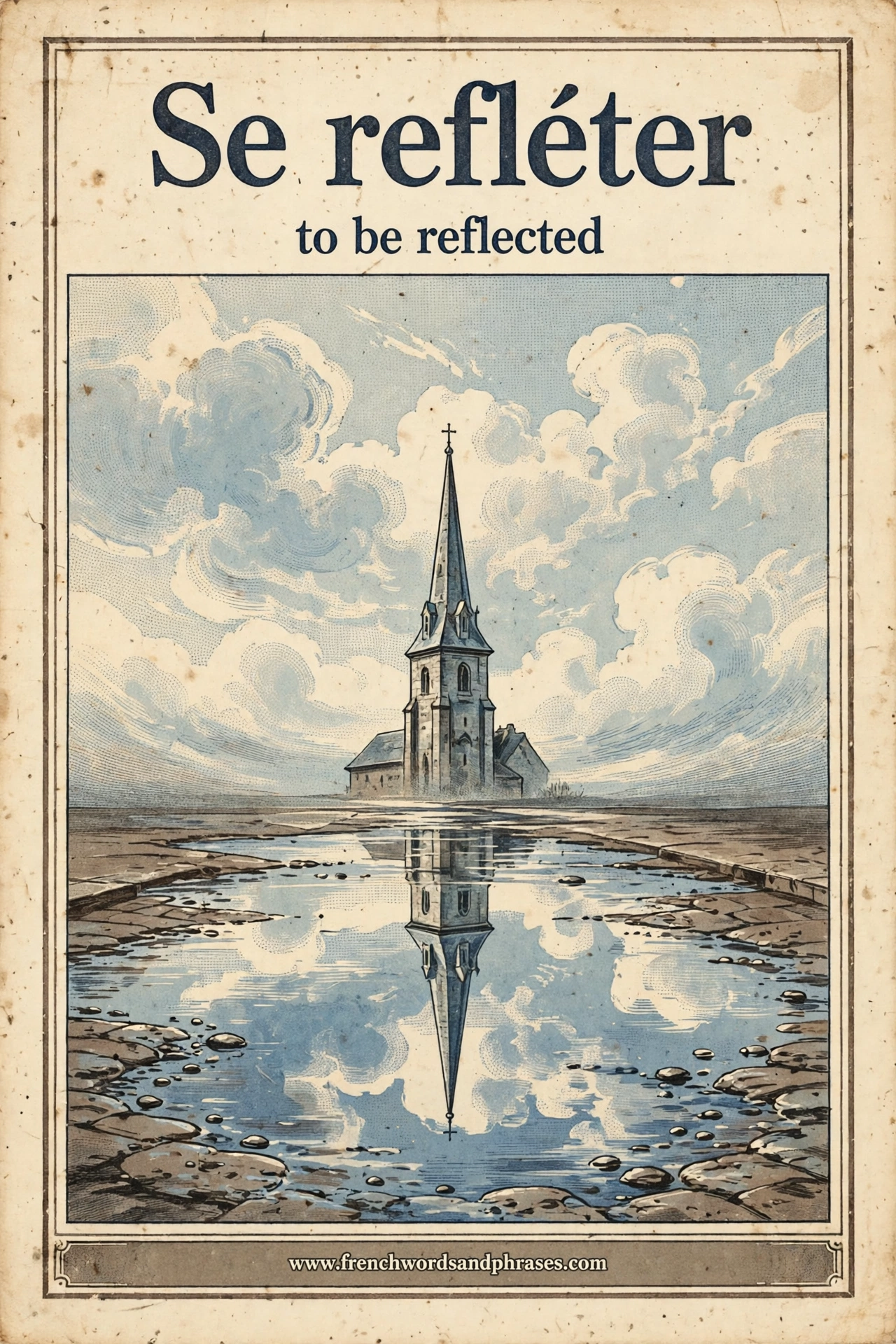
Refléter means to reflect — to give back an image like a mirror, or to show the truth of something, as a face reflects joy and figures reflect an economy.
A lake handing the mountains their portrait, a tired face telling the truth, a report showing what a country really thinks — refléter is the verb of faithful mirrors, in glass and in life.
In this guide, you’ll learn how to conjugate refléter in all the major French tenses and moods. Explore complete conjugation tables, French examples, English translations, and practice quizzes.
Understanding the French Verb Refléter
Refléter is a regular French verb belonging to the first group of verbs, those ending in-er.
It means to reflect. It works in two registers at once: the physical mirror (lakes, glass, polished metal reflecting light and images) and the abstract one (faces, statistics, reports and works of art reflecting feelings, crises and opinions). A faithful surface, in either sense, reflète.
Verb classification: First group (-er)
Auxiliary verb: Avoir
Past participle: reflété
Present participle: reflétant
English equivalents: To reflect, to mirror, to show; refléter une image — to reflect an image; son visage reflète la fatigue — his face shows his tiredness; ces chiffres reflètent la crise — these figures reflect the crisis; refléter la lumière — to reflect light; refléter l’opinion publique — to reflect public opinion.
One important detail: refléter is a céder-type verb — the é of the stem opens to è wherever the next syllable is mute: je reflète, tu reflètes, il reflète, ils reflètent, and through the future and conditional: je reflèterai, je reflèterais. The é survives where the ending is sounded: nous reflétons, vous reflétez, je reflétais, en reflétant, and in the participle reflété. Keep the twins apart: le miroir reflète ton visage (the mirror does it, transitive) but ton visage se reflète dans le miroir (the face appears, reflexive).
Experience the Word
Refléter is the verb of the honest surface — whatever shows you things as they are is reflétant them.
Imagine a mountain lake at six in the morning, before the wind wakes. The peaks stand in the water as clearly as in the sky — le lac reflète les montagnes, and for an hour the world exists twice, once in stone and once in light.
The lake has added nothing and hidden nothing. It has reflected — reflété — the mountain exactly as it is.
How to Conjugate Refléter: Complete French Conjugation Guide
Let’s explore every major conjugation of refléter, beginning with the indicative mood.
How to Conjugate Refléter in the Indicative Mood
The indicative mood is used to express facts, observations, actions, and events.
How to Conjugate Refléter in the Present Tense (Présent)
Used for actions happening now, habitual actions, and general truths.
| Subject | Conjugation |
|---|---|
| je | reflète |
| tu | reflètes |
| il / elle | reflète |
| nous | reflétons |
| vous | reflétez |
| ils / elles | reflètent |
Example
Le lac reflète les montagnes comme un miroir.
The lake reflects the mountains like a mirror.
Quick Quiz 1
Complete the sentence:
Nous admirons le lac qui ______ les peupliers.
Reveal the answer
reflète
Nous admirons le lac qui reflète les peupliers.
We are admiring the lake that reflects the poplars.
How to Conjugate Refléter in the Passé Composé
Used for completed actions in the past. Refléter takes the auxiliary verb avoir.
| Subject | Conjugation |
|---|---|
| j’ | ai reflété |
| tu | as reflété |
| il / elle | a reflété |
| nous | avons reflété |
| vous | avez reflété |
| ils / elles | ont reflété |
Example
Son sourire a reflété toute la joie de la salle.
Her smile reflected the joy of the whole room.
How to Conjugate Refléter in the Imparfait (Imperfect Tense)
Used for habitual past actions, descriptions, and ongoing situations in the past.
| Subject | Conjugation |
|---|---|
| je | reflétais |
| tu | reflétais |
| il / elle | reflétait |
| nous | reflétions |
| vous | reflétiez |
| ils / elles | reflétaient |
Example
Les vitrines reflétaient les lumières de Noël.
The shop windows used to reflect the Christmas lights.
Quick Quiz 2
Choose the correct form:
Her smile reflected her joy.
Son sourire ______ sa joie. (a reflété / s’est reflété)
Reveal the answer
a reflété
Son sourire a reflété sa joie.
Refléter is transitive and takes avoir; the reflexive is for the image appearing in a surface.
How to Conjugate Refléter in the Plus-que-parfait
Used to describe an action that had already been completed before another past event.
| Subject | Conjugation |
|---|---|
| j’ | avais reflété |
| tu | avais reflété |
| il / elle | avait reflété |
| nous | avions reflété |
| vous | aviez reflété |
| ils / elles | avaient reflété |
Example
Le rapport avait fidèlement reflété l’opinion des habitants.
The report had faithfully reflected the residents’ opinion.
How to Conjugate Refléter in the Passé Simple
Primarily used in formal writing, literature, and historical narratives. It is rarely used in everyday conversation.
| Subject | Conjugation |
|---|---|
| je | reflétai |
| tu | reflétas |
| il / elle | refléta |
| nous | reflétâmes |
| vous | reflétâtes |
| ils / elles | reflétèrent |
Example
La mer calme refléta le ciel du soir.
The calm sea mirrored the evening sky.
How to Conjugate Refléter in the Passé Antérieur
A literary tense used to express an action completed immediately before another past action, generally in the passé simple.
| Subject | Conjugation |
|---|---|
| j’ | eus reflété |
| tu | eus reflété |
| il / elle | eut reflété |
| nous | eûmes reflété |
| vous | eûtes reflété |
| ils / elles | eurent reflété |
Example
Quand le miroir eut reflété son visage, elle sourit.
When the mirror had reflected her face, she smiled.
How to Conjugate Refléter in the Future Tense (Futur Simple)
Used to describe actions that will take place in the future.
| Subject | Conjugation |
|---|---|
| je | reflèterai |
| tu | reflèteras |
| il / elle | reflètera |
| nous | reflèterons |
| vous | reflèterez |
| ils / elles | reflèteront |
Example
Ce soir, la rivière reflètera les feux d’artifice.
Tonight, the river will reflect the fireworks.
How to Conjugate Refléter in the Futur Antérieur (Future Perfect)
Used for an action that will have been completed before a particular point in the future.
| Subject | Conjugation |
|---|---|
| j’ | aurai reflété |
| tu | auras reflété |
| il / elle | aura reflété |
| nous | aurons reflété |
| vous | aurez reflété |
| ils / elles | auront reflété |
Example
À la fin du mois, l’enquête aura reflété l’avis de tout le quartier.
By the end of the month, the survey will have reflected the whole neighbourhood’s views.
How to Conjugate Refléter in the Near Future (Futur Proche)
Used to describe something that is going to happen soon. Formed with aller + infinitive.
| Subject | Conjugation |
|---|---|
| je | vais refléter |
| tu | vas refléter |
| il / elle | va refléter |
| nous | allons refléter |
| vous | allez refléter |
| ils / elles | vont refléter |
Example
Ce tableau va refléter la lumière, accroche-le ailleurs.
This painting is going to reflect the light, hang it somewhere else.
How to Conjugate Refléter in the Conditional Mood
The conditional mood expresses what would happen under certain circumstances. It is also frequently used to make polite requests or express wishes.
How to Conjugate Refléter in the Present Conditional
| Subject | Conjugation |
|---|---|
| je | reflèterais |
| tu | reflèterais |
| il / elle | reflèterait |
| nous | reflèterions |
| vous | reflèteriez |
| ils / elles | reflèteraient |
Example
Un bon journaliste reflèterait la réalité sans la déformer.
A good journalist would reflect reality without distorting it.
How to Conjugate Refléter in the Past Conditional
| Subject | Conjugation |
|---|---|
| j’ | aurais reflété |
| tu | aurais reflété |
| il / elle | aurait reflété |
| nous | aurions reflété |
| vous | auriez reflété |
| ils / elles | auraient reflété |
Example
Le sondage aurait mieux reflété le pays avec plus de réponses.
The poll would have reflected the country better with more responses.
Refléter in the Literary Past Conditional Form
This less common literary form uses the imperfect subjunctive of avoir.
| Subject | Conjugation |
|---|---|
| j’ | eusse reflété |
| tu | eusses reflété |
| il / elle | eût reflété |
| nous | eussions reflété |
| vous | eussiez reflété |
| ils / elles | eussent reflété |
Example
Le lac eût reflété la lune sans le vent du soir.
The lake would have mirrored the moon without the evening wind.
How to Conjugate Refléter in the Subjunctive Mood
The subjunctive is used to express wishes, emotions, doubts, necessity, and uncertainty. It frequently follows expressions such as il faut que (it is necessary that) or bien que (although).
How to Conjugate Refléter in the Present Subjunctive
| Subject | Conjugation |
|---|---|
| que je | reflète |
| que tu | reflètes |
| qu’il / qu’elle | reflète |
| que nous | reflétions |
| que vous | reflétiez |
| qu’ils / qu’elles | reflètent |
Example
Je veux que ce portrait reflète sa vraie personnalité.
I want this portrait to reflect her true personality.
Quick Quiz 3
Complete the sentence using the subjunctive:
Il faut que ce rapport ______ la réalité.
Reveal the answer
reflète
Il faut que ce rapport reflète la réalité.
This report must reflect reality.
How to Conjugate Refléter in the Imperfect Subjunctive
A literary tense, rarely encountered in modern spoken French.
| Subject | Conjugation |
|---|---|
| que je | reflétasse |
| que tu | reflétasses |
| qu’il / qu’elle | reflétât |
| que nous | reflétassions |
| que vous | reflétassiez |
| qu’ils / qu’elles | reflétassent |
Example
On souhaitait que le journal reflétât toutes les opinions.
People wished the newspaper would reflect all opinions.
How to Conjugate Refléter in the Pluperfect Subjunctive
A literary construction used to express an action completed before another past action.
| Subject | Conjugation |
|---|---|
| que j’ | eusse reflété |
| que tu | eusses reflété |
| qu’il / qu’elle | eût reflété |
| nous | eussions reflété |
| que vous | eussiez reflété |
| qu’ils / qu’elles | eussent reflété |
Example
On admirait que l’eau eût reflété le ciel en feu.
People admired that the water had mirrored the blazing sky.
How to Conjugate Refléter in the Past Subjunctive
| Subject | Conjugation |
|---|---|
| que j’ | aie reflété |
| que tu | aies reflété |
| qu’il / qu’elle | ait reflété |
| que nous | ayons reflété |
| que vous | ayez reflété |
| qu’ils / qu’elles | aient reflété |
Example
Je suis heureux que le rapport ait reflété nos efforts.
I am happy the report reflected our efforts.
How to Conjugate Refléter in the Imperative
The imperative is used to give commands, instructions, invitations, or suggestions. Subject pronouns are omitted.
How to Conjugate Refléter in the Present Imperative
| Person | Conjugation |
|---|---|
| (tu) | reflète |
| (nous) | reflétons |
| (vous) | reflétez |
Example
Reflète la lumière vers la plante, pas vers la route !
Reflect the light towards the plant, not towards the road!
Quick Quiz 4
How would you say Reflect the light towards the plant (tu form)?
Reveal the answer
Reflète la lumière vers la plante !
French Participles of Refléter
Participles are verb forms that can be used in compound tenses and other grammatical constructions.
Present Participle of Refléter
reflétant
En reflétant le soleil, la tour éblouit les passants.
By reflecting the sun, the tower dazzles passers-by.
Past Participle of Refléter
reflété
Reflétée par la vitre, son image tremblait légèrement.
Reflected by the glass, her image trembled slightly.
Refléter in Everyday French: Real-Life Examples
Now that you know the conjugations, let’s see how refléter appears in everyday French.
Example 1 — Present
Le lac reflète les montagnes.
The lake reflects the mountains.
Example 2 — Passé composé
Son sourire a reflété sa joie.
Her smile reflected her joy.
Example 3 — Imparfait
Les vitrines reflétaient les lumières.
The windows used to reflect the lights.
Example 4 — Future
La rivière reflètera les feux d’artifice.
The river will reflect the fireworks.
Example 5 — Conditional
Un bon journal reflèterait toutes les opinions.
A good newspaper would reflect all opinions.
Example 6 — Imperative
Reflète la lumière vers la plante !
Reflect the light towards the plant!
Beyond Translation: The Meaning of Refléter
English reflect covers both, but French refléter stays close to the mirror — its noun is un reflet, the image itself, trembling on the water.
A reflet is never the thing, and everyone knows it.
That built-in honesty is why the abstract sense is so sharp: to say a report reflète la crise is to claim the figures are a true image — and to invite the question every mirror invites: is the glass faithful?
How to Remember the French Verb Refléter
Remember it this way: Refléter is about the still lake handing the mountains their portrait.
- Céder-type spelling: je reflète with è, but nous reflétons with é — and je reflèterai in the future.
- Transitive twin: le miroir reflète ton visage (avoir); reflexive twin: ton visage se reflète dans le miroir (être).
- Two mirrors, one verb: water and glass for images, faces and figures for feelings and facts.
The key idea is the still lake handing the mountains their portrait.
Test Your Knowledge of Refléter
Let’s see how much you’ve learned. Try answering these questions before revealing the answers.
Question 1
Why does je reflète have a grave accent but nous reflétons an acute one?
Reveal the answer
The céder-type rule — é becomes è before a mute syllable (je reflète), and stays é where the ending is sounded (nous reflétons).
Question 2
How do you say The lake reflects the mountains in French?
Reveal the answer
Le lac reflète les montagnes.
Question 3
Translate: These figures reflect the crisis.
Reveal the answer
Ces chiffres reflètent la crise.
Question 4
What is the past participle of refléter?
Reveal the answer
Reflété.
Question 5
Complete the sentence:
Je veux que ce portrait ______ sa vraie personnalité.
Reveal the answer
reflète
Je veux que ce portrait reflète sa vraie personnalité.
I want this portrait to reflect her true personality.
Your Final Challenge
Can You Use It?
How would you say this in French?
The lake reflects the mountain in the morning, and the mountain, every evening, returns the courtesy to the lake.
Reveal the answer
Le lac reflète la montagne le matin, et la montagne, chaque soir, rend la politesse au lac.
The lake reflects the mountain in the morning, and the mountain, every evening, returns the courtesy to the lake.
A little French. A little curiosity. A richer everyday life.
LEARN FRENCH ONE WORD AT A TIME