A French Word to Live By
How to Conjugate Refermer in French
/ʁə.fɛʁ.me/
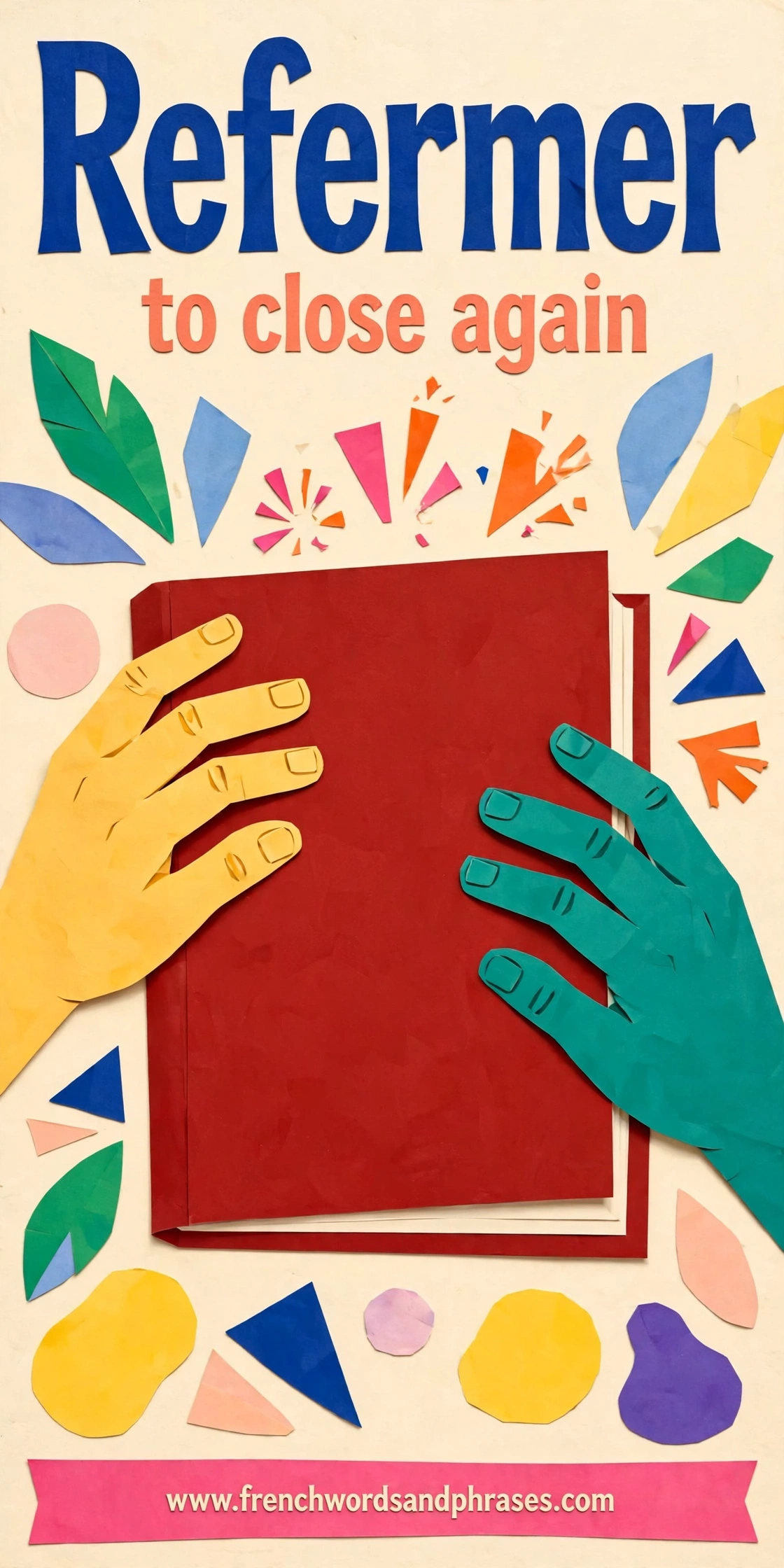
Refermer means to close again — to shut a second time what was opened: a door, a book, a box, a lid.
A hand going back to the door it just opened, a book shut on its bookmark, a lid pressed back onto the jam jar — refermer is the small, satisfying verb of putting things shut again.
In this guide, you’ll learn how to conjugate refermer in all the major French tenses and moods. Explore complete conjugation tables, French examples, English translations, and practice quizzes.
Understanding the French Verb Refermer
Refermer is a regular French verb belonging to the first group of verbs, those ending in-er.
It means to close again. It is used for doors, books, boxes, lids and umbrellas — anything with a hinge, a cover or a clasp that has been opened once and must be shut a second time. Figuratively, refermer une parenthèse is to close a digression and get back to the point.
Verb classification: First group (-er)
Auxiliary verb: Avoir
Past participle: refermé
Present participle: refermant
English equivalents: To close again, to shut again; refermer la porte — to close the door again; refermer un livre — to close a book again; refermer une boîte — to shut a box again; refermer la porte derrière soi — to close the door behind oneself; refermer à clé — to lock shut again.
One important detail: refermer is simply re- (again) + fermer (to close), and it is perfectly regular — je referme, nous refermons, past participle refermé. The real trap is the division of labour with its reflexive twin: a person referme la porte (transitive, with avoir), but la porte se referme all by itself (reflexive, with être). If something closes it, use refermer; if it closes itself, use se refermer.
Experience the Word
Refermer is the verb of the second closing — the click, the thud, the lid pressed home that says: this is finished, this stays shut.
Imagine a bookseller at closing time. She walks the aisles one last time, referme les livres laissés ouverts par les clients, referme la caisse, referme les volets — each closing a small full stop at the end of the day’s sentence.
The shop is dark and quiet. She has closed everything again — tout refermé — and the day is sealed.
How to Conjugate Refermer: Complete French Conjugation Guide
Let’s explore every major conjugation of refermer, beginning with the indicative mood.
How to Conjugate Refermer in the Indicative Mood
The indicative mood is used to express facts, observations, actions, and events.
How to Conjugate Refermer in the Present Tense (Présent)
Used for actions happening now, habitual actions, and general truths.
| Subject | Conjugation |
|---|---|
| je | referme |
| tu | refermes |
| il / elle | referme |
| nous | refermons |
| vous | refermez |
| ils / elles | referment |
Example
Il referme la porte derrière lui sans bruit.
He closes the door behind him without a sound.
Quick Quiz 1
Complete the sentence:
Nous ______ la porte derrière nous.
Reveal the answer
refermons
Nous refermons la porte derrière nous.
We close the door behind us.
How to Conjugate Refermer in the Passé Composé
Used for completed actions in the past. Refermer takes the auxiliary verb avoir.
| Subject | Conjugation |
|---|---|
| j’ | ai refermé |
| tu | as refermé |
| il / elle | a refermé |
| nous | avons refermé |
| vous | avez refermé |
| ils / elles | ont refermé |
Example
Elle a refermé le livre sur un marque-page en soie.
She closed the book again on a silk bookmark.
How to Conjugate Refermer in the Imparfait (Imperfect Tense)
Used for habitual past actions, descriptions, and ongoing situations in the past.
| Subject | Conjugation |
|---|---|
| je | refermais |
| tu | refermais |
| il / elle | refermait |
| nous | refermions |
| vous | refermiez |
| ils / elles | refermaient |
Example
Chaque soir, le gardien refermait les volets du château.
Every evening, the caretaker would close the castle shutters again.
Quick Quiz 2
Choose the correct form:
She closed the book again.
Elle ______ le livre. (a refermé / s’est refermée)
Reveal the answer
a refermé
Elle a refermé le livre.
Refermer is transitive and takes avoir; the reflexive s’est refermée would need the book as subject.
How to Conjugate Refermer in the Plus-que-parfait
Used to describe an action that had already been completed before another past event.
| Subject | Conjugation |
|---|---|
| j’ | avais refermé |
| tu | avais refermé |
| il / elle | avait refermé |
| nous | avions refermé |
| vous | aviez refermé |
| ils / elles | avaient refermé |
Example
Nous avions refermé la boîte avant l’arrivée des enfants.
We had closed the box again before the children arrived.
How to Conjugate Refermer in the Passé Simple
Primarily used in formal writing, literature, and historical narratives. It is rarely used in everyday conversation.
| Subject | Conjugation |
|---|---|
| je | refermai |
| tu | refermas |
| il / elle | referma |
| nous | refermâmes |
| vous | refermâtes |
| ils / elles | refermèrent |
Example
Elle referma doucement le couvercle du piano.
She gently closed the piano lid again.
How to Conjugate Refermer in the Passé Antérieur
A literary tense used to express an action completed immediately before another past action, generally in the passé simple.
| Subject | Conjugation |
|---|---|
| j’ | eus refermé |
| tu | eus refermé |
| il / elle | eut refermé |
| nous | eûmes refermé |
| vous | eûtes refermé |
| ils / elles | eurent refermé |
Example
Dès qu’il eut refermé la porte, le silence revint.
As soon as he had closed the door again, silence returned.
How to Conjugate Refermer in the Future Tense (Futur Simple)
Used to describe actions that will take place in the future.
| Subject | Conjugation |
|---|---|
| je | refermerai |
| tu | refermeras |
| il / elle | refermera |
| nous | refermerons |
| vous | refermerez |
| ils / elles | refermeront |
Example
Tu refermeras le pot de confiture, s’il te plaît.
You will close the jam jar again, please.
How to Conjugate Refermer in the Futur Antérieur (Future Perfect)
Used for an action that will have been completed before a particular point in the future.
| Subject | Conjugation |
|---|---|
| j’ | aurai refermé |
| tu | auras refermé |
| il / elle | aura refermé |
| nous | aurons refermé |
| vous | aurez refermé |
| ils / elles | auront refermé |
Example
À minuit, le libraire aura refermé sa boutique depuis longtemps.
By midnight, the bookseller will have closed his shop long ago.
How to Conjugate Refermer in the Near Future (Futur Proche)
Used to describe something that is going to happen soon. Formed with aller + infinitive.
| Subject | Conjugation |
|---|---|
| je | vais refermer |
| tu | vas refermer |
| il / elle | va refermer |
| nous | allons refermer |
| vous | allez refermer |
| ils / elles | vont refermer |
Example
Attends, je vais refermer la fenêtre, il pleut.
Wait, I am going to close the window again, it is raining.
How to Conjugate Refermer in the Conditional Mood
The conditional mood expresses what would happen under certain circumstances. It is also frequently used to make polite requests or express wishes.
How to Conjugate Refermer in the Present Conditional
| Subject | Conjugation |
|---|---|
| je | refermerais |
| tu | refermerais |
| il / elle | refermerait |
| nous | refermerions |
| vous | refermeriez |
| ils / elles | refermeraient |
Example
Sans ce loquet cassé, je refermerais la porte correctement.
Without this broken latch, I would close the door properly.
How to Conjugate Refermer in the Past Conditional
| Subject | Conjugation |
|---|---|
| j’ | aurais refermé |
| tu | aurais refermé |
| il / elle | aurait refermé |
| nous | aurions refermé |
| vous | auriez refermé |
| ils / elles | auraient refermé |
Example
Elle aurait refermé le livre si la fin ne l’avait pas captivée.
She would have closed the book again if the ending had not gripped her.
Refermer in the Literary Past Conditional Form
This less common literary form uses the imperfect subjunctive of avoir.
| Subject | Conjugation |
|---|---|
| j’ | eusse refermé |
| tu | eusses refermé |
| il / elle | eût refermé |
| nous | eussions refermé |
| vous | eussiez refermé |
| ils / elles | eussent refermé |
Example
Il eût refermé la porte sur son passé sans un regard en arrière.
He would have closed the door on his past without a backward glance.
How to Conjugate Refermer in the Subjunctive Mood
The subjunctive is used to express wishes, emotions, doubts, necessity, and uncertainty. It frequently follows expressions such as il faut que (it is necessary that) or bien que (although).
How to Conjugate Refermer in the Present Subjunctive
| Subject | Conjugation |
|---|---|
| que je | referme |
| que tu | refermes |
| qu’il / qu’elle | referme |
| que nous | refermions |
| que vous | refermiez |
| qu’ils / qu’elles | referment |
Example
Il faut que tu refermes la boîte après chaque usage.
You must close the box again after each use.
Quick Quiz 3
Complete the sentence using the subjunctive:
Il faut que vous ______ les volets avant l’orage.
Reveal the answer
refermiez
Il faut que vous refermiez les volets avant l’orage.
You must close the shutters again before the storm.
How to Conjugate Refermer in the Imperfect Subjunctive
A literary tense, rarely encountered in modern spoken French.
| Subject | Conjugation |
|---|---|
| que je | refermasse |
| que tu | refermasses |
| qu’il / qu’elle | refermât |
| que nous | refermassions |
| que vous | refermassiez |
| qu’ils / qu’elles | refermassent |
Example
Elle voulait qu’il refermât la porte à clé.
She wanted him to lock the door shut again.
How to Conjugate Refermer in the Pluperfect Subjunctive
A literary construction used to express an action completed before another past action.
| Subject | Conjugation |
|---|---|
| que j’ | eusse refermé |
| que tu | eusses refermé |
| qu’il / qu’elle | eût refermé |
| que nous | eussions refermé |
| que vous | eussiez refermé |
| qu’ils / qu’elles | eussent refermé |
Example
On regrettait qu’ils eussent refermé la frontière si tôt.
People regretted that they had closed the border again so soon.
How to Conjugate Refermer in the Past Subjunctive
| Subject | Conjugation |
|---|---|
| que j’ | aie refermé |
| que tu | aies refermé |
| qu’il / qu’elle | ait refermé |
| que nous | ayons refermé |
| que vous | ayez refermé |
| qu’ils / qu’elles | aient refermé |
Example
Je suis content que tu aies refermé les volets avant l’orage.
I am glad you closed the shutters again before the storm.
How to Conjugate Refermer in the Imperative
The imperative is used to give commands, instructions, invitations, or suggestions. Subject pronouns are omitted.
How to Conjugate Refermer in the Present Imperative
| Person | Conjugation |
|---|---|
| (tu) | referme |
| (nous) | refermons |
| (vous) | refermez |
Example
Referme la porte, le chat va sortir !
Close the door again, the cat will get out!
Quick Quiz 4
How would you say Close the door again (tu form)?
Reveal the answer
Referme la porte !
French Participles of Refermer
Participles are verb forms that can be used in compound tenses and other grammatical constructions.
Present Participle of Refermer
refermant
En refermant le livre, il glissa un mot entre les pages.
As he closed the book again, he slipped a note between the pages.
Past Participle of Refermer
refermé
Le livre refermé, elle resta un moment les yeux dans le vide.
The book closed again, she sat for a moment staring into space.
Refermer in Everyday French: Real-Life Examples
Now that you know the conjugations, let’s see how refermer appears in everyday French.
Example 1 — Present
Il referme la porte derrière lui.
He closes the door behind him.
Example 2 — Passé composé
Elle a refermé le livre.
She closed the book again.
Example 3 — Imparfait
Le gardien refermait les volets chaque soir.
The caretaker closed the shutters again every evening.
Example 4 — Future
Tu refermeras le pot de confiture.
You will close the jam jar again.
Example 5 — Conditional
Je refermerais la fenêtre s’il pleuvait.
I would close the window again if it rained.
Example 6 — Imperative
Referme la porte !
Close the door again!
Beyond Translation: The Meaning of Refermer
English has to say close again in two words; French bolts the repetition onto the verb itself with re-, the hardest-working prefix in the language.
Re- is the prefix of second chances.
Rouvrir opens again, relire reads again, refaire does again — and refermer shuts again. Learn to hear that little re- and hundreds of French verbs confess their meaning before you even reach the stem.
How to Remember the French Verb Refermer
Remember it this way: Refermer is about the hand going back to shut the door a second time.
- Re- + fermer: to close AGAIN — if it was never opened, plain fermer is the verb.
- People referment things (avoir); things se referment by themselves (être) — keep the twins apart.
- Regular -er: je referme, nous refermons, past participle refermé.
The key idea is the hand going back to shut the door a second time.
Test Your Knowledge of Refermer
Let’s see how much you’ve learned. Try answering these questions before revealing the answers.
Question 1
What does the prefix re- add to fermer in refermer?
Reveal the answer
Again — refermer is to close a second time, after an opening.
Question 2
How do you say He closes the door behind him in French?
Reveal the answer
Il referme la porte derrière lui.
Question 3
Translate: She closed the book again.
Reveal the answer
Elle a refermé le livre.
Question 4
What is the past participle of refermer?
Reveal the answer
Refermé.
Question 5
Complete the sentence:
Il faut que tu ______ la boîte après chaque usage.
Reveal the answer
refermes
Il faut que tu refermes la boîte après chaque usage.
You must close the box again after each use.
Your Final Challenge
Can You Use It?
How would you say this in French?
He closes the book again, switches off the lamp, and the house keeps the story for tomorrow.
Reveal the answer
Il referme le livre, éteint la lampe, et la maison garde l’histoire pour demain.
He closes the book again, switches off the lamp, and the house keeps the story for tomorrow.
A little French. A little curiosity. A richer everyday life.
LEARN FRENCH ONE WORD AT A TIME