A French Word to Live By
How to Conjugate Se comprendre in French
/sə kɔ̃.pʁɑ̃dʁ/
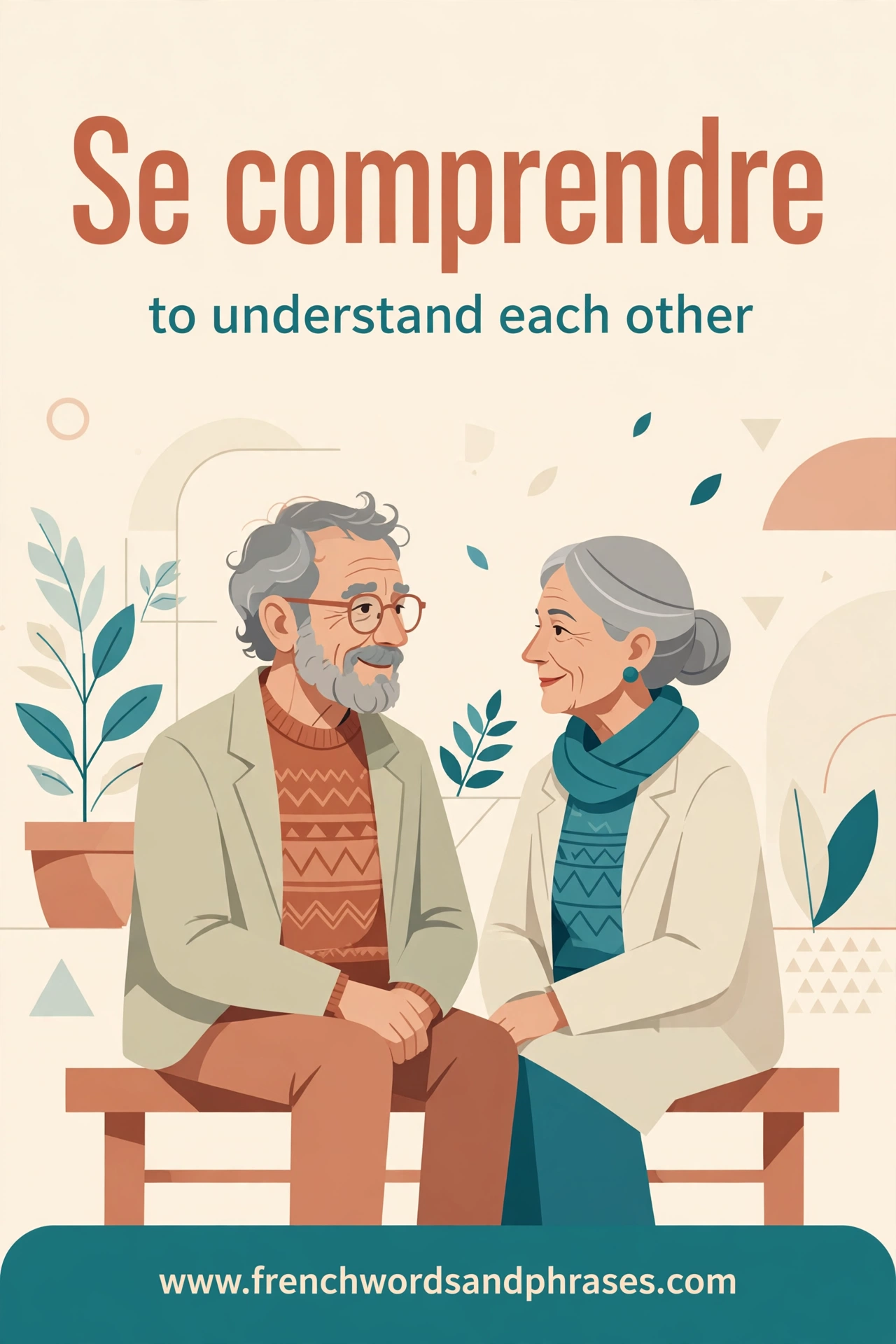
Se comprendre means to understand each other — to meet in the middle of a sentence, sometimes without finishing it.
Two old friends exchanging a glance across a crowded room, a couple finishing each other’s sentences after forty years — se comprendre is the verb of minds meeting: understanding that runs in both directions at once.
In this guide, you’ll learn how to conjugate se comprendre in all the major French tenses and moods. Explore complete conjugation tables, French examples, English translations, and practice quizzes.
Understanding the French Verb Se comprendre
Se comprendre is an irregular reflexive French verb ending in -prendre, conjugated like prendre with the reflexive pronoun and être in compound tenses.
It means to understand each other. It is the reciprocal heart of comprendre: comprendre quelqu’un is one-way traffic, se comprendre is the two-way street. It also softens judgements — après tout, ça se comprend — and it is the phrase couples reach for when words run out: on se comprend.
Verb classification: Irregular (-prendre), reflexive
Auxiliary verb: Être
Past participle: compris
Present participle: comprenant
English equivalents: To understand each other, to be understood; on se comprend — we understand each other; ça se comprend — that is understandable; se comprendre sans parler — to understand each other without speaking; ils se sont compris d’un regard — they understood each other with one look.
One important detail: se comprendre inherits every irregularity of prendre: double n in ils se comprennent and qu’ils se comprennent, single n in nous nous comprenons, and the participle compris. Being reflexive, it takes être, and because the pronoun is a direct object, the participle agrees: elles se sont comprises. Its secret second life is impersonal: ça se comprend — that is perfectly understandable — where nobody understands anybody in particular.
Experience the Word
Se comprendre is understanding with the traffic flowing both ways — no sooner said than already understood.
Imagine two sisters in a noisy kitchen. One raises an eyebrow; the other is already handing her the salt, laughing. Pas un mot — elles se sont comprises. Forty years of shared life travel faster than any sentence.
Nothing was explained. Everything was understood — elles se comprennent.
How to Conjugate Se comprendre: Complete French Conjugation Guide
Let’s explore every major conjugation of se comprendre, beginning with the indicative mood.
How to Conjugate Se comprendre in the Indicative Mood
The indicative mood is used to express facts, observations, actions, and events.
How to Conjugate Se comprendre in the Present Tense (Présent)
Used for actions happening now, habitual actions, and general truths.
| Subject | Conjugation |
|---|---|
| je | me comprends |
| tu | te comprends |
| il / elle | se comprend |
| nous | nous comprenons |
| vous | vous comprenez |
| ils / elles | se comprennent |
Example
Après quarante ans de mariage, ils se comprennent sans parler.
After forty years of marriage, they understand each other without speaking.
Quick Quiz 1
Complete the sentence:
Nous nous ______ à demi-mot.
Reveal the answer
comprenons
Nous nous comprenons à demi-mot.
We understand each other from half a word.
How to Conjugate Se comprendre in the Passé Composé
Used for completed actions in the past. Se comprendre takes the auxiliary verb être.
| Subject | Conjugation |
|---|---|
| je | me suis compris / me suis comprise |
| tu | t’es compris / t’es comprise |
| il / elle | s’est compris / s’est comprise |
| nous | nous sommes compris / nous sommes comprises |
| vous | vous êtes compris / vous êtes comprises / vous êtes compris / vous êtes comprise |
| ils / elles | se sont compris / se sont comprises |
Example
Dès le premier regard, elles se sont comprises.
From the very first look, they understood each other.
How to Conjugate Se comprendre in the Imparfait (Imperfect Tense)
Used for habitual past actions, descriptions, and ongoing situations in the past.
| Subject | Conjugation |
|---|---|
| je | me comprenais |
| tu | te comprenais |
| il / elle | se comprenait |
| nous | nous comprenions |
| vous | vous compreniez |
| ils / elles | se comprenaient |
Example
Enfants, nous nous comprenions à demi-mot.
As children, we understood each other from half a word.
Quick Quiz 2
Choose the correct form:
They (women) understood each other.
Elles ______ . (se sont comprises / ont compris)
Reveal the answer
se sont comprises
Elles se sont comprises.
Se comprendre is reflexive, takes être, and the participle agrees.
How to Conjugate Se comprendre in the Plus-que-parfait
Used to describe an action that had already been completed before another past event.
| Subject | Conjugation |
|---|---|
| je | m’étais compris / m’étais comprise |
| tu | t’étais compris / t’étais comprise |
| il / elle | s’était compris / s’était comprise |
| nous | nous étions compris / nous étions comprises |
| vous | vous étiez compris / vous étiez comprises / vous étiez compris / vous étiez comprise |
| ils / elles | s’étaient compris / s’étaient comprises |
Example
Ils s’étaient compris bien avant de se l’avouer.
They had understood each other long before admitting it to themselves.
How to Conjugate Se comprendre in the Passé Simple
Primarily used in formal writing, literature, and historical narratives. It is rarely used in everyday conversation.
| Subject | Conjugation |
|---|---|
| je | me compris |
| tu | te compris |
| il / elle | se comprit |
| nous | nous comprîmes |
| vous | vous comprîtes |
| ils / elles | se comprirent |
Example
Les deux négociateurs se comprirent enfin après des heures de discussion.
The two negotiators finally understood each other after hours of discussion.
How to Conjugate Se comprendre in the Passé Antérieur
A literary tense used to express an action completed immediately before another past action, generally in the passé simple.
| Subject | Conjugation |
|---|---|
| je | me fus compris / me fus comprise |
| tu | te fus compris / te fus comprise |
| il / elle | se fut compris / se fut comprise |
| nous | nous fûmes compris / nous fûmes comprises |
| vous | vous fûtes compris / vous fûtes comprises / vous fûtes compris / vous fûtes comprise |
| ils / elles | se furent compris / se furent comprises |
Example
Dès qu’ils se furent compris, la réunion devint facile.
As soon as they had understood each other, the meeting became easy.
How to Conjugate Se comprendre in the Future Tense (Futur Simple)
Used to describe actions that will take place in the future.
| Subject | Conjugation |
|---|---|
| je | me comprendrai |
| tu | te comprendras |
| il / elle | se comprendra |
| nous | nous comprendrons |
| vous | vous comprendrez |
| ils / elles | se comprendront |
Example
Avec le temps, vous vous comprendrez de mieux en mieux.
With time, you will understand each other better and better.
How to Conjugate Se comprendre in the Futur Antérieur (Future Perfect)
Used for an action that will have been completed before a particular point in the future.
| Subject | Conjugation |
|---|---|
| je | me serai compris / me serai comprise |
| tu | te seras compris / te seras comprise |
| il / elle | se sera compris / se sera comprise |
| nous | nous serons compris / nous serons comprises |
| vous | vous serez compris / vous serez comprises / vous serez compris / vous serez comprise |
| ils / elles | se seront compris / se seront comprises |
Example
À la fin du voyage, ils se seront compris sans un mot.
By the end of the trip, they will have understood each other without a word.
How to Conjugate Se comprendre in the Near Future (Futur Proche)
Used to describe something that is going to happen soon. Formed with aller + infinitive.
| Subject | Conjugation |
|---|---|
| je | vais me comprendre |
| tu | vas te comprendre |
| il / elle | va se comprendre |
| nous | allons nous comprendre |
| vous | allez vous comprendre |
| ils / elles | vont se comprendre |
Example
Regarde-les : ils vont se comprendre tout de suite.
Look at them: they are going to understand each other straight away.
How to Conjugate Se comprendre in the Conditional Mood
The conditional mood expresses what would happen under certain circumstances. It is also frequently used to make polite requests or express wishes.
How to Conjugate Se comprendre in the Present Conditional
| Subject | Conjugation |
|---|---|
| je | me comprendrais |
| tu | te comprendrais |
| il / elle | se comprendrait |
| nous | nous comprendrions |
| vous | vous comprendriez |
| ils / elles | se comprendraient |
Example
Sans le bruit, nous nous comprendrions beaucoup mieux.
Without the noise, we would understand each other much better.
How to Conjugate Se comprendre in the Past Conditional
| Subject | Conjugation |
|---|---|
| je | me serais compris / me serais comprise |
| tu | te serais compris / te serais comprise |
| il / elle | se serait compris / se serait comprise |
| nous | nous serions compris / nous serions comprises |
| vous | vous seriez compris / vous seriez comprises / vous seriez compris / vous seriez comprise |
| ils / elles | se seraient compris / se seraient comprises |
Example
Ils se seraient compris plus tôt avec un interprète.
They would have understood each other sooner with an interpreter.
Se comprendre in the Literary Past Conditional Form
This less common literary form uses the imperfect subjunctive of être.
| Subject | Conjugation |
|---|---|
| je | me fusse compris / me fusse comprise |
| tu | te fusses compris / te fusses comprise |
| il / elle | se fût compris / se fût comprise |
| nous | nous fussions compris / nous fussions comprises |
| vous | vous fussiez compris / vous fussiez comprises / vous fussiez compris / vous fussiez comprise |
| ils / elles | se fussent compris / se fussent comprises |
Example
Ils se fussent compris d’un seul regard, autrefois.
They would have understood each other with a single look, in the old days.
How to Conjugate Se comprendre in the Subjunctive Mood
The subjunctive is used to express wishes, emotions, doubts, necessity, and uncertainty. It frequently follows expressions such as il faut que (it is necessary that) or bien que (although).
How to Conjugate Se comprendre in the Present Subjunctive
| Subject | Conjugation |
|---|---|
| que je | me comprenne |
| que tu | te comprennes |
| qu’il / qu’elle | se comprenne |
| que nous | nous comprenions |
| que vous | vous compreniez |
| qu’ils / qu’elles | se comprennent |
Example
Il est essentiel que les deux équipes se comprennent bien.
It is essential that the two teams understand each other well.
Quick Quiz 3
Complete the sentence using the subjunctive:
Il faut que les voisins se ______ mieux.
Reveal the answer
comprennent
Il faut que les voisins se comprennent mieux.
The neighbours must understand each other better.
How to Conjugate Se comprendre in the Imperfect Subjunctive
A literary tense, rarely encountered in modern spoken French.
| Subject | Conjugation |
|---|---|
| que je | me comprisse |
| que tu | te comprisses |
| qu’il / qu’elle | se comprît |
| que nous | nous comprissions |
| que vous | vous comprissiez |
| qu’ils / qu’elles | se comprissent |
Example
On doutait qu’ils se comprissent un jour.
People doubted they would ever understand each other.
How to Conjugate Se comprendre in the Pluperfect Subjunctive
A literary construction used to express an action completed before another past action.
| Subject | Conjugation |
|---|---|
| que je | me fusse compris / me fusse comprise |
| que tu | te fusses compris / te fusses comprise |
| qu’il / qu’elle | se fût compris / se fût comprise |
| que nous | nous fussions compris / nous fussions comprises |
| que vous | vous fussiez compris / vous fussiez comprises / vous fussiez compris / vous fussiez comprise |
| qu’ils / qu’elles | se fussent compris / se fussent comprises |
Example
On racontait qu’ils se fussent compris dès l’enfance.
People said they had understood each other since childhood.
How to Conjugate Se comprendre in the Past Subjunctive
| Subject | Conjugation |
|---|---|
| que je | me sois compris / me sois comprise |
| que tu | te sois compris / te sois comprise |
| qu’il / qu’elle | se soit compris / se soit comprise |
| que nous | nous soyons compris / nous soyons comprises |
| que vous | vous soyez compris / vous soyez comprises / vous soyez compris / vous soyez comprise |
| qu’ils / qu’elles | se soient compris / se soient comprises |
Example
Je suis heureux qu’elles se soient enfin comprises.
I am happy that they have finally understood each other.
How to Conjugate Se comprendre in the Imperative
The imperative is used to give commands, instructions, invitations, or suggestions. Subject pronouns are omitted.
How to Conjugate Se comprendre in the Present Imperative
| Person | Conjugation |
|---|---|
| (tu) | comprends-toi |
| (nous) | comprenons-nous |
| (vous) | comprenez-vous |
Example
Comprenez-vous, au lieu de vous disputer !
Understand each other, instead of arguing!
Quick Quiz 4
How would you say Understand each other (said to a pair)?
Reveal the answer
Comprenez-vous !
French Participles of Se comprendre
Participles are verb forms that can be used in compound tenses and other grammatical constructions.
Present Participle of Se comprendre
comprenant
En nous comprenant mieux, nous travaillons mieux ensemble.
By understanding each other better, we work better together.
Past Participle of Se comprendre
compris
Comprises sans un mot, les deux sœurs éclatèrent de rire.
Understood by each other without a word, the two sisters burst out laughing.
Se comprendre in Everyday French: Real-Life Examples
Now that you know the conjugations, let’s see how se comprendre appears in everyday French.
Example 1 — Present
On se comprend sans parler.
We understand each other without speaking.
Example 2 — Passé composé
Ils se sont compris d’un regard.
They understood each other with one look.
Example 3 — Imparfait
Nous nous comprenions à demi-mot.
We understood each other from half a word.
Example 4 — Future
Vous vous comprendrez mieux demain.
You will understand each other better tomorrow.
Example 5 — Conditional
Ils se comprendraient avec plus de calme.
They would understand each other with more calm.
Example 6 — Imperative
Comprenez-vous, les enfants !
Understand each other, children!
Beyond Translation: The Meaning of Se comprendre
English needs four words — understand each other — where French folds the whole embrace into one reflexive: se comprendre.
The pronoun does the hugging.
Se points the verb back at its subjects, plural and mutual: what I understand of you, you understand of me. And when the subject is life itself, the same shape turns merciful: ça se comprend — of course, anyone can see why.
How to Remember the French Verb Se comprendre
Remember it this way: Se comprendre is about two sisters, one raised eyebrow, and the salt is already passed.
- Prendre’s paradigm in reflexive dress: ils se comprennent, nous nous comprenons, participle compris.
- Être, with agreement: elles se sont comprises.
- Ça se comprend = that is understandable — the impersonal twin.
The key idea is two sisters, one raised eyebrow, and the salt is already passed.
Test Your Knowledge of Se comprendre
Let’s see how much you’ve learned. Try answering these questions before revealing the answers.
Question 1
Which verb’s paradigm does se comprendre follow?
Reveal the answer
Prendre — ils se comprennent, nous nous comprenons, participle compris.
Question 2
How do you say They understood each other at first glance (two women) in French?
Reveal the answer
Elles se sont comprises au premier regard.
Question 3
Translate: That is understandable.
Reveal the answer
Ça se comprend.
Question 4
What is the past participle of se comprendre, for a group of women?
Reveal the answer
Comprises — elles se sont comprises.
Question 5
Complete the sentence:
Il est essentiel que vous vous ______ bien.
Reveal the answer
compreniez
Il est essentiel que vous vous compreniez bien.
It is essential that you understand each other well.
Your Final Challenge
Can You Use It?
How would you say this in French?
They understand each other with one look, the way old sailors read the sky.
Reveal the answer
Ils se comprennent d’un regard, comme les vieux marins lisent le ciel.
They understand each other with one look, the way old sailors read the sky.
A little French. A little curiosity. A richer everyday life.
LEARN FRENCH ONE WORD AT A TIME