A French Word to Live By
How to Conjugate Communier in French
/kɔ.my.nje/
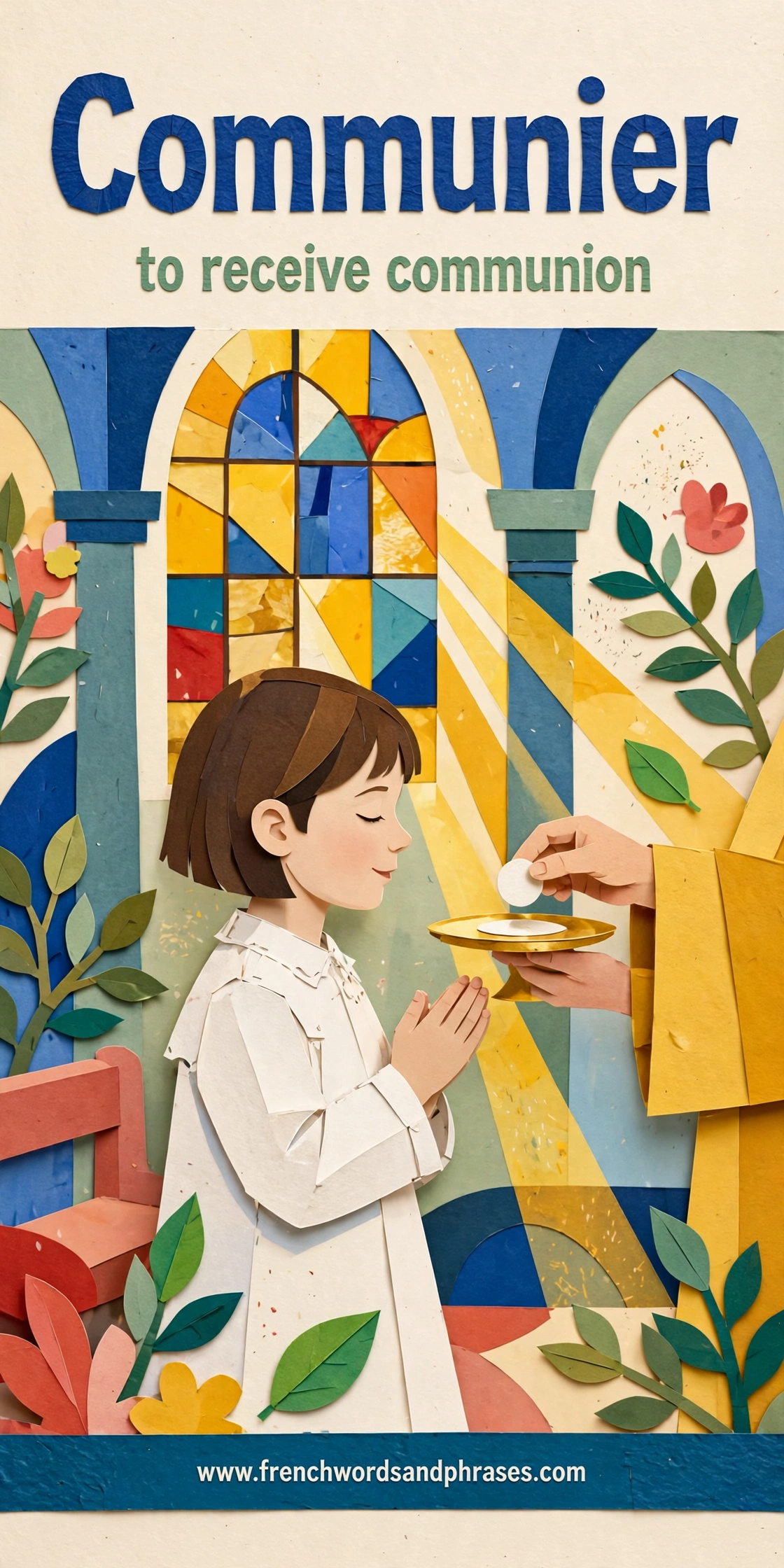
Communier means to receive communion — to take the consecrated host at Mass, and by extension to share a deep, almost sacred bond with people, places or ideas.
Sunday morning in a village church: the organ swells, the congregation files slowly toward the altar rail, hands folded. Communier is the verb of that moment — receiving the host — and French has stretched it far beyond the church: one can communier with a crowd at a concert, with nature on a mountain, with the memory of the dead.
In this guide, you’ll learn how to conjugate communier in all the major French tenses and moods. Explore complete conjugation tables, French examples, English translations, and practice quizzes.
Understanding the French Verb Communier
Communier is a regular French verb belonging to the first group of verbs, those ending in-er.
It means to receive communion. In church language communier is precise — receiving the Eucharist, as opposed to assister à la messe, merely attending. Outside church it is always warm and slightly solemn: communier avec un public, avec la nature, dans la douleur. For ordinary exchanging of messages, French uses its near-twin communiquer, in this same file.
Verb classification: First group (-er)
Auxiliary verb: Avoir
Past participle: communié
Present participle: communiant
English equivalents: To receive communion, to take communion; communier à la messe — to receive communion at Mass; communier avec la nature — to commune with nature; communier dans un même élan — to be united in a shared surge of feeling; la première communion — First Communion.
One important detail: communier is an -ier verb, so watch the double i wherever an ending itself begins with i: nous communiions, vous communiiez in the imperfect, and que nous communiions in the subjunctive. The single-i forms are the singular and the ils form: je communie, ils communient. And the preposition chooses the world you are in: one communie à la messe (receives at Mass) but communie avec la nature, avec une foule (communes with nature, with a crowd).
Experience the Word
Communier is the verb of the shared sacred moment — bread received in silence, or ten thousand strangers suddenly feeling the same thing at the same time.
Imagine the last night of a summer festival. The singer stops, the crowd takes up the chorus alone, and for one verse nobody is a spectator: tout le monde communie. No altar, no host — but the verb fits, because something invisible has just been shared by everyone at once.
Nothing has been said or signed. The crowd has communed — elle a communié, together, in a single voice.
How to Conjugate Communier: Complete French Conjugation Guide
Let’s explore every major conjugation of communier, beginning with the indicative mood.
How to Conjugate Communier in the Indicative Mood
The indicative mood is used to express facts, observations, actions, and events.
How to Conjugate Communier in the Present Tense (Présent)
Used for actions happening now, habitual actions, and general truths.
| Subject | Conjugation |
|---|---|
| je | communie |
| tu | communies |
| il / elle | communie |
| nous | communions |
| vous | communiez |
| ils / elles | communient |
Example
Chaque dimanche, ma grand-mère communie à la messe de huit heures.
Every Sunday, my grandmother receives communion at the eight o’clock Mass.
Quick Quiz 1
Complete the sentence:
Nous ______ à la messe du dimanche.
Reveal the answer
communions
Nous communions à la messe du dimanche.
We receive communion at Sunday Mass.
How to Conjugate Communier in the Passé Composé
Used for completed actions in the past. Communier takes the auxiliary verb avoir.
| Subject | Conjugation |
|---|---|
| j’ | ai communié |
| tu | as communié |
| il / elle | a communié |
| nous | avons communié |
| vous | avez communié |
| ils / elles | ont communié |
Example
Il a communié pour la première fois à l’âge de neuf ans.
He received communion for the first time at the age of nine.
How to Conjugate Communier in the Imparfait (Imperfect Tense)
Used for habitual past actions, descriptions, and ongoing situations in the past.
| Subject | Conjugation |
|---|---|
| je | communiais |
| tu | communiais |
| il / elle | communiait |
| nous | communiions |
| vous | communiiez |
| ils / elles | communiaient |
Example
Autrefois, les fidèles communiaient rarement, seulement à Pâques.
In the old days, the faithful received communion rarely, only at Easter.
Quick Quiz 2
Choose the correct form:
She received communion yesterday.
Elle ______ hier. (a communié / est communiée)
Reveal the answer
a communié
Elle a communié hier.
Communier takes avoir.
How to Conjugate Communier in the Plus-que-parfait
Used to describe an action that had already been completed before another past event.
| Subject | Conjugation |
|---|---|
| j’ | avais communié |
| tu | avais communié |
| il / elle | avait communié |
| nous | avions communié |
| vous | aviez communié |
| ils / elles | avaient communié |
Example
Elle avait communié avant de partir pour l’hôpital.
She had received communion before leaving for the hospital.
How to Conjugate Communier in the Passé Simple
Primarily used in formal writing, literature, and historical narratives. It is rarely used in everyday conversation.
| Subject | Conjugation |
|---|---|
| je | communiai |
| tu | communias |
| il / elle | communia |
| nous | communiâmes |
| vous | communiâtes |
| ils / elles | communièrent |
Example
Le jour de ses noces, elle communia avec une ferveur visible.
On her wedding day, she received communion with visible fervour.
How to Conjugate Communier in the Passé Antérieur
A literary tense used to express an action completed immediately before another past action, generally in the passé simple.
| Subject | Conjugation |
|---|---|
| j’ | eus communié |
| tu | eus communié |
| il / elle | eut communié |
| nous | eûmes communié |
| vous | eûtes communié |
| ils / elles | eurent communié |
Example
Quand il eut communié, il retourna à sa place en silence.
When he had received communion, he returned to his seat in silence.
How to Conjugate Communier in the Future Tense (Futur Simple)
Used to describe actions that will take place in the future.
| Subject | Conjugation |
|---|---|
| je | communierai |
| tu | communieras |
| il / elle | communiera |
| nous | communierons |
| vous | communierez |
| ils / elles | communieront |
Example
Demain, les enfants du village communieront pour la première fois.
Tomorrow, the village children will receive communion for the first time.
How to Conjugate Communier in the Futur Antérieur (Future Perfect)
Used for an action that will have been completed before a particular point in the future.
| Subject | Conjugation |
|---|---|
| j’ | aurai communié |
| tu | auras communié |
| il / elle | aura communié |
| nous | aurons communié |
| vous | aurez communié |
| ils / elles | auront communié |
Example
À la fin de la messe, tous les fidèles auront communié.
By the end of the Mass, all the faithful will have received communion.
How to Conjugate Communier in the Near Future (Futur Proche)
Used to describe something that is going to happen soon. Formed with aller + infinitive.
| Subject | Conjugation |
|---|---|
| je | vais communier |
| tu | vas communier |
| il / elle | va communier |
| nous | allons communier |
| vous | allez communier |
| ils / elles | vont communier |
Example
Regarde, le prêtre monte à l’autel : les fidèles vont communier.
Look, the priest is going up to the altar: the faithful are about to receive communion.
How to Conjugate Communier in the Conditional Mood
The conditional mood expresses what would happen under certain circumstances. It is also frequently used to make polite requests or express wishes.
How to Conjugate Communier in the Present Conditional
| Subject | Conjugation |
|---|---|
| je | communierais |
| tu | communierais |
| il / elle | communierait |
| nous | communierions |
| vous | communieriez |
| ils / elles | communieraient |
Example
Sans la foule, on communierait dans un silence parfait.
Without the crowd, one would receive communion in perfect silence.
How to Conjugate Communier in the Past Conditional
| Subject | Conjugation |
|---|---|
| j’ | aurais communié |
| tu | aurais communié |
| il / elle | aurait communié |
| nous | aurions communié |
| vous | auriez communié |
| ils / elles | auraient communié |
Example
Elle aurait communié avec plus de joie si sa famille avait été là.
She would have received communion with more joy if her family had been there.
Communier in the Literary Past Conditional Form
This less common literary form uses the imperfect subjunctive of avoir.
| Subject | Conjugation |
|---|---|
| j’ | eusse communié |
| tu | eusses communié |
| il / elle | eût communié |
| nous | eussions communié |
| vous | eussiez communié |
| ils / elles | eussent communié |
Example
Il eût communié en secret plutôt que de renoncer à sa foi.
He would have received communion in secret rather than renounce his faith.
How to Conjugate Communier in the Subjunctive Mood
The subjunctive is used to express wishes, emotions, doubts, necessity, and uncertainty. It frequently follows expressions such as il faut que (it is necessary that) or bien que (although).
How to Conjugate Communier in the Present Subjunctive
| Subject | Conjugation |
|---|---|
| que je | communie |
| que tu | communies |
| qu’il / qu’elle | communie |
| que nous | communiions |
| que vous | communiiez |
| qu’ils / qu’elles | communient |
Example
Le prêtre souhaite que tous les baptisés communient ce matin.
The priest hopes that all the baptised will receive communion this morning.
Quick Quiz 3
Complete the sentence using the subjunctive:
Il faut que vous ______ en silence.
Reveal the answer
communiiez
Il faut que vous communiiez en silence.
You must receive communion in silence — note the double i.
How to Conjugate Communier in the Imperfect Subjunctive
A literary tense, rarely encountered in modern spoken French.
| Subject | Conjugation |
|---|---|
| que je | communiasse |
| que tu | communiasses |
| qu’il / qu’elle | communiât |
| que nous | communiassions |
| que vous | communiassiez |
| qu’ils / qu’elles | communiassent |
Example
Elle voulait que son fils communiât le jour de Pâques.
She wanted her son to receive communion on Easter Day.
How to Conjugate Communier in the Pluperfect Subjunctive
A literary construction used to express an action completed before another past action.
| Subject | Conjugation |
|---|---|
| que j’ | eusse communié |
| que tu | eusses communié |
| qu’il / qu’elle | eût communié |
| que nous | eussions communié |
| que vous | eussiez communié |
| qu’ils / qu’elles | eussent communié |
Example
On racontait qu’ils eussent communié ensemble avant la bataille.
It was said that they had received communion together before the battle.
How to Conjugate Communier in the Past Subjunctive
| Subject | Conjugation |
|---|---|
| que j’ | aie communié |
| que tu | aies communié |
| qu’il / qu’elle | ait communié |
| que nous | ayons communié |
| que vous | ayez communié |
| qu’ils / qu’elles | aient communié |
Example
Je suis ému qu’elle ait communié entourée de ses petits-enfants.
I am moved that she received communion surrounded by her grandchildren.
How to Conjugate Communier in the Imperative
The imperative is used to give commands, instructions, invitations, or suggestions. Subject pronouns are omitted.
How to Conjugate Communier in the Present Imperative
| Person | Conjugation |
|---|---|
| (tu) | communie |
| (nous) | communions |
| (vous) | communiez |
Example
Communiez dans le recueillement, puis retournez à vos places.
Receive communion in recollection, then return to your seats.
Quick Quiz 4
How would you say Receive communion with the others (tu form)?
Reveal the answer
Communie avec les autres !
French Participles of Communier
Participles are verb forms that can be used in compound tenses and other grammatical constructions.
Present Participle of Communier
communiant
En communiant avec la nature, le poète oubliait la ville.
By communing with nature, the poet forgot the city.
Past Participle of Communier
communié
Les fidèles, ayant communié, sortirent de l’église en silence.
The faithful, having received communion, left the church in silence.
Communier in Everyday French: Real-Life Examples
Now that you know the conjugations, let’s see how communier appears in everyday French.
Example 1 — Present
Le dimanche, elle communie à la première messe.
On Sundays, she receives communion at the first Mass.
Example 2 — Passé composé
Mon fils a communié pour la première fois hier.
My son received his First Communion yesterday.
Example 3 — Imparfait
Nous communiions tous ensemble à Noël.
We all received communion together at Christmas.
Example 4 — Future
Ils communieront à Pâques cette année.
They will receive communion at Easter this year.
Example 5 — Conditional
On communierait mieux dans une église silencieuse.
One would commune better in a silent church.
Example 6 — Imperative
Communie avec les autres, ne reste pas seul dans ton coin.
Commune with the others, do not stay alone in your corner.
Beyond Translation: The Meaning of Communier
Communier and communiquer are twins separated at birth: both descend from Latin communicare, to share. One kept the altar, the other took the telephone.
To communier is to share something too deep for words.
A first communion — la première communion — remains a family landmark in France, with white clothes, a big lunch and photographs, even for families who rarely see the inside of a church.
How to Remember the French Verb Communier
Remember it this way: Communier is about the quiet queue at the altar rail — and the festival crowd singing as one.
- An -ier verb: watch the double i — nous communiions, que nous communiions.
- Two addresses: communier à la messe (at Mass), communier avec la nature (with nature).
- Regular -er endings otherwise: je communie, nous communions, past participle communié.
The key idea is the quiet queue at the altar rail — and the festival crowd singing as one.
Test Your Knowledge of Communier
Let’s see how much you’ve learned. Try answering these questions before revealing the answers.
Question 1
What is special about the nous form of communier in the imperfect?
Reveal the answer
The double i — nous communiions, vous communiiez: an -ier stem plus an ending that itself begins with i.
Question 2
How do you say She receives communion every Sunday in French?
Reveal the answer
Elle communie chaque dimanche.
Question 3
Translate: He received his First Communion at nine.
Reveal the answer
Il a communié pour la première fois à neuf ans.
Question 4
What is the past participle of communier?
Reveal the answer
Communié.
Question 5
Complete the sentence:
Le prêtre souhaite que tous les fidèles ______ ce matin.
Reveal the answer
communient
Le prêtre souhaite que tous les fidèles communient ce matin.
The priest hopes all the faithful will receive communion this morning.
Your Final Challenge
Can You Use It?
How would you say this in French?
That morning, the whole village received communion in silence, then the square filled with laughter and hot coffee.
Reveal the answer
Ce matin-là, tout le village a communié en silence, puis la place s’est remplie de rires et de café chaud.
That morning, the whole village received communion in silence, then the square filled with laughter and hot coffee.
A little French. A little curiosity. A richer everyday life.
LEARN FRENCH ONE WORD AT A TIME