A French Word to Live By
How to Conjugate Commuer in French
/kɔ.mɥe/
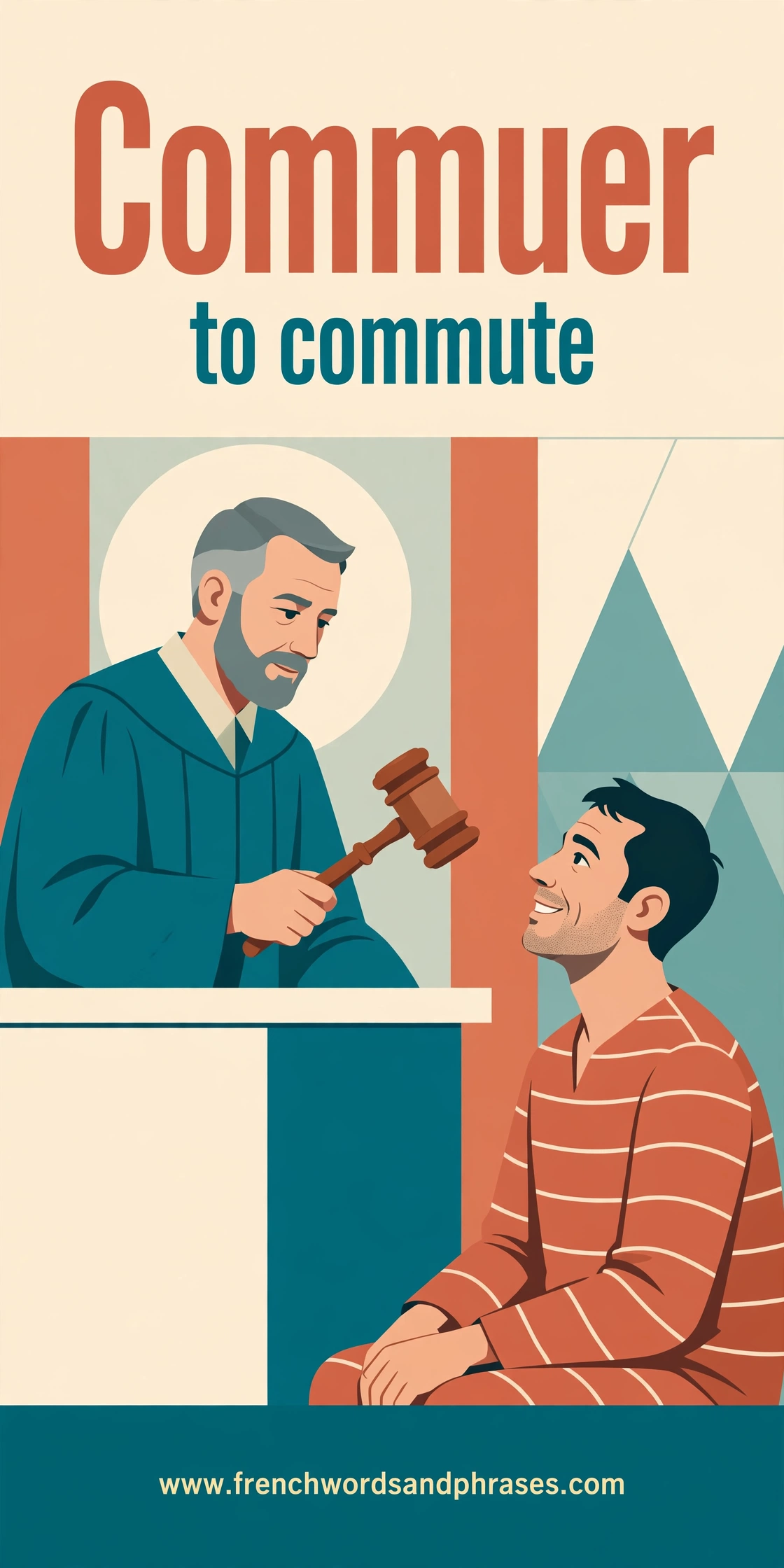
Commuer means to commute — in the language of courts, to change a punishment into a lighter one by official decision.
A condemned man waiting at dawn, a minister’s signature arriving with the post, a death sentence becoming life imprisonment on a single line of paper — commuer is the solemn legal verb of the softened sentence: punishment transformed, by grace or by law, into something less terrible.
In this guide, you’ll learn how to conjugate commuer in all the major French tenses and moods. Explore complete conjugation tables, French examples, English translations, and practice quizzes.
Understanding the French Verb Commuer
Commuer is a regular French verb belonging to the first group of verbs, those ending in-er.
It means to commute. It belongs entirely to law and official history: presidents and kings commuent death sentences; courts commuent prison terms into fines or community service. It has nothing to do with the English commuter’s daily train — a French commuter is un navetteur, and his journey is la navette.
Verb classification: First group (-er)
Auxiliary verb: Avoir
Past participle: commué
Present participle: commuant
English equivalents: To commute (a sentence); commuer une peine — to commute a sentence; commuer la peine de mort en réclusion à perpétuité — to commute the death penalty to life imprisonment; commuer une peine en amende — to convert a sentence into a fine; une commutation de peine — a commutation of sentence.
One important detail: commuer is a regular -er verb built on the stem commu-: je commue, nous commuons, vous commuez, imperfect je commuais, subjunctive que nous commuions — the u never changes, and the past participle is commué. Its object is always a punishment: on commue une peine, une condamnation — and the lighter sentence that replaces it is introduced by en: commuer une peine de prison en travaux d’intérêt général.
Experience the Word
Commuer is the verb of the reprieve — the punishment stands, the guilt stands, but the sentence itself is lifted and replaced by a lighter one.
Imagine Paris in 1975, a cell on death row at dawn. The execution is expected at five; at four, a telephone rings in the governor’s office — le président a commué la peine: the president has commuted the sentence to life imprisonment. The prisoner will live, behind walls, but he will live — because one verb was signed into being during the night.
The verdict has not changed. The sentence has been commuted — commuée — and a life has been handed back.
How to Conjugate Commuer: Complete French Conjugation Guide
Let’s explore every major conjugation of commuer, beginning with the indicative mood.
How to Conjugate Commuer in the Indicative Mood
The indicative mood is used to express facts, observations, actions, and events.
How to Conjugate Commuer in the Present Tense (Présent)
Used for actions happening now, habitual actions, and general truths.
| Subject | Conjugation |
|---|---|
| je | commue |
| tu | commues |
| il / elle | commue |
| nous | commuons |
| vous | commuez |
| ils / elles | commuent |
Example
Le président commue la peine du condamné en réclusion à perpétuité.
The president commutes the prisoner’s sentence to life imprisonment.
Quick Quiz 1
Complete the sentence:
Nous ______ les peines les plus lourdes en peines plus légères.
Reveal the answer
commuons
Nous commuons les peines les plus lourdes en peines plus légères.
We commute the heaviest sentences into lighter ones.
How to Conjugate Commuer in the Passé Composé
Used for completed actions in the past. Commuer takes the auxiliary verb avoir.
| Subject | Conjugation |
|---|---|
| j’ | ai commué |
| tu | as commué |
| il / elle | a commué |
| nous | avons commué |
| vous | avez commué |
| ils / elles | ont commué |
Example
Le tribunal a commué sa peine de prison en travaux d’intérêt général.
The court commuted his prison sentence to community service.
How to Conjugate Commuer in the Imparfait (Imperfect Tense)
Used for habitual past actions, descriptions, and ongoing situations in the past.
| Subject | Conjugation |
|---|---|
| je | commuais |
| tu | commuais |
| il / elle | commuait |
| nous | commuions |
| vous | commuiez |
| ils / elles | commuaient |
Example
Autrefois, le roi commuait souvent les peines de mort.
In the old days, the king often commuted death sentences.
Quick Quiz 2
Choose the correct form:
The court commuted his sentence.
Le tribunal ______ sa peine. (a commué / est commué)
Reveal the answer
a commué
Le tribunal a commué sa peine.
Commuer takes avoir.
How to Conjugate Commuer in the Plus-que-parfait
Used to describe an action that had already been completed before another past event.
| Subject | Conjugation |
|---|---|
| j’ | avais commué |
| tu | avais commué |
| il / elle | avait commué |
| nous | avions commué |
| vous | aviez commué |
| ils / elles | avaient commué |
Example
Le président avait commué la peine avant l’aube.
The president had commuted the sentence before dawn.
How to Conjugate Commuer in the Passé Simple
Primarily used in formal writing, literature, and historical narratives. It is rarely used in everyday conversation.
| Subject | Conjugation |
|---|---|
| je | commuai |
| tu | commuas |
| il / elle | commua |
| nous | commuâmes |
| vous | commuâtes |
| ils / elles | commuèrent |
Example
Le roi commua la peine de mort en exil.
The king commuted the death sentence to exile.
How to Conjugate Commuer in the Passé Antérieur
A literary tense used to express an action completed immediately before another past action, generally in the passé simple.
| Subject | Conjugation |
|---|---|
| j’ | eus commué |
| tu | eus commué |
| il / elle | eut commué |
| nous | eûmes commué |
| vous | eûtes commué |
| ils / elles | eurent commué |
Example
Quand le ministre eut commué la peine, la foule applaudit.
When the minister had commuted the sentence, the crowd applauded.
How to Conjugate Commuer in the Future Tense (Futur Simple)
Used to describe actions that will take place in the future.
| Subject | Conjugation |
|---|---|
| je | commuerai |
| tu | commueras |
| il / elle | commuera |
| nous | commuerons |
| vous | commuerez |
| ils / elles | commueront |
Example
Demain, le tribunal commuera peut-être sa peine en amende.
Tomorrow, the court may commute his sentence to a fine.
How to Conjugate Commuer in the Futur Antérieur (Future Perfect)
Used for an action that will have been completed before a particular point in the future.
| Subject | Conjugation |
|---|---|
| j’ | aurai commué |
| tu | auras commué |
| il / elle | aura commué |
| nous | aurons commué |
| vous | aurez commué |
| ils / elles | auront commué |
Example
À la fin du mois, le président aura commué dix peines.
By the end of the month, the president will have commuted ten sentences.
How to Conjugate Commuer in the Near Future (Futur Proche)
Used to describe something that is going to happen soon. Formed with aller + infinitive.
| Subject | Conjugation |
|---|---|
| je | vais commuer |
| tu | vas commuer |
| il / elle | va commuer |
| nous | allons commuer |
| vous | allez commuer |
| ils / elles | vont commuer |
Example
Le juge va commuer cette peine en sursis.
The judge is going to commute this sentence to a suspended one.
How to Conjugate Commuer in the Conditional Mood
The conditional mood expresses what would happen under certain circumstances. It is also frequently used to make polite requests or express wishes.
How to Conjugate Commuer in the Present Conditional
| Subject | Conjugation |
|---|---|
| je | commuerais |
| tu | commuerais |
| il / elle | commuerait |
| nous | commuerions |
| vous | commueriez |
| ils / elles | commueraient |
Example
À la place du président, je commuerais cette peine immédiatement.
In the president’s place, I would commute this sentence at once.
How to Conjugate Commuer in the Past Conditional
| Subject | Conjugation |
|---|---|
| j’ | aurais commué |
| tu | aurais commué |
| il / elle | aurait commué |
| nous | aurions commué |
| vous | auriez commué |
| ils / elles | auraient commué |
Example
Elle aurait commué la peine si le dossier avait été complet.
She would have commuted the sentence if the file had been complete.
Commuer in the Literary Past Conditional Form
This less common literary form uses the imperfect subjunctive of avoir.
| Subject | Conjugation |
|---|---|
| j’ | eusse commué |
| tu | eusses commué |
| il / elle | eût commué |
| nous | eussions commué |
| vous | eussiez commué |
| ils / elles | eussent commué |
Example
Il eût commué la peine sans la pression de la foule.
He would have commuted the sentence, without the pressure of the crowd.
How to Conjugate Commuer in the Subjunctive Mood
The subjunctive is used to express wishes, emotions, doubts, necessity, and uncertainty. It frequently follows expressions such as il faut que (it is necessary that) or bien que (although).
How to Conjugate Commuer in the Present Subjunctive
| Subject | Conjugation |
|---|---|
| que je | commue |
| que tu | commues |
| qu’il / qu’elle | commue |
| que nous | commuions |
| que vous | commuiez |
| qu’ils / qu’elles | commuent |
Example
Il faut que le tribunal commue cette peine excessive.
The court must commute this excessive sentence.
Quick Quiz 3
Complete the sentence using the subjunctive:
Il faut que vous ______ cette peine excessive.
Reveal the answer
commuiez
Il faut que vous commuiez cette peine excessive.
You must commute this excessive sentence.
How to Conjugate Commuer in the Imperfect Subjunctive
A literary tense, rarely encountered in modern spoken French.
| Subject | Conjugation |
|---|---|
| que je | commuasse |
| que tu | commuasses |
| qu’il / qu’elle | commuât |
| que nous | commuassions |
| que vous | commuassiez |
| qu’ils / qu’elles | commuassent |
Example
On ne pensait pas que le roi commuât la peine d’un inconnu.
No one thought the king would commute an unknown man’s sentence.
How to Conjugate Commuer in the Pluperfect Subjunctive
A literary construction used to express an action completed before another past action.
| Subject | Conjugation |
|---|---|
| que j’ | eusse commué |
| que tu | eusses commué |
| qu’il / qu’elle | eût commué |
| que nous | eussions commué |
| que vous | eussiez commué |
| qu’ils / qu’elles | eussent commué |
Example
On admirait qu’il eût commué tant de peines pendant son règne.
People admired that he had commuted so many sentences during his reign.
How to Conjugate Commuer in the Past Subjunctive
| Subject | Conjugation |
|---|---|
| que j’ | aie commué |
| que tu | aies commué |
| qu’il / qu’elle | ait commué |
| que nous | ayons commué |
| que vous | ayez commué |
| qu’ils / qu’elles | aient commué |
Example
Je suis soulagé que le président ait commué sa peine.
I am relieved the president commuted his sentence.
How to Conjugate Commuer in the Imperative
The imperative is used to give commands, instructions, invitations, or suggestions. Subject pronouns are omitted.
How to Conjugate Commuer in the Present Imperative
| Person | Conjugation |
|---|---|
| (tu) | commue |
| (nous) | commuons |
| (vous) | commuez |
Example
Commuez cette peine, monsieur le président, il est encore temps !
Commute this sentence, Mr President, there is still time!
Quick Quiz 4
How would you say Commute this sentence (tu form)?
Reveal the answer
Commue cette peine !
French Participles of Commuer
Participles are verb forms that can be used in compound tenses and other grammatical constructions.
Present Participle of Commuer
commuant
En commuant la peine, le président a évité une injustice.
By commuting the sentence, the president avoided an injustice.
Past Participle of Commuer
commué
Commuée en réclusion à perpétuité, la peine de mort n’a pas été exécutée.
Commuted to life imprisonment, the death sentence was not carried out.
Commuer in Everyday French: Real-Life Examples
Now that you know the conjugations, let’s see how commuer appears in everyday French.
Example 1 — Present
Le président commue la peine en réclusion à perpétuité.
The president commutes the sentence to life imprisonment.
Example 2 — Passé composé
Le tribunal a commué sa peine en amende.
The court commuted his sentence to a fine.
Example 3 — Imparfait
Le roi commuait les peines de mort.
The king used to commute death sentences.
Example 4 — Future
Le juge commuera cette peine en sursis.
The judge will commute this sentence to a suspended one.
Example 5 — Conditional
Je commuerais cette peine immédiatement.
I would commute this sentence at once.
Example 6 — Imperative
Commuez cette peine, il est encore temps !
Commute this sentence, there is still time!
Beyond Translation: The Meaning of Commuer
Commuer descends from Latin commutare — to change completely, com- plus mutare, the verb hiding inside mutation and muer.
It changes the punishment, never the verdict.
English commute took the same legal road — a death sentence commuted is a death sentence exchanged — before the word wandered off to the suburbs and the morning train. French commuer never left the courtroom.
How to Remember the French Verb Commuer
Remember it this way: Commuer is about the telephone ringing at dawn on death row — a signature turning death into life.
- The object is always a punishment: commuer une peine, and the lighter one follows with en.
- Not the train: a commuter is un navetteur; commuer belongs to courts and presidents.
- Regular -er on the stem commu-: je commue, nous commuons, past participle commué.
The key idea is the telephone ringing at dawn on death row — a signature turning death into life.
Test Your Knowledge of Commuer
Let’s see how much you’ve learned. Try answering these questions before revealing the answers.
Question 1
Which preposition introduces the lighter sentence after commuer?
Reveal the answer
En — commuer la peine de mort en réclusion à perpétuité.
Question 2
How do you say The court commuted his sentence to a fine in French?
Reveal the answer
Le tribunal a commué sa peine en amende.
Question 3
Translate: The king commuted the death sentence to exile.
Reveal the answer
Le roi commua la peine de mort en exil.
Question 4
What is the past participle of commuer?
Reveal the answer
Commué.
Question 5
Complete the sentence:
Il faut que le tribunal ______ cette peine excessive.
Reveal the answer
commue
Il faut que le tribunal commue cette peine excessive.
The court must commute this excessive sentence.
Your Final Challenge
Can You Use It?
How would you say this in French?
At dawn on the appointed day, the president commuted the sentence, and the condemned man saw the sun rise.
Reveal the answer
À l’aube du jour fixé, le président commua la peine, et le condamné vit le soleil se lever.
At dawn on the appointed day, the president commuted the sentence, and the condemned man saw the sun rise.
A little French. A little curiosity. A richer everyday life.
LEARN FRENCH ONE WORD AT A TIME