A French Word to Live By
How to Conjugate Bouillotter in French
/bu.jɔ.te/
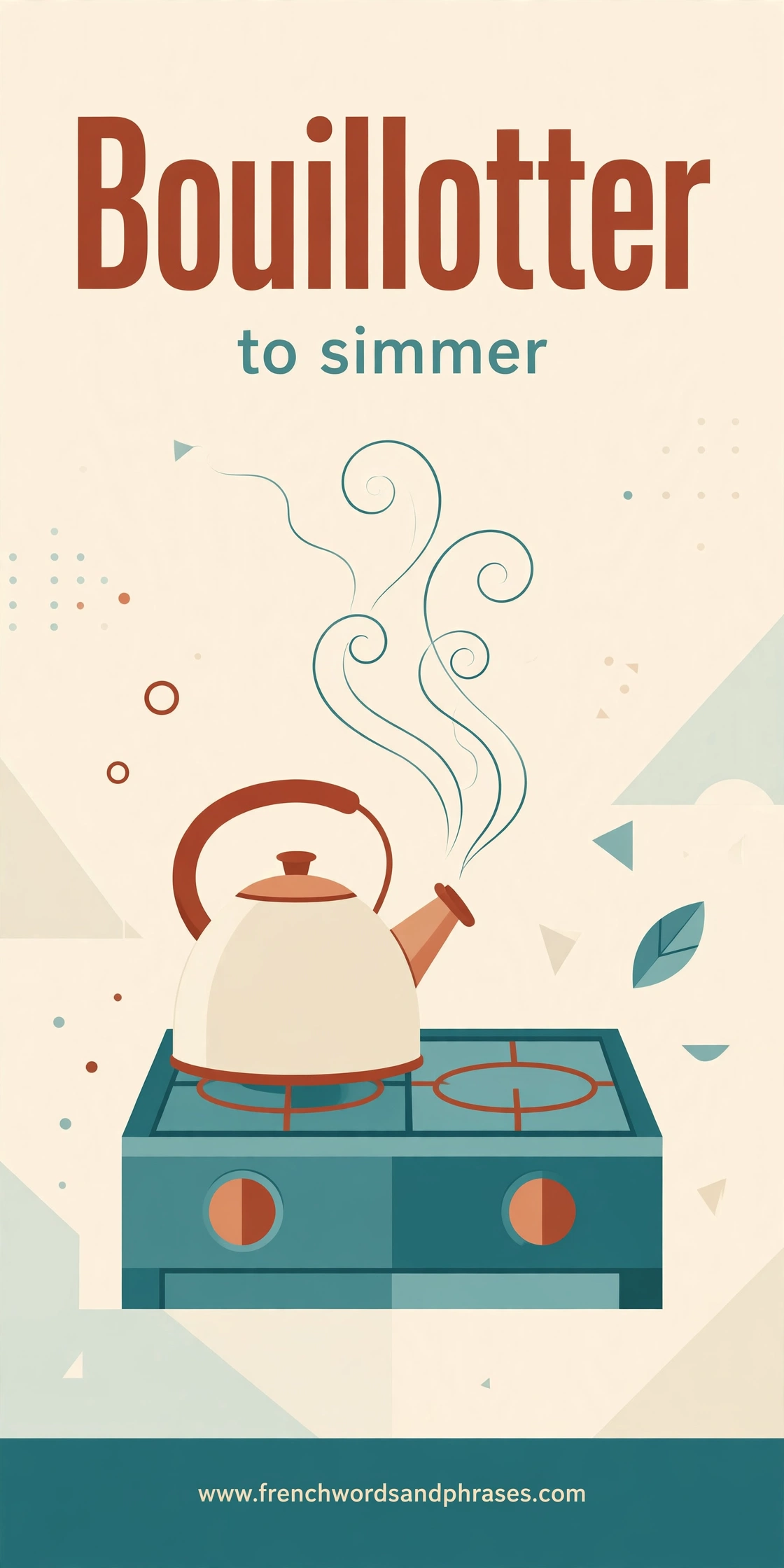
Bouillotter means to simmer — to bubble gently and quietly, just at the edge of boiling, like a small kettle keeping warm.
A small pot murmuring on the back of the stove, a kettle ticking with tiny bubbles before the whistle — bouillotter is the modest cousin of the rolling boil: small bubbles, small sounds, heat kept patiently at the threshold.
In this guide, you’ll learn how to conjugate bouillotter in all the major French tenses and moods. Explore complete conjugation tables, French examples, English translations, and practice quizzes.
Understanding the French Verb Bouillotter
Bouillotter is a regular French verb belonging to the first group of verbs, those ending in-er.
It means to simmer. It is used of small quantities of liquid — a kettle, a little saucepan, a sauce for two — kept bubbling gently, and rarely of anything grand: nobody says an ocean bouillotte. Its world is the kitchen corner and the bedtime hot-water bottle.
Verb classification: First group (-er)
Auxiliary verb: Avoir
Past participle: bouillotté
Present participle: bouillottant
English equivalents: To simmer, to bubble gently; une bouillotte — a hot-water bottle, a small kettle; laisser bouillotter — to leave to simmer gently; l’eau bouillotte — the water is just simmering; bouillotter à petit feu — to simmer over a low flame.
One important detail: bouillotter carries a double -tt- that never changes, the mark of its mother noun une bouillotte — a small kettle, and the hot-water bottle taken to bed: je bouillotte, nous bouillottions is wrong — it is nous bouillottons; past participle bouillotté. It sits on a scale of heat: frémir shivers, bouillotter simmers gently, bouillonner rolls and bouillir boils outright. Bouillotter is the quiet middle — a small, domestic, almost affectionate verb.
Experience the Word
Bouillotter is the verb of the small, patient bubble — heat without drama, a liquid talking quietly to itself.
Imagine a winter kitchen at dusk. On the smallest ring of the stove, a little pot of milk bouillotte for the children’s hot chocolate — tiny bubbles rising, breaking, rising again — while outside the window the snow falls and nobody is in any hurry at all.
The milk is not boiling and nobody wants it to. It is simmering — bouillottant doucement, exactly as it should.
How to Conjugate Bouillotter: Complete French Conjugation Guide
Let’s explore every major conjugation of bouillotter, beginning with the indicative mood.
How to Conjugate Bouillotter in the Indicative Mood
The indicative mood is used to express facts, observations, actions, and events.
How to Conjugate Bouillotter in the Present Tense (Présent)
Used for actions happening now, habitual actions, and general truths.
| Subject | Conjugation |
|---|---|
| je | bouillotte |
| tu | bouillottes |
| il / elle | bouillotte |
| nous | bouillottons |
| vous | bouillottez |
| ils / elles | bouillottent |
Example
Le lait bouillotte doucement sur le petit feu.
The milk is simmering gently over the low flame.
Quick Quiz 1
Complete the sentence:
Nous laissons la sauce ______ à petit feu.
Reveal the answer
bouillotter
Nous laissons la sauce bouillotter à petit feu.
We are leaving the sauce to simmer over a low flame.
How to Conjugate Bouillotter in the Passé Composé
Used for completed actions in the past. Bouillotter takes the auxiliary verb avoir.
| Subject | Conjugation |
|---|---|
| j’ | ai bouillotté |
| tu | as bouillotté |
| il / elle | a bouillotté |
| nous | avons bouillotté |
| vous | avez bouillotté |
| ils / elles | ont bouillotté |
Example
La soupe a bouillotté toute la matinée dans son coin.
The soup simmered all morning in its corner.
How to Conjugate Bouillotter in the Imparfait (Imperfect Tense)
Used for habitual past actions, descriptions, and ongoing situations in the past.
| Subject | Conjugation |
|---|---|
| je | bouillottais |
| tu | bouillottais |
| il / elle | bouillottait |
| nous | bouillottions |
| vous | bouillottiez |
| ils / elles | bouillottaient |
Example
Une petite casserole bouillottait toujours sur le poêle de ma grand-mère.
A little saucepan was always simmering on my grandmother’s stove.
Quick Quiz 2
Choose the correct form:
The water simmered all night.
L’eau ______ toute la nuit. (a bouillotté / est bouillottée)
Reveal the answer
a bouillotté
L’eau a bouillotté toute la nuit.
Bouillotter takes avoir.
How to Conjugate Bouillotter in the Plus-que-parfait
Used to describe an action that had already been completed before another past event.
| Subject | Conjugation |
|---|---|
| j’ | avais bouillotté |
| tu | avais bouillotté |
| il / elle | avait bouillotté |
| nous | avions bouillotté |
| vous | aviez bouillotté |
| ils / elles | avaient bouillotté |
Example
L’eau avait bouillotté si longtemps qu’il n’en restait presque plus.
The water had simmered so long that there was hardly any left.
How to Conjugate Bouillotter in the Passé Simple
Primarily used in formal writing, literature, and historical narratives. It is rarely used in everyday conversation.
| Subject | Conjugation |
|---|---|
| je | bouillottai |
| tu | bouillottas |
| il / elle | bouillotta |
| nous | bouillottâmes |
| vous | bouillottâtes |
| ils / elles | bouillottèrent |
Example
Le bouillon bouillotta lentement jusqu’au soir.
The broth simmered slowly until evening.
How to Conjugate Bouillotter in the Passé Antérieur
A literary tense used to express an action completed immediately before another past action, generally in the passé simple.
| Subject | Conjugation |
|---|---|
| j’ | eus bouillotté |
| tu | eus bouillotté |
| il / elle | eut bouillotté |
| nous | eûmes bouillotté |
| vous | eûtes bouillotté |
| ils / elles | eurent bouillotté |
Example
Quand la sauce eut bouillotté une heure, elle servit le dîner.
When the sauce had simmered for an hour, she served dinner.
How to Conjugate Bouillotter in the Future Tense (Futur Simple)
Used to describe actions that will take place in the future.
| Subject | Conjugation |
|---|---|
| je | bouillotterai |
| tu | bouillotteras |
| il / elle | bouillottera |
| nous | bouillotterons |
| vous | bouillotterez |
| ils / elles | bouillotteront |
Example
Ce soir, la tisane bouillottera sur le poêle pendant que nous lirons.
Tonight, the herbal tea will simmer on the stove while we read.
How to Conjugate Bouillotter in the Futur Antérieur (Future Perfect)
Used for an action that will have been completed before a particular point in the future.
| Subject | Conjugation |
|---|---|
| j’ | aurai bouillotté |
| tu | auras bouillotté |
| il / elle | aura bouillotté |
| nous | aurons bouillotté |
| vous | aurez bouillotté |
| ils / elles | auront bouillotté |
Example
À ton retour, le ragoût aura bouillotté trois heures.
By the time you get back, the stew will have simmered for three hours.
How to Conjugate Bouillotter in the Near Future (Futur Proche)
Used to describe something that is going to happen soon. Formed with aller + infinitive.
| Subject | Conjugation |
|---|---|
| je | vais bouillotter |
| tu | vas bouillotter |
| il / elle | va bouillotter |
| nous | allons bouillotter |
| vous | allez bouillotter |
| ils / elles | vont bouillotter |
Example
Ne t’éloigne pas, l’eau va bouillotter dans une minute.
Do not go away, the water is going to start simmering in a minute.
How to Conjugate Bouillotter in the Conditional Mood
The conditional mood expresses what would happen under certain circumstances. It is also frequently used to make polite requests or express wishes.
How to Conjugate Bouillotter in the Present Conditional
| Subject | Conjugation |
|---|---|
| je | bouillotterais |
| tu | bouillotterais |
| il / elle | bouillotterait |
| nous | bouillotterions |
| vous | bouillotteriez |
| ils / elles | bouillotteraient |
Example
À feu doux, la sauce bouillotterait sans attacher.
Over a low heat, the sauce would simmer without sticking.
How to Conjugate Bouillotter in the Past Conditional
| Subject | Conjugation |
|---|---|
| j’ | aurais bouillotté |
| tu | aurais bouillotté |
| il / elle | aurait bouillotté |
| nous | aurions bouillotté |
| vous | auriez bouillotté |
| ils / elles | auraient bouillotté |
Example
Le lait aurait bouillotté plus doucement avec un couvercle.
The milk would have simmered more gently with a lid.
Bouillotter in the Literary Past Conditional Form
This less common literary form uses the imperfect subjunctive of avoir.
| Subject | Conjugation |
|---|---|
| j’ | eusse bouillotté |
| tu | eusses bouillotté |
| il / elle | eût bouillotté |
| nous | eussions bouillotté |
| vous | eussiez bouillotté |
| ils / elles | eussent bouillotté |
Example
La marmite eût bouillotté jusqu’au matin sur les braises.
The pot would have simmered until morning on the embers.
How to Conjugate Bouillotter in the Subjunctive Mood
The subjunctive is used to express wishes, emotions, doubts, necessity, and uncertainty. It frequently follows expressions such as il faut que (it is necessary that) or bien que (although).
How to Conjugate Bouillotter in the Present Subjunctive
| Subject | Conjugation |
|---|---|
| que je | bouillotte |
| que tu | bouillottes |
| qu’il / qu’elle | bouillotte |
| que nous | bouillottions |
| que vous | bouillottiez |
| qu’ils / qu’elles | bouillottent |
Example
Il faut que la tisane bouillotte encore un peu.
The herbal tea needs to simmer a little longer.
Quick Quiz 3
Complete the sentence using the subjunctive:
Il faut que la tisane ______ encore cinq minutes.
Reveal the answer
bouillotte
Il faut que la tisane bouillotte encore cinq minutes.
The herbal tea must simmer for five more minutes.
How to Conjugate Bouillotter in the Imperfect Subjunctive
A literary tense, rarely encountered in modern spoken French.
| Subject | Conjugation |
|---|---|
| que je | bouillottasse |
| que tu | bouillottasses |
| qu’il / qu’elle | bouillottât |
| que nous | bouillottassions |
| que vous | bouillottassiez |
| qu’ils / qu’elles | bouillottassent |
Example
Elle veillait à ce que le lait bouillottât sans déborder.
She made sure the milk simmered without boiling over.
How to Conjugate Bouillotter in the Pluperfect Subjunctive
A literary construction used to express an action completed before another past action.
| Subject | Conjugation |
|---|---|
| que j’ | eusse bouillotté |
| que tu | eusses bouillotté |
| qu’il / qu’elle | eût bouillotté |
| que nous | eussions bouillotté |
| que vous | eussiez bouillotté |
| qu’ils / qu’elles | eussent bouillotté |
Example
On racontait que la potion eût bouillotté toute la nuit.
People said the potion had simmered all night.
How to Conjugate Bouillotter in the Past Subjunctive
| Subject | Conjugation |
|---|---|
| que j’ | aie bouillotté |
| que tu | aies bouillotté |
| qu’il / qu’elle | ait bouillotté |
| que nous | ayons bouillotté |
| que vous | ayez bouillotté |
| qu’ils / qu’elles | aient bouillotté |
Example
Je suis content que la soupe ait bouillotté à petit feu.
I am glad the soup simmered over a low flame.
How to Conjugate Bouillotter in the Imperative
The imperative is used to give commands, instructions, invitations, or suggestions. Subject pronouns are omitted.
How to Conjugate Bouillotter in the Present Imperative
| Person | Conjugation |
|---|---|
| (tu) | bouillotte |
| (nous) | bouillottons |
| (vous) | bouillottez |
Example
Bouillotte encore un peu, petite soupe, nous avons le temps !
Simmer a little longer, little soup, we have time!
Quick Quiz 4
How would you say Let the sauce simmer (tu form)?
Reveal the answer
Laisse bouillotter la sauce !
French Participles of Bouillotter
Participles are verb forms that can be used in compound tenses and other grammatical constructions.
Present Participle of Bouillotter
bouillottant
En bouillottant sans bruit, l’eau parfumait la cuisine de thym.
Simmering noiselessly, the water scented the kitchen with thyme.
Past Participle of Bouillotter
bouillotté
Bouillottée des heures à feu doux, la sauce devient veloutée.
Simmered for hours over a low heat, the sauce turns velvety.
Bouillotter in Everyday French: Real-Life Examples
Now that you know the conjugations, let’s see how bouillotter appears in everyday French.
Example 1 — Present
Le lait bouillotte sur le petit feu.
The milk is simmering over the low flame.
Example 2 — Passé composé
La soupe a bouillotté toute la matinée.
The soup simmered all morning.
Example 3 — Imparfait
Une casserole bouillottait toujours sur le poêle.
A saucepan was always simmering on the stove.
Example 4 — Future
La tisane bouillottera pendant que nous lirons.
The herbal tea will simmer while we read.
Example 5 — Conditional
À feu doux, la sauce bouillotterait sans attacher.
Over a low heat, the sauce would simmer without sticking.
Example 6 — Imperative
Laisse bouillotter la sauce encore un peu !
Let the sauce simmer a little longer!
Beyond Translation: The Meaning of Bouillotter
English simmer is the exact match, but bouillotter keeps a picture English has lost: une bouillotte is both the little kettle and the hot-water bottle slipped between cold sheets.
It is the smallest verb of the boiling family.
Bouillir boils, bouillonner rolls, bouillotter murmurs — French grades its bubbles by size, and bouillotter is the grade of patience, of things kept warm rather than cooked.
How to Remember the French Verb Bouillotter
Remember it this way: Bouillotter is about the little pot murmuring on the back of the stove all morning.
- From une bouillotte, the little kettle and hot-water bottle: double -tt- everywhere — nous bouillottons.
- The quiet middle of the heat scale: frémir shivers, bouillotter simmers, bouillonner rolls.
- Regular -er: je bouillotte, nous bouillottons, past participle bouillotté.
The key idea is the little pot murmuring on the back of the stove all morning.
Test Your Knowledge of Bouillotter
Let’s see how much you’ve learned. Try answering these questions before revealing the answers.
Question 1
What noun lies behind bouillotter, and what spelling does it explain?
Reveal the answer
Une bouillotte — a small kettle, a hot-water bottle; hence the double -tt- in every form: nous bouillottons.
Question 2
How do you say The milk is simmering gently over the low flame in French?
Reveal the answer
Le lait bouillotte doucement sur le petit feu.
Question 3
Translate: The soup simmered all morning.
Reveal the answer
La soupe a bouillotté toute la matinée.
Question 4
What is the past participle of bouillotter?
Reveal the answer
Bouillotté.
Question 5
Complete the sentence:
Il faut que la tisane ______ encore un peu.
Reveal the answer
bouillotte
Il faut que la tisane bouillotte encore un peu.
The herbal tea needs to simmer a little longer.
Your Final Challenge
Can You Use It?
How would you say this in French?
On the kitchen stove, the little soup has been simmering since dawn, and the whole house smells of thyme and patience.
Reveal the answer
Sur le poêle de la cuisine, la petite soupe bouillotte depuis l’aube, et toute la maison sent le thym et la patience.
On the kitchen stove, the little soup has been simmering since dawn, and the whole house smells of thyme and patience.
A little French. A little curiosity. A richer everyday life.
LEARN FRENCH ONE WORD AT A TIME