A French Word to Live By
How to Conjugate Bouffir in French
/bu.fiʁ/
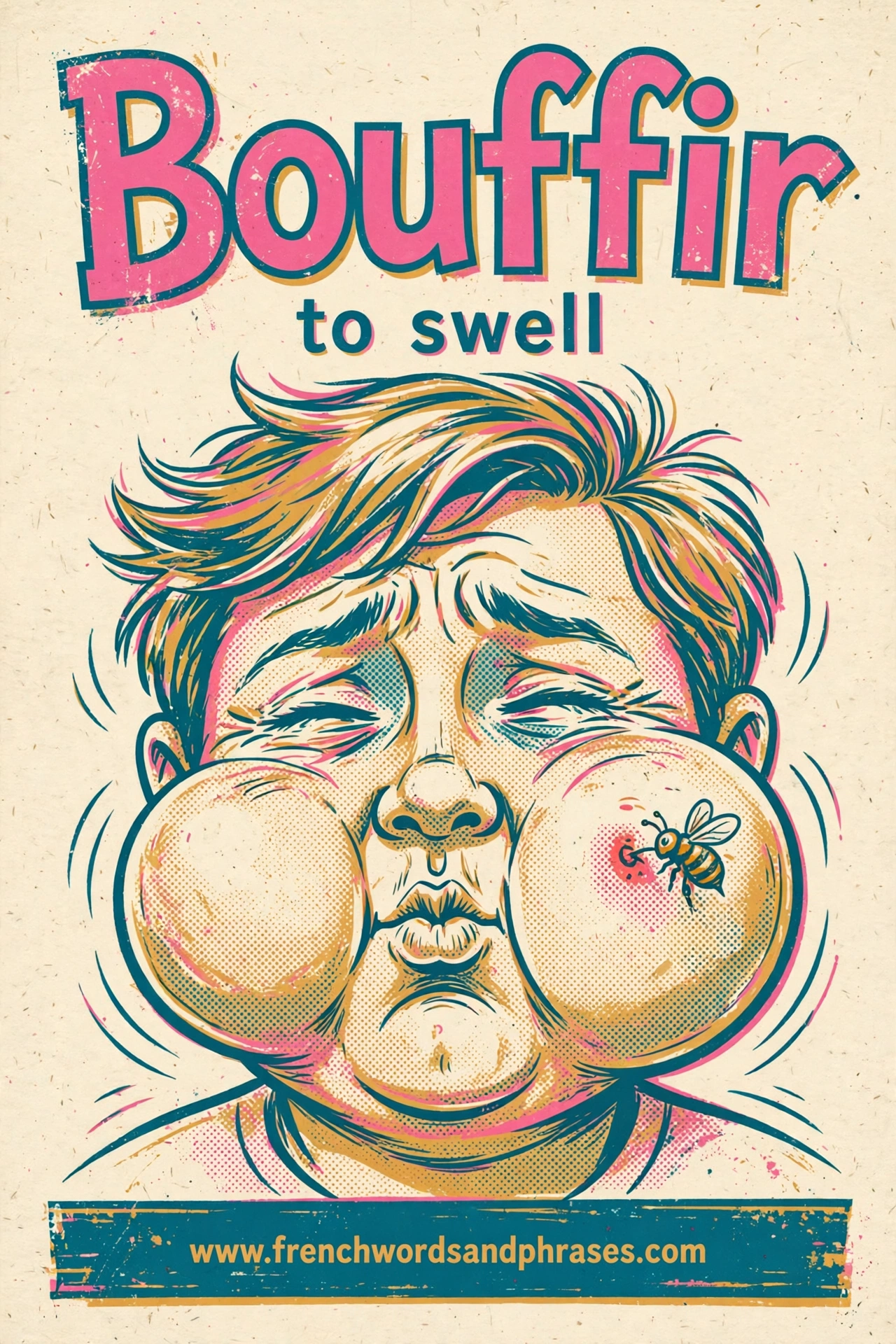
Bouffir means to swell — to puff up and become swollen, as a face does with sleep, tears or a bee sting.
A face in the mirror after a night of crying, cheeks round as cushions, eyelids heavy — bouffir is the verb of the puff: flesh that fills with fluid, softens its own outlines and makes its owner barely recognisable.
In this guide, you’ll learn how to conjugate bouffir in all the major French tenses and moods. Explore complete conjugation tables, French examples, English translations, and practice quizzes.
Understanding the French Verb Bouffir
Bouffir is a regular French verb belonging to the second group of verbs, those ending in -ir.
It means to swell. It is used almost entirely of the face and its features — cheeks, eyelids, eyes — swollen by sleep, tears, illness, alcohol or a sting, and figuratively of someone swollen with pride or self-importance: bouffi d’orgueil, bouffi de suffisance.
Verb classification: Second group (-ir)
Auxiliary verb: Avoir
Past participle: bouffi
Present participle: bouffissant
English equivalents: To swell, to puff up, to become swollen; un visage bouffi — a puffy, swollen face; bouffi de sommeil — puffy with sleep; bouffi d’orgueil — swollen with pride; les yeux bouffis — swollen eyes.
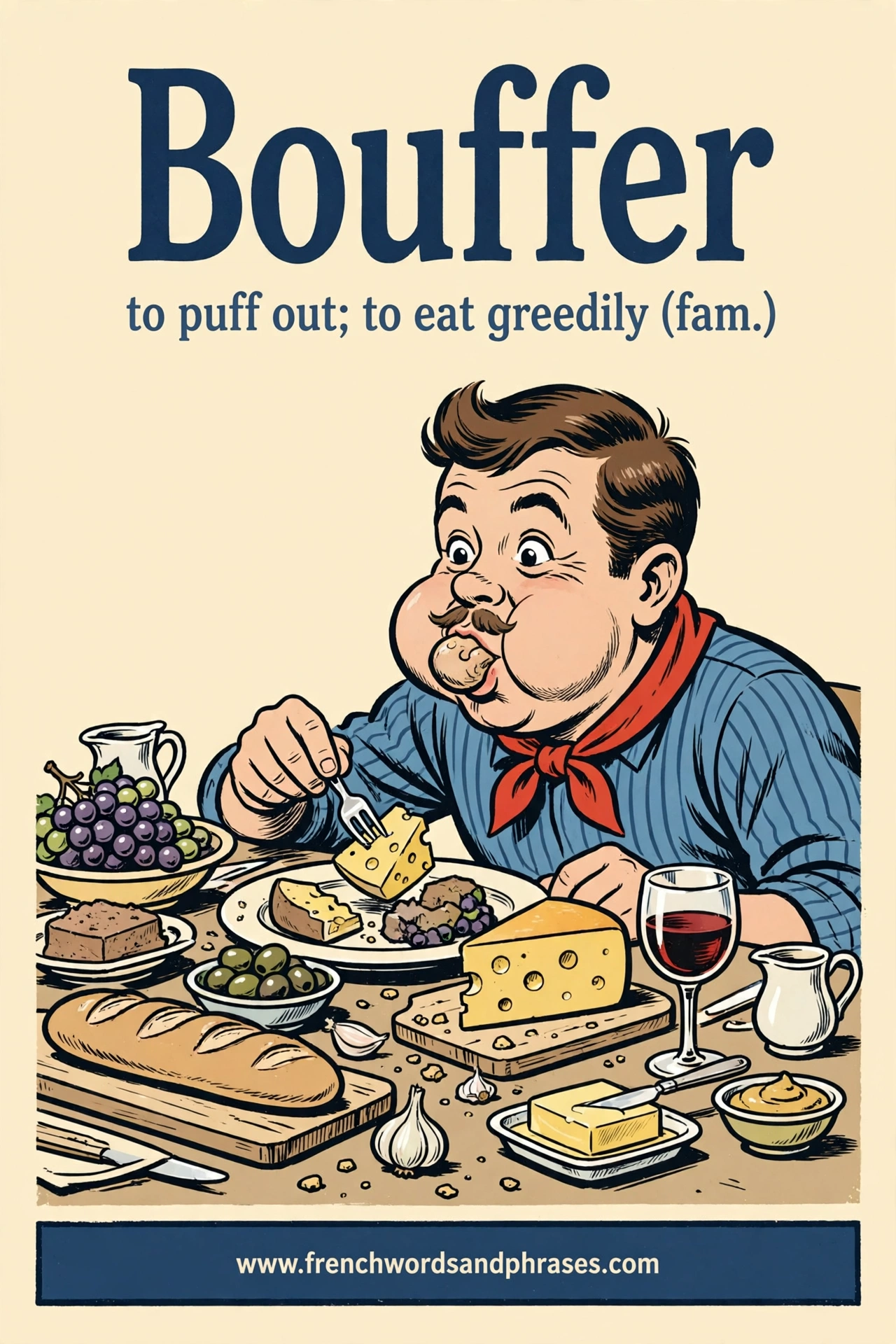
One important detail: bouffir is a finir-type -ir verb, so the -iss- of the plural and the imperfect is its fingerprint: je bouffis, tu bouffis, il bouffit, but nous bouffissons, vous bouffissez, ils bouffissent, and je bouffissais all through the imperfect. Its past participle is bouffi, and the adjective bouffi (puffy) is the form you will meet most often: un visage bouffi, des joues bouffies. Do not confuse it with bouffer, the familiar verb for eating — bouffir is about swelling, not supper.
Experience the Word
Bouffir is the verb of the morning-after face — the features still there, but softened, rounded and drowned in their own swelling.
Imagine a student who has cried half the night over an exam result. At dawn she splashes cold water on her face and looks up: the eyes are slits, the cheeks are cushions, the whole face has bouffi — she will need sunglasses and an hour before she looks like herself again.
Nothing is broken, nothing is cut. Her face has simply swollen — bouffi, puffed beyond its usual shape.
How to Conjugate Bouffir: Complete French Conjugation Guide
Let’s explore every major conjugation of bouffir, beginning with the indicative mood.
How to Conjugate Bouffir in the Indicative Mood
The indicative mood is used to express facts, observations, actions, and events.
How to Conjugate Bouffir in the Present Tense (Présent)
Used for actions happening now, habitual actions, and general truths.
| Subject | Conjugation |
|---|---|
| je | bouffis |
| tu | bouffis |
| il / elle | bouffit |
| nous | bouffissons |
| vous | bouffissez |
| ils / elles | bouffissent |
Example
Son visage bouffit dès qu’elle manque de sommeil.
Her face swells as soon as she misses sleep.
Quick Quiz 1
Complete the sentence:
Nous ______ dès que nous manquons de sommeil.
Reveal the answer
bouffissons
Nous bouffissons dès que nous manquons de sommeil.
We swell up as soon as we miss sleep.
How to Conjugate Bouffir in the Passé Composé
Used for completed actions in the past. Bouffir takes the auxiliary verb avoir.
| Subject | Conjugation |
|---|---|
| j’ | ai bouffi |
| tu | as bouffi |
| il / elle | a bouffi |
| nous | avons bouffi |
| vous | avez bouffi |
| ils / elles | ont bouffi |
Example
Ses paupières ont bouffi après la piqûre d’abeille.
His eyelids swelled up after the bee sting.
How to Conjugate Bouffir in the Imparfait (Imperfect Tense)
Used for habitual past actions, descriptions, and ongoing situations in the past.
| Subject | Conjugation |
|---|---|
| je | bouffissais |
| tu | bouffissais |
| il / elle | bouffissait |
| nous | bouffissions |
| vous | bouffissiez |
| ils / elles | bouffissaient |
Example
Enfant, ses joues bouffissaient au moindre rhume.
As a child, her cheeks would swell at the slightest cold.
Quick Quiz 2
Choose the correct form:
His eyelids swelled after the sting.
Ses paupières ______ après la piqûre. (ont bouffi / ont bouffé)
Reveal the answer
ont bouffi
Ses paupières ont bouffi après la piqûre.
Bouffir means to swell; bouffer is the familiar verb for eating.
How to Conjugate Bouffir in the Plus-que-parfait
Used to describe an action that had already been completed before another past event.
| Subject | Conjugation |
|---|---|
| j’ | avais bouffi |
| tu | avais bouffi |
| il / elle | avait bouffi |
| nous | avions bouffi |
| vous | aviez bouffi |
| ils / elles | avaient bouffi |
Example
Son visage avait bouffi pendant la nuit.
His face had swollen during the night.
How to Conjugate Bouffir in the Passé Simple
Primarily used in formal writing, literature, and historical narratives. It is rarely used in everyday conversation.
| Subject | Conjugation |
|---|---|
| je | bouffis |
| tu | bouffis |
| il / elle | bouffit |
| nous | bouffîmes |
| vous | bouffîtes |
| ils / elles | bouffirent |
Example
Sous l’effet du sel, ses doigts bouffirent légèrement.
From the effect of the salt, her fingers swelled slightly.
How to Conjugate Bouffir in the Passé Antérieur
A literary tense used to express an action completed immediately before another past action, generally in the passé simple.
| Subject | Conjugation |
|---|---|
| j’ | eus bouffi |
| tu | eus bouffi |
| il / elle | eut bouffi |
| nous | eûmes bouffi |
| vous | eûtes bouffi |
| ils / elles | eurent bouffi |
Example
Quand ses yeux eurent bouffi, elle mit des lunettes de soleil.
When her eyes had swollen up, she put on sunglasses.
How to Conjugate Bouffir in the Future Tense (Futur Simple)
Used to describe actions that will take place in the future.
| Subject | Conjugation |
|---|---|
| je | bouffirai |
| tu | bouffiras |
| il / elle | bouffira |
| nous | bouffirons |
| vous | bouffirez |
| ils / elles | bouffiront |
Example
Si tu pleures encore, ton visage bouffira davantage.
If you cry any more, your face will swell even more.
How to Conjugate Bouffir in the Futur Antérieur (Future Perfect)
Used for an action that will have been completed before a particular point in the future.
| Subject | Conjugation |
|---|---|
| j’ | aurai bouffi |
| tu | auras bouffi |
| il / elle | aura bouffi |
| nous | aurons bouffi |
| vous | aurez bouffi |
| ils / elles | auront bouffi |
Example
Demain matin, ses paupières auront bouffi sous l’effet de l’allergie.
By tomorrow morning, her eyelids will have swollen from the allergy.
How to Conjugate Bouffir in the Near Future (Futur Proche)
Used to describe something that is going to happen soon. Formed with aller + infinitive.
| Subject | Conjugation |
|---|---|
| je | vais bouffir |
| tu | vas bouffir |
| il / elle | va bouffir |
| nous | allons bouffir |
| vous | allez bouffir |
| ils / elles | vont bouffir |
Example
Regarde, sa joue va bouffir autour de la piqûre.
Look, her cheek is going to swell around the sting.
How to Conjugate Bouffir in the Conditional Mood
The conditional mood expresses what would happen under certain circumstances. It is also frequently used to make polite requests or express wishes.
How to Conjugate Bouffir in the Present Conditional
| Subject | Conjugation |
|---|---|
| je | bouffirais |
| tu | bouffirais |
| il / elle | bouffirait |
| nous | bouffirions |
| vous | bouffiriez |
| ils / elles | bouffiraient |
Example
Sans ce traitement, son visage bouffirait chaque matin.
Without this treatment, his face would swell every morning.
How to Conjugate Bouffir in the Past Conditional
| Subject | Conjugation |
|---|---|
| j’ | aurais bouffi |
| tu | aurais bouffi |
| il / elle | aurait bouffi |
| nous | aurions bouffi |
| vous | auriez bouffi |
| ils / elles | auraient bouffi |
Example
Elle aurait moins bouffi si elle avait dormi davantage.
She would have swollen less if she had slept more.
Bouffir in the Literary Past Conditional Form
This less common literary form uses the imperfect subjunctive of avoir.
| Subject | Conjugation |
|---|---|
| j’ | eusse bouffi |
| tu | eusses bouffi |
| il / elle | eût bouffi |
| nous | eussions bouffi |
| vous | eussiez bouffi |
| ils / elles | eussent bouffi |
Example
Il eût bouffi de honte devant toute la cour.
He would have swollen with shame before the whole court.
How to Conjugate Bouffir in the Subjunctive Mood
The subjunctive is used to express wishes, emotions, doubts, necessity, and uncertainty. It frequently follows expressions such as il faut que (it is necessary that) or bien que (although).
How to Conjugate Bouffir in the Present Subjunctive
| Subject | Conjugation |
|---|---|
| que je | bouffisse |
| que tu | bouffisses |
| qu’il / qu’elle | bouffisse |
| que nous | bouffissions |
| que vous | bouffissiez |
| qu’ils / qu’elles | bouffissent |
Example
Il est possible que son visage bouffisse avec la chaleur.
It is possible his face swells in the heat.
Quick Quiz 3
Complete the sentence using the subjunctive:
Il est possible que vous ______ avec cette allergie.
Reveal the answer
bouffissiez
Il est possible que vous bouffissiez avec cette allergie.
It is possible you swell with this allergy.
How to Conjugate Bouffir in the Imperfect Subjunctive
A literary tense, rarely encountered in modern spoken French.
| Subject | Conjugation |
|---|---|
| que je | bouffisse |
| que tu | bouffisses |
| qu’il / qu’elle | bouffît |
| que nous | bouffissions |
| que vous | bouffissiez |
| qu’ils / qu’elles | bouffissent |
Example
Le médecin doutait que la joue bouffît davantage.
The doctor doubted the cheek would swell any further.
How to Conjugate Bouffir in the Pluperfect Subjunctive
A literary construction used to express an action completed before another past action.
| Subject | Conjugation |
|---|---|
| que j’ | eusse bouffi |
| que tu | eusses bouffi |
| qu’il / qu’elle | eût bouffi |
| que nous | eussions bouffi |
| que vous | eussiez bouffi |
| qu’ils / qu’elles | eussent bouffi |
Example
On craignait que son visage eût bouffi pendant l’opération.
They feared his face had swollen during the operation.
How to Conjugate Bouffir in the Past Subjunctive
| Subject | Conjugation |
|---|---|
| que j’ | aie bouffi |
| que tu | aies bouffi |
| qu’il / qu’elle | ait bouffi |
| que nous | ayons bouffi |
| que vous | ayez bouffi |
| qu’ils / qu’elles | aient bouffi |
Example
Je suis désolé que tes yeux aient bouffi à ce point.
I am sorry your eyes have swollen this much.
How to Conjugate Bouffir in the Imperative
The imperative is used to give commands, instructions, invitations, or suggestions. Subject pronouns are omitted.
How to Conjugate Bouffir in the Present Imperative
| Person | Conjugation |
|---|---|
| (tu) | bouffis |
| (nous) | bouffissons |
| (vous) | bouffissez |
Example
Ne bouffis pas ainsi d’orgueil, reste humble !
Do not swell with pride like that, stay humble!
Quick Quiz 4
How would you say Do not swell with pride (tu form)?
Reveal the answer
Ne bouffis pas d’orgueil !
French Participles of Bouffir
Participles are verb forms that can be used in compound tenses and other grammatical constructions.
Present Participle of Bouffir
bouffissant
En bouffissant de suffisance, il perdait ses derniers amis.
By swelling with self-importance, he was losing his last friends.
Past Participle of Bouffir
bouffi
Bouffie par les larmes, elle refusait de sortir.
Swollen with tears, she refused to go out.
Bouffir in Everyday French: Real-Life Examples
Now that you know the conjugations, let’s see how bouffir appears in everyday French.
Example 1 — Present
Son visage bouffit quand elle est fatiguée.
Her face swells when she is tired.
Example 2 — Passé composé
Ses yeux ont bouffi pendant la nuit.
His eyes swelled during the night.
Example 3 — Imparfait
Ses joues bouffissaient au moindre rhume.
Her cheeks would swell at the slightest cold.
Example 4 — Future
Ta joue bouffira si tu ne mets pas de glace.
Your cheek will swell if you do not put ice on it.
Example 5 — Conditional
Sans l’allergie, il ne bouffirait pas ainsi.
Without the allergy, he would not swell like that.
Example 6 — Imperative
Ne bouffis pas d’orgueil !
Do not swell with pride!
Beyond Translation: The Meaning of Bouffir
English puff up and swell split the work that French bouffir does alone, and its past participle bouffi has become the everyday adjective for a puffy face.
The swelling is never only physical.
A minister bouffi d’orgueil is swollen with pride, a style bouffi is bloated prose — wherever French sees soft excess with no firm shape, bouffir and bouffi are waiting.
How to Remember the French Verb Bouffir
Remember it this way: Bouffir is about the morning-after face — cheeks like cushions, eyes like slits.
- Finir-type -ir: je bouffis, but nous bouffissons — the -iss- is the giveaway.
- Its living form is the adjective: un visage bouffi, des yeux bouffis — puffy, swollen.
- Not bouffer (to eat, familiar): bouffir is swelling, bouffi d’orgueil is swollen with pride.
The key idea is the morning-after face — cheeks like cushions, eyes like slits.
Test Your Knowledge of Bouffir
Let’s see how much you’ve learned. Try answering these questions before revealing the answers.
Question 1
Which group does bouffir belong to, and what is its giveaway?
Reveal the answer
The second group (-ir) — the -iss- of nous bouffissons and je bouffissais.
Question 2
How do you say Her face swells when she is tired in French?
Reveal the answer
Son visage bouffit quand elle est fatiguée.
Question 3
Translate: His eyes swelled during the night.
Reveal the answer
Ses yeux ont bouffi pendant la nuit.
Question 4
What is the past participle of bouffir?
Reveal the answer
Bouffi — the same word as the adjective meaning puffy.
Question 5
Complete the sentence:
Il est possible que son visage ______ avec la chaleur.
Reveal the answer
bouffisse
Il est possible que son visage bouffisse avec la chaleur.
It is possible his face swells in the heat.
Your Final Challenge
Can You Use It?
How would you say this in French?
She cried all night, and in the morning her swollen face told everything without a word.
Reveal the answer
Elle a pleuré toute la nuit, et au matin son visage bouffi racontait tout sans un mot.
She cried all night, and in the morning her swollen face told everything without a word.
A little French. A little curiosity. A richer everyday life.
LEARN FRENCH ONE WORD AT A TIME