A French Word to Live By
How to Conjugate Bonimenter in French
/bɔ.ni.mɑ̃.te/
Bonimenter means to coax — to sweet-talk someone with a smooth, practised patter until resistance melts and they say yes.
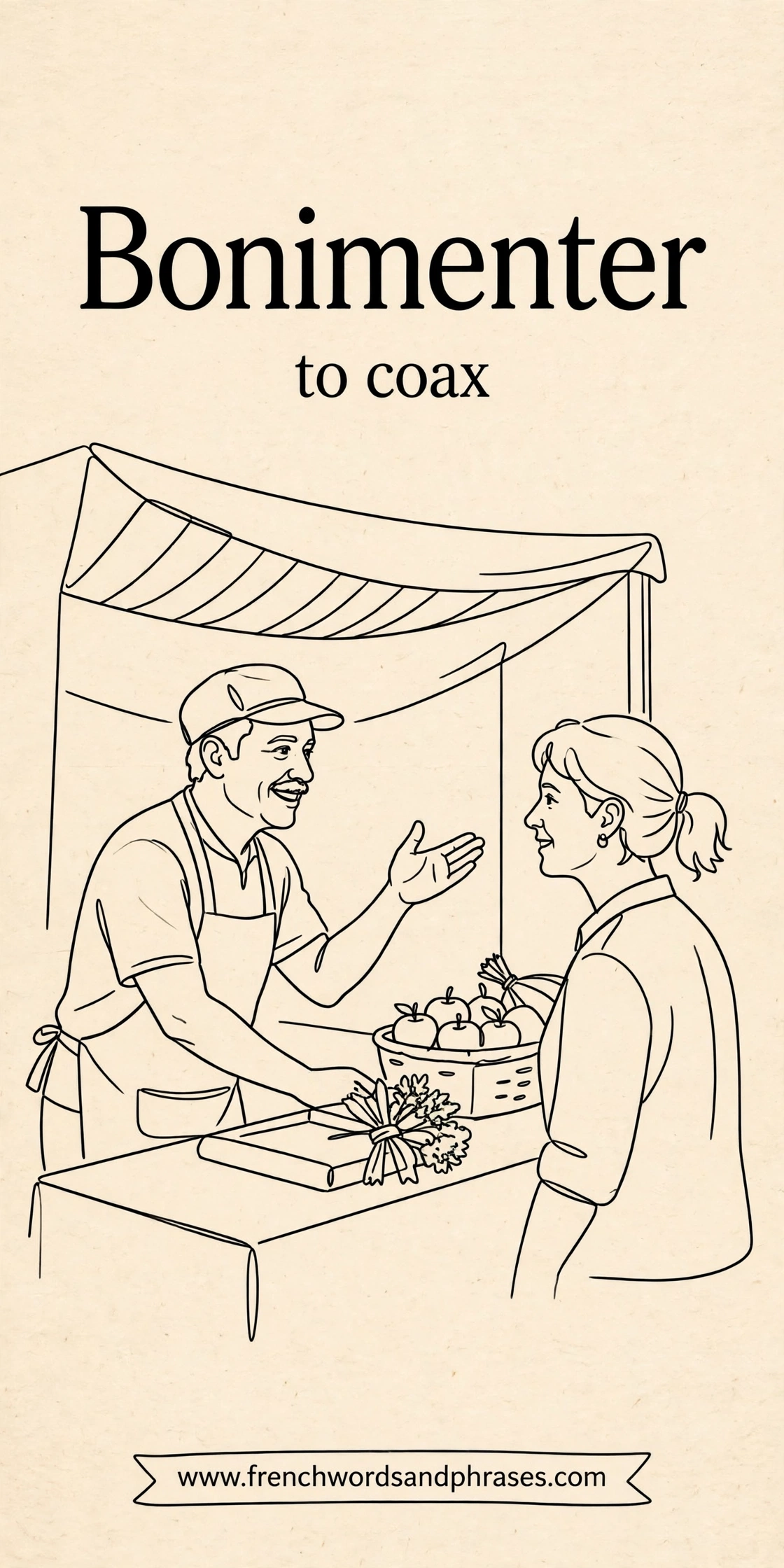
A market salesman in full flow, hands dancing over his stall of miracle pans; a fairground barker promising wonders — bonimenter is the familiar verb of the gift of the gab: words used as honey, and just as sticky.
In this guide, you’ll learn how to conjugate bonimenter in all the major French tenses and moods. Explore complete conjugation tables, French examples, English translations, and practice quizzes.
Understanding the French Verb Bonimenter
Bonimenter is a regular French verb belonging to the first group of verbs, those ending in-er.
It means to coax. It always carries a smile and a suspicion: the person bonimenté is being charmed, certainly, but also worked on — the word sits between compliment and con, and French speakers reach for it exactly when they cannot decide which.
Verb classification: First group (-er)
Auxiliary verb: Avoir
Past participle: bonimenté
Present participle: bonimentant
English equivalents: To sweet-talk, to soft-soap, to spin a line (familiar); bonimenter un client — to sweet-talk a customer; un boniment — a sales pitch, smooth talk; un bonimenteur — a smooth talker, a fast-talking salesman; se laisser bonimenter — to let oneself be talked into something.
One important detail: bonimenter is a familiar verb — the word of market stalls, fairgrounds and door-to-door salesmen, not of polite letters. Its family does the talking: un boniment is the patter itself, the spiel, and un bonimenteur is the artist who delivers it. The conjugation is a plain, regular -er: je bonimente, nous bonimentons — all the irregularity is in the tongue, not the grammar.
Experience the Word
Bonimenter is the verb of honeyed pressure — no force, no argument, just a river of words flowing one way until you find yourself nodding.
Imagine a Saturday market. The salesman has sold the same pan for twenty years and his pitch is a work of art: jokes, compliments, a fried egg flipped without fat. He bonimente la foule, the crowd laughs, the crowd reaches for its wallets — and everyone goes home happy, including the crowd.
Nobody was forced and nothing was quite proven. They were sweet-talked — bonimentés, and they loved it.
How to Conjugate Bonimenter: Complete French Conjugation Guide
Let’s explore every major conjugation of bonimenter, beginning with the indicative mood.
How to Conjugate Bonimenter in the Indicative Mood
The indicative mood is used to express facts, observations, actions, and events.
How to Conjugate Bonimenter in the Present Tense (Présent)
Used for actions happening now, habitual actions, and general truths.
| Subject | Conjugation |
|---|---|
| je | bonimente |
| tu | bonimentes |
| il / elle | bonimente |
| nous | bonimentons |
| vous | bonimentez |
| ils / elles | bonimentent |
Example
Le vendeur bonimente les passants devant son étal.
The salesman sweet-talks passers-by in front of his stall.
Quick Quiz 1
Complete the sentence:
Nous ______ les clients depuis ce matin.
Reveal the answer
bonimentons
Nous bonimentons les clients depuis ce matin.
We have been sweet-talking the customers since this morning.
How to Conjugate Bonimenter in the Passé Composé
Used for completed actions in the past. Bonimenter takes the auxiliary verb avoir.
| Subject | Conjugation |
|---|---|
| j’ | ai bonimenté |
| tu | as bonimenté |
| il / elle | a bonimenté |
| nous | avons bonimenté |
| vous | avez bonimenté |
| ils / elles | ont bonimenté |
Example
Il m’a bonimenté pendant dix minutes et j’ai fini par acheter.
He sweet-talked me for ten minutes and I ended up buying.
How to Conjugate Bonimenter in the Imparfait (Imperfect Tense)
Used for habitual past actions, descriptions, and ongoing situations in the past.
| Subject | Conjugation |
|---|---|
| je | bonimentais |
| tu | bonimentais |
| il / elle | bonimentait |
| nous | bonimentions |
| vous | bonimentiez |
| ils / elles | bonimentaient |
Example
Au marché, il bonimentait les clients avec un sourire d’ange.
At the market, he used to soft-soap the customers with an angelic smile.
Quick Quiz 2
Choose the correct form:
He sweet-talked even the mayor.
Il ______ jusqu’au maire. (a bonimenté / est bonimenté)
Reveal the answer
a bonimenté
Il a bonimenté jusqu’au maire.
Bonimenter takes avoir.
How to Conjugate Bonimenter in the Plus-que-parfait
Used to describe an action that had already been completed before another past event.
| Subject | Conjugation |
|---|---|
| j’ | avais bonimenté |
| tu | avais bonimenté |
| il / elle | avait bonimenté |
| nous | avions bonimenté |
| vous | aviez bonimenté |
| ils / elles | avaient bonimenté |
Example
Elle l’avait bonimenté si bien qu’il avait signé sans lire.
She had sweet-talked him so well that he had signed without reading.
How to Conjugate Bonimenter in the Passé Simple
Primarily used in formal writing, literature, and historical narratives. It is rarely used in everyday conversation.
| Subject | Conjugation |
|---|---|
| je | bonimentai |
| tu | bonimentas |
| il / elle | bonimenta |
| nous | bonimentâmes |
| vous | bonimentâtes |
| ils / elles | bonimentèrent |
Example
Le camelot bonimenta la foule et vendit tout son stock.
The pedlar worked the crowd with his patter and sold all his stock.
How to Conjugate Bonimenter in the Passé Antérieur
A literary tense used to express an action completed immediately before another past action, generally in the passé simple.
| Subject | Conjugation |
|---|---|
| j’ | eus bonimenté |
| tu | eus bonimenté |
| il / elle | eut bonimenté |
| nous | eûmes bonimenté |
| vous | eûtes bonimenté |
| ils / elles | eurent bonimenté |
Example
Quand il eut bonimenté les voisins, ils acceptèrent le projet.
When he had sweet-talked the neighbours, they accepted the plan.
How to Conjugate Bonimenter in the Future Tense (Futur Simple)
Used to describe actions that will take place in the future.
| Subject | Conjugation |
|---|---|
| je | bonimenterai |
| tu | bonimenteras |
| il / elle | bonimentera |
| nous | bonimenterons |
| vous | bonimenterez |
| ils / elles | bonimenteront |
Example
Demain, il bonimentera les touristes sur la place.
Tomorrow, he will sweet-talk the tourists on the square.
How to Conjugate Bonimenter in the Futur Antérieur (Future Perfect)
Used for an action that will have been completed before a particular point in the future.
| Subject | Conjugation |
|---|---|
| j’ | aurai bonimenté |
| tu | auras bonimenté |
| il / elle | aura bonimenté |
| nous | aurons bonimenté |
| vous | aurez bonimenté |
| ils / elles | auront bonimenté |
Example
À la fin de la foire, il aura bonimenté des centaines de clients.
By the end of the fair, he will have sweet-talked hundreds of customers.
How to Conjugate Bonimenter in the Near Future (Futur Proche)
Used to describe something that is going to happen soon. Formed with aller + infinitive.
| Subject | Conjugation |
|---|---|
| je | vais bonimenter |
| tu | vas bonimenter |
| il / elle | va bonimenter |
| nous | allons bonimenter |
| vous | allez bonimenter |
| ils / elles | vont bonimenter |
Example
Attention, il va te bonimenter pour te vendre sa camelote.
Watch out, he is going to sweet-talk you into buying his junk.
How to Conjugate Bonimenter in the Conditional Mood
The conditional mood expresses what would happen under certain circumstances. It is also frequently used to make polite requests or express wishes.
How to Conjugate Bonimenter in the Present Conditional
| Subject | Conjugation |
|---|---|
| je | bonimenterais |
| tu | bonimenterais |
| il / elle | bonimenterait |
| nous | bonimenterions |
| vous | bonimenteriez |
| ils / elles | bonimenteraient |
Example
Avec un peu de vin, il bonimenterait n’importe qui.
With a little wine in him, he would sweet-talk anyone.
How to Conjugate Bonimenter in the Past Conditional
| Subject | Conjugation |
|---|---|
| j’ | aurais bonimenté |
| tu | aurais bonimenté |
| il / elle | aurait bonimenté |
| nous | aurions bonimenté |
| vous | auriez bonimenté |
| ils / elles | auraient bonimenté |
Example
Tu l’aurais bonimenté, toi, ce client méfiant ?
Would you have sweet-talked that suspicious customer?
Bonimenter in the Literary Past Conditional Form
This less common literary form uses the imperfect subjunctive of avoir.
| Subject | Conjugation |
|---|---|
| j’ | eusse bonimenté |
| tu | eusses bonimenté |
| il / elle | eût bonimenté |
| nous | eussions bonimenté |
| vous | eussiez bonimenté |
| ils / elles | eussent bonimenté |
Example
Le marchand eût bonimenté la foule entière.
The merchant would have sweet-talked the whole crowd.
How to Conjugate Bonimenter in the Subjunctive Mood
The subjunctive is used to express wishes, emotions, doubts, necessity, and uncertainty. It frequently follows expressions such as il faut que (it is necessary that) or bien que (although).
How to Conjugate Bonimenter in the Present Subjunctive
| Subject | Conjugation |
|---|---|
| que je | bonimente |
| que tu | bonimentes |
| qu’il / qu’elle | bonimente |
| que nous | bonimentions |
| que vous | bonimentiez |
| qu’ils / qu’elles | bonimentent |
Example
Je ne crois pas qu’il bonimente encore à son âge.
I do not think he still does his patter at his age.
Quick Quiz 3
Complete the sentence using the subjunctive:
Je doute qu’il ______ encore à son âge.
Reveal the answer
bonimente
Je doute qu’il bonimente encore à son âge.
I doubt he still does his patter at his age.
How to Conjugate Bonimenter in the Imperfect Subjunctive
A literary tense, rarely encountered in modern spoken French.
| Subject | Conjugation |
|---|---|
| que je | bonimentasse |
| que tu | bonimentasses |
| qu’il / qu’elle | bonimentât |
| que nous | bonimentassions |
| que vous | bonimentassiez |
| qu’ils / qu’elles | bonimentassent |
Example
Il fallait qu’il bonimentât les clients pour écouler la marchandise.
He had to sweet-talk the customers to shift the goods.
How to Conjugate Bonimenter in the Pluperfect Subjunctive
A literary construction used to express an action completed before another past action.
| Subject | Conjugation |
|---|---|
| que j’ | eusse bonimenté |
| que tu | eusses bonimenté |
| qu’il / qu’elle | eût bonimenté |
| que nous | eussions bonimenté |
| que vous | eussiez bonimenté |
| qu’ils / qu’elles | eussent bonimenté |
Example
On racontait qu’il eût bonimenté jusqu’au maire du village.
People said he had sweet-talked even the village mayor.
How to Conjugate Bonimenter in the Past Subjunctive
| Subject | Conjugation |
|---|---|
| que j’ | aie bonimenté |
| que tu | aies bonimenté |
| qu’il / qu’elle | ait bonimenté |
| que nous | ayons bonimenté |
| que vous | ayez bonimenté |
| qu’ils / qu’elles | aient bonimenté |
Example
Je m’étonne qu’il ait bonimenté tant de monde.
I am amazed he sweet-talked so many people.
How to Conjugate Bonimenter in the Imperative
The imperative is used to give commands, instructions, invitations, or suggestions. Subject pronouns are omitted.
How to Conjugate Bonimenter in the Present Imperative
| Person | Conjugation |
|---|---|
| (tu) | bonimente |
| (nous) | bonimentons |
| (vous) | bonimentez |
Example
Bonimente-les un peu, ils hésitent encore !
Sweet-talk them a little, they are still hesitating!
Quick Quiz 4
How would you say Sweet-talk them a little (tu form)?
Reveal the answer
Bonimente-les un peu !
French Participles of Bonimenter
Participles are verb forms that can be used in compound tenses and other grammatical constructions.
Present Participle of Bonimenter
bonimentant
En bonimentant les passants, il a vendu toutes ses montres.
By sweet-talking passers-by, he sold all his watches.
Past Participle of Bonimenter
bonimenté
Bonimenté par le vendeur, le client est reparti avec trois casseroles.
Sweet-talked by the salesman, the customer left with three saucepans.
Bonimenter in Everyday French: Real-Life Examples
Now that you know the conjugations, let’s see how bonimenter appears in everyday French.
Example 1 — Present
Le vendeur bonimente les passants.
The salesman sweet-talks passers-by.
Example 2 — Passé composé
Il m’a bonimenté et j’ai acheté.
He sweet-talked me and I bought.
Example 3 — Imparfait
Au marché, il bonimentait tout le monde.
At the market, he used to sweet-talk everyone.
Example 4 — Future
Demain, il bonimentera les touristes.
Tomorrow, he will sweet-talk the tourists.
Example 5 — Conditional
Il bonimenterait n’importe qui.
He would sweet-talk anyone.
Example 6 — Imperative
Bonimente-les un peu, ils hésitent !
Sweet-talk them a little, they are hesitating!
Beyond Translation: The Meaning of Bonimenter
English spiel and soft-soap circle the same stall, but bonimenter is warmer — its root is boniment, the fairground barker’s practised pitch, a little theatre performed over a tray of goods.
Every market has its bonimenteur.
He is a stock character of French life: part actor, part salesman, part poet of the useless gadget — and the verb that bears his patter admits, with a grin, that being bonimenté is half swindle and half entertainment, and entirely your own fault for stopping to listen.
How to Remember the French Verb Bonimenter
Remember it this way: Bonimenter is about the market salesman whose words are honey.
- Un boniment is the patter, un bonimenteur the artist — bonimenter is the patter in action.
- Familiar register: the word of market stalls and fairgrounds, said with a grin.
- Plain regular -er: je bonimente, nous bonimentons, past participle bonimenté, auxiliary avoir.
The key idea is the market salesman whose words are honey.
Test Your Knowledge of Bonimenter
Let’s see how much you’ve learned. Try answering these questions before revealing the answers.
Question 1
What register is bonimenter, and what is un bonimenteur?
Reveal the answer
Familiar — the register of markets and fairgrounds. Un bonimenteur is a smooth talker, a salesman with the gift of the gab.
Question 2
How do you say He sweet-talked me for ten minutes in French?
Reveal the answer
Il m’a bonimenté pendant dix minutes.
Question 3
Translate: He sweet-talked the neighbours into accepting the plan.
Reveal the answer
Il a bonimenté les voisins pour leur faire accepter le projet.
Question 4
What is the past participle of bonimenter?
Reveal the answer
Bonimenté.
Question 5
Complete the sentence:
Je doute qu’il ______ encore à son âge.
Reveal the answer
bonimente
Je doute qu’il bonimente encore à son âge.
I doubt he still does his patter at his age.
Your Final Challenge
Can You Use It?
How would you say this in French?
He sweet-talked the crowd for an hour, and the crowd went home happy, its arms loaded with saucepans.
Reveal the answer
Il a bonimenté la foule pendant une heure, et la foule est repartie heureuse, les bras chargés de casseroles.
He sweet-talked the crowd for an hour, and the crowd went home happy, its arms loaded with saucepans.
A little French. A little curiosity. A richer everyday life.
LEARN FRENCH ONE WORD AT A TIME