A French Word to Live By
How to Conjugate Se bonifier in French
/sə bɔ.ni.fje/
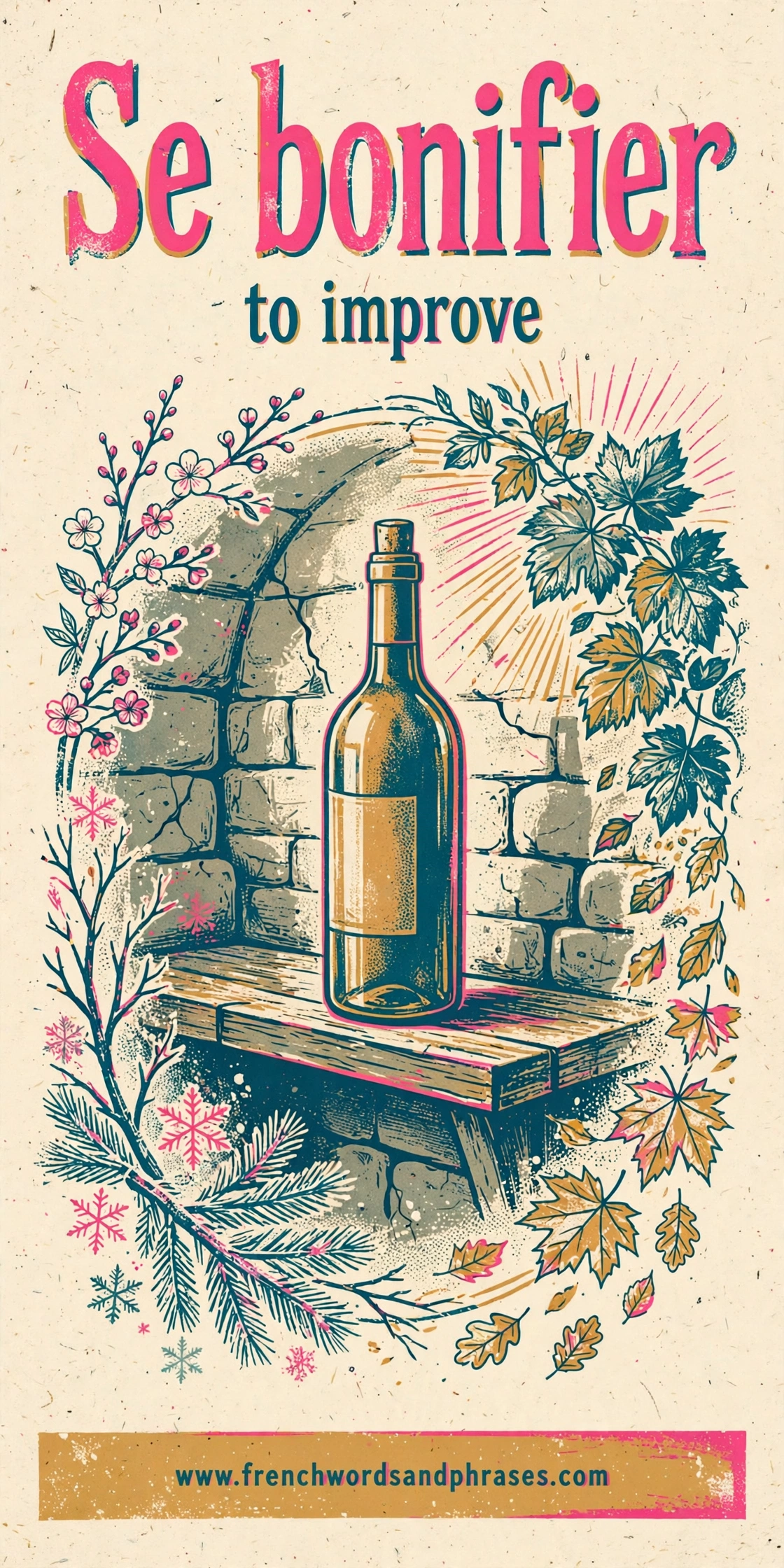
Se bonifier means to improve — to get better with time, the way a wine softens in the cellar and a character mellows with the years.
A young wine, harsh in spring and silky by winter; a hot-headed young man whom thirty years have turned gentle — se bonifier is the verb of improvement that happens from inside, with nothing but time as the workman.
In this guide, you’ll learn how to conjugate se bonifier in all the major French tenses and moods. Explore complete conjugation tables, French examples, English translations, and practice quizzes.
Understanding the French Verb Se bonifier
Se bonifier is a regular French verb belonging to the first group of verbs, those ending in-er.
It means to improve. Its kingdom is wine first of all — vins, fromages and jambons se bonifient in cellars — and then, by the happiest of metaphors, people: to say of someone il se bonifie avec l’âge is to pay them the compliment of the cellar, better every year.
Verb classification: First group (-er), reflexive
Auxiliary verb: Être
Past participle: bonifié
Present participle: bonifiant
English equivalents: To improve, to get better, to mellow; un vin qui se bonifie en vieillissant — a wine that improves as it ages; se bonifier avec l’âge — to improve with age; se bonifier avec le temps — to get better with time; il se bonifie comme un grand cru — he is improving like a fine vintage.
One important detail: se bonifier is the reflexive twin of bonifier, and it changes the picture completely — the grower bonifie his wine from outside, but the wine se bonifie all by itself in the dark of the cellar. Being reflexive, it takes être in every compound tense and the participle agrees: elle s’est bonifiée, ils se sont bonifiés. It keeps the -ier trap of its twin: nous nous bonifiions in the imperfect and the subjunctive. The tu imperative tucks the pronoun behind the verb: bonifie-toi !
Experience the Word
Se bonifier is the verb of time as a craftsman — leave the wine, the cheese or the person alone, and they quietly become better.
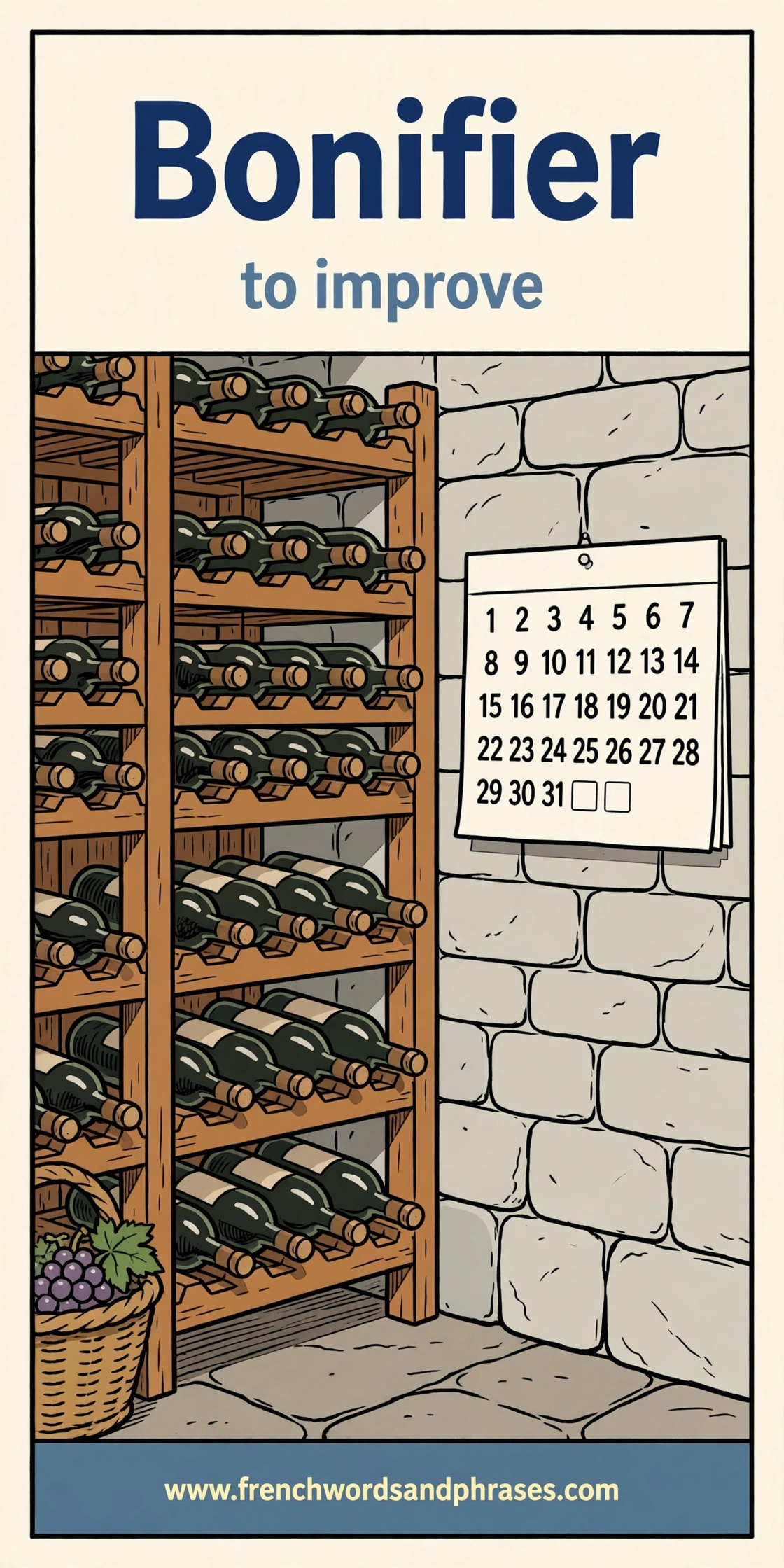
Imagine a cellar in Burgundy. The barrels rest in the cool dark, nobody touches them, nobody hurries them — and month by month the young wine loses its edges, se bonifie, until the grower tastes it, smiles, and reaches for the bottles.
Nobody improved it from outside. It improved itself — il s’est bonifié, in the dark and in its own time.
How to Conjugate Se bonifier: Complete French Conjugation Guide
Let’s explore every major conjugation of se bonifier, beginning with the indicative mood.
How to Conjugate Se bonifier in the Indicative Mood
The indicative mood is used to express facts, observations, actions, and events.
How to Conjugate Se bonifier in the Present Tense (Présent)
Used for actions happening now, habitual actions, and general truths.
| Subject | Conjugation |
|---|---|
| je | me bonifie |
| tu | te bonifies |
| il / elle | se bonifie |
| nous | nous bonifions |
| vous | vous bonifiez |
| ils / elles | se bonifient |
Example
Ce vin se bonifie en vieillissant.
This wine improves as it ages.
Quick Quiz 1
Complete the sentence:
Nous nous ______ avec l’âge.
Reveal the answer
bonifions
Nous nous bonifions avec l’âge.
We improve with age.
How to Conjugate Se bonifier in the Passé Composé
Used for completed actions in the past. Se bonifier takes the auxiliary verb être.
| Subject | Conjugation |
|---|---|
| je | me suis bonifié / me suis bonifiée |
| tu | t’es bonifié / t’es bonifiée |
| il / elle | s’est bonifié / s’est bonifiée |
| nous | nous sommes bonifiés / nous sommes bonifiées |
| vous | vous êtes bonifiés / vous êtes bonifiées / vous êtes bonifié / vous êtes bonifiée |
| ils / elles | se sont bonifiés / se sont bonifiées |
Example
Avec les années, elle s’est bonifiée comme un grand cru.
Over the years, she has mellowed like a fine vintage.
How to Conjugate Se bonifier in the Imparfait (Imperfect Tense)
Used for habitual past actions, descriptions, and ongoing situations in the past.
| Subject | Conjugation |
|---|---|
| je | me bonifiais |
| tu | te bonifiais |
| il / elle | se bonifiait |
| nous | nous bonifiions |
| vous | vous bonifiiez |
| ils / elles | se bonifiaient |
Example
Son caractère se bonifiait doucement avec l’âge.
His character was slowly improving with age.
Quick Quiz 2
Choose the correct form:
She has mellowed like a fine vintage.
Elle ______ comme un grand cru. (s’est bonifiée / a bonifié)
Reveal the answer
s’est bonifiée
Elle s’est bonifiée comme un grand cru.
Se bonifier is reflexive, takes être, and the participle agrees: bonifiée.
How to Conjugate Se bonifier in the Plus-que-parfait
Used to describe an action that had already been completed before another past event.
| Subject | Conjugation |
|---|---|
| je | m’étais bonifié / m’étais bonifiée |
| tu | t’étais bonifié / t’étais bonifiée |
| il / elle | s’était bonifié / s’était bonifiée |
| nous | nous étions bonifiés / nous étions bonifiées |
| vous | vous étiez bonifiés / vous étiez bonifiées / vous étiez bonifié / vous étiez bonifiée |
| ils / elles | s’étaient bonifiés / s’étaient bonifiées |
Example
Le vin s’était bonifié après dix ans de cave.
The wine had improved after ten years in the cellar.
How to Conjugate Se bonifier in the Passé Simple
Primarily used in formal writing, literature, and historical narratives. It is rarely used in everyday conversation.
| Subject | Conjugation |
|---|---|
| je | me bonifiai |
| tu | te bonifias |
| il / elle | se bonifia |
| nous | nous bonifiâmes |
| vous | vous bonifiâtes |
| ils / elles | se bonifièrent |
Example
Le fromage se bonifia dans la cave fraîche.
The cheese improved in the cool cellar.
How to Conjugate Se bonifier in the Passé Antérieur
A literary tense used to express an action completed immediately before another past action, generally in the passé simple.
| Subject | Conjugation |
|---|---|
| je | me fus bonifié / me fus bonifiée |
| tu | te fus bonifié / te fus bonifiée |
| il / elle | se fut bonifié / se fut bonifiée |
| nous | nous fûmes bonifiés / nous fûmes bonifiées |
| vous | vous fûtes bonifiés / vous fûtes bonifiées / vous fûtes bonifié / vous fûtes bonifiée |
| ils / elles | se furent bonifiés / se furent bonifiées |
Example
Dès que le vin se fut bonifié, on le mit en bouteille.
As soon as the wine had improved, it was bottled.
How to Conjugate Se bonifier in the Future Tense (Futur Simple)
Used to describe actions that will take place in the future.
| Subject | Conjugation |
|---|---|
| je | me bonifierai |
| tu | te bonifieras |
| il / elle | se bonifiera |
| nous | nous bonifierons |
| vous | vous bonifierez |
| ils / elles | se bonifieront |
Example
Tu verras, il se bonifiera avec le temps.
You will see, he will improve with time.
How to Conjugate Se bonifier in the Futur Antérieur (Future Perfect)
Used for an action that will have been completed before a particular point in the future.
| Subject | Conjugation |
|---|---|
| je | me serai bonifié / me serai bonifiée |
| tu | te seras bonifié / te seras bonifiée |
| il / elle | se sera bonifié / se sera bonifiée |
| nous | nous serons bonifiés / nous serons bonifiées |
| vous | vous serez bonifiés / vous serez bonifiées / vous serez bonifié / vous serez bonifiée |
| ils / elles | se seront bonifiés / se seront bonifiées |
Example
À cinquante ans, elle se sera bonifiée comme les grands vins.
By fifty, she will have mellowed like the great wines.
How to Conjugate Se bonifier in the Near Future (Futur Proche)
Used to describe something that is going to happen soon. Formed with aller + infinitive.
| Subject | Conjugation |
|---|---|
| je | vais me bonifier |
| tu | vas te bonifier |
| il / elle | va se bonifier |
| nous | allons nous bonifier |
| vous | allez vous bonifier |
| ils / elles | vont se bonifier |
Example
Ce jeune vin va se bonifier en bouteille.
This young wine is going to improve in the bottle.
How to Conjugate Se bonifier in the Conditional Mood
The conditional mood expresses what would happen under certain circumstances. It is also frequently used to make polite requests or express wishes.
How to Conjugate Se bonifier in the Present Conditional
| Subject | Conjugation |
|---|---|
| je | me bonifierais |
| tu | te bonifierais |
| il / elle | se bonifierait |
| nous | nous bonifierions |
| vous | vous bonifieriez |
| ils / elles | se bonifieraient |
Example
Ce fromage se bonifierait encore dans une cave plus humide.
This cheese would improve further in a damper cellar.
How to Conjugate Se bonifier in the Past Conditional
| Subject | Conjugation |
|---|---|
| je | me serais bonifié / me serais bonifiée |
| tu | te serais bonifié / te serais bonifiée |
| il / elle | se serait bonifié / se serait bonifiée |
| nous | nous serions bonifiés / nous serions bonifiées |
| vous | vous seriez bonifiés / vous seriez bonifiées / vous seriez bonifié / vous seriez bonifiée |
| ils / elles | se seraient bonifiés / se seraient bonifiées |
Example
Il se serait bonifié plus vite loin de la ville.
He would have improved faster away from the city.
Se bonifier in the Literary Past Conditional Form
This less common literary form uses the imperfect subjunctive of être.
| Subject | Conjugation |
|---|---|
| je | me fusse bonifié / me fusse bonifiée |
| tu | te fusses bonifié / te fusses bonifiée |
| il / elle | se fût bonifié / se fût bonifiée |
| nous | nous fussions bonifiés / nous fussions bonifiées |
| vous | vous fussiez bonifiés / vous fussiez bonifiées / vous fussiez bonifié / vous fussiez bonifiée |
| ils / elles | se fussent bonifiés / se fussent bonifiées |
Example
Elle se fût bonifiée avec l’âge, comme sa mère.
She would have mellowed with age, like her mother.
How to Conjugate Se bonifier in the Subjunctive Mood
The subjunctive is used to express wishes, emotions, doubts, necessity, and uncertainty. It frequently follows expressions such as il faut que (it is necessary that) or bien que (although).
How to Conjugate Se bonifier in the Present Subjunctive
| Subject | Conjugation |
|---|---|
| que je | me bonifie |
| que tu | te bonifies |
| qu’il / qu’elle | se bonifie |
| que nous | nous bonifiions |
| que vous | vous bonifiiez |
| qu’ils / qu’elles | se bonifient |
Example
Il est rare qu’un vin se bonifie si vite.
It is rare for a wine to improve so quickly.
Quick Quiz 3
Complete the sentence using the subjunctive:
Il est rare qu’un vin se ______ si vite.
Reveal the answer
bonifie
Il est rare qu’un vin se bonifie si vite.
It is rare for a wine to improve so quickly.
How to Conjugate Se bonifier in the Imperfect Subjunctive
A literary tense, rarely encountered in modern spoken French.
| Subject | Conjugation |
|---|---|
| que je | me bonifiasse |
| que tu | te bonifiasses |
| qu’il / qu’elle | se bonifiât |
| que nous | nous bonifiassions |
| que vous | vous bonifiassiez |
| qu’ils / qu’elles | se bonifiassent |
Example
On ne pensait pas qu’il se bonifiât jamais.
No one thought he would ever improve.
How to Conjugate Se bonifier in the Pluperfect Subjunctive
A literary construction used to express an action completed before another past action.
| Subject | Conjugation |
|---|---|
| que je | me fusse bonifié / me fusse bonifiée |
| que tu | te fusses bonifié / te fusses bonifiée |
| qu’il / qu’elle | se fût bonifié / se fût bonifiée |
| que nous | nous fussions bonifiés / nous fussions bonifiées |
| que vous | vous fussiez bonifiés / vous fussiez bonifiées / vous fussiez bonifié / vous fussiez bonifiée |
| qu’ils / qu’elles | se fussent bonifiés / se fussent bonifiées |
Example
On disait que le vin se fût bonifié en fût de chêne.
People said the wine had improved in oak barrels.
How to Conjugate Se bonifier in the Past Subjunctive
| Subject | Conjugation |
|---|---|
| que je | me sois bonifié / me sois bonifiée |
| que tu | te sois bonifié / te sois bonifiée |
| qu’il / qu’elle | se soit bonifié / se soit bonifiée |
| que nous | nous soyons bonifiés / nous soyons bonifiées |
| que vous | vous soyez bonifiés / vous soyez bonifiées / vous soyez bonifié / vous soyez bonifiée |
| qu’ils / qu’elles | se soient bonifiés / se soient bonifiées |
Example
Je suis étonné que ce vin se soit bonifié si jeune.
I am surprised this wine has improved so young.
How to Conjugate Se bonifier in the Imperative
The imperative is used to give commands, instructions, invitations, or suggestions. Subject pronouns are omitted.
How to Conjugate Se bonifier in the Present Imperative
| Person | Conjugation |
|---|---|
| (tu) | bonifie-toi |
| (nous) | bonifions-nous |
| (vous) | bonifiez-vous |
Example
Bonifie-toi avec le temps, comme un bon vin !
Improve with time, like a good wine!
Quick Quiz 4
How would you say Improve with time, like a good wine (tu form)?
Reveal the answer
Bonifie-toi avec le temps, comme un bon vin !
French Participles of Se bonifier
Participles are verb forms that can be used in compound tenses and other grammatical constructions.
Present Participle of Se bonifier
bonifiant
En se bonifiant, le vin gagne en douceur.
As it improves, the wine gains in smoothness.
Past Participle of Se bonifier
bonifié
Bonifiée par les années, elle est devenue la sagesse même.
Improved by the years, she has become wisdom itself.
Se bonifier in Everyday French: Real-Life Examples
Now that you know the conjugations, let’s see how se bonifier appears in everyday French.
Example 1 — Present
Ce vin se bonifie en vieillissant.
This wine improves as it ages.
Example 2 — Passé composé
Il s’est bonifié avec les années.
He has improved over the years.
Example 3 — Imparfait
Le fromage se bonifiait dans la cave.
The cheese was improving in the cellar.
Example 4 — Future
Elle se bonifiera avec le temps.
She will improve with time.
Example 5 — Conditional
Ce vin se bonifierait encore un an de plus.
This wine would improve for another year yet.
Example 6 — Imperative
Bonifie-toi comme un bon vin !
Improve like a good wine!
Beyond Translation: The Meaning of Se bonifier
English says a wine matures or a person mellows; French se bonifier keeps both under one roof, and the roof is a cellar.
It is the politest compliment in the language.
To tell someone tu te bonifies avec l’âge is to compare them to a grand cru — the years are not taking anything away; they are doing the cellar’s quiet work. The opposite fate has its own verb: a wine that turns is un vin qui tourne, and a person who sours has simply chosen the wrong cellar.
How to Remember the French Verb Se bonifier
Remember it this way: Se bonifier is about the wine in the cellar, better every year.
- The wine improves itself: se bonifier is bonifier turned inward, and it takes être — elle s’est bonifiée.
- With age is its favourite phrase: se bonifier avec l’âge, comme un grand cru.
- The -ier double i survives: nous nous bonifiions; participle bonifié, agreeing with the subject.
The key idea is the wine in the cellar, better every year.
Test Your Knowledge of Se bonifier
Let’s see how much you’ve learned. Try answering these questions before revealing the answers.
Question 1
Which auxiliary does se bonifier use, and why?
Reveal the answer
Être — it is a reflexive verb: elle s’est bonifiée avec les années.
Question 2
How do you say This wine improves as it ages in French?
Reveal the answer
Ce vin se bonifie en vieillissant.
Question 3
Translate: She has mellowed like a fine vintage.
Reveal the answer
Elle s’est bonifiée comme un grand cru.
Question 4
What is the past participle of se bonifier?
Reveal the answer
Bonifié — agreeing with the subject: bonifiée, bonifiés, bonifiées.
Question 5
Complete the sentence:
Il est rare qu’un vin se ______ si vite.
Reveal the answer
bonifie
Il est rare qu’un vin se bonifie si vite.
It is rare for a wine to improve so quickly.
Your Final Challenge
Can You Use It?
How would you say this in French?
He improves with age, like great wines and old friendships.
Reveal the answer
Il se bonifie avec l’âge, comme les grands vins et les vieilles amitiés.
He improves with age, like great wines and old friendships.
A little French. A little curiosity. A richer everyday life.
LEARN FRENCH ONE WORD AT A TIME