A French Word to Live By
How to Conjugate Bonifier in French
/bɔ.ni.fje/
Bonifier means to improve — to take land, wine or a result and make it better than it was.
A winegrower blending two vats into something finer than either, a farmer draining a marsh into good pasture, a runner shaving ten seconds off her time — bonifier is the verb of deliberate improvement, of making a good thing better by work and patience.
In this guide, you’ll learn how to conjugate bonifier in all the major French tenses and moods. Explore complete conjugation tables, French examples, English translations, and practice quizzes.
Understanding the French Verb Bonifier
Bonifier is a regular French verb belonging to the first group of verbs, those ending in-er.
It means to improve. It is at home in wine-making (bonifier un vin by blending or resting), in agriculture (bonifier des terres by drainage and manure) and in sport and administration, where results and conditions get bonifiés — improved by a measurable step.
Verb classification: First group (-er)
Auxiliary verb: Avoir
Past participle: bonifié
Present participle: bonifiant
English equivalents: To improve, to better, to reclaim; bonifier un vin — to improve a wine (by blending or ageing); bonifier des terres — to improve, to reclaim land; bonifier un résultat — to better a result; une bonification — an improvement, a bonus.
One important detail: bonifier is an -ier verb, and the i of its stem meets the i of the plural endings head-on: nous bonifiions, vous bonifiiez in both the imperfect and the present subjunctive — two i’s in a row, and both are written. Elsewhere it behaves: je bonifie, je bonifiais, nous bonifions in the present. Its close cousin améliorer is the general word for improving; bonifier is the improver of wine, land and figures, the word of cellars, fields and pay slips.
Experience the Word
Bonifier is the verb of the patient improver — nothing is created from nothing; something decent is coaxed into something better.
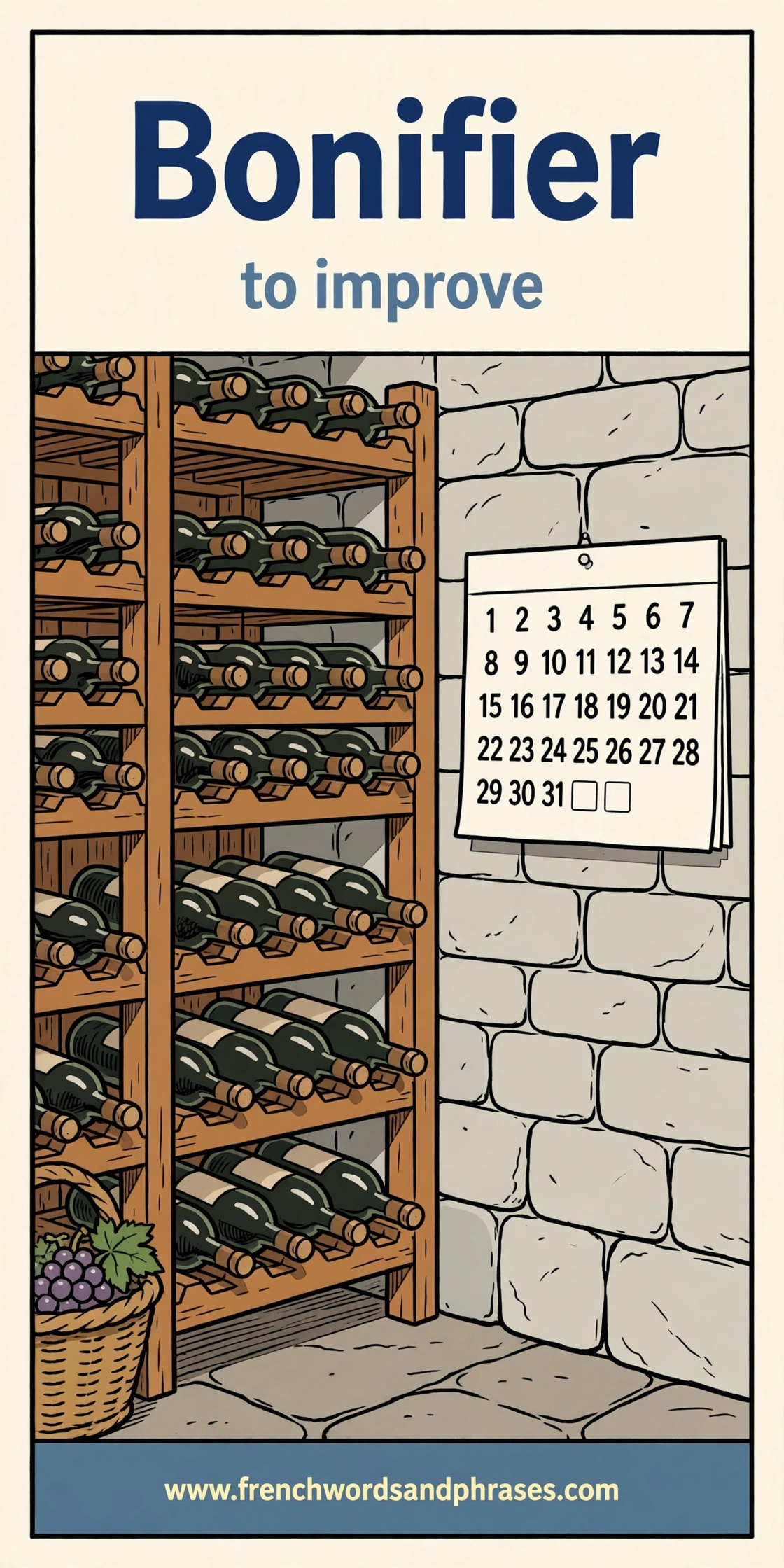
Imagine a small vineyard after a hard year. The wine in the vats is honest but rough; the grower tastes, blends a cask of this with a cask of that, rests it, tastes again — il bonifie son vin, week by week, until the roughness is gone and the fruit comes forward.
The wine was never bad. It has been improved — bonifié, by patience and a good palate.
How to Conjugate Bonifier: Complete French Conjugation Guide
Let’s explore every major conjugation of bonifier, beginning with the indicative mood.
How to Conjugate Bonifier in the Indicative Mood
The indicative mood is used to express facts, observations, actions, and events.
How to Conjugate Bonifier in the Present Tense (Présent)
Used for actions happening now, habitual actions, and general truths.
| Subject | Conjugation |
|---|---|
| je | bonifie |
| tu | bonifies |
| il / elle | bonifie |
| nous | bonifions |
| vous | bonifiez |
| ils / elles | bonifient |
Example
Le fumier bonifie la terre année après année.
Manure improves the soil year after year.
Quick Quiz 1
Complete the sentence:
Nous ______ les terres du domaine.
Reveal the answer
bonifions
Nous bonifions les terres du domaine.
We improve the estate’s land.
How to Conjugate Bonifier in the Passé Composé
Used for completed actions in the past. Bonifier takes the auxiliary verb avoir.
| Subject | Conjugation |
|---|---|
| j’ | ai bonifié |
| tu | as bonifié |
| il / elle | a bonifié |
| nous | avons bonifié |
| vous | avez bonifié |
| ils / elles | ont bonifié |
Example
Le vigneron a bonifié son vin en l’assemblant.
The winegrower improved his wine by blending it.
How to Conjugate Bonifier in the Imparfait (Imperfect Tense)
Used for habitual past actions, descriptions, and ongoing situations in the past.
| Subject | Conjugation |
|---|---|
| je | bonifiais |
| tu | bonifiais |
| il / elle | bonifiait |
| nous | bonifiions |
| vous | bonifiiez |
| ils / elles | bonifiaient |
Example
Ces travaux bonifiaient lentement les marais.
These works were slowly improving the marshes.
Quick Quiz 2
Choose the correct form:
She improved her time.
Elle ______ son temps. (a bonifié / est bonifiée)
Reveal the answer
a bonifié
Elle a bonifié son temps.
Bonifier takes avoir.
How to Conjugate Bonifier in the Plus-que-parfait
Used to describe an action that had already been completed before another past event.
| Subject | Conjugation |
|---|---|
| j’ | avais bonifié |
| tu | avais bonifié |
| il / elle | avait bonifié |
| nous | avions bonifié |
| vous | aviez bonifié |
| ils / elles | avaient bonifié |
Example
Elle avait bonifié son temps de course de dix secondes.
She had improved her race time by ten seconds.
How to Conjugate Bonifier in the Passé Simple
Primarily used in formal writing, literature, and historical narratives. It is rarely used in everyday conversation.
| Subject | Conjugation |
|---|---|
| je | bonifiai |
| tu | bonifias |
| il / elle | bonifia |
| nous | bonifiâmes |
| vous | bonifiâtes |
| ils / elles | bonifièrent |
Example
Le drainage bonifia les prairies de la vallée.
Drainage improved the valley meadows.
How to Conjugate Bonifier in the Passé Antérieur
A literary tense used to express an action completed immediately before another past action, generally in the passé simple.
| Subject | Conjugation |
|---|---|
| j’ | eus bonifié |
| tu | eus bonifié |
| il / elle | eut bonifié |
| nous | eûmes bonifié |
| vous | eûtes bonifié |
| ils / elles | eurent bonifié |
Example
Quand il eut bonifié le sol, il sema le blé.
When he had improved the soil, he sowed the wheat.
How to Conjugate Bonifier in the Future Tense (Futur Simple)
Used to describe actions that will take place in the future.
| Subject | Conjugation |
|---|---|
| je | bonifierai |
| tu | bonifieras |
| il / elle | bonifiera |
| nous | bonifierons |
| vous | bonifierez |
| ils / elles | bonifieront |
Example
Ce repos bonifiera le vin en fût.
This rest will improve the wine in the cask.
How to Conjugate Bonifier in the Futur Antérieur (Future Perfect)
Used for an action that will have been completed before a particular point in the future.
| Subject | Conjugation |
|---|---|
| j’ | aurai bonifié |
| tu | auras bonifié |
| il / elle | aura bonifié |
| nous | aurons bonifié |
| vous | aurez bonifié |
| ils / elles | auront bonifié |
Example
À la récolte, le soleil aura bonifié les raisins.
By the harvest, the sun will have improved the grapes.
How to Conjugate Bonifier in the Near Future (Futur Proche)
Used to describe something that is going to happen soon. Formed with aller + infinitive.
| Subject | Conjugation |
|---|---|
| je | vais bonifier |
| tu | vas bonifier |
| il / elle | va bonifier |
| nous | allons bonifier |
| vous | allez bonifier |
| ils / elles | vont bonifier |
Example
Ce nouvel entraînement va bonifier tes résultats.
This new training is going to improve your results.
How to Conjugate Bonifier in the Conditional Mood
The conditional mood expresses what would happen under certain circumstances. It is also frequently used to make polite requests or express wishes.
How to Conjugate Bonifier in the Present Conditional
| Subject | Conjugation |
|---|---|
| je | bonifierais |
| tu | bonifierais |
| il / elle | bonifierait |
| nous | bonifierions |
| vous | bonifieriez |
| ils / elles | bonifieraient |
Example
Un peu de chaux bonifierait cette terre acide.
A little lime would improve this acid soil.
How to Conjugate Bonifier in the Past Conditional
| Subject | Conjugation |
|---|---|
| j’ | aurais bonifié |
| tu | aurais bonifié |
| il / elle | aurait bonifié |
| nous | aurions bonifié |
| vous | auriez bonifié |
| ils / elles | auraient bonifié |
Example
Ils auraient bonifié le vin avec un meilleur assemblage.
They would have improved the wine with a better blend.
Bonifier in the Literary Past Conditional Form
This less common literary form uses the imperfect subjunctive of avoir.
| Subject | Conjugation |
|---|---|
| j’ | eusse bonifié |
| tu | eusses bonifié |
| il / elle | eût bonifié |
| nous | eussions bonifié |
| vous | eussiez bonifié |
| ils / elles | eussent bonifié |
Example
Le temps eût bonifié ce vin rude.
Time would have improved this rough wine.
How to Conjugate Bonifier in the Subjunctive Mood
The subjunctive is used to express wishes, emotions, doubts, necessity, and uncertainty. It frequently follows expressions such as il faut que (it is necessary that) or bien que (although).
How to Conjugate Bonifier in the Present Subjunctive
| Subject | Conjugation |
|---|---|
| que je | bonifie |
| que tu | bonifies |
| qu’il / qu’elle | bonifie |
| que nous | bonifiions |
| que vous | bonifiiez |
| qu’ils / qu’elles | bonifient |
Example
Je veux que ce stage bonifie ton français.
I want this course to improve your French.
Quick Quiz 3
Complete the sentence using the subjunctive:
Il faut que nous ______ le sol avant de semer.
Reveal the answer
bonifiions
Il faut que nous bonifiions le sol avant de semer.
We must improve the soil before sowing — note the double i.
How to Conjugate Bonifier in the Imperfect Subjunctive
A literary tense, rarely encountered in modern spoken French.
| Subject | Conjugation |
|---|---|
| que je | bonifiasse |
| que tu | bonifiasses |
| qu’il / qu’elle | bonifiât |
| que nous | bonifiassions |
| que vous | bonifiassiez |
| qu’ils / qu’elles | bonifiassent |
Example
On espérait que le repos bonifiât le vin.
They hoped the rest would improve the wine.
How to Conjugate Bonifier in the Pluperfect Subjunctive
A literary construction used to express an action completed before another past action.
| Subject | Conjugation |
|---|---|
| que j’ | eusse bonifié |
| que tu | eusses bonifié |
| qu’il / qu’elle | eût bonifié |
| que nous | eussions bonifié |
| que vous | eussiez bonifié |
| qu’ils / qu’elles | eussent bonifié |
Example
On savait que le drainage eût bonifié les terres.
People knew the drainage had improved the land.
How to Conjugate Bonifier in the Past Subjunctive
| Subject | Conjugation |
|---|---|
| que j’ | aie bonifié |
| que tu | aies bonifié |
| qu’il / qu’elle | ait bonifié |
| que nous | ayons bonifié |
| que vous | ayez bonifié |
| qu’ils / qu’elles | aient bonifié |
Example
Je suis ravi que l’entraînement ait bonifié ses performances.
I am delighted the training improved his performance.
How to Conjugate Bonifier in the Imperative
The imperative is used to give commands, instructions, invitations, or suggestions. Subject pronouns are omitted.
How to Conjugate Bonifier in the Present Imperative
| Person | Conjugation |
|---|---|
| (tu) | bonifie |
| (nous) | bonifions |
| (vous) | bonifiez |
Example
Bonifie ce sol avant de planter !
Improve this soil before planting!
Quick Quiz 4
How would you say Improve this soil before planting (tu form)?
Reveal the answer
Bonifie ce sol avant de planter !
French Participles of Bonifier
Participles are verb forms that can be used in compound tenses and other grammatical constructions.
Present Participle of Bonifier
bonifiant
En bonifiant les terres, les paysans ont créé ce paysage.
By improving the land, the farmers created this landscape.
Past Participle of Bonifier
bonifié
Bonifié par dix ans de cave, le vin était devenu magnifique.
Improved by ten years in the cellar, the wine had become magnificent.
Bonifier in Everyday French: Real-Life Examples
Now that you know the conjugations, let’s see how bonifier appears in everyday French.
Example 1 — Present
Le fumier bonifie la terre.
Manure improves the soil.
Example 2 — Passé composé
Elle a bonifié son temps de dix secondes.
She improved her time by ten seconds.
Example 3 — Imparfait
Le drainage bonifiait les marais.
Drainage was improving the marshes.
Example 4 — Future
Le repos bonifiera le vin.
Rest will improve the wine.
Example 5 — Conditional
Un peu de chaux bonifierait ce sol.
A little lime would improve this soil.
Example 6 — Imperative
Bonifie tes résultats, travaille régulièrement !
Improve your results, work regularly!
Beyond Translation: The Meaning of Bonifier
Built from bon (good) with the maker suffix -fier, bonifier literally says to good-ify — and French keeps the receipt in the noun une bonification, an improvement you can count: a better rate, a better score, a better wine.
Its reflexive twin is the compliment.
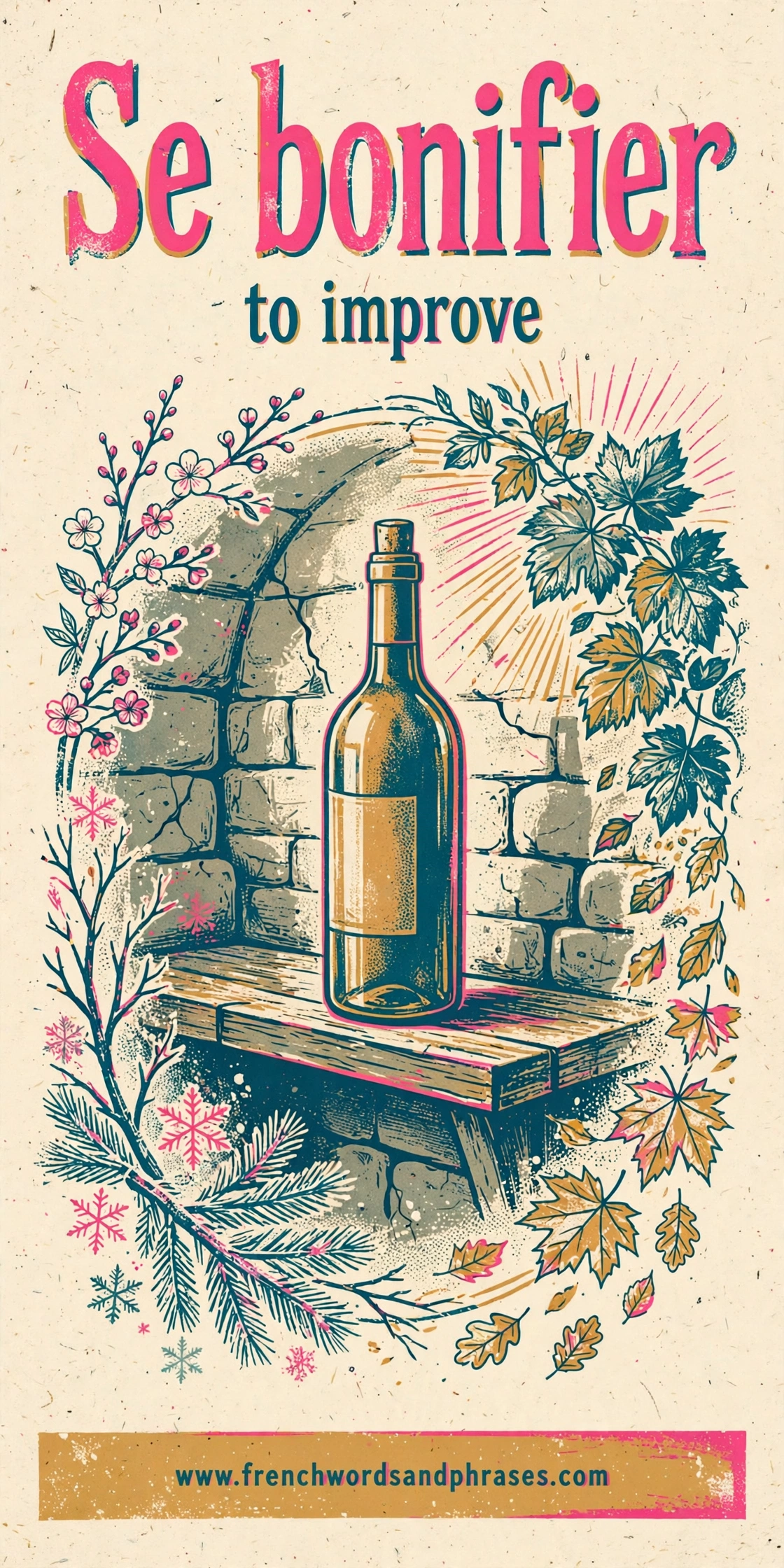
Se bonifier is what wines and people do with age; bonifier is what a skilled hand does to them from outside — the grower bonifie le vin, and the vin, left alone, se bonifie.
How to Remember the French Verb Bonifier
Remember it this way: Bonifier is about the winegrower blending a rough wine into a fine one.
- Bon + -fier: to make good — the improver’s verb for wine, land and results.
- -ier trap: nous bonifiions, vous bonifiiez — two i’s where stem and ending meet.
- Regular otherwise: je bonifie, nous bonifions, past participle bonifié, auxiliary avoir.
The key idea is the winegrower blending a rough wine into a fine one.
Test Your Knowledge of Bonifier
Let’s see how much you’ve learned. Try answering these questions before revealing the answers.
Question 1
Why does the nous form of the subjunctive of bonifier have two i’s?
Reveal the answer
Because it is an -ier verb — the stem ends in i and the ending -ions begins with i: que nous bonifiions.
Question 2
How do you say Manure improves the soil in French?
Reveal the answer
Le fumier bonifie la terre.
Question 3
Translate: The winegrower improved his wine by blending it.
Reveal the answer
Le vigneron a bonifié son vin en l’assemblant.
Question 4
What is the past participle of bonifier?
Reveal the answer
Bonifié.
Question 5
Complete the sentence:
Il faut que nous ______ le sol avant de semer.
Reveal the answer
bonifiions
Il faut que nous bonifiions le sol avant de semer.
We must improve the soil before sowing.
Your Final Challenge
Can You Use It?
How would you say this in French?
Every year, the winegrower improves his wine a little more, and the cellar repays him in aromas.
Reveal the answer
Chaque année, le vigneron bonifie son vin un peu plus, et la cave le lui rend en parfums.
Every year, the winegrower improves his wine a little more, and the cellar repays him in aromas.
A little French. A little curiosity. A richer everyday life.
LEARN FRENCH ONE WORD AT A TIME