A French Word to Live By
How to Conjugate Bonder in French
/bɔ̃.de/
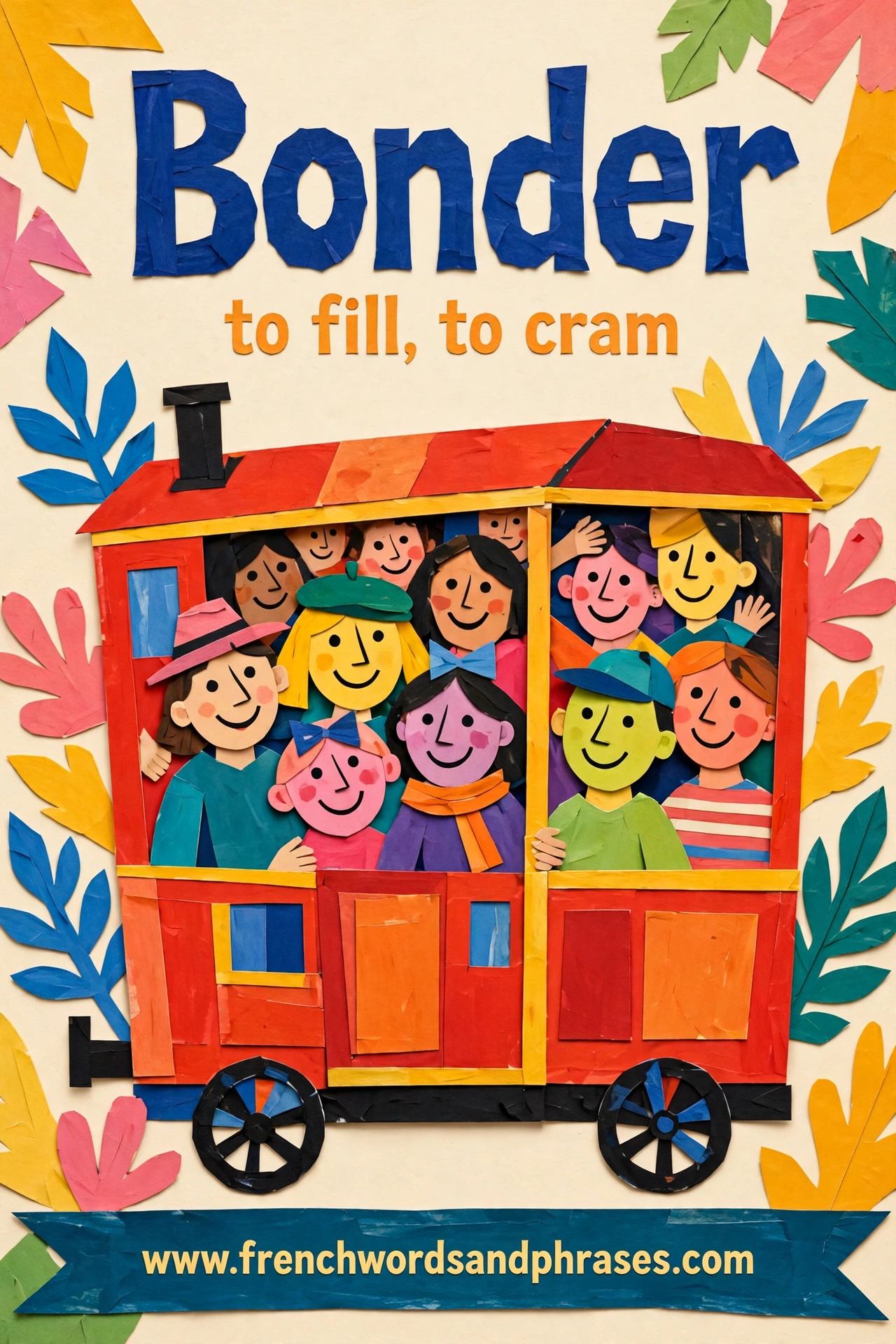
Bonder means to fill, to cram — to pack a hold, a tank or a carriage until not one more thing fits.
A ferry’s hold stuffed with cars before the crossing, a fuel tank brimful before a long drive, a commuter train at eight in the morning — bonder is the verb of filling something right up to its absolute limit.
In this guide, you’ll learn how to conjugate bonder in all the major French tenses and moods. Explore complete conjugation tables, French examples, English translations, and practice quizzes.
Understanding the French Verb Bonder
Bonder is a regular French verb belonging to the first group of verbs, those ending in-er.
It means to fill, to cram. Remplir is the neutral verb for filling anything; bonder insists on the limit — filled to capacity, with pressure behind it. It is the word of ship’s holds, fuel tanks and, as an adjective, of every overcrowded train and theatre in France.
Verb classification: First group (-er)
Auxiliary verb: Avoir
Past participle: bondé
Present participle: bondant
English equivalents: To fill to the brim, to cram full, to pack; bonder un réservoir — to fill a tank to the top; bonder la cale — to fill the hold; un train bondé — a packed train; une salle bondée — a crowded hall; bonder de — to cram with.
One important detail: bonder comes from la bonde, the bung that plugs a barrel — a cask is filled until the wine reaches the bung-hole, and that is exactly the image of the verb. Do not confuse it with bondir, to leap, which shares nothing but letters. In daily French the hardest-working form is the past participle used as an adjective: un train bondé, une salle bondée — packed, crammed, bursting. The verb itself is perfectly regular: je bonde, nous bondons, ils bondent.
Experience the Word
Bonder is the verb of the last centimetre — the moment when a container, a room or a train simply cannot take one more thing.
Imagine the last ferry of the evening. The dockers wave in car after car, lorry after lorry, until the hold is a solid block of metal with no gaps left at all — ils ont bondé la cale, and the ramp rises on a ship filled to the brim.
Nothing is half-empty or loosely packed. The hold is full — bondée, to the very bung.
How to Conjugate Bonder: Complete French Conjugation Guide
Let’s explore every major conjugation of bonder, beginning with the indicative mood.
How to Conjugate Bonder in the Indicative Mood
The indicative mood is used to express facts, observations, actions, and events.
How to Conjugate Bonder in the Present Tense (Présent)
Used for actions happening now, habitual actions, and general truths.
| Subject | Conjugation |
|---|---|
| je | bonde |
| tu | bondes |
| il / elle | bonde |
| nous | bondons |
| vous | bondez |
| ils / elles | bondent |
Example
Les dockers bondent la cale du ferry avant le départ.
The dockers pack the ferry’s hold full before departure.
Quick Quiz 1
Complete the sentence:
Nous ______ le coffre de valises.
Reveal the answer
bondons
Nous bondons le coffre de valises.
We cram the boot full of suitcases.
How to Conjugate Bonder in the Passé Composé
Used for completed actions in the past. Bonder takes the auxiliary verb avoir.
| Subject | Conjugation |
|---|---|
| j’ | ai bondé |
| tu | as bondé |
| il / elle | a bondé |
| nous | avons bondé |
| vous | avez bondé |
| ils / elles | ont bondé |
Example
Nous avons bondé le coffre de valises et de cartons.
We crammed the boot full of suitcases and boxes.
How to Conjugate Bonder in the Imparfait (Imperfect Tense)
Used for habitual past actions, descriptions, and ongoing situations in the past.
| Subject | Conjugation |
|---|---|
| je | bondais |
| tu | bondais |
| il / elle | bondait |
| nous | bondions |
| vous | bondiez |
| ils / elles | bondaient |
Example
Chaque matin, les voyageurs bondaient le quai de la gare.
Every morning, the travellers used to pack the station platform.
Quick Quiz 2
Choose the correct form:
They packed the hall.
Ils ______ la salle. (ont bondé / sont bondés)
Reveal the answer
ont bondé
Ils ont bondé la salle.
Bonder takes avoir.
How to Conjugate Bonder in the Plus-que-parfait
Used to describe an action that had already been completed before another past event.
| Subject | Conjugation |
|---|---|
| j’ | avais bondé |
| tu | avais bondé |
| il / elle | avait bondé |
| nous | avions bondé |
| vous | aviez bondé |
| ils / elles | avaient bondé |
Example
Elle avait bondé le réservoir avant le long trajet.
She had filled the tank to the brim before the long journey.
How to Conjugate Bonder in the Passé Simple
Primarily used in formal writing, literature, and historical narratives. It is rarely used in everyday conversation.
| Subject | Conjugation |
|---|---|
| je | bondai |
| tu | bondas |
| il / elle | bonda |
| nous | bondâmes |
| vous | bondâtes |
| ils / elles | bondèrent |
Example
L’équipage bonda les soutes en une heure.
The crew filled the bunkers in one hour.
How to Conjugate Bonder in the Passé Antérieur
A literary tense used to express an action completed immediately before another past action, generally in the passé simple.
| Subject | Conjugation |
|---|---|
| j’ | eus bondé |
| tu | eus bondé |
| il / elle | eut bondé |
| nous | eûmes bondé |
| vous | eûtes bondé |
| ils / elles | eurent bondé |
Example
Quand les marins eurent bondé la cale, le navire appareilla.
When the sailors had filled the hold, the ship set sail.
How to Conjugate Bonder in the Future Tense (Futur Simple)
Used to describe actions that will take place in the future.
| Subject | Conjugation |
|---|---|
| je | bonderai |
| tu | bonderas |
| il / elle | bondera |
| nous | bonderons |
| vous | bonderez |
| ils / elles | bonderont |
Example
Demain, les supporters bonderont le stade dès l’ouverture.
Tomorrow, the fans will pack the stadium as soon as it opens.
How to Conjugate Bonder in the Futur Antérieur (Future Perfect)
Used for an action that will have been completed before a particular point in the future.
| Subject | Conjugation |
|---|---|
| j’ | aurai bondé |
| tu | auras bondé |
| il / elle | aura bondé |
| nous | aurons bondé |
| vous | aurez bondé |
| ils / elles | auront bondé |
Example
À six heures, ils auront bondé la salle des fêtes.
By six o’clock, they will have packed the village hall.
How to Conjugate Bonder in the Near Future (Futur Proche)
Used to describe something that is going to happen soon. Formed with aller + infinitive.
| Subject | Conjugation |
|---|---|
| je | vais bonder |
| tu | vas bonder |
| il / elle | va bonder |
| nous | allons bonder |
| vous | allez bonder |
| ils / elles | vont bonder |
Example
On va bonder le grenier de vieux meubles.
We are going to cram the attic full of old furniture.
How to Conjugate Bonder in the Conditional Mood
The conditional mood expresses what would happen under certain circumstances. It is also frequently used to make polite requests or express wishes.
How to Conjugate Bonder in the Present Conditional
| Subject | Conjugation |
|---|---|
| je | bonderais |
| tu | bonderais |
| il / elle | bonderait |
| nous | bonderions |
| vous | bonderiez |
| ils / elles | bonderaient |
Example
Sans les places numérotées, les spectateurs bonderaient la salle.
Without numbered seats, the audience would pack the hall.
How to Conjugate Bonder in the Past Conditional
| Subject | Conjugation |
|---|---|
| j’ | aurais bondé |
| tu | aurais bondé |
| il / elle | aurait bondé |
| nous | aurions bondé |
| vous | auriez bondé |
| ils / elles | auraient bondé |
Example
Vous auriez bondé le camion avec trois cartons de plus.
You would have crammed the van full with three more boxes.
Bonder in the Literary Past Conditional Form
This less common literary form uses the imperfect subjunctive of avoir.
| Subject | Conjugation |
|---|---|
| j’ | eusse bondé |
| tu | eusses bondé |
| il / elle | eût bondé |
| nous | eussions bondé |
| vous | eussiez bondé |
| ils / elles | eussent bondé |
Example
Le navire eût bondé ses cales avant la tempête.
The ship would have filled its holds before the storm.
How to Conjugate Bonder in the Subjunctive Mood
The subjunctive is used to express wishes, emotions, doubts, necessity, and uncertainty. It frequently follows expressions such as il faut que (it is necessary that) or bien que (although).
How to Conjugate Bonder in the Present Subjunctive
| Subject | Conjugation |
|---|---|
| que je | bonde |
| que tu | bondes |
| qu’il / qu’elle | bonde |
| que nous | bondions |
| que vous | bondiez |
| qu’ils / qu’elles | bondent |
Example
Il faut que l’on bonde les réservoirs avant l’hiver.
The tanks must be filled to the top before winter.
Quick Quiz 3
Complete the sentence using the subjunctive:
Il faut que vous ______ le réservoir avant l’hiver.
Reveal the answer
bondiez
Il faut que vous bondiez le réservoir avant l’hiver.
You must fill the tank to the top before winter.
How to Conjugate Bonder in the Imperfect Subjunctive
A literary tense, rarely encountered in modern spoken French.
| Subject | Conjugation |
|---|---|
| que je | bondasse |
| que tu | bondasses |
| qu’il / qu’elle | bondât |
| que nous | bondassions |
| que vous | bondassiez |
| qu’ils / qu’elles | bondassent |
Example
Je craignais que les spectateurs bondassent la salle en un instant.
I feared the audience would pack the hall in an instant.
How to Conjugate Bonder in the Pluperfect Subjunctive
A literary construction used to express an action completed before another past action.
| Subject | Conjugation |
|---|---|
| que j’ | eusse bondé |
| que tu | eusses bondé |
| qu’il / qu’elle | eût bondé |
| que nous | eussions bondé |
| que vous | eussiez bondé |
| qu’ils / qu’elles | eussent bondé |
Example
On disait que les dockers eussent bondé la cale en une nuit.
People said the dockers had filled the hold in one night.
How to Conjugate Bonder in the Past Subjunctive
| Subject | Conjugation |
|---|---|
| que j’ | aie bondé |
| que tu | aies bondé |
| qu’il / qu’elle | ait bondé |
| que nous | ayons bondé |
| que vous | ayez bondé |
| qu’ils / qu’elles | aient bondé |
Example
Je suis content que vous ayez bondé le réservoir.
I am glad you filled the tank to the brim.
How to Conjugate Bonder in the Imperative
The imperative is used to give commands, instructions, invitations, or suggestions. Subject pronouns are omitted.
How to Conjugate Bonder in the Present Imperative
| Person | Conjugation |
|---|---|
| (tu) | bonde |
| (nous) | bondons |
| (vous) | bondez |
Example
Bondez les caisses, il ne doit rester aucun vide !
Pack the crates full, there must be no gap left!
Quick Quiz 4
How would you say Fill the tank to the top (tu form)?
Reveal the answer
Bonde le réservoir !
French Participles of Bonder
Participles are verb forms that can be used in compound tenses and other grammatical constructions.
Present Participle of Bonder
bondant
En bondant le coffre, il a cassé une valise.
By cramming the boot full, he broke a suitcase.
Past Participle of Bonder
bondé
Bondé de marchandises, le navire peinait à quitter le port.
Filled to the brim with goods, the ship struggled to leave port.
Bonder in Everyday French: Real-Life Examples
Now that you know the conjugations, let’s see how bonder appears in everyday French.
Example 1 — Present
Les voyageurs bondent le train de huit heures.
The travellers pack the eight o’clock train.
Example 2 — Passé composé
Ils ont bondé la salle en dix minutes.
They packed the hall in ten minutes.
Example 3 — Imparfait
Le marché bondait la place chaque samedi.
The market used to fill the square every Saturday.
Example 4 — Future
Les fans bonderont le stade samedi.
The fans will pack the stadium on Saturday.
Example 5 — Conditional
On bonderait le grenier si on triait moins.
We would cram the attic full if we threw less away.
Example 6 — Imperative
Bonde le réservoir avant de partir !
Fill the tank to the top before leaving!
Beyond Translation: The Meaning of Bonder
English has no exact everyday twin — to cram comes closest, but bonder keeps its picture of the barrel filled to the bung-hole, la bonde.
Its participle has escaped the verb.
Ask any Parisian about un métro bondé and they will groan: bondé is simply the standard adjective for packed transport, packed rooms and packed beaches, long after the dockers and their holds have been forgotten.
How to Remember the French Verb Bonder
Remember it this way: Bonder is about the barrel filled right up to the bung.
- Picture the barrel filled until the wine reaches la bonde, the bung — bonder is filling to that last centimetre.
- Its famous participle: un train bondé, une salle bondée — packed, crammed, bursting.
- Not bondir (to leap): je bonde, nous bondons, past participle bondé, auxiliary avoir.
The key idea is the barrel filled right up to the bung.
Test Your Knowledge of Bonder
Let’s see how much you’ve learned. Try answering these questions before revealing the answers.
Question 1
What is the difference between bonder and bondir?
Reveal the answer
Bonder is to fill to the brim; bondir is to leap — same letters, different worlds.
Question 2
How do you say The train was packed in French?
Reveal the answer
Le train était bondé.
Question 3
Translate: We crammed the boot full of suitcases.
Reveal the answer
Nous avons bondé le coffre de valises.
Question 4
What is the past participle of bonder?
Reveal the answer
Bondé — agreeing: bondée, bondés, bondées.
Question 5
Complete the sentence:
Il faut que l’on ______ les réservoirs avant l’hiver.
Reveal the answer
bonde
Il faut que l’on bonde les réservoirs avant l’hiver.
The tanks must be filled to the top before winter.
Your Final Challenge
Can You Use It?
How would you say this in French?
They packed the little hall with chairs, laughter and neighbours, and the party could begin.
Reveal the answer
Ils ont bondé la petite salle de chaises, de rires et de voisins, et la fête a pu commencer.
They packed the little hall with chairs, laughter and neighbours, and the party could begin.
A little French. A little curiosity. A richer everyday life.
LEARN FRENCH ONE WORD AT A TIME