A French Word to Live By
How to Conjugate Bleuter in French
/blø.te/
Bleuter means to blue — to rinse laundry with a touch of blue so the whites look whiter, or to tint something a pale, watery blue.
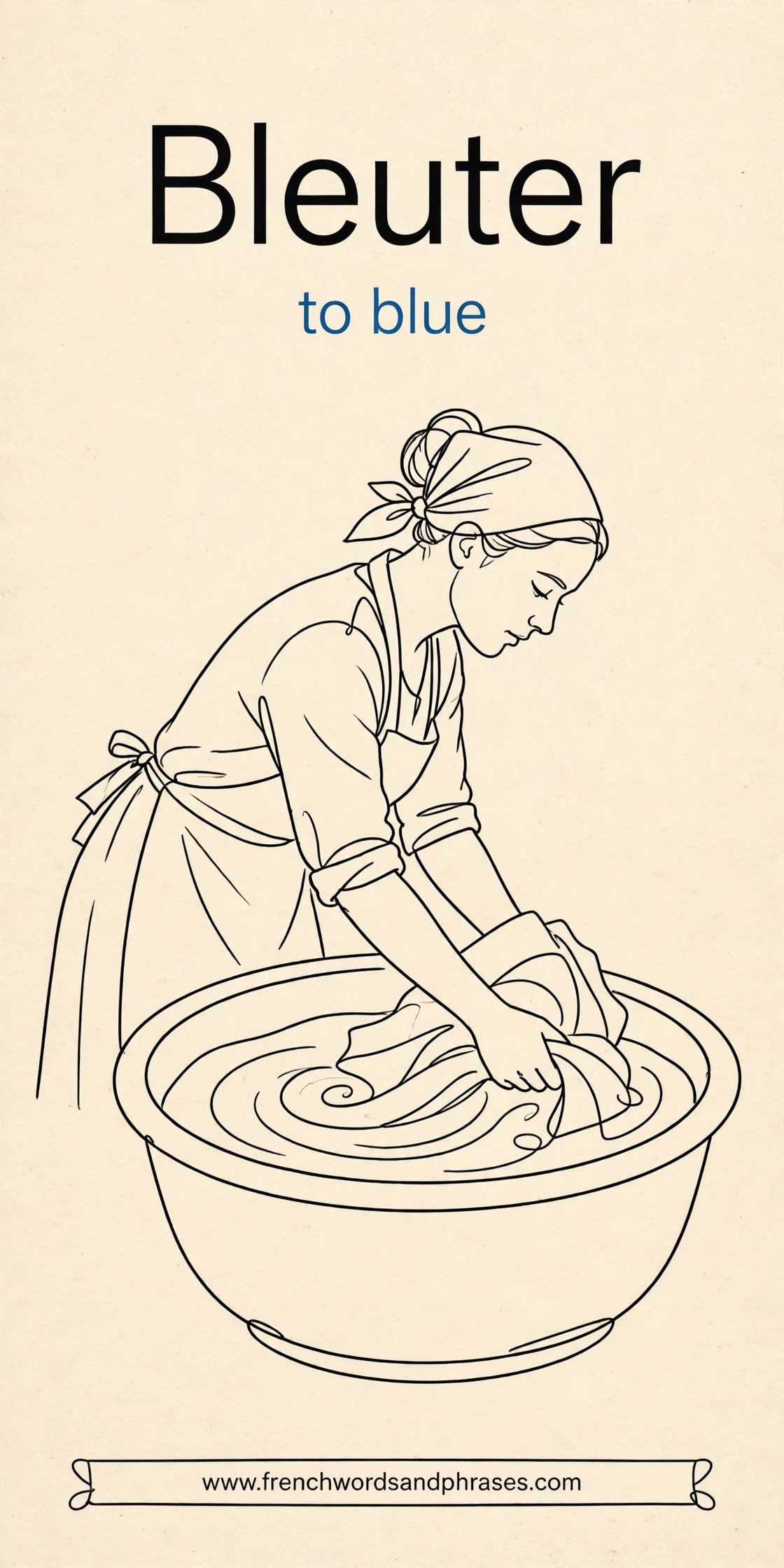
A washerwoman at the village lavoir a century ago, dissolving a ball of blue in the rinsing water so her sheets come out dazzling; a painter washing the faintest blue over a sky — bleuter is the small, deliberate act of adding blue: to linen, to paper, to anything that needs whitening or cooling.
In this guide, you’ll learn how to conjugate bleuter in all the major French tenses and moods. Explore complete conjugation tables, French examples, English translations, and practice quizzes.
Understanding the French Verb Bleuter
Bleuter is a regular French verb belonging to the first group of verbs, those ending in-er.
It means to blue. It belongs to the old laundry craft: a blue rinse (le bleu de lessive) counteracts the yellowing of white linen, an optical trick every French grandmother once knew. Today the verb survives mostly in that heritage sense and in the adjective bleuté used by painters, decorators and wine tasters for pale blue-tinged colours.
Verb classification: First group (-er)
Auxiliary verb: Avoir
Past participle: bleuté
Present participle: bleutant
English equivalents: To blue, to rinse blue; bleuter le linge — to blue the laundry; bleuter l’eau de rinçage — to blue the rinsing water; un blanc bleuté — a blue-tinted white; bleuter légèrement — to blue lightly.
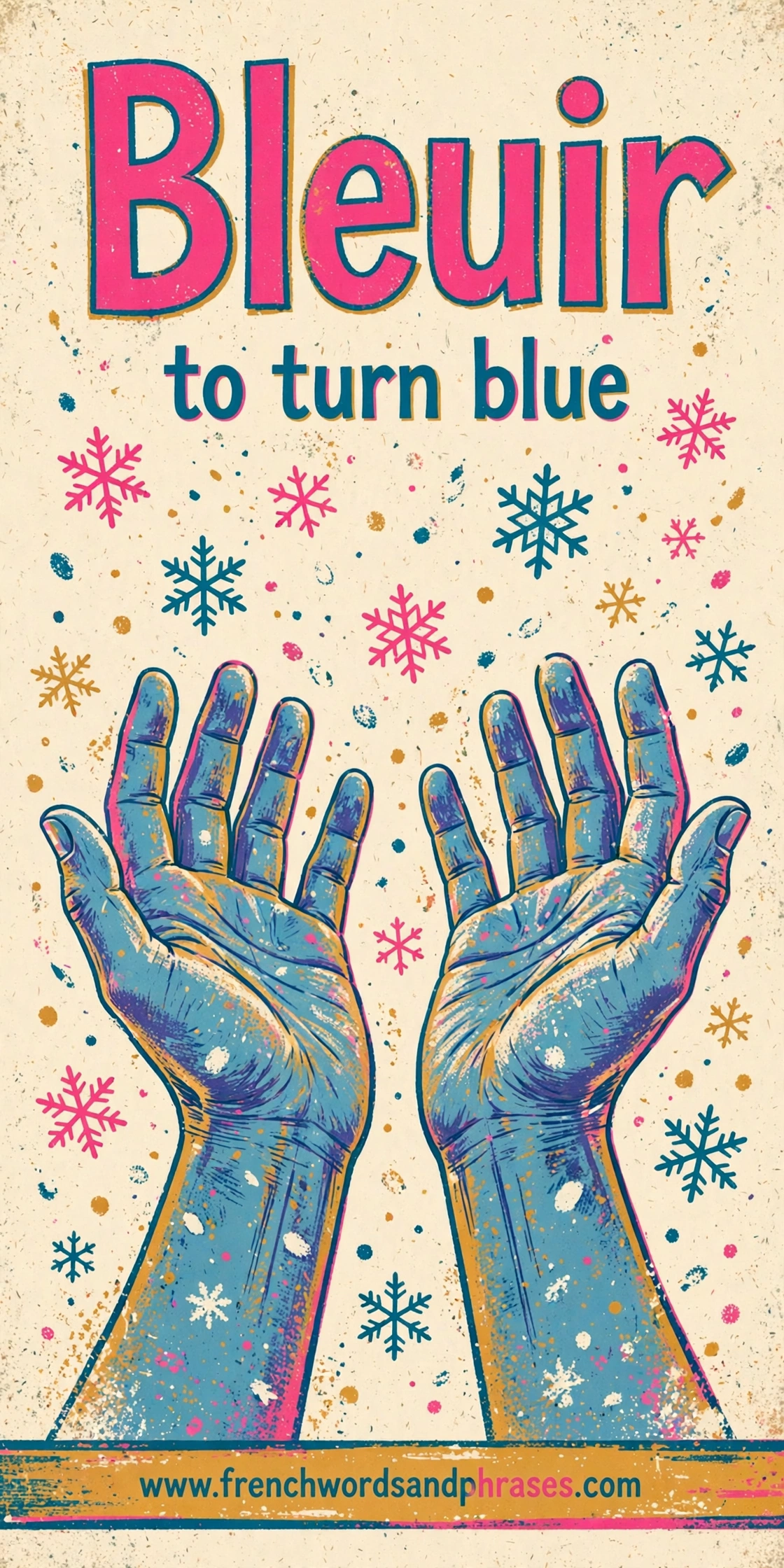
One important detail: bleuter is a regular -er verb — je bleute, nous bleutons, participle bleuté — and it is transitive: someone bleute something. Keep it apart from bleuir, which is what skin and steel do by themselves: the swimmer’s lips bleuissent in the cold lake, but the laundress bleute her sheets on purpose. The adjective bleuté lives on in colour names: un blanc bleuté, un gris bleuté — a white or grey with a whisper of blue in it.
Experience the Word
Bleuter is the verb of the helpful lie — a pinch of blue that persuades the eye the white was always this white.
Imagine a lavoir in a Burgundy village in 1910. The washing is done, the water runs clear, and the oldest woman there unwraps a paper twist of blue powder, stirs it into the last rinse and lifts out a sheet that seems to shine. Elle a bleuté le linge, and the whole village’s Sunday linen will look newer than it is.
Nothing was bleached and nothing was dyed. She has blued it — bleuté — and the eye does the rest.
How to Conjugate Bleuter: Complete French Conjugation Guide
Let’s explore every major conjugation of bleuter, beginning with the indicative mood.
How to Conjugate Bleuter in the Indicative Mood
The indicative mood is used to express facts, observations, actions, and events.
How to Conjugate Bleuter in the Present Tense (Présent)
Used for actions happening now, habitual actions, and general truths.
| Subject | Conjugation |
|---|---|
| je | bleute |
| tu | bleutes |
| il / elle | bleute |
| nous | bleutons |
| vous | bleutez |
| ils / elles | bleutent |
Example
Elle bleute son linge pour le rendre éclatant de blancheur.
She blues her laundry to make it dazzlingly white.
Quick Quiz 1
Complete the sentence:
Nous ______ le linge comme nos grands-mères.
Reveal the answer
bleutons
Nous bleutons le linge comme nos grands-mères.
We blue the laundry like our grandmothers.
How to Conjugate Bleuter in the Passé Composé
Used for completed actions in the past. Bleuter takes the auxiliary verb avoir.
| Subject | Conjugation |
|---|---|
| j’ | ai bleuté |
| tu | as bleuté |
| il / elle | a bleuté |
| nous | avons bleuté |
| vous | avez bleuté |
| ils / elles | ont bleuté |
Example
Ma grand-mère a bleuté ses draps toute sa vie.
My grandmother blued her sheets all her life.
How to Conjugate Bleuter in the Imparfait (Imperfect Tense)
Used for habitual past actions, descriptions, and ongoing situations in the past.
| Subject | Conjugation |
|---|---|
| je | bleutais |
| tu | bleutais |
| il / elle | bleutait |
| nous | bleutions |
| vous | bleutiez |
| ils / elles | bleutaient |
Example
Autrefois, on bleutait le linge après chaque lessive.
In the old days, people blued the laundry after every wash.
Quick Quiz 2
Choose the correct form:
She blued the sheets.
Elle ______ les draps. (a bleuté / est bleutée)
Reveal the answer
a bleuté
Elle a bleuté les draps.
Bleuter takes avoir.
How to Conjugate Bleuter in the Plus-que-parfait
Used to describe an action that had already been completed before another past event.
| Subject | Conjugation |
|---|---|
| j’ | avais bleuté |
| tu | avais bleuté |
| il / elle | avait bleuté |
| nous | avions bleuté |
| vous | aviez bleuté |
| ils / elles | avaient bleuté |
Example
Elle avait bleuté les rideaux avant de les accrocher.
She had blued the curtains before hanging them.
How to Conjugate Bleuter in the Passé Simple
Primarily used in formal writing, literature, and historical narratives. It is rarely used in everyday conversation.
| Subject | Conjugation |
|---|---|
| je | bleutai |
| tu | bleutas |
| il / elle | bleuta |
| nous | bleutâmes |
| vous | bleutâtes |
| ils / elles | bleutèrent |
Example
La blanchisseuse bleuta le linge dans une grande bassine.
The laundress blued the linen in a large basin.
How to Conjugate Bleuter in the Passé Antérieur
A literary tense used to express an action completed immediately before another past action, generally in the passé simple.
| Subject | Conjugation |
|---|---|
| j’ | eus bleuté |
| tu | eus bleuté |
| il / elle | eut bleuté |
| nous | eûmes bleuté |
| vous | eûtes bleuté |
| ils / elles | eurent bleuté |
Example
Quand elle eut bleuté les draps, elle les étendit au soleil.
When she had blued the sheets, she spread them out in the sun.
How to Conjugate Bleuter in the Future Tense (Futur Simple)
Used to describe actions that will take place in the future.
| Subject | Conjugation |
|---|---|
| je | bleuterai |
| tu | bleuteras |
| il / elle | bleutera |
| nous | bleuterons |
| vous | bleuterez |
| ils / elles | bleuteront |
Example
Demain, je bleuterai les serviettes pour le repas de dimanche.
Tomorrow, I will blue the napkins for Sunday’s meal.
How to Conjugate Bleuter in the Futur Antérieur (Future Perfect)
Used for an action that will have been completed before a particular point in the future.
| Subject | Conjugation |
|---|---|
| j’ | aurai bleuté |
| tu | auras bleuté |
| il / elle | aura bleuté |
| nous | aurons bleuté |
| vous | aurez bleuté |
| ils / elles | auront bleuté |
Example
À midi, elle aura bleuté tout le linge de la maison.
By noon, she will have blued all the household linen.
How to Conjugate Bleuter in the Near Future (Futur Proche)
Used to describe something that is going to happen soon. Formed with aller + infinitive.
| Subject | Conjugation |
|---|---|
| je | vais bleuter |
| tu | vas bleuter |
| il / elle | va bleuter |
| nous | allons bleuter |
| vous | allez bleuter |
| ils / elles | vont bleuter |
Example
Tu vas bleuter ces chemises, vraiment ?
You are really going to blue those shirts?
How to Conjugate Bleuter in the Conditional Mood
The conditional mood expresses what would happen under certain circumstances. It is also frequently used to make polite requests or express wishes.
How to Conjugate Bleuter in the Present Conditional
| Subject | Conjugation |
|---|---|
| je | bleuterais |
| tu | bleuterais |
| il / elle | bleuterait |
| nous | bleuterions |
| vous | bleuteriez |
| ils / elles | bleuteraient |
Example
Avec un bon bleu de lessive, elle bleuterait tout le linge du village.
With good laundry blue, she would blue the whole village’s linen.
How to Conjugate Bleuter in the Past Conditional
| Subject | Conjugation |
|---|---|
| j’ | aurais bleuté |
| tu | aurais bleuté |
| il / elle | aurait bleuté |
| nous | aurions bleuté |
| vous | auriez bleuté |
| ils / elles | auraient bleuté |
Example
Elle aurait bleuté les rideaux si elle avait eu du bleu.
She would have blued the curtains if she had had some blue.
Bleuter in the Literary Past Conditional Form
This less common literary form uses the imperfect subjunctive of avoir.
| Subject | Conjugation |
|---|---|
| j’ | eusse bleuté |
| tu | eusses bleuté |
| il / elle | eût bleuté |
| nous | eussions bleuté |
| vous | eussiez bleuté |
| ils / elles | eussent bleuté |
Example
La blanchisseuse eût bleuté tout le linge du village pour la fête.
The laundress would have blued all the village’s linen for the feast day.
How to Conjugate Bleuter in the Subjunctive Mood
The subjunctive is used to express wishes, emotions, doubts, necessity, and uncertainty. It frequently follows expressions such as il faut que (it is necessary that) or bien que (although).
How to Conjugate Bleuter in the Present Subjunctive
| Subject | Conjugation |
|---|---|
| que je | bleute |
| que tu | bleutes |
| qu’il / qu’elle | bleute |
| que nous | bleutions |
| que vous | bleutiez |
| qu’ils / qu’elles | bleutent |
Example
Il faut que tu bleutes légèrement, sans exagérer.
You must blue lightly, without overdoing it.
Quick Quiz 3
Complete the sentence using the subjunctive:
Je veux que vous ______ le linge d’une main légère.
Reveal the answer
bleutiez
Je veux que vous bleutiez le linge d’une main légère.
I want you to blue the linen with a light hand.
How to Conjugate Bleuter in the Imperfect Subjunctive
A literary tense, rarely encountered in modern spoken French.
| Subject | Conjugation |
|---|---|
| que je | bleutasse |
| que tu | bleutasses |
| qu’il / qu’elle | bleutât |
| que nous | bleutassions |
| que vous | bleutassiez |
| qu’ils / qu’elles | bleutassent |
Example
Je voulais qu’elle bleutât le linge comme autrefois.
I wanted her to blue the linen as in the old days.
How to Conjugate Bleuter in the Pluperfect Subjunctive
A literary construction used to express an action completed before another past action.
| Subject | Conjugation |
|---|---|
| que j’ | eusse bleuté |
| que tu | eusses bleuté |
| qu’il / qu’elle | eût bleuté |
| que nous | eussions bleuté |
| que vous | eussiez bleuté |
| qu’ils / qu’elles | eussent bleuté |
Example
On disait qu’elle eût bleuté les draps de tout le quartier.
People said she had blued the sheets of the whole neighbourhood.
How to Conjugate Bleuter in the Past Subjunctive
| Subject | Conjugation |
|---|---|
| que j’ | aie bleuté |
| que tu | aies bleuté |
| qu’il / qu’elle | ait bleuté |
| que nous | ayons bleuté |
| que vous | ayez bleuté |
| qu’ils / qu’elles | aient bleuté |
Example
Je suis content qu’elle ait bleuté les nappes pour dimanche.
I am glad she blued the tablecloths for Sunday.
How to Conjugate Bleuter in the Imperative
The imperative is used to give commands, instructions, invitations, or suggestions. Subject pronouns are omitted.
How to Conjugate Bleuter in the Present Imperative
| Person | Conjugation |
|---|---|
| (tu) | bleute |
| (nous) | bleutons |
| (vous) | bleutez |
Example
Bleute le linge, mais d’une main légère !
Blue the laundry, but with a light hand!
Quick Quiz 4
How would you say Blue the laundry (tu form)?
Reveal the answer
Bleute le linge !
French Participles of Bleuter
Participles are verb forms that can be used in compound tenses and other grammatical constructions.
Present Participle of Bleuter
bleutant
En bleutant l’eau de rinçage, on ravive le blanc du linge.
By bluing the rinsing water, you brighten the white of the linen.
Past Participle of Bleuter
bleuté
Bleutés avec soin, les draps semblaient neufs.
Carefully blued, the sheets looked new.
Bleuter in Everyday French: Real-Life Examples
Now that you know the conjugations, let’s see how bleuter appears in everyday French.
Example 1 — Present
Elle bleute son linge après la lessive.
She blues her laundry after the wash.
Example 2 — Passé composé
Ma grand-mère a bleuté ses draps toute sa vie.
My grandmother blued her sheets all her life.
Example 3 — Imparfait
On bleutait le linge autrefois.
People used to blue the laundry in the old days.
Example 4 — Future
Je bleuterai les nappes pour dimanche.
I will blue the tablecloths for Sunday.
Example 5 — Conditional
Elle bleuterait les rideaux avec un peu de bleu.
She would blue the curtains with a little blue.
Example 6 — Imperative
Bleute le linge d’une main légère !
Blue the laundry with a light hand!
Beyond Translation: The Meaning of Bleuter
English to blue exists in exactly the same laundry sense — a ball of Reckitt’s blue in the rinse — and French bleuter is its twin across the Channel, both born of the same optical trick: blue cancels yellow in the eye.
The verb has retired into an adjective.
Few people bleutent their laundry now, but bleuté is everywhere a colour is named with precision: un ciel bleuté, un gris bleuté, des reflets bleutés — the laundress’s powder dissolved into the language of painters.
How to Remember the French Verb Bleuter
Remember it this way: Bleuter is about the washerwoman stirring blue into the last rinse at the lavoir.
- Transitive and deliberate: someone bleute something — the opposite of bleuir, which just happens.
- Its home is the laundry: bleuter le linge, with le bleu de lessive, to make whites look whiter.
- Regular -er: je bleute, nous bleutons, past participle bleuté — still alive in un blanc bleuté.
The key idea is the washerwoman stirring blue into the last rinse at the lavoir.
Test Your Knowledge of Bleuter
Let’s see how much you’ve learned. Try answering these questions before revealing the answers.
Question 1
What is the difference between bleuter and bleuir?
Reveal the answer
Bleuter is something you do on purpose (blueing laundry); bleuir is what happens by itself (lips turning blue with cold).
Question 2
How do you say She blues her laundry in French?
Reveal the answer
Elle bleute son linge.
Question 3
Translate: My grandmother blued her sheets all her life.
Reveal the answer
Ma grand-mère a bleuté ses draps toute sa vie.
Question 4
What is the past participle of bleuter?
Reveal the answer
Bleuté — still common as an adjective: un blanc bleuté.
Question 5
Complete the sentence:
Il faut que tu ______ légèrement, sans exagérer.
Reveal the answer
bleutes
Il faut que tu bleutes légèrement, sans exagérer.
You must blue lightly, without overdoing it.
Your Final Challenge
Can You Use It?
How would you say this in French?
At the wash-house, she blues the linen one last time, and the white becomes light.
Reveal the answer
Au lavoir, elle bleute le linge une dernière fois, et le blanc devient lumière.
At the wash-house, she blues the linen one last time, and the white becomes light.
A little French. A little curiosity. A richer everyday life.
LEARN FRENCH ONE WORD AT A TIME