A French Word to Live By
How to Conjugate Biscuiter in French
/bis.kɥi.te/
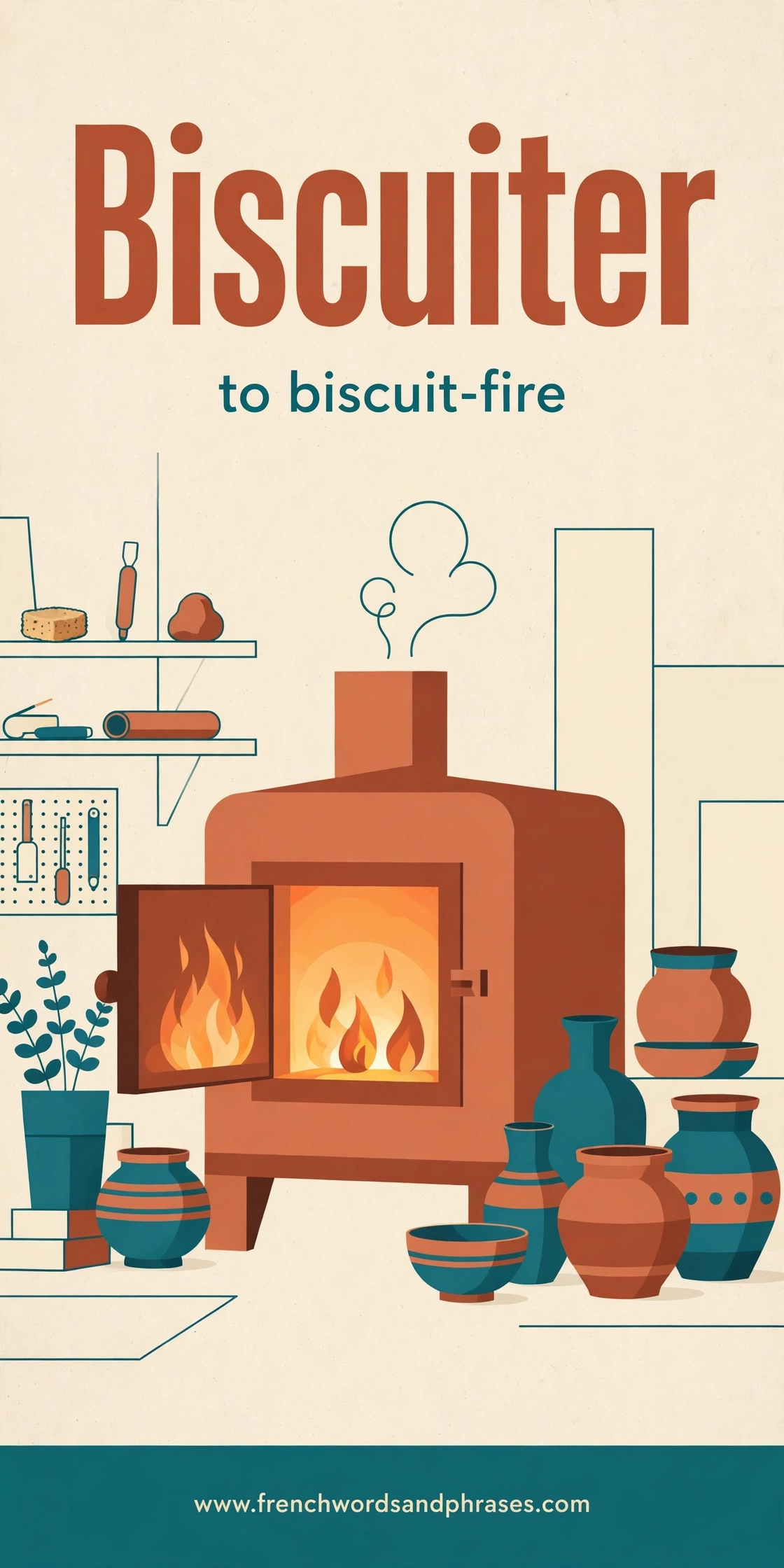
Biscuiter means to biscuit-fire — to give porcelain or pottery its first firing in the kiln, before any glaze goes on.
A porcelain workshop in Limoges, shelves of white cups and plates still dull and fragile, and a kiln glowing through the night — biscuiter is the potter’s first firing: the moment clay becomes biscuit, ready for its colours.
In this guide, you’ll learn how to conjugate biscuiter in all the major French tenses and moods. Explore complete conjugation tables, French examples, English translations, and practice quizzes.
Understanding the French Verb Biscuiter
Biscuiter is a regular French verb belonging to the first group of verbs, those ending in -er.
It means to biscuit-fire. It belongs to the pottery and porcelain workshop — Limoges, Sèvres, the studio potter’s kiln — and describes only the first firing, before glazing; a piece that has been biscuitée is halfway to finished, strong enough to handle but still thirsty for colour.
Verb classification: First group (-er)
Auxiliary verb: Avoir
Past participle: biscuité
Present participle: biscuitant
English equivalents: To biscuit-fire, to fire a first time; biscuiter des pièces de porcelaine — to biscuit-fire porcelain pieces; une pièce biscuitée — a biscuit-fired piece; le biscuit — unglazed porcelain after the first firing; le biscuitage — the biscuit firing itself.
One important detail: in ceramics, le biscuit is not a cookie — it is the unglazed body of porcelain after its first firing, at around nine hundred degrees, still matt and porous, ready to receive enamel and glaze. So biscuiter means to put pieces through that first firing: biscuiter des tasses, une pièce biscuitée. The two biscuits are cousins, though: both come from bis cuit, twice cooked — the sailor’s biscuit was baked twice to keep, and the porcelain one is fired more than once before it shines. The verb is a regular -er: je biscuite, nous biscuitons, past participle biscuité.
Experience the Word
Biscuiter is the verb of the first fire — the firing that turns shaped clay into something permanent, but leaves it white, matt and waiting.
Imagine the kiln being unloaded at dawn in a Limoges workshop. Yesterday these cups were grey and fragile as chalk; the potter lifts them out one by one — il les a biscuitées — and now they ring faintly when tapped, white and hard, ready for the painter’s hand.
They are not finished, only founded. The biscuit firing — le biscuitage — has given them their bones.
How to Conjugate Biscuiter: Complete French Conjugation Guide
Let’s explore every major conjugation of biscuiter, beginning with the indicative mood.
How to Conjugate Biscuiter in the Indicative Mood
The indicative mood is used to express facts, observations, actions, and events.
How to Conjugate Biscuiter in the Present Tense (Présent)
Used for actions happening now, habitual actions, and general truths.
| Subject | Conjugation |
|---|---|
| je | biscuite |
| tu | biscuites |
| il / elle | biscuite |
| nous | biscuitons |
| vous | biscuitez |
| ils / elles | biscuitent |
Example
L’atelier biscuite les pièces avant l’émaillage.
The workshop biscuit-fires the pieces before glazing.
Quick Quiz 1
Complete the sentence:
Nous ______ les bols avant l’émaillage.
Reveal the answer
biscuitons
Nous biscuitons les bols avant l’émaillage.
We biscuit-fire the bowls before glazing.
How to Conjugate Biscuiter in the Passé Composé
Used for completed actions in the past. Biscuiter takes the auxiliary verb avoir.
| Subject | Conjugation |
|---|---|
| j’ | ai biscuité |
| tu | as biscuité |
| il / elle | a biscuité |
| nous | avons biscuité |
| vous | avez biscuité |
| ils / elles | ont biscuité |
Example
Le potier a biscuité les tasses hier.
The potter biscuit-fired the cups yesterday.
How to Conjugate Biscuiter in the Imparfait (Imperfect Tense)
Used for habitual past actions, descriptions, and ongoing situations in the past.
| Subject | Conjugation |
|---|---|
| je | biscuitais |
| tu | biscuitais |
| il / elle | biscuitait |
| nous | biscuitions |
| vous | biscuitiez |
| ils / elles | biscuitaient |
Example
Autrefois, on biscuitait la porcelaine dans des fours à bois.
In the old days, porcelain was biscuit-fired in wood-fired kilns.
Quick Quiz 2
Choose the correct form:
She biscuit-fired the bowls yesterday.
Elle ______ les bols hier. (a biscuité / est biscuitée)
Reveal the answer
a biscuité
Elle a biscuité les bols hier.
Biscuiter takes avoir.
How to Conjugate Biscuiter in the Plus-que-parfait
Used to describe an action that had already been completed before another past event.
| Subject | Conjugation |
|---|---|
| j’ | avais biscuité |
| tu | avais biscuité |
| il / elle | avait biscuité |
| nous | avions biscuité |
| vous | aviez biscuité |
| ils / elles | avaient biscuité |
Example
Elle avait biscuité les assiettes avant de les décorer.
She had biscuit-fired the plates before decorating them.
How to Conjugate Biscuiter in the Passé Simple
Primarily used in formal writing, literature, and historical narratives. It is rarely used in everyday conversation.
| Subject | Conjugation |
|---|---|
| je | biscuitai |
| tu | biscuitas |
| il / elle | biscuita |
| nous | biscuitâmes |
| vous | biscuitâtes |
| ils / elles | biscuitèrent |
Example
L’artisan biscuita sa première série de vases.
The craftsman biscuit-fired his first series of vases.
How to Conjugate Biscuiter in the Passé Antérieur
A literary tense used to express an action completed immediately before another past action, generally in the passé simple.
| Subject | Conjugation |
|---|---|
| j’ | eus biscuité |
| tu | eus biscuité |
| il / elle | eut biscuité |
| nous | eûmes biscuité |
| vous | eûtes biscuité |
| ils / elles | eurent biscuité |
Example
Quand il eut biscuité les pièces, il prépara les émaux.
When he had biscuit-fired the pieces, he prepared the glazes.
How to Conjugate Biscuiter in the Future Tense (Futur Simple)
Used to describe actions that will take place in the future.
| Subject | Conjugation |
|---|---|
| je | biscuiterai |
| tu | biscuiteras |
| il / elle | biscuitera |
| nous | biscuiterons |
| vous | biscuiterez |
| ils / elles | biscuiteront |
Example
Nous biscuiterons les bols demain matin.
We shall biscuit-fire the bowls tomorrow morning.
How to Conjugate Biscuiter in the Futur Antérieur (Future Perfect)
Used for an action that will have been completed before a particular point in the future.
| Subject | Conjugation |
|---|---|
| j’ | aurai biscuité |
| tu | auras biscuité |
| il / elle | aura biscuité |
| nous | aurons biscuité |
| vous | aurez biscuité |
| ils / elles | auront biscuité |
Example
À la fin de la semaine, l’atelier aura biscuité cent pièces.
By the end of the week, the workshop will have biscuit-fired a hundred pieces.
How to Conjugate Biscuiter in the Near Future (Futur Proche)
Used to describe something that is going to happen soon. Formed with aller + infinitive.
| Subject | Conjugation |
|---|---|
| je | vais biscuiter |
| tu | vas biscuiter |
| il / elle | va biscuiter |
| nous | allons biscuiter |
| vous | allez biscuiter |
| ils / elles | vont biscuiter |
Example
Le four va biscuiter une nouvelle fournée ce soir.
The kiln is going to biscuit-fire a new batch this evening.
How to Conjugate Biscuiter in the Conditional Mood
The conditional mood expresses what would happen under certain circumstances. It is also frequently used to make polite requests or express wishes.
How to Conjugate Biscuiter in the Present Conditional
| Subject | Conjugation |
|---|---|
| je | biscuiterais |
| tu | biscuiterais |
| il / elle | biscuiterait |
| nous | biscuiterions |
| vous | biscuiteriez |
| ils / elles | biscuiteraient |
Example
Avec un four plus grand, elle biscuiterait deux fois plus de pièces.
With a bigger kiln, she would biscuit-fire twice as many pieces.
How to Conjugate Biscuiter in the Past Conditional
| Subject | Conjugation |
|---|---|
| j’ | aurais biscuité |
| tu | aurais biscuité |
| il / elle | aurait biscuité |
| nous | aurions biscuité |
| vous | auriez biscuité |
| ils / elles | auraient biscuité |
Example
Il aurait biscuité les vases sans la panne du four.
He would have biscuit-fired the vases if the kiln had not broken down.
Biscuiter in the Literary Past Conditional Form
This less common literary form uses the imperfect subjunctive of avoir.
| Subject | Conjugation |
|---|---|
| j’ | eusse biscuité |
| tu | eusses biscuité |
| il / elle | eût biscuité |
| nous | eussions biscuité |
| vous | eussiez biscuité |
| ils / elles | eussent biscuité |
Example
Elle eût biscuité toute la collection sans la grève.
She would have biscuit-fired the whole collection without the strike.
How to Conjugate Biscuiter in the Subjunctive Mood
The subjunctive is used to express wishes, emotions, doubts, necessity, and uncertainty. It frequently follows expressions such as il faut que (it is necessary that) or bien que (although).
How to Conjugate Biscuiter in the Present Subjunctive
| Subject | Conjugation |
|---|---|
| que je | biscuite |
| que tu | biscuites |
| qu’il / qu’elle | biscuite |
| que nous | biscuitions |
| que vous | biscuitiez |
| qu’ils / qu’elles | biscuitent |
Example
Il faut que le potier biscuite les pièces avant samedi.
The potter must biscuit-fire the pieces before Saturday.
Quick Quiz 3
Complete the sentence using the subjunctive:
Il faut que vous ______ les pièces avant samedi.
Reveal the answer
biscuitiez
Il faut que vous biscuitiez les pièces avant samedi.
You must biscuit-fire the pieces before Saturday.
How to Conjugate Biscuiter in the Imperfect Subjunctive
A literary tense, rarely encountered in modern spoken French.
| Subject | Conjugation |
|---|---|
| que je | biscuitasse |
| que tu | biscuitasses |
| qu’il / qu’elle | biscuitât |
| que nous | biscuitassions |
| que vous | biscuitassiez |
| qu’ils / qu’elles | biscuitassent |
Example
L’apprenti attendait que le maître biscuitât les porcelaines.
The apprentice waited for the master to biscuit-fire the porcelain.
How to Conjugate Biscuiter in the Pluperfect Subjunctive
A literary construction used to express an action completed before another past action.
| Subject | Conjugation |
|---|---|
| que j’ | eusse biscuité |
| que tu | eusses biscuité |
| qu’il / qu’elle | eût biscuité |
| que nous | eussions biscuité |
| que vous | eussiez biscuité |
| qu’ils / qu’elles | eussent biscuité |
Example
On racontait qu’elle eût biscuité les pièces dès l’aube.
People told how she had biscuit-fired the pieces from dawn.
How to Conjugate Biscuiter in the Past Subjunctive
| Subject | Conjugation |
|---|---|
| que j’ | aie biscuité |
| que tu | aies biscuité |
| qu’il / qu’elle | ait biscuité |
| que nous | ayons biscuité |
| que vous | ayez biscuité |
| qu’ils / qu’elles | aient biscuité |
Example
Je suis ravi que tu aies biscuité les tasses à temps.
I am delighted you biscuit-fired the cups in time.
How to Conjugate Biscuiter in the Imperative
The imperative is used to give commands, instructions, invitations, or suggestions. Subject pronouns are omitted.
How to Conjugate Biscuiter in the Present Imperative
| Person | Conjugation |
|---|---|
| (tu) | biscuite |
| (nous) | biscuitons |
| (vous) | biscuitez |
Example
Biscuite les pièces à neuf cent cinquante degrés !
Biscuit-fire the pieces at nine hundred and fifty degrees!
Quick Quiz 4
How would you say Biscuit-fire the pieces at nine hundred degrees (tu form)?
Reveal the answer
Biscuite les pièces à neuf cents degrés !
French Participles of Biscuiter
Participles are verb forms that can be used in compound tenses and other grammatical constructions.
Present Participle of Biscuiter
biscuitant
En biscuitant à température régulière, on évite les fissures.
By biscuit-firing at a steady temperature, you avoid cracks.
Past Participle of Biscuiter
biscuité
Biscuitée une première fois, la tasse attend son émail.
Biscuit-fired a first time, the cup awaits its glaze.
Biscuiter in Everyday French: Real-Life Examples
Now that you know the conjugations, let’s see how biscuiter appears in everyday French.
Example 1 — Present
Le potier biscuite les pièces avant l’émail.
The potter biscuit-fires the pieces before the glaze.
Example 2 — Passé composé
Elle a biscuité les bols hier.
She biscuit-fired the bowls yesterday.
Example 3 — Imparfait
On biscuitait la porcelaine à Limoges depuis des siècles.
Porcelain had been biscuit-fired at Limoges for centuries.
Example 4 — Future
Nous biscuiterons la prochaine fournée demain.
We shall biscuit-fire the next batch tomorrow.
Example 5 — Conditional
Il biscuiterait plus de pièces avec un four électrique.
He would biscuit-fire more pieces with an electric kiln.
Example 6 — Imperative
Biscuitez les assiettes avant de les décorer !
Biscuit-fire the plates before decorating them!
Beyond Translation: The Meaning of Biscuiter
One word, two worlds: biscuit is bis cuit, twice cooked — the sailor’s rock-hard biscuit, baked twice so it would keep at sea, and the porcelain biscuit, fired before its glaze.
French porcelain made the word beautiful.
The unglazed, matt statuettes of Sèvres are simply called des biscuits — and every one of them began with this verb, in the heat of the first fire.
How to Remember the French Verb Biscuiter
Remember it this way: Biscuiter is about unglazed porcelain coming out of its first kiln.
- Think porcelain, not cookies: le biscuit is unglazed ware after the first firing, and biscuiter is that firing.
- Sequence in the workshop: on biscuite d’abord, on émaille ensuite — first the biscuit firing, then the glaze.
- Regular -er: je biscuite, nous biscuitons, past participle biscuité, agreeing in une pièce biscuitée.
The key idea is unglazed porcelain coming out of its first kiln.
Test Your Knowledge of Biscuiter
Let’s see how much you’ve learned. Try answering these questions before revealing the answers.
Question 1
What exactly happens when a potter biscuite a piece?
Reveal the answer
It gets its first firing — before any glaze, at around nine hundred degrees.
Question 2
How do you say The potter biscuit-fired the cups yesterday in French?
Reveal the answer
Le potier a biscuité les tasses hier.
Question 3
Translate: The workshop biscuit-fires the pieces before glazing.
Reveal the answer
L’atelier biscuite les pièces avant l’émaillage.
Question 4
What is the past participle of biscuiter?
Reveal the answer
Biscuité — une tasse biscuitée.
Question 5
Complete the sentence:
Il faut que le potier ______ les pièces avant samedi.
Reveal the answer
biscuite
Il faut que le potier biscuite les pièces avant samedi.
The potter must biscuit-fire the pieces before Saturday.
Your Final Challenge
Can You Use It?
How would you say this in French?
She biscuit-fires the cups on Monday, and by Friday they are already gleaming under the glaze.
Reveal the answer
Elle biscuite les tasses le lundi, et le vendredi elles brillent déjà sous l’émail.
She biscuit-fires the cups on Monday, and by Friday they are already gleaming under the glaze.
A little French. A little curiosity. A richer everyday life.
LEARN FRENCH ONE WORD AT A TIME