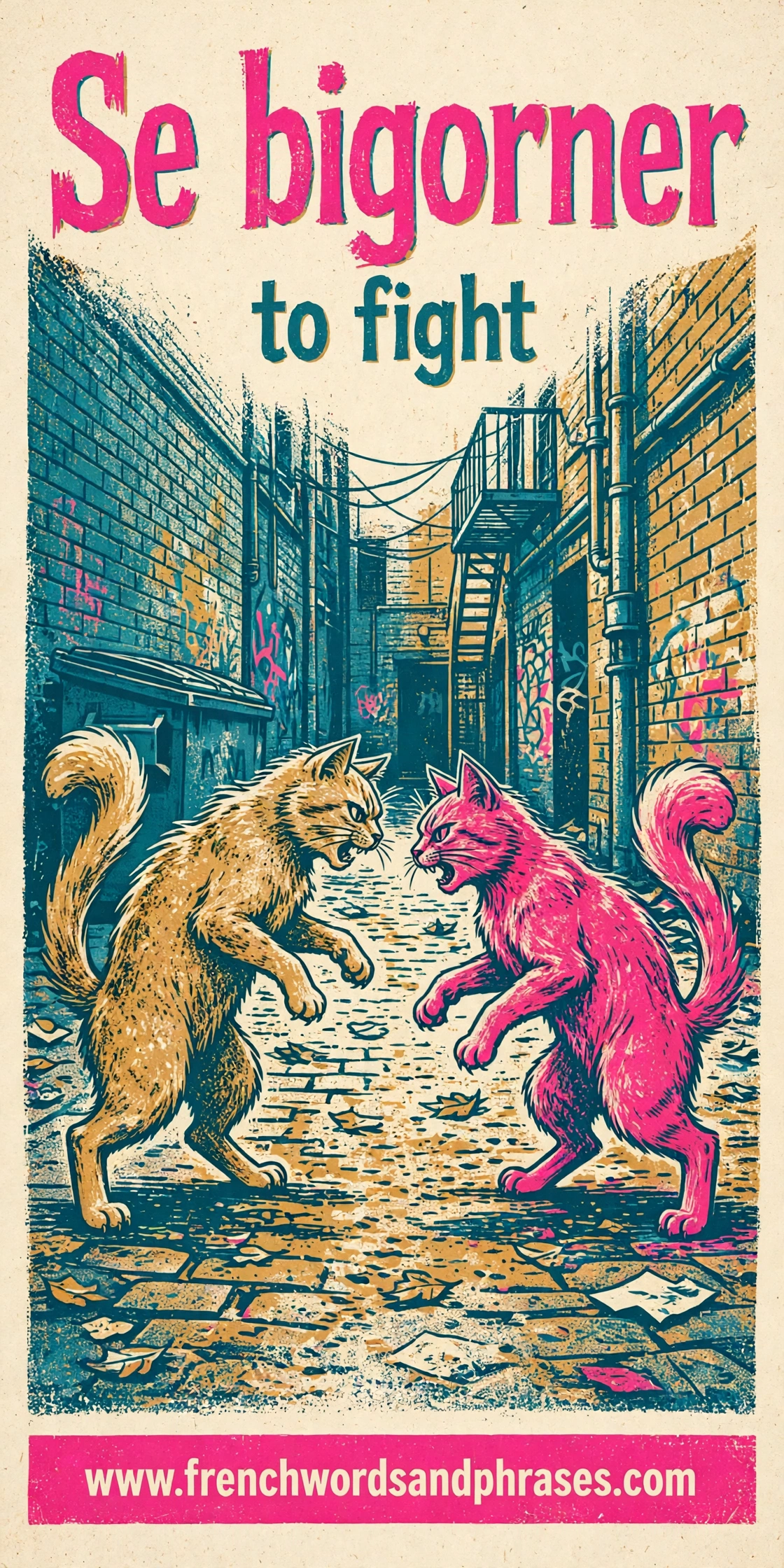
A French Word to Live By
How to Conjugate Bigorner in French
/bi.ɡɔʁ.ne/
Bigorner means to hit — to bang or bash something in familiar French, above all to dent a car.
A tight parking space in a Paris street, a concrete post exactly where you did not expect it, and that small crunching sound every driver dreads — bigorner is the verb of the bash: the knock, the bump and the dent that follows.
In this guide, you’ll learn how to conjugate bigorner in all the major French tenses and moods. Explore complete conjugation tables, French examples, English translations, and practice quizzes.
Understanding the French Verb Bigorner
Bigorner is a regular French verb belonging to the first group of verbs, those ending in -er.
It means to hit. It is used for things that get bashed rather than people who get hit: cars, doors, bumpers, dustbins. For hitting a person, French reaches for cogner or frapper — and for two people bashing each other, the reflexive se bigorner takes over.
Verb classification: First group (-er)
Auxiliary verb: Avoir
Past participle: bigorné
Present participle: bigornant
English equivalents: To hit, to bang, to dent (fam.); bigorner une voiture — to dent a car; bigorner une aile — to bash a wing; bigorner une portière — to dent a door panel; se faire bigorner sa voiture — to get one’s car dented.
One important detail: bigorner is familiar register — the word of car parks, garages and insurance arguments, not of careful French, where you would say cogner (to bang), heurter (to hit) or cabosser (to dent). Its favourite victim is a car or a piece of metal: bigorner une voiture, bigorner un pare-chocs. The verb itself is a perfectly regular -er: je bigorne, nous bigornons, ils bigornent, past participle bigorné. The word comes from la bigorne, the blacksmith’s two-horned anvil — bashing metal is in its blood.
Experience the Word
Bigorner is the verb of the expensive little noise — the crunch that turns a parking manoeuvre into a visit to the garage.
Imagine a driver reversing into the last space on a narrow street. A passenger waves him back, a post hides behind the rear window, and — crac — il bigorne l’aile contre le poteau. Nothing is broken, nobody is hurt, but the wing wears a dent like a signature.
The car still runs perfectly. It has simply been bigornée — bashed, dented, and marked by the street.
How to Conjugate Bigorner: Complete French Conjugation Guide
Let’s explore every major conjugation of bigorner, beginning with the indicative mood.
How to Conjugate Bigorner in the Indicative Mood
The indicative mood is used to express facts, observations, actions, and events.
How to Conjugate Bigorner in the Present Tense (Présent)
Used for actions happening now, habitual actions, and general truths.
| Subject | Conjugation |
|---|---|
| je | bigorne |
| tu | bigornes |
| il / elle | bigorne |
| nous | bigornons |
| vous | bigornez |
| ils / elles | bigornent |
Example
Attention, tu vas bigorner le poteau !
Careful, you are going to hit the post!
Quick Quiz 1
Complete the sentence:
Nous ______ toujours quelque chose en nous garant.
Reveal the answer
bigornons
Nous bigornons toujours quelque chose en nous garant.
We always bash something when we park.
How to Conjugate Bigorner in the Passé Composé
Used for completed actions in the past. Bigorner takes the auxiliary verb avoir.
| Subject | Conjugation |
|---|---|
| j’ | ai bigorné |
| tu | as bigorné |
| il / elle | a bigorné |
| nous | avons bigorné |
| vous | avez bigorné |
| ils / elles | ont bigorné |
Example
Un scooter a bigorné ma portière hier soir.
A scooter dented my door last night.
How to Conjugate Bigorner in the Imparfait (Imperfect Tense)
Used for habitual past actions, descriptions, and ongoing situations in the past.
| Subject | Conjugation |
|---|---|
| je | bigornais |
| tu | bigornais |
| il / elle | bigornait |
| nous | bigornions |
| vous | bigorniez |
| ils / elles | bigornaient |
Example
Le vieux camion bigornait les trottoirs à chaque virage.
The old lorry used to bang the kerbs at every turn.
Quick Quiz 2
Choose the correct form:
A scooter dented my door.
Un scooter ______ ma portière. (a bigorné / est bigorné)
Reveal the answer
a bigorné
Un scooter a bigorné ma portière.
Bigorner takes avoir.
How to Conjugate Bigorner in the Plus-que-parfait
Used to describe an action that had already been completed before another past event.
| Subject | Conjugation |
|---|---|
| j’ | avais bigorné |
| tu | avais bigorné |
| il / elle | avait bigorné |
| nous | avions bigorné |
| vous | aviez bigorné |
| ils / elles | avaient bigorné |
Example
Elle avait bigorné le pare-chocs avant même de partir.
She had dented the bumper before even setting off.
How to Conjugate Bigorner in the Passé Simple
Primarily used in formal writing, literature, and historical narratives. It is rarely used in everyday conversation.
| Subject | Conjugation |
|---|---|
| je | bigornai |
| tu | bigornas |
| il / elle | bigorna |
| nous | bigornâmes |
| vous | bigornâtes |
| ils / elles | bigornèrent |
Example
La camionnette bigorna le poteau et s’arrêta net.
The van hit the post and stopped dead.
How to Conjugate Bigorner in the Passé Antérieur
A literary tense used to express an action completed immediately before another past action, generally in the passé simple.
| Subject | Conjugation |
|---|---|
| j’ | eus bigorné |
| tu | eus bigorné |
| il / elle | eut bigorné |
| nous | eûmes bigorné |
| vous | eûtes bigorné |
| ils / elles | eurent bigorné |
Example
Quand il eut bigorné le portail, il descendit constater les dégâts.
When he had bashed the gate, he got out to inspect the damage.
How to Conjugate Bigorner in the Future Tense (Futur Simple)
Used to describe actions that will take place in the future.
| Subject | Conjugation |
|---|---|
| je | bigornerai |
| tu | bigorneras |
| il / elle | bigornera |
| nous | bigornerons |
| vous | bigornerez |
| ils / elles | bigorneront |
Example
Si tu recules sans regarder, tu bigorneras la voiture du voisin.
If you reverse without looking, you will dent the neighbour’s car.
How to Conjugate Bigorner in the Futur Antérieur (Future Perfect)
Used for an action that will have been completed before a particular point in the future.
| Subject | Conjugation |
|---|---|
| j’ | aurai bigorné |
| tu | auras bigorné |
| il / elle | aura bigorné |
| nous | aurons bigorné |
| vous | aurez bigorné |
| ils / elles | auront bigorné |
Example
À ce rythme, il aura bigorné toutes les voitures du quartier.
At this rate, he will have dented every car in the neighbourhood.
How to Conjugate Bigorner in the Near Future (Futur Proche)
Used to describe something that is going to happen soon. Formed with aller + infinitive.
| Subject | Conjugation |
|---|---|
| je | vais bigorner |
| tu | vas bigorner |
| il / elle | va bigorner |
| nous | allons bigorner |
| vous | allez bigorner |
| ils / elles | vont bigorner |
Example
Recule doucement, tu vas bigorner le mur !
Reverse gently, you are going to hit the wall!
How to Conjugate Bigorner in the Conditional Mood
The conditional mood expresses what would happen under certain circumstances. It is also frequently used to make polite requests or express wishes.
How to Conjugate Bigorner in the Present Conditional
| Subject | Conjugation |
|---|---|
| je | bigornerais |
| tu | bigornerais |
| il / elle | bigornerait |
| nous | bigornerions |
| vous | bigorneriez |
| ils / elles | bigorneraient |
Example
Sans les capteurs, je bigornerais le pare-chocs à chaque créneau.
Without the sensors, I would dent the bumper at every attempt to park.
How to Conjugate Bigorner in the Past Conditional
| Subject | Conjugation |
|---|---|
| j’ | aurais bigorné |
| tu | aurais bigorné |
| il / elle | aurait bigorné |
| nous | aurions bigorné |
| vous | auriez bigorné |
| ils / elles | auraient bigorné |
Example
Il aurait bigorné le poteau sans ton coup de klaxon.
He would have hit the post without your blast on the horn.
Bigorner in the Literary Past Conditional Form
This less common literary form uses the imperfect subjunctive of avoir.
| Subject | Conjugation |
|---|---|
| j’ | eusse bigorné |
| tu | eusses bigorné |
| il / elle | eût bigorné |
| nous | eussions bigorné |
| vous | eussiez bigorné |
| ils / elles | eussent bigorné |
Example
Il eût bigorné le portail sans le cri du gardien.
He would have bashed the gate without the caretaker’s shout.
How to Conjugate Bigorner in the Subjunctive Mood
The subjunctive is used to express wishes, emotions, doubts, necessity, and uncertainty. It frequently follows expressions such as il faut que (it is necessary that) or bien que (although).
How to Conjugate Bigorner in the Present Subjunctive
| Subject | Conjugation |
|---|---|
| que je | bigorne |
| que tu | bigornes |
| qu’il / qu’elle | bigorne |
| que nous | bigornions |
| que vous | bigorniez |
| qu’ils / qu’elles | bigornent |
Example
Je crains qu’il bigorne encore une fois l’aile droite.
I am afraid he will dent the right wing yet again.
Quick Quiz 3
Complete the sentence using the subjunctive:
Je crains qu’il ______ l’aile droite.
Reveal the answer
bigorne
Je crains qu’il bigorne l’aile droite.
I am afraid he will dent the right wing.
How to Conjugate Bigorner in the Imperfect Subjunctive
A literary tense, rarely encountered in modern spoken French.
| Subject | Conjugation |
|---|---|
| que je | bigornasse |
| que tu | bigornasses |
| qu’il / qu’elle | bigornât |
| que nous | bigornassions |
| que vous | bigornassiez |
| qu’ils / qu’elles | bigornassent |
Example
Elle lui avait demandé de reculer doucement pour qu’il ne bigornât pas le mur.
She had asked him to reverse gently so that he would not hit the wall.
How to Conjugate Bigorner in the Pluperfect Subjunctive
A literary construction used to express an action completed before another past action.
| Subject | Conjugation |
|---|---|
| que j’ | eusse bigorné |
| que tu | eusses bigorné |
| qu’il / qu’elle | eût bigorné |
| que nous | eussions bigorné |
| que vous | eussiez bigorné |
| qu’ils / qu’elles | eussent bigorné |
Example
On racontait qu’il eût bigorné trois voitures en un mois.
People said he had dented three cars in one month.
How to Conjugate Bigorner in the Past Subjunctive
| Subject | Conjugation |
|---|---|
| que j’ | aie bigorné |
| que tu | aies bigorné |
| qu’il / qu’elle | ait bigorné |
| que nous | ayons bigorné |
| que vous | ayez bigorné |
| qu’ils / qu’elles | aient bigorné |
Example
Je suis désolé qu’il ait bigorné ta portière.
I am sorry he dented your door.
How to Conjugate Bigorner in the Imperative
The imperative is used to give commands, instructions, invitations, or suggestions. Subject pronouns are omitted.
How to Conjugate Bigorner in the Present Imperative
| Person | Conjugation |
|---|---|
| (tu) | bigorne |
| (nous) | bigornons |
| (vous) | bigornez |
Example
Ne bigorne pas le poteau, recule en ligne droite !
Do not hit the post, reverse in a straight line!
Quick Quiz 4
How would you say Do not hit the post (tu form)?
Reveal the answer
Ne bigorne pas le poteau !
French Participles of Bigorner
Participles are verb forms that can be used in compound tenses and other grammatical constructions.
Present Participle of Bigorner
bigornant
En bigornant l’aile contre le pilier, il a rayé toute la peinture.
By bashing the wing against the pillar, he scratched all the paintwork.
Past Participle of Bigorner
bigorné
Bigornée par un scooter, la portière portait une belle bosse.
Dented by a scooter, the door bore a fine bump.
Bigorner in Everyday French: Real-Life Examples
Now that you know the conjugations, let’s see how bigorner appears in everyday French.
Example 1 — Present
Il bigorne toujours quelque chose en se garant.
He always bashes something when he parks.
Example 2 — Passé composé
Elle a bigorné le pare-chocs ce matin.
She dented the bumper this morning.
Example 3 — Imparfait
Le camion bigornait les bordures à chaque livraison.
The lorry used to bang the kerbs at every delivery.
Example 4 — Future
Tu bigorneras le portail si tu ne fais pas attention.
You will hit the gate if you are not careful.
Example 5 — Conditional
Sans caméra de recul, je bigornerais le mur.
Without a reversing camera, I would hit the wall.
Example 6 — Imperative
Ne bigorne pas ma voiture !
Do not bash my car!
Beyond Translation: The Meaning of Bigorner
English bash and bang cover the noise, but bigorner keeps the blacksmith in the word — la bigorne is his two-horned anvil, and the verb travelled from the forge to the street.
It is the connoisseur’s word for a dent.
A car can be cabossée in neutral French, but say elle est bigornée and everyone hears the crunch, sees the post, and knows exactly whose fault it was.
How to Remember the French Verb Bigorner
Remember it this way: Bigorner is about the dented wing in the car park.
- Register first: bigorner is familiar French — the word of dented wings and car-park arguments; in polite French, say cogner or cabosser.
- Its favourite victim is a car: bigorner une voiture, une aile, une portière, un pare-chocs.
- Regular -er: je bigorne, nous bigornons, past participle bigorné.
The key idea is the dented wing in the car park.
Test Your Knowledge of Bigorner
Let’s see how much you’ve learned. Try answering these questions before revealing the answers.
Question 1
Which auxiliary does bigorner use?
Reveal the answer
Avoir — un scooter a bigorné ma portière.
Question 2
How do you say A scooter dented my door in French?
Reveal the answer
Un scooter a bigorné ma portière.
Question 3
Translate: Careful, you are going to hit the post!
Reveal the answer
Attention, tu vas bigorner le poteau !
Question 4
What is the past participle of bigorner?
Reveal the answer
Bigorné — la portière est bigornée.
Question 5
Complete the sentence:
Je suis désolé qu’il ______ ta portière.
Reveal the answer
ait bigorné
Je suis désolé qu’il ait bigorné ta portière.
I am sorry he dented your door.
Your Final Challenge
Can You Use It?
How would you say this in French?
He dented the wing against a post, and the mechanic smiled at the dent.
Reveal the answer
Il a bigorné l’aile contre un poteau, et le garagiste a souri en voyant la bosse.
He dented the wing against a post, and the mechanic smiled at the dent.
A little French. A little curiosity. A richer everyday life.
LEARN FRENCH ONE WORD AT A TIME