A French Word to Live By
How to Conjugate Bigarrer in French
/bi.ɡa.ʁe/
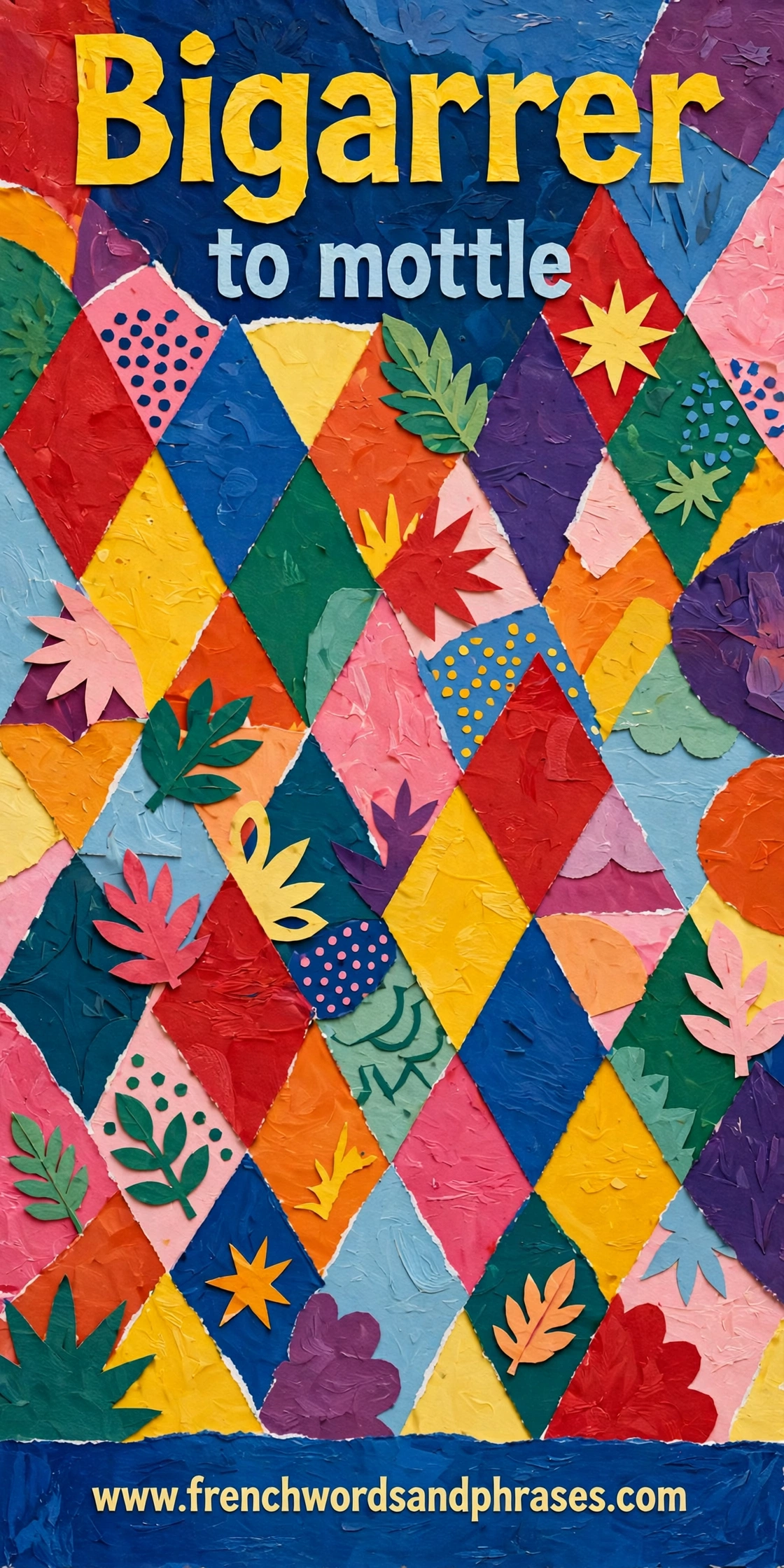
Bigarrer means to mottle — to colour something in many clashing patches, stripes and spots all at once.
A market square on a Saturday morning: red awnings, green shutters, yellow parasols, blue overalls, white dresses, a brass band in scarlet — bigarrer is the verb of cheerful colour-chaos, the mottling of a surface with every colour at once, and of the crowd that wears them all.
In this guide, you’ll learn how to conjugate bigarrer in all the major French tenses and moods. Explore complete conjugation tables, French examples, English translations, and practice quizzes.
Understanding the French Verb Bigarrer
Bigarrer is a regular French verb belonging to the first group of verbs, those ending in -er.
It means to mottle. It is used of fabrics, flowerbeds, market stalls and carnival streets — and, figuratively, of crowds, audiences and programmes whose charm is their mixture. The word is never an insult: what is bigarré is varied, colourful and alive.
Verb classification: First group (-er)
Auxiliary verb: Avoir
Past participle: bigarré
Present participle: bigarrant
English equivalents: To mottle, to variegate, to streak with colours; bigarrer un tissu — to pattern a fabric with many colours; une foule bigarrée — a motley, mixed crowd; des fleurs bigarrées — variegated flowers; un programme bigarré — a mixed, varied programme.
One important detail: the living form of bigarrer is its past participle used as an adjective — bigarré, bigarrée. The classic phrase is une foule bigarrée, a motley crowd of every kind, colour and origin, and French reaches for it whenever a group is joyfully mixed. The verb itself is rarer but perfectly regular, with a double r in every form: je bigarre, nous bigarrons, ils bigarrent. Said of things, it means to colour in patches and stripes; said of people, always through the participle, it means gloriously miscellaneous.
Experience the Word
Bigarrer is the verb of the patchwork — no single colour rules, and the mixture itself is the beauty.
Imagine the market at Apt on a summer Saturday. From the church steps the square is a single moving mosaic: parasols, aprons, baskets, awnings, a dog with a red scarf, a band with gold braid. A painter on the terrace gives up choosing a palette — la place est bigarrée, the whole square is mottled with a thousand colours, and that is exactly its glory.
No colour wins. The square is mottled — bigarrée — and the mixture is the picture.
How to Conjugate Bigarrer: Complete French Conjugation Guide
Let’s explore every major conjugation of bigarrer, beginning with the indicative mood.
How to Conjugate Bigarrer in the Indicative Mood
The indicative mood is used to express facts, observations, actions, and events.
How to Conjugate Bigarrer in the Present Tense (Présent)
Used for actions happening now, habitual actions, and general truths.
| Subject | Conjugation |
|---|---|
| je | bigarre |
| tu | bigarres |
| il / elle | bigarre |
| nous | bigarrons |
| vous | bigarrez |
| ils / elles | bigarrent |
Example
Le peintre bigarre sa toile de touches vives.
The painter mottles his canvas with vivid touches.
Quick Quiz 1
Complete the sentence:
Nous ______ nos étals de fruits colorés.
Reveal the answer
bigarrons
Nous bigarrons nos étals de fruits colorés.
We deck our stalls with colourful fruit.
How to Conjugate Bigarrer in the Passé Composé
Used for completed actions in the past. Bigarrer takes the auxiliary verb avoir.
| Subject | Conjugation |
|---|---|
| j’ | ai bigarré |
| tu | as bigarré |
| il / elle | a bigarré |
| nous | avons bigarré |
| vous | avez bigarré |
| ils / elles | ont bigarré |
Example
Elle a bigarré le tissu de rayures rouges et vertes.
She patterned the fabric with red and green stripes.
How to Conjugate Bigarrer in the Imparfait (Imperfect Tense)
Used for habitual past actions, descriptions, and ongoing situations in the past.
| Subject | Conjugation |
|---|---|
| je | bigarrais |
| tu | bigarrais |
| il / elle | bigarrait |
| nous | bigarrions |
| vous | bigarriez |
| ils / elles | bigarraient |
Example
Les marchands bigarraient leurs étals de fruits colorés.
The stallholders used to deck their stalls with colourful fruit.
Quick Quiz 2
Choose the correct form:
She patterned the fabric with stripes.
Elle ______ le tissu de rayures. (a bigarré / est bigarrée)
Reveal the answer
a bigarré
Elle a bigarré le tissu de rayures.
Bigarrer takes avoir.
How to Conjugate Bigarrer in the Plus-que-parfait
Used to describe an action that had already been completed before another past event.
| Subject | Conjugation |
|---|---|
| j’ | avais bigarré |
| tu | avais bigarré |
| il / elle | avait bigarré |
| nous | avions bigarré |
| vous | aviez bigarré |
| ils / elles | avaient bigarré |
Example
Il avait bigarré la couverture de motifs anciens.
He had patterned the cover with old motifs.
How to Conjugate Bigarrer in the Passé Simple
Primarily used in formal writing, literature, and historical narratives. It is rarely used in everyday conversation.
| Subject | Conjugation |
|---|---|
| je | bigarrai |
| tu | bigarras |
| il / elle | bigarra |
| nous | bigarrâmes |
| vous | bigarrâtes |
| ils / elles | bigarrèrent |
Example
Le carnaval bigarra les rues de confettis.
The carnival mottled the streets with confetti.
How to Conjugate Bigarrer in the Passé Antérieur
A literary tense used to express an action completed immediately before another past action, generally in the passé simple.
| Subject | Conjugation |
|---|---|
| j’ | eus bigarré |
| tu | eus bigarré |
| il / elle | eut bigarré |
| nous | eûmes bigarré |
| vous | eûtes bigarré |
| ils / elles | eurent bigarré |
Example
Quand elle eut bigarré le dernier étal, le marché ouvrit ses portes.
When she had decked the last stall with colours, the market opened its gates.
How to Conjugate Bigarrer in the Future Tense (Futur Simple)
Used to describe actions that will take place in the future.
| Subject | Conjugation |
|---|---|
| je | bigarrerai |
| tu | bigarreras |
| il / elle | bigarrera |
| nous | bigarrerons |
| vous | bigarrerez |
| ils / elles | bigarreront |
Example
Au printemps, les fleurs bigarreront la prairie.
In spring, the flowers will mottle the meadow.
How to Conjugate Bigarrer in the Futur Antérieur (Future Perfect)
Used for an action that will have been completed before a particular point in the future.
| Subject | Conjugation |
|---|---|
| j’ | aurai bigarré |
| tu | auras bigarré |
| il / elle | aura bigarré |
| nous | aurons bigarré |
| vous | aurez bigarré |
| ils / elles | auront bigarré |
Example
À la fin de la semaine, ils auront bigarré toutes les affiches du festival.
By the end of the week, they will have covered all the festival posters with colours.
How to Conjugate Bigarrer in the Near Future (Futur Proche)
Used to describe something that is going to happen soon. Formed with aller + infinitive.
| Subject | Conjugation |
|---|---|
| je | vais bigarrer |
| tu | vas bigarrer |
| il / elle | va bigarrer |
| nous | allons bigarrer |
| vous | allez bigarrer |
| ils / elles | vont bigarrer |
Example
Ce tissu va bigarrer toute la collection.
This fabric is going to splash the whole collection with colour.
How to Conjugate Bigarrer in the Conditional Mood
The conditional mood expresses what would happen under certain circumstances. It is also frequently used to make polite requests or express wishes.
How to Conjugate Bigarrer in the Present Conditional
| Subject | Conjugation |
|---|---|
| je | bigarrerais |
| tu | bigarrerais |
| il / elle | bigarrerait |
| nous | bigarrerions |
| vous | bigarreriez |
| ils / elles | bigarreraient |
Example
Avec d’autres teintures, elle bigarrerait encore plus ses étoffes.
With other dyes, she would pattern her fabrics with even more colours.
How to Conjugate Bigarrer in the Past Conditional
| Subject | Conjugation |
|---|---|
| j’ | aurais bigarré |
| tu | aurais bigarré |
| il / elle | aurait bigarré |
| nous | aurions bigarré |
| vous | auriez bigarré |
| ils / elles | auraient bigarré |
Example
Il aurait bigarré la toile si on le lui avait demandé.
He would have mottled the canvas if he had been asked.
Bigarrer in the Literary Past Conditional Form
This less common literary form uses the imperfect subjunctive of avoir.
| Subject | Conjugation |
|---|---|
| j’ | eusse bigarré |
| tu | eusses bigarré |
| il / elle | eût bigarré |
| nous | eussions bigarré |
| vous | eussiez bigarré |
| ils / elles | eussent bigarré |
Example
Le peintre eût bigarré le ciel de mille teintes.
The painter would have mottled the sky with a thousand hues.
How to Conjugate Bigarrer in the Subjunctive Mood
The subjunctive is used to express wishes, emotions, doubts, necessity, and uncertainty. It frequently follows expressions such as il faut que (it is necessary that) or bien que (although).
How to Conjugate Bigarrer in the Present Subjunctive
| Subject | Conjugation |
|---|---|
| que je | bigarre |
| que tu | bigarres |
| qu’il / qu’elle | bigarre |
| que nous | bigarrions |
| que vous | bigarriez |
| qu’ils / qu’elles | bigarrent |
Example
Il faut que tu bigarres moins ce motif.
You must put fewer colours into this pattern.
Quick Quiz 3
Complete the sentence using the subjunctive:
Il faut que vous ______ moins ce motif.
Reveal the answer
bigarriez
Il faut que vous bigarriez moins ce motif.
You must put fewer colours into this pattern.
How to Conjugate Bigarrer in the Imperfect Subjunctive
A literary tense, rarely encountered in modern spoken French.
| Subject | Conjugation |
|---|---|
| que je | bigarrasse |
| que tu | bigarrasses |
| qu’il / qu’elle | bigarrât |
| que nous | bigarrassions |
| que vous | bigarrassiez |
| qu’ils / qu’elles | bigarrassent |
Example
On souhaitait que la fête bigarrât le quartier entier.
People wished the festival would splash the whole district with colour.
How to Conjugate Bigarrer in the Pluperfect Subjunctive
A literary construction used to express an action completed before another past action.
| Subject | Conjugation |
|---|---|
| que j’ | eusse bigarré |
| que tu | eusses bigarré |
| qu’il / qu’elle | eût bigarré |
| que nous | eussions bigarré |
| que vous | eussiez bigarré |
| qu’ils / qu’elles | eussent bigarré |
Example
On admirait qu’elle eût bigarré si bien ses massifs.
People admired that she had patterned her flowerbeds so well.
How to Conjugate Bigarrer in the Past Subjunctive
| Subject | Conjugation |
|---|---|
| que j’ | aie bigarré |
| que tu | aies bigarré |
| qu’il / qu’elle | ait bigarré |
| que nous | ayons bigarré |
| que vous | ayez bigarré |
| qu’ils / qu’elles | aient bigarré |
Example
Je suis étonné que les fleurs aient bigarré le jardin si tôt.
I am amazed the flowers have mottled the garden so early.
How to Conjugate Bigarrer in the Imperative
The imperative is used to give commands, instructions, invitations, or suggestions. Subject pronouns are omitted.
How to Conjugate Bigarrer in the Present Imperative
| Person | Conjugation |
|---|---|
| (tu) | bigarre |
| (nous) | bigarrons |
| (vous) | bigarrez |
Example
Bigarre ce tissu, il est trop uni !
Put some colours into this fabric, it is too plain!
Quick Quiz 4
How would you say Put some colours into this fabric (tu form)?
Reveal the answer
Bigarre ce tissu !
French Participles of Bigarrer
Participles are verb forms that can be used in compound tenses and other grammatical constructions.
Present Participle of Bigarrer
bigarrant
En bigarrant ses étals, le marchand attire les clients.
By decking his stalls with colours, the stallholder attracts the customers.
Past Participle of Bigarrer
bigarré
Bigarrée de mille couleurs, la foule avançait lentement.
Mottled with a thousand colours, the crowd moved slowly forward.
Bigarrer in Everyday French: Real-Life Examples
Now that you know the conjugations, let’s see how bigarrer appears in everyday French.
Example 1 — Present
Le peintre bigarre sa toile de touches vives.
The painter mottles his canvas with vivid touches.
Example 2 — Passé composé
Elle a bigarré le tissu de rayures vives.
She patterned the fabric with bright stripes.
Example 3 — Imparfait
Les marchands bigarraient leurs étals.
The stallholders used to deck their stalls with colours.
Example 4 — Future
Les fleurs bigarreront la prairie au printemps.
The flowers will mottle the meadow in spring.
Example 5 — Conditional
Elle bigarrerait encore plus ses étoffes.
She would pattern her fabrics with even more colours.
Example 6 — Imperative
Bigarre ce tissu, il est trop uni !
Put some colours into this fabric, it is too plain!
Beyond Translation: The Meaning of Bigarrer
English motley is the true cousin — the fool’s motley was a costume of many-coloured patches, and a foule bigarrée is a motley crowd in exactly that spirit.
In French, the mixture is a compliment.
A public bigarré, a programme bigarré, a market bigarré: the word praises the patchwork — many colours, many kinds, one joyful whole — and quietly mocks every beige uniformity.
How to Remember the French Verb Bigarrer
Remember it this way: Bigarrer is about the motley crowd of a thousand colours.
- The star form is the participle: une foule bigarrée, a motley crowd — learn bigarré first.
- Double r everywhere: je bigarre, nous bigarrons, bigarré.
- Always cheerful: fabrics, flowers, crowds and programmes — the mixture is the charm, never a fault.
The key idea is the motley crowd of a thousand colours.
Test Your Knowledge of Bigarrer
Let’s see how much you’ve learned. Try answering these questions before revealing the answers.
Question 1
What does the classic phrase une foule bigarrée describe?
Reveal the answer
A motley crowd — a joyfully mixed crowd of every kind, colour and origin.
Question 2
How do you say The flowers will mottle the meadow in French?
Reveal the answer
Les fleurs bigarreront la prairie.
Question 3
Translate: She patterned the fabric with bright stripes.
Reveal the answer
Elle a bigarré le tissu de rayures vives.
Question 4
What is the past participle of bigarrer?
Reveal the answer
Bigarré — the form you will meet most: une foule bigarrée.
Question 5
Complete the sentence:
Il faut que tu ______ moins ce motif.
Reveal the answer
bigarres
Il faut que tu bigarres moins ce motif.
You must put fewer colours into this pattern.
Your Final Challenge
Can You Use It?
How would you say this in French?
Mottled with a thousand colours, the market crowd climbs toward the square like a river in celebration.
Reveal the answer
Bigarrée de mille couleurs, la foule du marché monte vers la place comme un fleuve en fête.
Mottled with a thousand colours, the market crowd climbs toward the square like a river in celebration.
A little French. A little curiosity. A richer everyday life.
LEARN FRENCH ONE WORD AT A TIME