A French Word to Live By
How to Conjugate Biffer in French
/bi.fe/
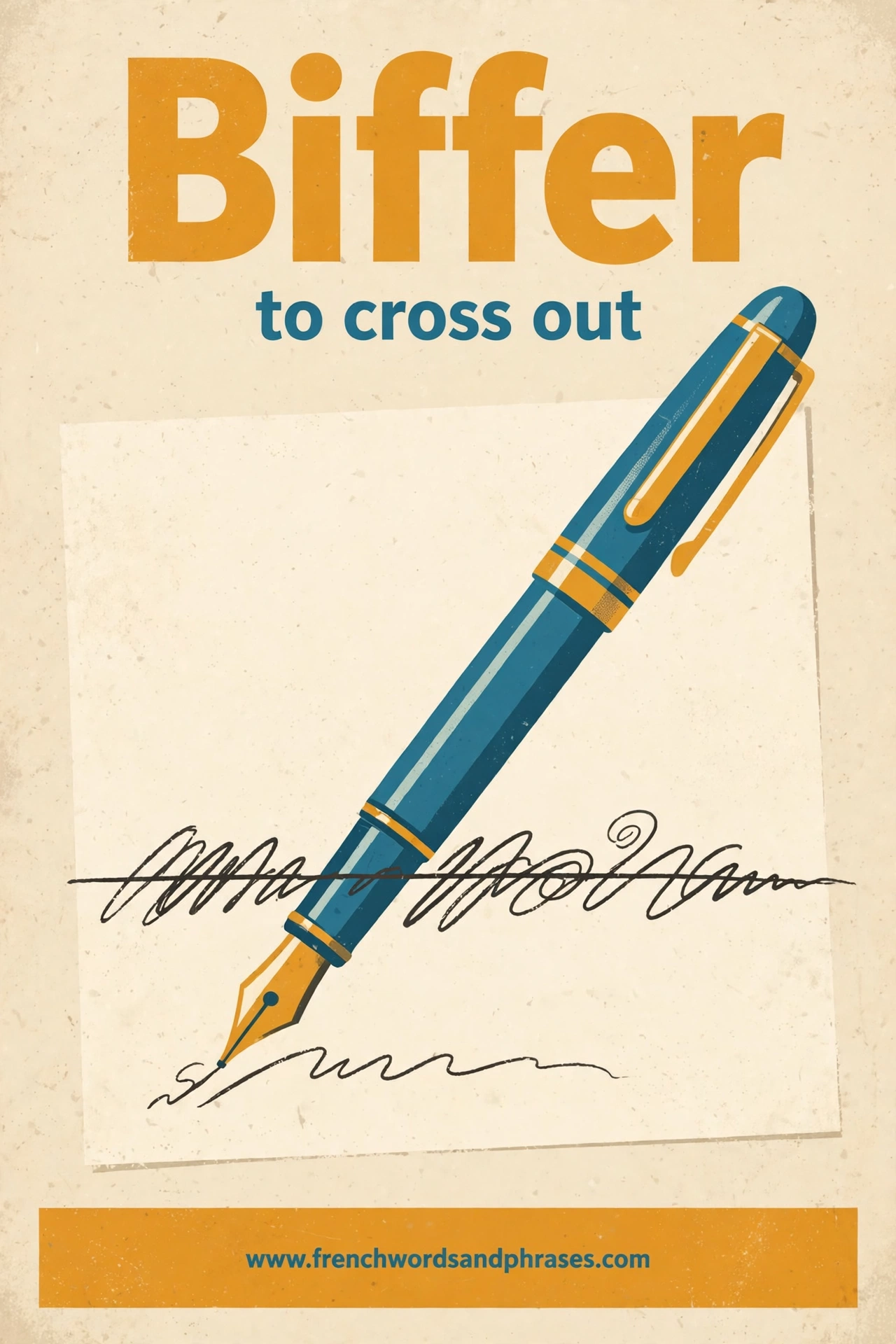
Biffer means to cross out — to draw one firm line through a word, a name or a whole paragraph and strike it from the page.
A proofreader’s desk at midnight, a red pen, and a manuscript bleeding corrections: one stroke through a clumsy sentence, one stroke through a name on a list — biffer is the verb of that decisive line, the gesture by which writing un-says what it said.
In this guide, you’ll learn how to conjugate biffer in all the major French tenses and moods. Explore complete conjugation tables, French examples, English translations, and practice quizzes.
Understanding the French Verb Biffer
Biffer is a regular French verb belonging to the first group of verbs, those ending in -er.
It means to cross out. It is used of words, lines, names and entries — anything written that must be visibly cancelled rather than erased. Unlike effacer (to erase), biffer leaves the cancelled text legible beneath the stroke; unlike supprimer, it names the physical gesture of the pen.
Verb classification: First group (-er)
Auxiliary verb: Avoir
Past participle: biffé
Present participle: biffant
English equivalents: To cross out, to strike out, to delete; biffer un mot — to cross out a word; biffer un nom d’une liste — to strike a name off a list; biffer une phrase entière — to delete a whole sentence; rayer — its close synonym.
One important detail: biffer is done with a single stroke — the word crossed out stays readable under the line, which is exactly why editors and correctors love it: the deletion itself remains part of the record. The verb is regular (je biffe, nous biffons) and belongs to the world of manuscripts, proofs, forms and lists. Its twin is rayer (to cross out, also to scratch): French forms famously order you to rayer la mention inutile — cross out whichever statement does not apply — and biffer does the same job with the same pen.
Experience the Word
Biffer is the verb of the honest deletion — nothing is hidden, the mistake stays visible under one clean, decisive line.
Imagine a novelist reading her proofs at midnight. A sentence she loved in June now embarrasses her; the red pen comes down and, in one movement, la phrase est biffée. She does not reach for correction fluid. The crossed-out sentence stays on the page like a crossed-out day in a diary — gone, but honestly gone.
The word has not vanished. It has been crossed out — biffé — struck through, and struck off, in a single stroke.
How to Conjugate Biffer: Complete French Conjugation Guide
Let’s explore every major conjugation of biffer, beginning with the indicative mood.
How to Conjugate Biffer in the Indicative Mood
The indicative mood is used to express facts, observations, actions, and events.
How to Conjugate Biffer in the Present Tense (Présent)
Used for actions happening now, habitual actions, and general truths.
| Subject | Conjugation |
|---|---|
| je | biffe |
| tu | biffes |
| il / elle | biffe |
| nous | biffons |
| vous | biffez |
| ils / elles | biffent |
Example
Elle biffe les erreurs d’un trait de plume.
She crosses out the mistakes with one stroke of the pen.
Quick Quiz 1
Complete the sentence:
Nous ______ les erreurs du brouillon.
Reveal the answer
biffons
Nous biffons les erreurs du brouillon.
We cross out the mistakes in the draft.
How to Conjugate Biffer in the Passé Composé
Used for completed actions in the past. Biffer takes the auxiliary verb avoir.
| Subject | Conjugation |
|---|---|
| j’ | ai biffé |
| tu | as biffé |
| il / elle | a biffé |
| nous | avons biffé |
| vous | avez biffé |
| ils / elles | ont biffé |
Example
Il a biffé trois paragraphes entiers.
He crossed out three whole paragraphs.
How to Conjugate Biffer in the Imparfait (Imperfect Tense)
Used for habitual past actions, descriptions, and ongoing situations in the past.
| Subject | Conjugation |
|---|---|
| je | biffais |
| tu | biffais |
| il / elle | biffait |
| nous | biffions |
| vous | biffiez |
| ils / elles | biffaient |
Example
Le correcteur biffait chaque faute avec soin.
The proofreader used to cross out every error carefully.
Quick Quiz 2
Choose the correct form:
He crossed out the whole paragraph.
Il ______ tout le paragraphe. (a biffé / est biffé)
Reveal the answer
a biffé
Il a biffé tout le paragraphe.
Biffer takes avoir.
How to Conjugate Biffer in the Plus-que-parfait
Used to describe an action that had already been completed before another past event.
| Subject | Conjugation |
|---|---|
| j’ | avais biffé |
| tu | avais biffé |
| il / elle | avait biffé |
| nous | avions biffé |
| vous | aviez biffé |
| ils / elles | avaient biffé |
Example
Ils avaient biffé son nom de la liste.
They had struck his name off the list.
How to Conjugate Biffer in the Passé Simple
Primarily used in formal writing, literature, and historical narratives. It is rarely used in everyday conversation.
| Subject | Conjugation |
|---|---|
| je | biffai |
| tu | biffas |
| il / elle | biffa |
| nous | biffâmes |
| vous | biffâtes |
| ils / elles | biffèrent |
Example
D’un geste sec, elle biffa la phrase.
With one sharp movement, she crossed out the sentence.
How to Conjugate Biffer in the Passé Antérieur
A literary tense used to express an action completed immediately before another past action, generally in the passé simple.
| Subject | Conjugation |
|---|---|
| j’ | eus biffé |
| tu | eus biffé |
| il / elle | eut biffé |
| nous | eûmes biffé |
| vous | eûtes biffé |
| ils / elles | eurent biffé |
Example
Quand il eut biffé la dernière ligne, il signa la page.
When he had crossed out the last line, he signed the page.
How to Conjugate Biffer in the Future Tense (Futur Simple)
Used to describe actions that will take place in the future.
| Subject | Conjugation |
|---|---|
| je | bifferai |
| tu | bifferas |
| il / elle | biffera |
| nous | bifferons |
| vous | bifferez |
| ils / elles | bifferont |
Example
Demain, je bifferai les passages inutiles.
Tomorrow, I will cross out the useless passages.
How to Conjugate Biffer in the Futur Antérieur (Future Perfect)
Used for an action that will have been completed before a particular point in the future.
| Subject | Conjugation |
|---|---|
| j’ | aurai biffé |
| tu | auras biffé |
| il / elle | aura biffé |
| nous | aurons biffé |
| vous | aurez biffé |
| ils / elles | auront biffé |
Example
À la fin de la journée, elle aura biffé vingt pages.
By the end of the day, she will have crossed out twenty pages.
How to Conjugate Biffer in the Near Future (Futur Proche)
Used to describe something that is going to happen soon. Formed with aller + infinitive.
| Subject | Conjugation |
|---|---|
| je | vais biffer |
| tu | vas biffer |
| il / elle | va biffer |
| nous | allons biffer |
| vous | allez biffer |
| ils / elles | vont biffer |
Example
Attention, il va biffer tout ton paragraphe !
Careful, he is going to cross out your whole paragraph!
How to Conjugate Biffer in the Conditional Mood
The conditional mood expresses what would happen under certain circumstances. It is also frequently used to make polite requests or express wishes.
How to Conjugate Biffer in the Present Conditional
| Subject | Conjugation |
|---|---|
| je | bifferais |
| tu | bifferais |
| il / elle | bifferait |
| nous | bifferions |
| vous | bifferiez |
| ils / elles | bifferaient |
Example
Avec plus de temps, je bifferais la moitié du chapitre.
With more time, I would cross out half the chapter.
How to Conjugate Biffer in the Past Conditional
| Subject | Conjugation |
|---|---|
| j’ | aurais biffé |
| tu | aurais biffé |
| il / elle | aurait biffé |
| nous | aurions biffé |
| vous | auriez biffé |
| ils / elles | auraient biffé |
Example
Elle aurait biffé ce nom si elle l’avait vu.
She would have struck off that name if she had seen it.
Biffer in the Literary Past Conditional Form
This less common literary form uses the imperfect subjunctive of avoir.
| Subject | Conjugation |
|---|---|
| j’ | eusse biffé |
| tu | eusses biffé |
| il / elle | eût biffé |
| nous | eussions biffé |
| vous | eussiez biffé |
| ils / elles | eussent biffé |
Example
Il eût biffé la phrase entière d’un seul trait.
He would have crossed out the whole sentence with a single stroke.
How to Conjugate Biffer in the Subjunctive Mood
The subjunctive is used to express wishes, emotions, doubts, necessity, and uncertainty. It frequently follows expressions such as il faut que (it is necessary that) or bien que (although).
How to Conjugate Biffer in the Present Subjunctive
| Subject | Conjugation |
|---|---|
| que je | biffe |
| que tu | biffes |
| qu’il / qu’elle | biffe |
| que nous | biffions |
| que vous | biffiez |
| qu’ils / qu’elles | biffent |
Example
Il faut que tu biffes les mentions inutiles.
You must cross out the statements that do not apply.
Quick Quiz 3
Complete the sentence using the subjunctive:
Il faut que vous ______ les mentions inutiles.
Reveal the answer
biffiez
Il faut que vous biffiez les mentions inutiles.
You must cross out the statements that do not apply.
How to Conjugate Biffer in the Imperfect Subjunctive
A literary tense, rarely encountered in modern spoken French.
| Subject | Conjugation |
|---|---|
| que je | biffasse |
| que tu | biffasses |
| qu’il / qu’elle | biffât |
| que nous | biffassions |
| que vous | biffassiez |
| qu’ils / qu’elles | biffassent |
Example
L’éditeur voulait qu’il biffât ce passage délicat.
The editor wanted him to cross out that delicate passage.
How to Conjugate Biffer in the Pluperfect Subjunctive
A literary construction used to express an action completed before another past action.
| Subject | Conjugation |
|---|---|
| que j’ | eusse biffé |
| que tu | eusses biffé |
| qu’il / qu’elle | eût biffé |
| que nous | eussions biffé |
| que vous | eussiez biffé |
| qu’ils / qu’elles | eussent biffé |
Example
On disait qu’elle eût biffé les noms gênants.
People said she had struck off the embarrassing names.
How to Conjugate Biffer in the Past Subjunctive
| Subject | Conjugation |
|---|---|
| que j’ | aie biffé |
| que tu | aies biffé |
| qu’il / qu’elle | ait biffé |
| que nous | ayons biffé |
| que vous | ayez biffé |
| qu’ils / qu’elles | aient biffé |
Example
Je regrette qu’il ait biffé ton nom.
I regret that he struck off your name.
How to Conjugate Biffer in the Imperative
The imperative is used to give commands, instructions, invitations, or suggestions. Subject pronouns are omitted.
How to Conjugate Biffer in the Present Imperative
| Person | Conjugation |
|---|---|
| (tu) | biffe |
| (nous) | biffons |
| (vous) | biffez |
Example
Biffe ce mot, il est de trop !
Cross out that word, it is one too many!
Quick Quiz 4
How would you say Cross out that word (tu form)?
Reveal the answer
Biffe ce mot !
French Participles of Biffer
Participles are verb forms that can be used in compound tenses and other grammatical constructions.
Present Participle of Biffer
biffant
En biffant les erreurs, elle améliore le texte.
By crossing out the errors, she improves the text.
Past Participle of Biffer
biffé
Biffé de la liste, son nom n’apparaissait plus nulle part.
Struck off the list, his name no longer appeared anywhere.
Biffer in Everyday French: Real-Life Examples
Now that you know the conjugations, let’s see how biffer appears in everyday French.
Example 1 — Present
Elle biffe les erreurs d’un trait de plume.
She crosses out the mistakes with one stroke of the pen.
Example 2 — Passé composé
Il a biffé trois paragraphes entiers.
He crossed out three whole paragraphs.
Example 3 — Imparfait
Le correcteur biffait chaque faute.
The proofreader used to cross out every error.
Example 4 — Future
Je bifferai les passages inutiles demain.
I will cross out the useless passages tomorrow.
Example 5 — Conditional
Je bifferais la moitié du chapitre.
I would cross out half the chapter.
Example 6 — Imperative
Biffe ce mot, il est de trop !
Cross out that word, it is one too many!
Beyond Translation: The Meaning of Biffer
English cross out describes the geometry; French biffer describes the act of office — the corrector’s stroke that cancels a word while leaving it readable, a small ceremony of accountability.
What is biffé is cancelled, not hidden.
That is why the word rules the world of contracts, proofs and official lists: a name biffé is a name removed in full view, and everyone can see both the name and the line that removed it.
How to Remember the French Verb Biffer
Remember it this way: Biffer is about one stroke of the pen through the unwanted word.
- One stroke of the pen: the crossed-out word stays readable under the line — that is biffer, not effacer.
- Its twin is rayer: forms order you to rayer (or biffer) la mention inutile.
- Regular -er: je biffe, nous biffons, past participle biffé.
The key idea is one stroke of the pen through the unwanted word.
Test Your Knowledge of Biffer
Let’s see how much you’ve learned. Try answering these questions before revealing the answers.
Question 1
What is the difference between biffer and effacer?
Reveal the answer
Biffer crosses out with a visible line — the text stays readable underneath; effacer erases it completely.
Question 2
How do you say He crossed out three paragraphs in French?
Reveal the answer
Il a biffé trois paragraphes.
Question 3
Translate: They had struck his name off the list.
Reveal the answer
Ils avaient biffé son nom de la liste.
Question 4
What is the past participle of biffer?
Reveal the answer
Biffé.
Question 5
Complete the sentence:
Il faut que tu ______ les mentions inutiles.
Reveal the answer
biffes
Il faut que tu biffes les mentions inutiles.
You must cross out the statements that do not apply.
Your Final Challenge
Can You Use It?
How would you say this in French?
She crosses out the sentence without hesitating, and suddenly the text breathes more easily.
Reveal the answer
Elle biffe la phrase sans hésiter, et le texte, soudain, respire mieux.
She crosses out the sentence without hesitating, and suddenly the text breathes more easily.
A little French. A little curiosity. A richer everyday life.
LEARN FRENCH ONE WORD AT A TIME