A French Word to Live By
How to Conjugate Convaincre in French
/kɔ̃.vɛ̃kʁ/
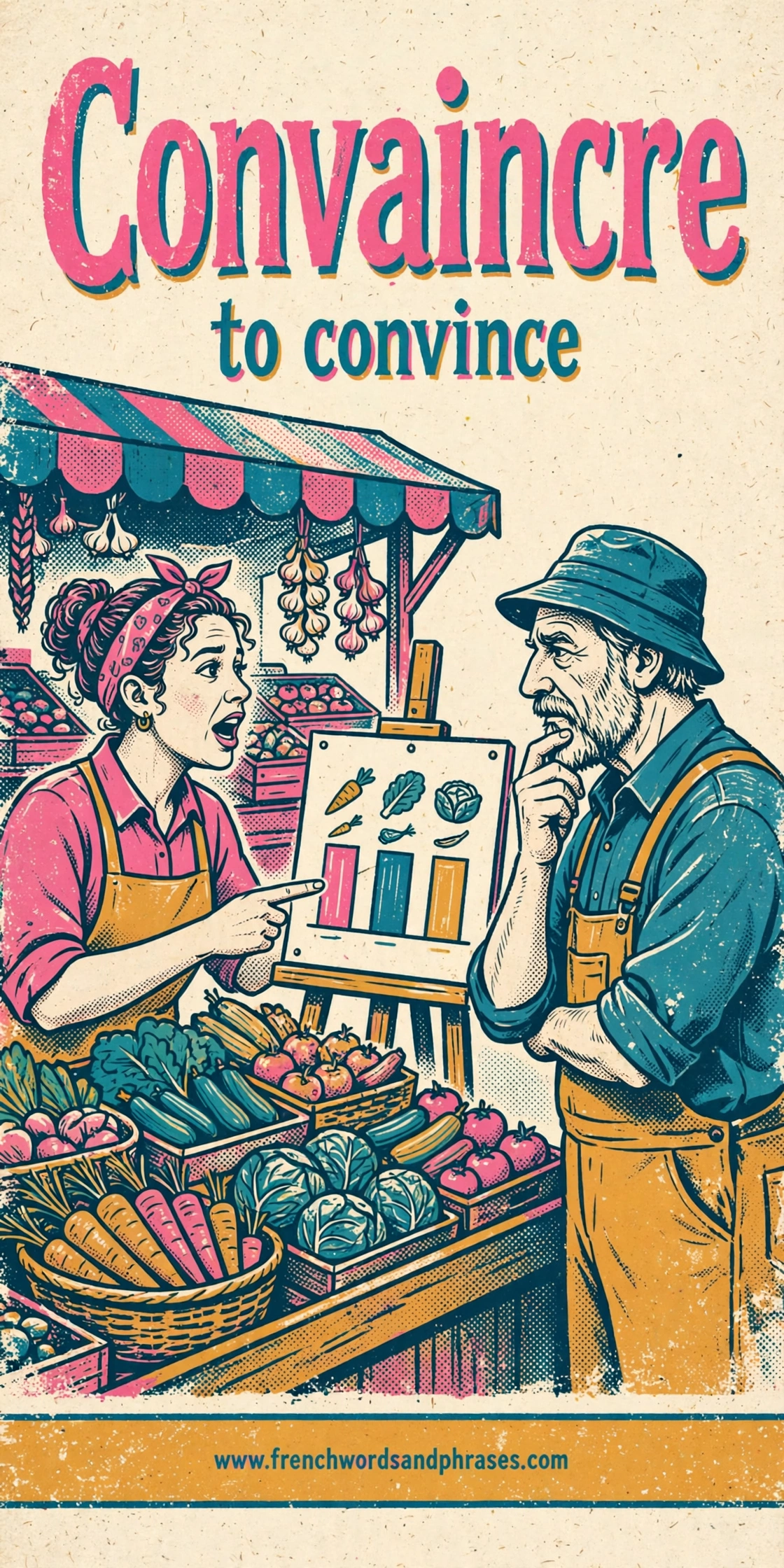
Convaincre means to convince — to win someone over to your view by force of argument or evidence.
A lawyer before the jury, a child arguing for a later bedtime, a salesman with one last demonstration — convaincre is the verb of minds changed by reasons: someone resists, someone argues, and at the end, someone believes.
In this guide, you’ll learn how to conjugate convaincre in all the major French tenses and moods. Explore complete conjugation tables, French examples, English translations, and practice quizzes.
Understanding the French Verb Convaincre
Convaincre is an irregular French verb ending in -vaincre, conjugated exactly like vaincre.
It means to convince. Convaincre works on the mind — you convince someone that something is true; persuader is its close twin, slightly warmer and more personal. Être convaincu de means to be firmly convinced of something.
Verb classification: Irregular (-vaincre)
Auxiliary verb: Avoir
Past participle: convaincu
Present participle: convainquant
English equivalents: To convince, to persuade; convaincre quelqu’un de quelque chose — to convince someone of something; convaincre quelqu’un de faire quelque chose — to convince someone to do something; être convaincu de — to be convinced of; convaincre un jury — to convince a jury.
One important detail: convaincre follows vaincre, and its c dances with qu. The singular present keeps a bare c — je convaincs, tu convaincs, il convainc — but almost everywhere else the c hardens into qu to keep its hard k sound: nous convainquons, vous convainquez, je convainquais, qu’il convainque, en convainquant, and even in the passé simple, je convainquis. Two refuges keep the plain c: the future stem — je convaincrai — and the past participle — convaincu. Its construction: convaincre quelqu’un de quelque chose, convaincre quelqu’un de faire quelque chose.
Experience the Word
Convaincre is the verb of the won argument — evidence and eloquence against doubt, and doubt gives way.
Imagine a village meeting about a new road. The mayor speaks for an hour; the farmers shake their heads. Then an old woman stands, tells one story about the winter the ambulance came too late — et elle les convainc, tous, en trois minutes.
The facts were always there. She convinced them — elle les a convaincus — by making the facts impossible to refuse.
How to Conjugate Convaincre: Complete French Conjugation Guide
Let’s explore every major conjugation of convaincre, beginning with the indicative mood.
How to Conjugate Convaincre in the Indicative Mood
The indicative mood is used to express facts, observations, actions, and events.
How to Conjugate Convaincre in the Present Tense (Présent)
Used for actions happening now, habitual actions, and general truths.
| Subject | Conjugation |
|---|---|
| je | convaincs |
| tu | convaincs |
| il / elle | convainc |
| nous | convainquons |
| vous | convainquez |
| ils / elles | convainquent |
Example
Cet avocat convainc toujours le jury.
This lawyer always convinces the jury.
Quick Quiz 1
Complete the sentence:
Nous ______ le jury avec ces preuves.
Reveal the answer
convainquons
Nous convainquons le jury avec ces preuves.
We convince the jury with this evidence.
How to Conjugate Convaincre in the Passé Composé
Used for completed actions in the past. Convaincre takes the auxiliary verb avoir.
| Subject | Conjugation |
|---|---|
| j’ | ai convaincu |
| tu | as convaincu |
| il / elle | a convaincu |
| nous | avons convaincu |
| vous | avez convaincu |
| ils / elles | ont convaincu |
Example
Elle nous a convaincus avec des chiffres.
She convinced us with figures.
How to Conjugate Convaincre in the Imparfait (Imperfect Tense)
Used for habitual past actions, descriptions, and ongoing situations in the past.
| Subject | Conjugation |
|---|---|
| je | convainquais |
| tu | convainquais |
| il / elle | convainquait |
| nous | convainquions |
| vous | convainquiez |
| ils / elles | convainquaient |
Example
Il convainquait ses clients en cinq minutes.
He used to convince his clients in five minutes.
Quick Quiz 2
Choose the correct form:
She convinced us.
Elle nous ______ . (a convaincus / a convaincu)
Reveal the answer
a convaincus
Elle nous a convaincus.
The participle agrees with the preceding direct object nous: convaincus.
How to Conjugate Convaincre in the Plus-que-parfait
Used to describe an action that had already been completed before another past event.
| Subject | Conjugation |
|---|---|
| j’ | avais convaincu |
| tu | avais convaincu |
| il / elle | avait convaincu |
| nous | avions convaincu |
| vous | aviez convaincu |
| ils / elles | avaient convaincu |
Example
Ils avaient convaincu le maire avant la réunion.
They had convinced the mayor before the meeting.
How to Conjugate Convaincre in the Passé Simple
Primarily used in formal writing, literature, and historical narratives. It is rarely used in everyday conversation.
| Subject | Conjugation |
|---|---|
| je | convainquis |
| tu | convainquis |
| il / elle | convainquit |
| nous | convainquîmes |
| vous | convainquîtes |
| ils / elles | convainquirent |
Example
Son discours convainquit toute l’assemblée.
His speech convinced the whole assembly.
How to Conjugate Convaincre in the Passé Antérieur
A literary tense used to express an action completed immediately before another past action, generally in the passé simple.
| Subject | Conjugation |
|---|---|
| j’ | eus convaincu |
| tu | eus convaincu |
| il / elle | eut convaincu |
| nous | eûmes convaincu |
| vous | eûtes convaincu |
| ils / elles | eurent convaincu |
Example
Quand elle eut convaincu les derniers hésitants, le vote commença.
When she had convinced the last doubters, the vote began.
How to Conjugate Convaincre in the Future Tense (Futur Simple)
Used to describe actions that will take place in the future.
| Subject | Conjugation |
|---|---|
| je | convaincrai |
| tu | convaincras |
| il / elle | convaincra |
| nous | convaincrons |
| vous | convaincrez |
| ils / elles | convaincront |
Example
Ces preuves convaincront les plus sceptiques.
This evidence will convince the most sceptical.
How to Conjugate Convaincre in the Futur Antérieur (Future Perfect)
Used for an action that will have been completed before a particular point in the future.
| Subject | Conjugation |
|---|---|
| j’ | aurai convaincu |
| tu | auras convaincu |
| il / elle | aura convaincu |
| nous | aurons convaincu |
| vous | aurez convaincu |
| ils / elles | auront convaincu |
Example
À la fin du procès, l’avocat aura convaincu les jurés.
By the end of the trial, the lawyer will have convinced the jurors.
How to Conjugate Convaincre in the Near Future (Futur Proche)
Used to describe something that is going to happen soon. Formed with aller + infinitive.
| Subject | Conjugation |
|---|---|
| je | vais convaincre |
| tu | vas convaincre |
| il / elle | va convaincre |
| nous | allons convaincre |
| vous | allez convaincre |
| ils / elles | vont convaincre |
Example
Écoute-le bien, il va te convaincre !
Listen to him carefully, he is going to convince you!
How to Conjugate Convaincre in the Conditional Mood
The conditional mood expresses what would happen under certain circumstances. It is also frequently used to make polite requests or express wishes.
How to Conjugate Convaincre in the Present Conditional
| Subject | Conjugation |
|---|---|
| je | convaincrais |
| tu | convaincrais |
| il / elle | convaincrait |
| nous | convaincrions |
| vous | convaincriez |
| ils / elles | convaincraient |
Example
Avec de meilleurs arguments, tu convaincrais tout le monde.
With better arguments, you would convince everyone.
How to Conjugate Convaincre in the Past Conditional
| Subject | Conjugation |
|---|---|
| j’ | aurais convaincu |
| tu | aurais convaincu |
| il / elle | aurait convaincu |
| nous | aurions convaincu |
| vous | auriez convaincu |
| ils / elles | auraient convaincu |
Example
Elle aurait convaincu son père si elle avait osé parler.
She would have convinced her father if she had dared to speak.
Convaincre in the Literary Past Conditional Form
This less common literary form uses the imperfect subjunctive of avoir.
| Subject | Conjugation |
|---|---|
| j’ | eusse convaincu |
| tu | eusses convaincu |
| il / elle | eût convaincu |
| nous | eussions convaincu |
| vous | eussiez convaincu |
| ils / elles | eussent convaincu |
Example
Il eût convaincu le roi lui-même.
He would have convinced the king himself.
How to Conjugate Convaincre in the Subjunctive Mood
The subjunctive is used to express wishes, emotions, doubts, necessity, and uncertainty. It frequently follows expressions such as il faut que (it is necessary that) or bien que (although).
How to Conjugate Convaincre in the Present Subjunctive
| Subject | Conjugation |
|---|---|
| que je | convainque |
| que tu | convainques |
| qu’il / qu’elle | convainque |
| que nous | convainquions |
| que vous | convainquiez |
| qu’ils / qu’elles | convainquent |
Example
Il faut que tu me convainques avec des faits.
You must convince me with facts.
Quick Quiz 3
Complete the sentence using the subjunctive:
Il faut que vous les ______ avec des faits.
Reveal the answer
convainquiez
Il faut que vous les convainquiez avec des faits.
You must convince them with facts.
How to Conjugate Convaincre in the Imperfect Subjunctive
A literary tense, rarely encountered in modern spoken French.
| Subject | Conjugation |
|---|---|
| que je | convainquisse |
| que tu | convainquisses |
| qu’il / qu’elle | convainquît |
| que nous | convainquissions |
| que vous | convainquissiez |
| qu’ils / qu’elles | convainquissent |
Example
On doutait qu’il convainquît qui que ce soit.
People doubted he would convince anyone at all.
How to Conjugate Convaincre in the Pluperfect Subjunctive
A literary construction used to express an action completed before another past action.
| Subject | Conjugation |
|---|---|
| que j’ | eusse convaincu |
| que tu | eusses convaincu |
| qu’il / qu’elle | eût convaincu |
| que nous | eussions convaincu |
| que vous | eussiez convaincu |
| qu’ils / qu’elles | eussent convaincu |
Example
On admirait qu’elle eût convaincu tant de monde.
People admired that she had convinced so many people.
How to Conjugate Convaincre in the Past Subjunctive
| Subject | Conjugation |
|---|---|
| que j’ | aie convaincu |
| que tu | aies convaincu |
| qu’il / qu’elle | ait convaincu |
| que nous | ayons convaincu |
| que vous | ayez convaincu |
| qu’ils / qu’elles | aient convaincu |
Example
Je suis heureux que tu les aies convaincus.
I am glad you convinced them.
How to Conjugate Convaincre in the Imperative
The imperative is used to give commands, instructions, invitations, or suggestions. Subject pronouns are omitted.
How to Conjugate Convaincre in the Present Imperative
| Person | Conjugation |
|---|---|
| (tu) | convaincs |
| (nous) | convainquons |
| (vous) | convainquez |
Example
Convainquez-les avec des faits, pas avec des cris !
Convince them with facts, not with shouting!
Quick Quiz 4
How would you say Convince me (tu form)?
Reveal the answer
Convaincs-moi !
French Participles of Convaincre
Participles are verb forms that can be used in compound tenses and other grammatical constructions.
Present Participle of Convaincre
convainquant
En convainquant les voisins, elle a sauvé le projet.
By convincing the neighbours, she saved the project.
Past Participle of Convaincre
convaincu
Convaincue par ses arguments, elle a signé le contrat.
Convinced by his arguments, she signed the contract.
Convaincre in Everyday French: Real-Life Examples
Now that you know the conjugations, let’s see how convaincre appears in everyday French.
Example 1 — Present
Il convainc toujours ses clients.
He always convinces his clients.
Example 2 — Passé composé
Elle nous a convaincus.
She convinced us.
Example 3 — Imparfait
Tu convainquais tout le monde.
You used to convince everyone.
Example 4 — Future
Ces preuves convaincront le jury.
This evidence will convince the jury.
Example 5 — Conditional
Tu convaincrais ton père avec ces chiffres.
You would convince your father with these figures.
Example 6 — Imperative
Convaincs-moi si tu peux !
Convince me if you can!
Beyond Translation: The Meaning of Convaincre
English convince and French convaincre are the same Roman soldier: Latin convincere meant to conquer completely, to defeat in argument.
To convince is to win.
That is why French law can convaincre a criminal — convaincu de meurtre is convicted of murder — and why une conviction in French is both a firm belief and a criminal record. The cousin vaincre still fights battles; convaincre fights only with words.
How to Remember the French Verb Convaincre
Remember it this way: Convaincre is about the old woman at the village meeting, winning everyone in three minutes.
- C becomes qu almost everywhere: nous convainquons, je convainquais — but je convaincs and convaincu keep the bare c.
- Convaincre quelqu’un de quelque chose, de faire quelque chose — the construction is always de.
- Latin vincere, to conquer: to convince someone is to defeat their doubt.
The key idea is the old woman at the village meeting, winning everyone in three minutes.
Test Your Knowledge of Convaincre
Let’s see how much you’ve learned. Try answering these questions before revealing the answers.
Question 1
Why does nous convainquons take qu while je convaincs keeps c?
Reveal the answer
The vaincre spelling dance — c hardens to qu before most vowels (convainquons, convainquais), but the singular present, the future stem and the participle keep c: convaincs, convaincrai, convaincu.
Question 2
How do you say She convinced us in French?
Reveal the answer
Elle nous a convaincus.
Question 3
Translate: This evidence will convince the jury.
Reveal the answer
Ces preuves convaincront le jury.
Question 4
What is the past participle of convaincre?
Reveal the answer
Convaincu.
Question 5
Complete the sentence:
Il faut que tu me ______ avec des faits.
Reveal the answer
convainques
Il faut que tu me convainques avec des faits.
You must convince me with facts.
Your Final Challenge
Can You Use It?
How would you say this in French?
She convinces by gentleness what others never obtain by force.
Reveal the answer
Elle convainc par la douceur ce que d’autres n’obtiennent jamais par la force.
She convinces by gentleness what others never obtain by force.
A little French. A little curiosity. A richer everyday life.
LEARN FRENCH ONE WORD AT A TIME