A French Word to Live By
How to Conjugate Mentir in French
/mɑ̃.tiʁ/
Mentir means to lie — to say what you know is false, with the intention of deceiving.
A child with chocolate on his chin swearing he touched nothing, a witness trembling before the court, a lover’s promise nobody believes — mentir is the verb of the deliberate untruth: not being wrong, but saying what you know is not so.
In this guide, you’ll learn how to conjugate mentir in all the major French tenses and moods. Explore complete conjugation tables, French examples, English translations, and practice quizzes.
Understanding the French Verb Mentir
Mentir is an irregular French verb ending in -ir, conjugated like partir: the stem’s final consonant drops in the singular (je mens, but nous mentons).
It means to lie. Mentir is always deliberate: for innocent mistakes, use se tromper. It governs à for the person deceived, and sur or à propos de for the subject lied about.
Verb classification: Irregular (-ir, partir family)
Auxiliary verb: Avoir
Past participle: menti
Present participle: mentant
English equivalents: To lie, to tell lies; mentir à quelqu’un — to lie to someone; mentir sur son âge — to lie about one’s age; mentir comme un arracheur de dents — to lie like a trooper; un menteur, une menteuse — a liar.
One important detail: mentir belongs to the partir family, not the finir family — there is no -iss- anywhere. The final consonant of the stem vanishes in the singular: je mens, tu mens, il ment, but it returns in the plural: nous mentons, vous mentez, ils mentent. The preposition is à: mentir à quelqu’un, to lie to someone — never forget it. And to accuse a person, French has the famous insult: Menteur !
Experience the Word
Mentir is the verb of the gap between what you say and what you know — crossed on purpose.
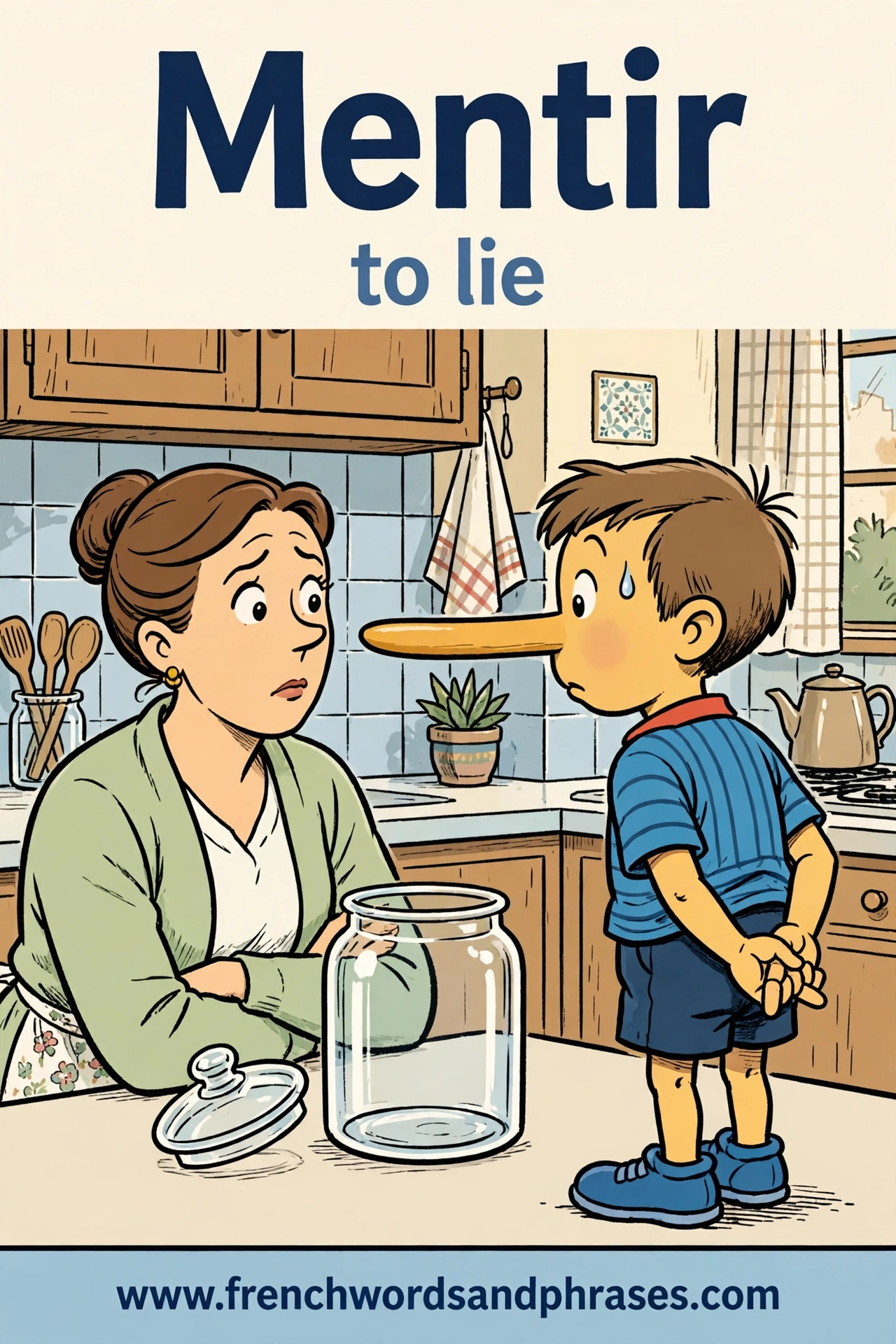
Imagine a small boy before an empty biscuit tin. « Ce n’est pas moi ! » he cries, while the crumbs on his jumper tell the true story — il ment, and his mother, who was young herself once, hides a smile behind her hand.
The tin is empty and everyone knows it. He has lied — il a menti — bravely, badly, and completely in vain.
How to Conjugate Mentir: Complete French Conjugation Guide
Let’s explore every major conjugation of mentir, beginning with the indicative mood.
How to Conjugate Mentir in the Indicative Mood
The indicative mood is used to express facts, observations, actions, and events.
How to Conjugate Mentir in the Present Tense (Présent)
Used for actions happening now, habitual actions, and general truths.
| Subject | Conjugation |
|---|---|
| je | mens |
| tu | mens |
| il / elle | ment |
| nous | mentons |
| vous | mentez |
| ils / elles | mentent |
Example
Il ment à ses parents sur ses notes.
He lies to his parents about his marks.
Quick Quiz 1
Complete the sentence:
Nous ne ______ jamais à nos amis.
Reveal the answer
mentons
Nous ne mentons jamais à nos amis.
We never lie to our friends.
How to Conjugate Mentir in the Passé Composé
Used for completed actions in the past. Mentir takes the auxiliary verb avoir.
| Subject | Conjugation |
|---|---|
| j’ | ai menti |
| tu | as menti |
| il / elle | a menti |
| nous | avons menti |
| vous | avez menti |
| ils / elles | ont menti |
Example
Tu m’as menti, et je le sais.
You lied to me, and I know it.
How to Conjugate Mentir in the Imparfait (Imperfect Tense)
Used for habitual past actions, descriptions, and ongoing situations in the past.
| Subject | Conjugation |
|---|---|
| je | mentais |
| tu | mentais |
| il / elle | mentait |
| nous | mentions |
| vous | mentiez |
| ils / elles | mentaient |
Example
Enfant, il mentait pour éviter les punitions.
As a child, he used to lie to avoid punishment.
Quick Quiz 2
Choose the correct form:
You lied to me.
Tu m’______ . (as menti / as mentis)
Reveal the answer
as menti
Tu m’as menti.
The past participle is menti — there is no -iss- in mentir.
How to Conjugate Mentir in the Plus-que-parfait
Used to describe an action that had already been completed before another past event.
| Subject | Conjugation |
|---|---|
| j’ | avais menti |
| tu | avais menti |
| il / elle | avait menti |
| nous | avions menti |
| vous | aviez menti |
| ils / elles | avaient menti |
Example
Elle avait menti sur son âge pendant des années.
She had lied about her age for years.
How to Conjugate Mentir in the Passé Simple
Primarily used in formal writing, literature, and historical narratives. It is rarely used in everyday conversation.
| Subject | Conjugation |
|---|---|
| je | mentis |
| tu | mentis |
| il / elle | mentit |
| nous | mentîmes |
| vous | mentîtes |
| ils / elles | mentirent |
Example
Devant le juge, le témoin mentit sans trembler.
Before the judge, the witness lied without trembling.
How to Conjugate Mentir in the Passé Antérieur
A literary tense used to express an action completed immediately before another past action, generally in the passé simple.
| Subject | Conjugation |
|---|---|
| j’ | eus menti |
| tu | eus menti |
| il / elle | eut menti |
| nous | eûmes menti |
| vous | eûtes menti |
| ils / elles | eurent menti |
Example
Quand il eut menti une fois de trop, personne ne le crut plus.
When he had lied once too often, nobody believed him any more.
How to Conjugate Mentir in the Future Tense (Futur Simple)
Used to describe actions that will take place in the future.
| Subject | Conjugation |
|---|---|
| je | mentirai |
| tu | mentiras |
| il / elle | mentira |
| nous | mentirons |
| vous | mentirez |
| ils / elles | mentiront |
Example
Si tu mens encore, tu perdras notre confiance.
If you lie again, you will lose our trust.
How to Conjugate Mentir in the Futur Antérieur (Future Perfect)
Used for an action that will have been completed before a particular point in the future.
| Subject | Conjugation |
|---|---|
| j’ | aurai menti |
| tu | auras menti |
| il / elle | aura menti |
| nous | aurons menti |
| vous | aurez menti |
| ils / elles | auront menti |
Example
À la fin de l’enquête, il aura menti à tout le monde.
By the end of the inquiry, he will have lied to everyone.
How to Conjugate Mentir in the Near Future (Futur Proche)
Used to describe something that is going to happen soon. Formed with aller + infinitive.
| Subject | Conjugation |
|---|---|
| je | vais mentir |
| tu | vas mentir |
| il / elle | va mentir |
| nous | allons mentir |
| vous | allez mentir |
| ils / elles | vont mentir |
Example
Attention, il va encore mentir !
Careful, he is going to lie again!
How to Conjugate Mentir in the Conditional Mood
The conditional mood expresses what would happen under certain circumstances. It is also frequently used to make polite requests or express wishes.
How to Conjugate Mentir in the Present Conditional
| Subject | Conjugation |
|---|---|
| je | mentirais |
| tu | mentirais |
| il / elle | mentirait |
| nous | mentirions |
| vous | mentiriez |
| ils / elles | mentiraient |
Example
Sans peur d’être découvert, il mentirait tous les jours.
Without fear of being found out, he would lie every day.
How to Conjugate Mentir in the Past Conditional
| Subject | Conjugation |
|---|---|
| j’ | aurais menti |
| tu | aurais menti |
| il / elle | aurait menti |
| nous | aurions menti |
| vous | auriez menti |
| ils / elles | auraient menti |
Example
Elle aurait menti pour protéger son frère.
She would have lied to protect her brother.
Mentir in the Literary Past Conditional Form
This less common literary form uses the imperfect subjunctive of avoir.
| Subject | Conjugation |
|---|---|
| j’ | eusse menti |
| tu | eusses menti |
| il / elle | eût menti |
| nous | eussions menti |
| vous | eussiez menti |
| ils / elles | eussent menti |
Example
Il eût menti même devant Dieu.
He would have lied even before God.
How to Conjugate Mentir in the Subjunctive Mood
The subjunctive is used to express wishes, emotions, doubts, necessity, and uncertainty. It frequently follows expressions such as il faut que (it is necessary that) or bien que (although).
How to Conjugate Mentir in the Present Subjunctive
| Subject | Conjugation |
|---|---|
| que je | mente |
| que tu | mentes |
| qu’il / qu’elle | mente |
| que nous | mentions |
| que vous | mentiez |
| qu’ils / qu’elles | mentent |
Example
Je déteste que tu mentes à ta mère.
I hate it when you lie to your mother.
Quick Quiz 3
Complete the sentence using the subjunctive:
Je déteste qu’il ______ à ses parents.
Reveal the answer
mente
Je déteste qu’il mente à ses parents.
I hate it when he lies to his parents.
How to Conjugate Mentir in the Imperfect Subjunctive
A literary tense, rarely encountered in modern spoken French.
| Subject | Conjugation |
|---|---|
| que je | mentisse |
| que tu | mentisses |
| qu’il / qu’elle | mentît |
| que nous | mentissions |
| que vous | mentissiez |
| qu’ils / qu’elles | mentissent |
Example
Il parlait trop vite, de peur qu’on ne crût qu’il mentît.
He spoke too quickly, for fear people might think he was lying.
How to Conjugate Mentir in the Pluperfect Subjunctive
A literary construction used to express an action completed before another past action.
| Subject | Conjugation |
|---|---|
| que j’ | eusse menti |
| que tu | eusses menti |
| qu’il / qu’elle | eût menti |
| que nous | eussions menti |
| que vous | eussiez menti |
| qu’ils / qu’elles | eussent menti |
Example
On découvrit qu’il eût menti dès le premier jour.
It was discovered that he had lied from the very first day.
How to Conjugate Mentir in the Past Subjunctive
| Subject | Conjugation |
|---|---|
| que j’ | aie menti |
| que tu | aies menti |
| qu’il / qu’elle | ait menti |
| que nous | ayons menti |
| que vous | ayez menti |
| qu’ils / qu’elles | aient menti |
Example
Je suis déçu qu’elle ait menti sur ce point.
I am disappointed that she lied on this point.
How to Conjugate Mentir in the Imperative
The imperative is used to give commands, instructions, invitations, or suggestions. Subject pronouns are omitted.
How to Conjugate Mentir in the Present Imperative
| Person | Conjugation |
|---|---|
| (tu) | mens |
| (nous) | mentons |
| (vous) | mentez |
Example
Ne mens jamais à ceux qui t’aiment !
Never lie to those who love you!
Quick Quiz 4
How would you say Never lie to me (tu form)?
Reveal the answer
Ne me mens jamais !
French Participles of Mentir
Participles are verb forms that can be used in compound tenses and other grammatical constructions.
Present Participle of Mentir
mentant
En mentant, il a perdu ses meilleurs amis.
By lying, he lost his best friends.
Past Participle of Mentir
menti
Ses excuses, menties tant de fois, ne trompaient plus personne.
His excuses, lied so many times, fooled nobody any more.
Mentir in Everyday French: Real-Life Examples
Now that you know the conjugations, let’s see how mentir appears in everyday French.
Example 1 — Present
Il ment à ses parents.
He lies to his parents.
Example 2 — Passé composé
Tu m’as menti.
You lied to me.
Example 3 — Imparfait
Enfant, elle mentait souvent.
As a child, she often used to lie.
Example 4 — Future
Je ne mentirai jamais.
I will never lie.
Example 5 — Conditional
Il mentirait pour se protéger.
He would lie to protect himself.
Example 6 — Imperative
Ne mens pas !
Don’t lie!
Beyond Translation: The Meaning of Mentir
English lie hides two verbs — to recline and to deceive; French mentir is only the second, and it never pretends otherwise.
Its family is a rogues’ gallery.
Un mensonge is a lie, un menteur a liar, and the proverb warns: menteur un jour, menteur toujours — a liar once is a liar for ever. The root is Latin mentiri, and English borrowed the flavour in mendacious — a very formal word for exactly what the small boy at the biscuit tin did.
How to Remember the French Verb Mentir
Remember it this way: Mentir is about the boy at the empty biscuit tin, crumbs on his jumper.
- Partir family, no -iss-: je mens, tu mens, il ment — the t drops in the singular.
- The plural brings the consonant back: nous mentons, vous mentez, ils mentent.
- Mentir à quelqu’un — the person lied to always takes à.
The key idea is the boy at the empty biscuit tin, crumbs on his jumper.
Test Your Knowledge of Mentir
Let’s see how much you’ve learned. Try answering these questions before revealing the answers.
Question 1
Why is je mens spelled without a t?
Reveal the answer
The partir-family rule — the stem’s final consonant drops in the singular: je mens, tu mens, il ment, but nous mentons.
Question 2
How do you say You lied to me in French?
Reveal the answer
Tu m’as menti.
Question 3
Translate: He lies to his parents about his marks.
Reveal the answer
Il ment à ses parents sur ses notes.
Question 4
What is the past participle of mentir?
Reveal the answer
Menti.
Question 5
Complete the sentence:
Je déteste que tu ______ à ta mère.
Reveal the answer
mentes
Je déteste que tu mentes à ta mère.
I hate it when you lie to your mother.
Your Final Challenge
Can You Use It?
How would you say this in French?
He lies so often that even his truth sounds like a lie.
Reveal the answer
Il ment si souvent que même sa vérité a l’air d’un mensonge.
He lies so often that even his truth sounds like a lie.
A little French. A little curiosity. A richer everyday life.
LEARN FRENCH ONE WORD AT A TIME