A French Word to Live By
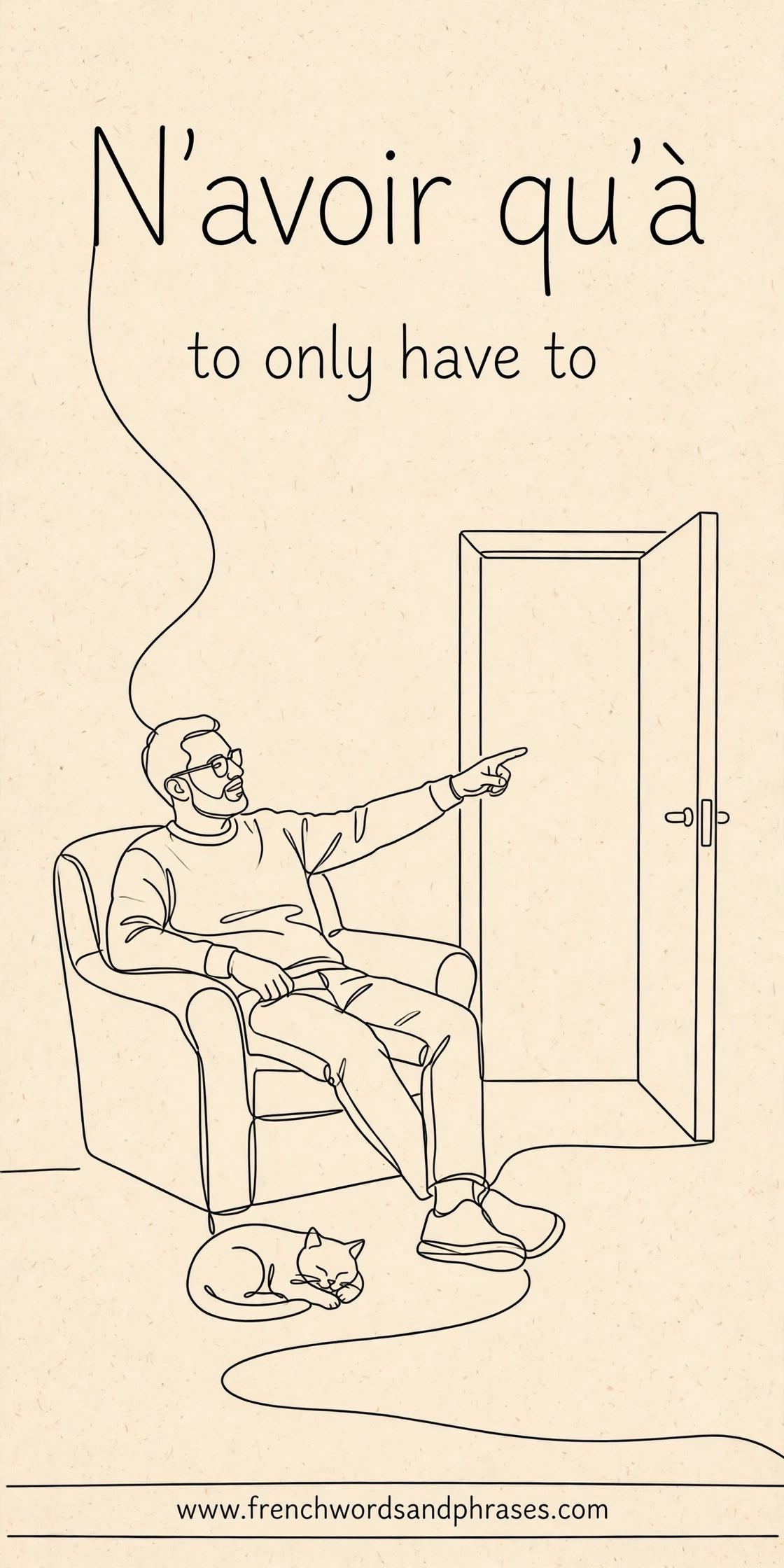
Translate N’avoir qu’à to English
/na.vwaʁ ka/
N’avoir qu’à means to only have to — to just need to.
Your friend is turning the whole kitchen upside down looking for the spare key. You watch for a moment, then point at the hook by the door where it has hung all along: « Tu n’as qu’à regarder avant de paniquer. » One tiny phrase, and the problem shrinks to a single small action.
Let’s explore how n’avoir qu’à works in French, beginning with the whole phrase on one card.
Understanding the French Phrase N’avoir qu’à
N’avoir qu’à is a French idiomatic construction built from ne… que (only) wrapped around avoir à (to have to). Said to someone — tu n’as qu’à, vous n’avez qu’à — it reduces a whole problem to one simple step: you only have to do this one thing.
It means to only have to, to just need to: tu n’as qu’à demander, you only have to ask. It is the language of easy solutions and kind advice — and, in the past tense, of gentle reproach: tu n’avais qu’à faire attention, you should have been careful, said when the lesson arrives too late.
Type: Idiomatic construction — advice (ne + avoir + que + à + infinitive)
Answers the need: Telling someone the one simple thing they need to do
Register: Neutral — everyday speech and writing; warmth or reproach comes from the tone
Strength: Reassuring in the present, reproachful in the past — tense carries the mood
One important usage detail: the phrase is almost always addressed to someone — tu n’as qu’à + infinitive, or politely vous n’avez qu’à. Its impersonal cousin il n’y a qu’à does the same job without a person: il n’y a qu’à suivre les panneaux, you just follow the signs. In the past, the meaning flips to reproach: il n’avait qu’à écouter, he should have listened.
Experience the Word
N’avoir qu’à is the smallest toolbox in French — one tool, one gesture, and the problem is supposed to fold.
Imagine a grandmother in a village in the Périgord teaching her grandson to mend a fence. He stares at the wire, the posts, the whole leaning catastrophe. She hands him the pliers and reduces the afternoon to a sentence: tu n’as qu’à serrer ici. Watch. Learn. The fence, and the lesson, stand up straight.
French loves an economy of effort. N’avoir qu’à is the philosophy of the single step: most mountains, it claims, are one gesture high.
How to Use N’avoir qu’à in French: Complete Guide
Let’s explore how n’avoir qu’à works in French, beginning with the whole phrase on one card.
N’avoir qu’à at a Glance
The Whole Phrase on One Card
Real meaning, literal picture, English twin and register — n’avoir qu’à in five lines.
| Point | N’avoir qu’à |
|---|---|
| What it really means | to only have to — one simple action is all it takes |
| Word for word | to not have except to — ne… que is French’s ‘only’, wrapped around avoir à, to have to |
| English equivalent | you only have to / you just need to / all you have to do is |
| Register | neutral — kind advice in the present, reproach in the past |
| Use it for | simple instructions, reassuring advice, and ‘you should have’ lessons |
Example
Tu n’as qu’à demander, je te prêterai la voiture.
You only have to ask, I’ll lend you the car.
Word by Word: Building the Single Step
Four small pieces — take them one by one and the mountain shrinks to a gesture.
| Word | Literal meaning | Its job in the phrase |
|---|---|---|
| ne (n’) | not | the first half of ne… que — together they mean ‘only’, not a true negation |
| avoir | to have | the verb of obligation here: avoir à faire, to have something to do |
| que (qu’) | except, only | the second half of ne… que — it keeps just one action and dismisses the rest |
| à | to | the link before the infinitive: qu’à demander, only to ask |
Example
Vous n’avez qu’à signer en bas de la page.
You only have to sign at the bottom of the page.
Quick Quiz 1
Does tu n’as qu’à demander mean ‘you must not ask’?
Reveal the answer
No — the opposite. Ne… que means ‘only’: you only have to ask. The ne here is not a real negation.
Tu n’as qu’à demander, la réponse est oui.
You only have to ask, the answer is yes.
When You Say It: The Advice Moments
N’avoir qu’à fires at moments like these — a worried person, and one small action that solves it.
| Situation | Example |
|---|---|
| Offering help | tu n’as qu’à demander — you only have to ask |
| Giving directions | vous n’avez qu’à suivre la rivière — you just follow the river |
| At the office | tu n’as qu’à cliquer ici pour imprimer — you only have to click here to print |
| Reassuring a child | tu n’as qu’à lever la main si tu as peur — just raise your hand if you’re scared |
| The reproach, afterwards | tu n’avais qu’à faire attention — you should have been careful |
Example
Elles n’ont qu’à prendre le train de huit heures.
They only have to take the eight o’clock train.
Make It Yours: Every Person, Two Moods
Avoir conjugates as usual — and the tense quietly chooses between advice and reproach.
| Form | French | In English |
|---|---|---|
| To a friend | tu n’as qu’à essayer | you only have to try |
| Polite | vous n’avez qu’à entrer | you only have to come in |
| About them | ils n’ont qu’à attendre | they just have to wait |
| Impersonal | il n’y a qu’à suivre le plan | you just follow the plan |
| Past — reproach | tu n’avais qu’à écouter | you should have listened |
| Past — reproach, polite | vous n’aviez qu’à me prévenir | you should have warned me |
Example
Il n’avait qu’à regarder l’heure, le train est parti sans lui.
He should have watched the time — the train left without him.
Quick Quiz 2
What changes when tu n’as qu’à becomes tu n’avais qu’à?
Reveal the answer
Advice becomes reproach — the imperfect turns ‘you only have to’ into ‘you should have’, said after the mistake.
Tu n’avais qu’à prendre ton parapluie.
You should have taken your umbrella.
Everyday Expressions: Building on the Single Step
N’avoir qu’à slots into these everyday frames — each one ready to use as it stands.
| Frame | In English |
|---|---|
| tu n’as qu’à + infinitive | you only have to… |
| vous n’avez qu’à + infinitive | you only have to… (polite or plural) |
| il n’y a qu’à + infinitive | you just have to… (no person named) |
| tu n’as qu’à demander | you only have to ask |
| tu n’avais qu’à… | you should have… (reproach) |
Example
Il n’y a qu’à traverser la place pour trouver la poste.
You just cross the square to find the post office.
Close Cousins: The Other Easy Solutions
French has a whole shelf of small-effort phrases — n’avoir qu’à is the personal one; its cousins hand the job to suffire or to nobody in particular.
| Expression | The difference |
|---|---|
| n’avoir qu’à | you only have to — addressed to a person, warm or reproachful |
| il suffit de | it is enough to — the solution stated impersonally, slightly more formal |
| il n’y a qu’à | you just have to — the same idea with no one named |
| avoir juste à | to just have to — the modern, relaxed twin, common in speech |
| devoir | to have to, must — plain obligation, no ‘only’ shrinking it |
Example
Il suffit de tourner la clé ; tu n’as qu’à essayer.
It is enough to turn the key; you only have to try.
Quick Quiz 3
Which cousin states the solution without naming any person — tu n’as qu’à or il suffit de?
Reveal the answer
Il suffit de — it floats above the scene: it is enough to… Tu n’as qu’à speaks straight to you.
Il suffit de réserver en ligne.
You just book online (it is enough to book online).
N’avoir qu’à and Its Neighbours
The obligation shelf around the phrase — from the gentlest nudge to the plain order.
| French | In English |
|---|---|
| il faut | it is necessary, you must — the stronger demand |
| devoir | to have to, must |
| n’avoir qu’à | to only have to |
| il suffit de | it is enough to |
| un conseil | a piece of advice — what the phrase usually delivers |
| falloir | the verb behind il faut — obligation itself |
Example
Il faut partir tôt, mais tu n’as qu’à mettre un réveil.
We have to leave early, but you only have to set an alarm.
Watch Out: The Traps Around N’avoir qu’à
The traps: a negation that is not one, a tense that turns kindness into blame, and a que that must not wander.
| Trap | The truth |
|---|---|
| reading ne as ‘not’ | ne… que means only — tu n’as qu’à venir invites you; it does not forbid you |
| the past-tense flip | tu n’avais qu’à is a reproach (you should have) — do not use it when you mean kind, present advice |
| que stays glued | the order is fixed: n’ + avoir + qu’ + à + infinitive — tu n’as à que is not French |
| not for heavy duties | for real obligation, il faut and devoir carry the weight; n’avoir qu’à shrinks the task on purpose |
Example
Il faut travailler dur, mais pour commencer, tu n’as qu’à ouvrir le livre.
You have to work hard, but to start, you only have to open the book.
Quick Quiz 4
True or false: vous n’avez qu’à entrer is a polite way to give a simple instruction.
Reveal the answer
True — vous n’avez qu’à + infinitive is the polite, everyday way to reduce a task to one step.
Vous n’avez qu’à pousser la porte, elle est ouverte.
You only have to push the door, it’s open.
N’avoir qu’à in Everyday French: Real-Life Examples
Now that you know the word, let’s see how n’avoir qu’à appears in everyday French.
Example 1 — Offering help
Tu n’as qu’à demander si tu as besoin d’aide.
You only have to ask if you need help.
Example 2 — Directions
Vous n’avez qu’à suivre cette rue jusqu’à la place.
You just follow this street as far as the square.
Example 3 — At the computer
Tu n’as qu’à cliquer sur le bouton vert.
You only have to click the green button.
Example 4 — The impersonal tip
Il n’y a qu’à réserver en ligne, c’est plus simple.
You just book online, it’s simpler.
Example 5 — The gentle reproach
Tu n’avais qu’à mettre ton réveil.
You should have set your alarm.
Example 6 — Reassuring a friend
Tu n’as qu’à respirer et commencer doucement.
You only have to breathe and start slowly.
Beyond Translation: The Meaning of N’avoir qu’à
English ‘you only have to ask’ keeps the same gentle fiction: that help, love and solutions are one small gesture away. The French construction is more elegant — a negation that does not negate, ne… que, wrapping obligation until only one kind step remains.
N’avoir qu’à is generosity disguised as grammar: it makes the favour sound smaller than it is.
And its shadow is just as French: the same words, one tense later, become the mildest blame in the language — tu n’avais qu’à.
How to Remember the French Phrase N’avoir qu’à
Remember it this way: N’avoir qu’à is a mountain reduced to one step — ne… que means ‘only’, and it keeps a single small action out of the whole problem.
- You read ne… que as only — the ne does not forbid; it shrinks the task to one gesture.
- You mind the tense — present is advice, tu n’as qu’à; past is reproach, tu n’avais qu’à.
- You keep the chain glued — n’ + avoir + qu’ + à + infinitive, in that order, always.
The key idea is n’avoir qu’à means to only have to — one small action, and the problem folds.
Test Your Knowledge of N’avoir qu’à
Let’s see how much you’ve learned. Try answering these questions before revealing the answers.
Question 1
What does tu n’as qu’à demander mean?
Reveal the answer
You only have to ask — one small action is all it takes.
Question 2
What does ne… que mean in this construction?
Reveal the answer
Only — the ne is not a true negation; ne… que together limit the task to one step.
Question 3
How do you say ‘you should have listened’ as a reproach?
Reveal the answer
Tu n’avais qu’à écouter — the imperfect turns the advice into ‘you should have’.
Question 4
What is the impersonal cousin of the phrase?
Reveal the answer
Il n’y a qu’à — it gives the same ‘just do this’ without naming a person.
Question 5
Complete the sentence:
Tu n’as ______ demander. (You only have to ask.)
Reveal the answer
qu’à
Tu n’as qu’à demander.
You only have to ask.
Your Final Challenge
Can You Use It?
How would you say this in French?
“You only have to ask.”
Reveal the answer
Tu n’as qu’à demander.
You only have to ask.
A little French. A little curiosity. A richer everyday life.
LEARN FRENCH ONE WORD AT A TIME