A French Word to Live By
Translate Avoir peur to English
/a.vwaʁ pœʁ/
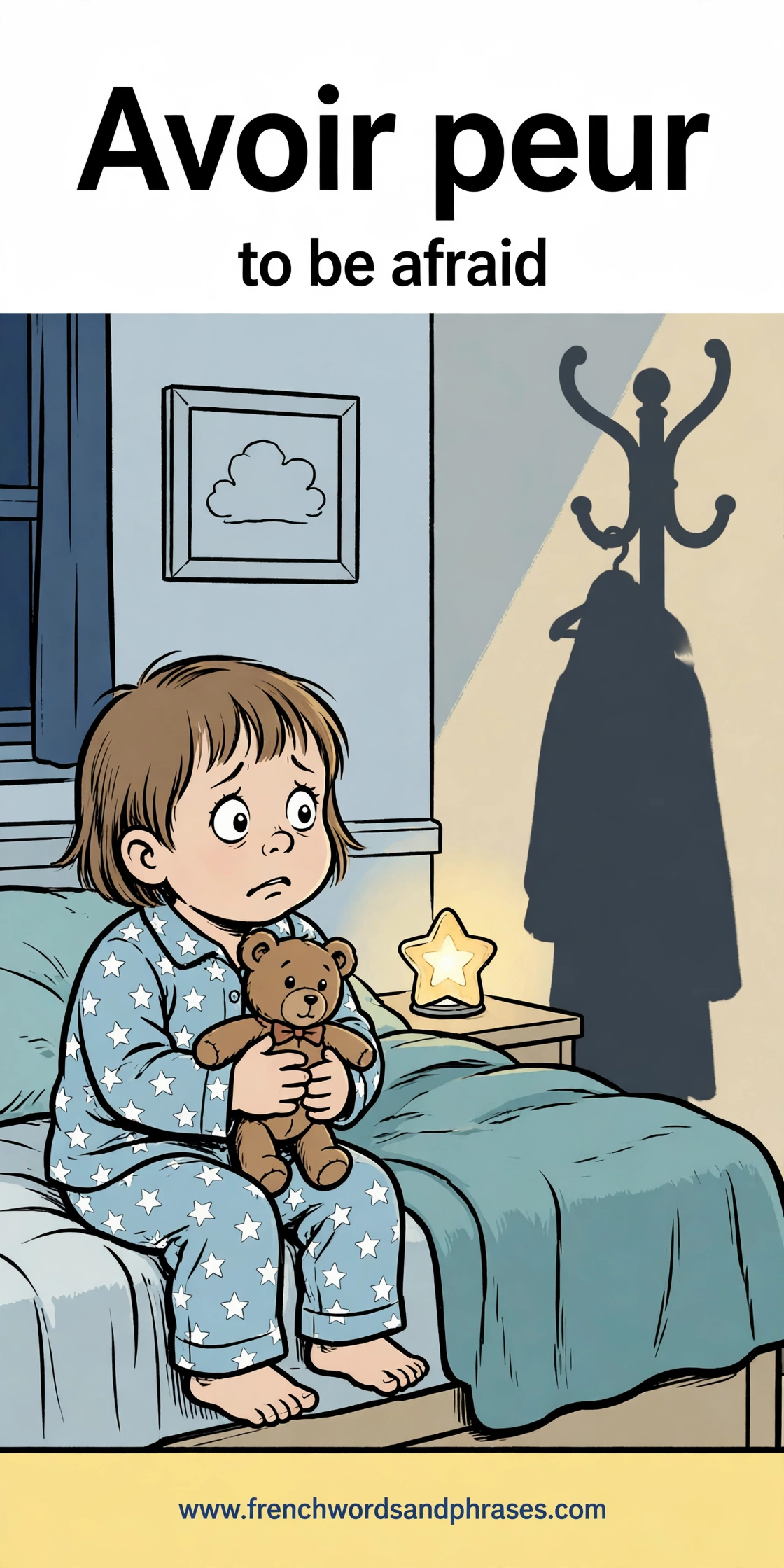
Avoir peur means to be afraid, to be scared — of something, of someone, or of doing something.
The thunderstorm arrives over the campsite at two in the morning, and the youngest camper crawls out of his sleeping bag and whispers it to the dark: « J’ai peur. » Two small words — in French, fear is not something you are, it is something you have, like a stone in your pocket.
Let’s explore how avoir peur works in French, beginning with the whole phrase on one card.
Understanding the French Phrase Avoir peur
Avoir peur is a French expression built from avoir (to have) and la peur (fear). English speakers say I am afraid — a state of being. French says j’ai peur — I have fear, a thing carried. Peur is the noun, and avoir is simply the verb that holds it.
It means to be afraid, to be scared. The fear takes a source with de: avoir peur de + a noun (j’ai peur des araignées, I am afraid of spiders) or de + an infinitive (j’ai peur de tomber, I am afraid of falling). For a fear that something might happen, French adds que and the subjunctive: j’ai peur qu’il pleuve, I am afraid it might rain.
Type: Expression — feelings (avoir + noun peur)
Answers the need: Saying you are afraid — of a thing, a person, an action or an outcome
Register: Neutral — everywhere, from the playground to the newsroom
Strength: Adjustable — from a small startle (un peu peur) to terror (une peur bleue)
One important usage detail: never translate ‘I am afraid’ word for word — je suis peur is impossible French; the fear is had, not been. Watch the infinitive after de: avoir peur de + infinitive needs the de kept (j’ai peur de rater le train), and when the fear is about someone else’s action, switch to que + subjunctive: j’ai peur qu’elle parte, I am afraid she will leave.
Experience the Word
Avoir peur is the first avoir phrase every child in France masters — usually in the dark, out loud, to someone bigger.
Imagine the funfair’s haunted house at the village fête. The queue of teenagers performs bravery for each other, but at the door the smallest one says it plainly, and the whole group relaxes: at last, honesty. J’ai peur is the bravest sentence at the fair.
French hands fear to you as an object. What you have, you can set down — and French speakers do, usually right after saying it.
How to Use Avoir peur in French: Complete Guide
Let’s explore how avoir peur works in French, beginning with the whole phrase on one card.
Avoir peur at a Glance
The Whole Phrase on One Card
Real meaning, literal picture, English twin and register — avoir peur in five lines.
| Point | Avoir peur |
|---|---|
| What it really means | to be afraid, to be scared |
| Word for word | to have fear (peur = fear) |
| English equivalent | to be afraid / to be scared / to be frightened |
| Register | neutral — safe everywhere, at every age |
| Use it for | fears of animals, the dark, heights, failure, and feared outcomes |
Example
J’ai peur des orages depuis toujours.
I have been afraid of storms for as long as I can remember.
Word by Word: Building the Fear
Two pieces — the verb that carries, and the noun that is carried.
| Word | Literal meaning | Its job in the phrase |
|---|---|---|
| avoir | to have | the carrier — fear is a possession in French, not an identity |
| peur | fear | the noun itself — feminine, la peur; it never takes an article inside this phrase |
| de | of | the little bridge to the source: peur de l’avion, peur de tomber |
Example
Elle a peur de l’eau depuis l’enfance.
She has been afraid of water since childhood.
Quick Quiz 1
Why is je suis peur impossible French?
Reveal the answer
Because fear is had, not been — peur is a noun carried by avoir: j’ai peur.
Ne t’inquiète pas, j’ai peur mais je viens.
Don’t worry, I am afraid but I am coming.
When You Say It: The Fear Moments
Avoir peur fires at moments like these — the dark, the height, the result still unknown.
| Situation | Example |
|---|---|
| A childhood fear | il a peur du noir — he is afraid of the dark |
| Of an animal | elle a peur des chiens depuis sa morsure — she has been afraid of dogs since her bite |
| Of doing something | j’ai peur de parler en public — I am afraid of speaking in public |
| Of an outcome | nous avons peur de rater le train — we are afraid of missing the train |
| Comforting | n’aie pas peur, je suis là — don’t be afraid, I am here |
Example
N’aie pas peur, le chien est gentil.
Don’t be afraid, the dog is gentle.
Make It Yours: Fear for Every Person
Avoir bends for the person; de introduces what the fear is of.
| Form | French | In English |
|---|---|---|
| I am afraid | j’ai peur | I am afraid |
| Afraid of a noun | j’ai peur des araignées | I am afraid of spiders |
| Afraid of doing | j’ai peur de tomber | I am afraid of falling |
| Afraid that… | j’ai peur qu’il soit trop tard | I am afraid it may be too late |
| In the past | elle avait peur du tonnerre | she was afraid of thunder |
| Very afraid | j’ai très peur | I am very afraid |
Example
J’ai peur qu’il pleuve pendant la randonnée.
I am afraid it might rain during the hike.
Quick Quiz 2
How do you say ‘I am afraid of falling’?
Reveal the answer
J’ai peur de tomber — de + infinitive carries the feared action.
Sur le pont étroit, elle a peur de tomber.
On the narrow bridge, she is afraid of falling.
Everyday Expressions: Building on the Fear
Avoir peur slots into these everyday frames — each one ready to use as it stands.
| Frame | In English |
|---|---|
| avoir peur de + noun | to be afraid of something |
| avoir peur de + infinitive | to be afraid of doing something |
| avoir peur que + subjunctive | to be afraid that something may happen |
| n’aie pas peur | don’t be afraid — the comfort formula |
| avoir une peur bleue | to be scared stiff — a ‘blue’ fear, total terror |
Example
Il a eu une peur bleue dans le tunnel.
He was scared stiff in the tunnel.
Close Cousins: The Other Fear Words
French shades fear finely — avoir peur is the everyday standard; its cousins frighten, worry or formalise.
| Expression | The difference |
|---|---|
| avoir peur | to be afraid — the standard, all-purpose fear |
| avoir le trac | to have stage fright — nerves before performing or speaking |
| avoir la frousse | to have the jitters — informal, a bit comic |
| être terrifié | to be terrified — fear at maximum, formal and strong |
| s’inquiéter | to worry — fear pointed at the future, quieter than peur |
Example
Avant son discours, elle avait le trac, pas vraiment peur.
Before her speech, she had stage fright, not real fear.
Quick Quiz 3
Which cousin is the nerves you feel before going on stage?
Reveal the answer
Avoir le trac — stage fright: the performer’s fear, gone once the lights are up.
Même les grands acteurs ont le trac.
Even great actors get stage fright.
Avoir peur and Its Neighbours
The fear shelf around the phrase — from the startle to the bravery that answers it.
| French | In English |
|---|---|
| la peur | fear — the noun on its own |
| faire peur | to frighten, to scare someone — peur turned outward |
| un trouillard | a coward, a scaredy-cat — informal |
| le courage | courage — what acts despite the fear |
| se rassurer | to reassure oneself, to calm down |
| une peur bleue | a terrible fright, sheer terror |
Example
Ce bruit m’a fait peur, puis je me suis rassuré.
That noise frightened me, then I calmed down.
Watch Out: The Traps Around Avoir peur
The traps: being instead of having, a missing de, and making fear when you only have it.
| Trap | The truth |
|---|---|
| je suis peur | never — peur is a noun: j’ai peur. English ‘am’ must become French ‘have’ |
| dropping the de | the source needs its bridge: peur des chiens, peur de tomber — never peur tomber |
| avoir peur vs faire peur | avoir peur is feeling it; faire peur à quelqu’un is causing it in someone else — opposite directions |
| peur que needs the subjunctive | j’ai peur qu’il vienne (not vient) — feared outcomes take the subjunctive in careful French |
Example
Tu me fais peur avec cette histoire !
You’re scaring me with that story!
Quick Quiz 4
True or false: tu as peur à moi means ‘you are scaring me’.
Reveal the answer
False — scaring someone is faire peur: tu me fais peur. Avoir peur only ever describes your own fear.
Ce film me fait peur, éteins-le.
This film is scaring me, turn it off.
Avoir peur in Everyday French: Real-Life Examples
Now that you know the word, let’s see how avoir peur appears in everyday French.
Example 1 — In the dark
J’ai peur du noir, laisse la petite lumière.
I am afraid of the dark, leave the little light on.
Example 2 — At the dentist
Elle a peur d’aller chez le dentiste depuis des années.
She has been afraid of going to the dentist for years.
Example 3 — The high dive
Il a peur de sauter du grand plongeoir.
He is afraid to jump from the high diving board.
Example 4 — Comforting a child
N’aie pas peur, ce n’est qu’un orage.
Don’t be afraid, it’s only a storm.
Example 5 — The feared result
Nous avons peur que le train soit en retard.
We are afraid the train may be late.
Example 6 — Scared stiff
Quand le chien a aboyé, j’ai eu une peur bleue.
When the dog barked, I was scared stiff.
Beyond Translation: The Meaning of Avoir peur
English is afraid — fear as an identity, worn like a coat you cannot take off. French has fear — a possession, picked up and, crucially, set down. The grammar is a small philosophy lesson: you are not your fear; you are merely carrying it at the moment.
Avoir peur turns terror into luggage — heavy, but luggage can be put down.
Perhaps that is why n’aie pas peur, don’t have fear, sounds in French less like an order and more like an offer to help you carry it.
How to Remember the French Phrase Avoir peur
Remember it this way: Avoir peur is fear carried like a stone in the pocket — you have it, you feel its weight, and you can set it down.
- You switch the verb — English says I am afraid, French says j’ai peur: the fear is had, never been.
- You build the bridge with de — peur des araignées, peur de tomber; the source always hangs on de.
- You turn it around to frighten — faire peur à quelqu’un is scaring them; avoir peur is feeling it yourself.
The key idea is avoir peur means to be afraid — in French, fear is something you have, not something you are.
Test Your Knowledge of Avoir peur
Let’s see how much you’ve learned. Try answering these questions before revealing the answers.
Question 1
What does avoir peur mean?
Reveal the answer
To be afraid, to be scared — literally, to have fear.
Question 2
How do you say ‘she is afraid of dogs’?
Reveal the answer
Elle a peur des chiens — the source of the fear attaches with de.
Question 3
How do you say ‘I am afraid of falling’?
Reveal the answer
J’ai peur de tomber — de + infinitive for a feared action.
Question 4
What is the difference between avoir peur and faire peur?
Reveal the answer
Avoir peur is feeling fear; faire peur is causing it — tu me fais peur, you are scaring me.
Question 5
Complete the sentence:
Les enfants ______ peur du noir. (The children are afraid of the dark.)
Reveal the answer
ont
Les enfants ont peur du noir.
The children are afraid of the dark.
Your Final Challenge
Can You Use It?
How would you say this in French?
“I am afraid of spiders.”
Reveal the answer
J’ai peur des araignées.
I am afraid of spiders.
A little French. A little curiosity. A richer everyday life.
LEARN FRENCH ONE WORD AT A TIME