A French Word to Live By
Translate Avoir lieu to English
/a.vwaʁ ljø/
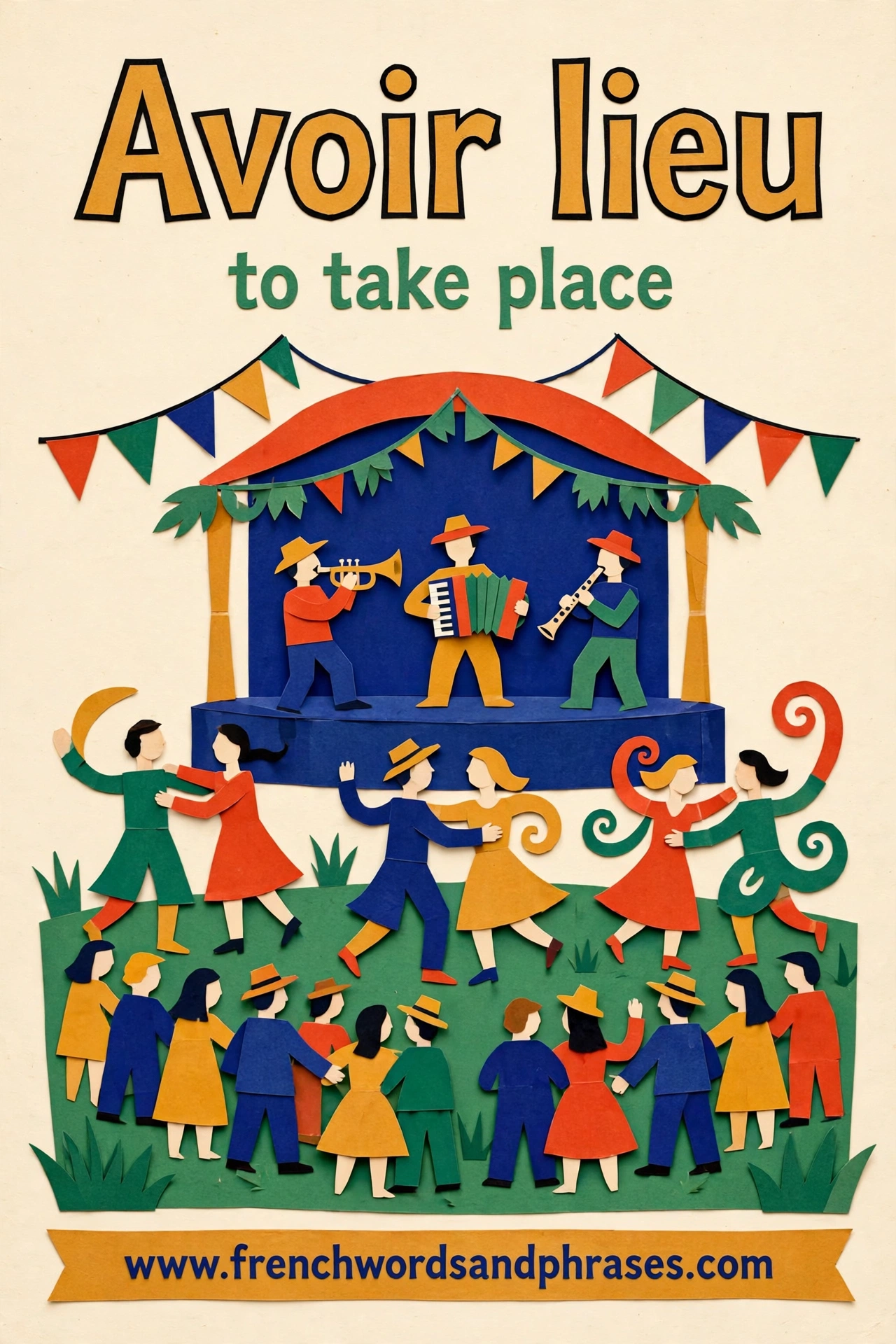
Avoir lieu means to take place — to happen, said of an event, a meeting or a ceremony.
The town hall clerk pins the notice to the board outside the mairie: the summer festival, cancelled twice, is back. Beneath the dates, one small line does all the work: « Le festival aura lieu le 14 juillet. » The festival will take place on 14 July — and the whole village starts planning around it.
Let’s explore how avoir lieu works in French, beginning with the whole phrase on one card.
Understanding the French Phrase Avoir lieu
Avoir lieu is a French set expression built from avoir (to have) and le lieu (the place). Literally ‘to have place’, it is the standard French way to say that an event takes place — it happens, at a stated time and in a stated place.
It means to take place, to happen — but only of organised things: meetings, weddings, concerts, exams, ceremonies. Nobody is holding a physical place: the phrase says an event occupies its slot in the calendar. Avoir lieu is the voice of posters, programmes and announcements: la réunion a lieu demain, the meeting takes place tomorrow.
Type: Set expression — events (avoir + noun lieu)
Answers the need: Saying when and where an event happens
Register: Neutral to formal — the language of announcements, news and programmes; fine in speech too
Strength: Factual and official — it states a schedule, it does not celebrate or complain
One important usage detail: the subject of avoir lieu is always the event itself — le mariage a lieu en juin, never the people. Place and time attach with à and le or en: la fête a lieu à Lyon, the party takes place in Lyon; la réunion a lieu lundi, the meeting is on Monday. And do not confuse it with avoir lieu de, an older formal phrase meaning ‘to have reason to’: il y a lieu de s’inquiéter, there is reason to worry.
Experience the Word
Avoir lieu is the quiet phrase behind every poster and programme in France — the moment an idea becomes a date.
Imagine the wedding invitations arriving in spring letterboxes across the country. The couple chose the words months ago, but it is this small formula — la cérémonie aura lieu à midi — that turns their plan into something guests can circle on a calendar.
French keeps a calm, official verb for happenings. An event does not merely happen in French; it takes its place.
How to Use Avoir lieu in French: Complete Guide
Let’s explore how avoir lieu works in French, beginning with the whole phrase on one card.
Avoir lieu at a Glance
The Whole Phrase on One Card
Real meaning, literal picture, English twin and register — avoir lieu in five lines.
| Point | Avoir lieu |
|---|---|
| What it really means | to take place — an event happens at a set time and place |
| Word for word | to have place (lieu = place) |
| English equivalent | to take place / to be held / to happen (of an event) |
| Register | neutral to formal — announcements, news, programmes |
| Use it for | meetings, weddings, concerts, exams, ceremonies, matches |
Example
La réunion a lieu demain à dix heures.
The meeting takes place tomorrow at ten o’clock.
Word by Word: Building the Event
Two small pieces — a verb that holds, and a noun that gives the event its spot.
| Word | Literal meaning | Its job in the phrase |
|---|---|---|
| avoir | to have | the holder — it carries the tense: a lieu (present), a eu lieu (past), aura lieu (future) |
| lieu | place | the noun — the event ‘has’ its place in the calendar and on the map |
Example
Le concert a eu lieu hier soir.
The concert took place last night.
Quick Quiz 1
What is the subject of a lieu in la réunion a lieu demain?
Reveal the answer
The event itself — la réunion takes place; the people attending never ‘have place’.
La fête a lieu samedi dans le jardin.
The party takes place on Saturday in the garden.
When You Say It: The Scheduled Moments
Avoir lieu fires at moments like these — wherever an event is announced, reported or checked.
| Situation | Example |
|---|---|
| Announcing a meeting | la réunion a lieu demain matin — the meeting takes place tomorrow morning |
| On a poster | le festival a lieu du 3 au 5 août — the festival takes place from 3 to 5 August |
| Reporting afterwards | le mariage a eu lieu en Provence — the wedding took place in Provence |
| Asking where | où a lieu la conférence ? — where does the conference take place? |
| A regular event | le marché a lieu tous les dimanches — the market takes place every Sunday |
Example
Où a lieu le concert de ce soir ?
Where does tonight’s concert take place?
Make It Yours: The Event in Every Tense
Avoir carries the tense — lieu itself never changes.
| Form | French | In English |
|---|---|---|
| Present | la réunion a lieu demain | the meeting takes place tomorrow |
| Past | la réunion a eu lieu hier | the meeting took place yesterday |
| Future | la réunion aura lieu lundi | the meeting will take place on Monday |
| With a place | le match a lieu à Paris | the match takes place in Paris |
| Question | quand a lieu l’examen ? | when does the exam take place? |
| Negative — cancelled | la fête n’aura pas lieu | the party will not take place |
Example
À cause de la pluie, la fête n’aura pas lieu.
Because of the rain, the party will not take place.
Quick Quiz 2
How do you say ‘the ceremony took place yesterday’?
Reveal the answer
La cérémonie a eu lieu hier — avoir goes into the past (a eu), lieu stays exactly the same.
La cérémonie a eu lieu hier à la mairie.
The ceremony took place yesterday at the town hall.
Everyday Expressions: Building on the Place
Avoir lieu slots into these everyday frames — each one ready to use as it stands.
| Frame | In English |
|---|---|
| avoir lieu | to take place |
| avoir lieu à | to take place in/at (a place) |
| avoir lieu le… | to take place on (a date or day) |
| avoir eu lieu | to have taken place |
| où et quand a lieu… ? | where and when does … take place? |
Example
Le salon a lieu à Lyon cette année.
The trade fair takes place in Lyon this year.
Close Cousins: The Other Ways Things Happen
French has a whole shelf of happening phrases — avoir lieu is the scheduled one; its cousins are sudden, personal or plainer.
| Expression | The difference |
|---|---|
| avoir lieu | to take place — planned events with a time and a place |
| se passer | to happen, to go (of an event) — comment ça s’est passé ? how did it go? |
| se dérouler | to unfold, to take place — a slightly formal twin, loved by news reports |
| arriver | to happen — for accidents and surprises: un accident est arrivé |
| se tenir | to be held — for meetings and fairs: le salon se tient à Paris |
Example
Comment s’est passé ton examen ? Il a eu lieu hier.
How did your exam go? It took place yesterday.
Quick Quiz 3
A car crash closes the motorway. Avoir lieu or arriver?
Reveal the answer
Arriver — accidents and surprises arrive; only planned events ont lieu.
Un accident est arrivé sur l’autoroute ce matin.
An accident happened on the motorway this morning.
Avoir lieu and Its Neighbours
The events shelf around the phrase — from the announcement to the cancellation.
| French | In English |
|---|---|
| un événement | an event |
| une réunion | a meeting |
| être annulé | to be cancelled |
| être reporté | to be postponed |
| se tenir | to be held |
| avoir lieu | to take place |
Example
Reporté deux fois, le concert a enfin eu lieu.
Postponed twice, the concert finally took place.
Watch Out: The Traps Around Avoir lieu
The traps: a noun with other jobs, an old-fashioned cousin, and events that refuse to be scheduled.
| Trap | The truth |
|---|---|
| lieu’s other lives | un lieu is also simply a place — un lieu calme, a quiet place; only avoir lieu makes the event phrase |
| avoir lieu de | il y a lieu de douter means there is reason to doubt — a formal cousin with a different meaning; do not merge them |
| not for accidents | crashes, storms and surprises arriver or se passer — avoir lieu is for the diary, not the disaster |
| the people never take place | you cannot say nous avons lieu — the event is the subject, always |
Example
Il y a lieu de vérifier la date avant d’annoncer le concert.
There is reason to check the date before announcing the concert.
Quick Quiz 4
True or false: you can say nous avons lieu à Paris to mean the group is meeting in Paris.
Reveal the answer
False — people never ‘have place’. The meeting does: la réunion a lieu à Paris.
Notre réunion a lieu à Paris, au bureau.
Our meeting takes place in Paris, at the office.
Avoir lieu in Everyday French: Real-Life Examples
Now that you know the word, let’s see how avoir lieu appears in everyday French.
Example 1 — The team meeting
La réunion a lieu demain à neuf heures, salle 12.
The meeting takes place tomorrow at nine o’clock, room 12.
Example 2 — The wedding
Le mariage aura lieu en juin, dans un petit village.
The wedding will take place in June, in a small village.
Example 3 — The exam
L’examen a eu lieu hier matin, sans problème.
The exam took place yesterday morning, without a hitch.
Example 4 — The weekly market
Le marché a lieu tous les samedis sur la place.
The market takes place every Saturday in the square.
Example 5 — Asking the way
Excusez-moi, où a lieu la conférence ?
Excuse me, where does the conference take place?
Example 6 — The cancellation
À cause de la neige, le match n’aura pas lieu.
Because of the snow, the match will not take place.
Beyond Translation: The Meaning of Avoir lieu
English lets events ‘take place’ too — but where English pictures an event seizing a spot, French pictures it quietly having one, the way a guest has a chair. Avoir lieu is administrative poetry: nothing in France truly exists until it has its lieu, its date and its little line on a notice board.
To say a lieu is to move an event from someone’s intention to the public calendar.
That is why the phrase lives on posters and in news reports — it is the sound of a plan becoming official.
How to Remember the French Phrase Avoir lieu
Remember it this way: Avoir lieu is an event taking its seat — every happening in France has its place in the calendar, the way a guest has a chair at the table.
- You picture the notice board — lieu is a place, and the event ‘has’ its place: dated, located, official.
- You give it an event as its subject — la réunion a lieu; the people attending never do.
- You bend only avoir — a lieu, a eu lieu, aura lieu; lieu itself never moves.
The key idea is avoir lieu means to take place — the event has its place in the calendar.
Test Your Knowledge of Avoir lieu
Let’s see how much you’ve learned. Try answering these questions before revealing the answers.
Question 1
What does avoir lieu mean?
Reveal the answer
To take place — said of a planned event: a meeting, a wedding, a concert, an exam.
Question 2
What is the literal, word-for-word meaning?
Reveal the answer
To have place — lieu is a place, and the event ‘has’ its place in the calendar.
Question 3
How do you say ‘the meeting took place yesterday’?
Reveal the answer
La réunion a eu lieu hier — avoir goes into the past as a eu; lieu never changes.
Question 4
Why can’t you use avoir lieu for a car accident?
Reveal the answer
Because accidents are not scheduled — French says un accident est arrivé; avoir lieu belongs to planned events.
Question 5
Complete the sentence:
Le festival ______ lieu le 14 juillet. (The festival takes place on 14 July.)
Reveal the answer
a
Le festival a lieu le 14 juillet.
The festival takes place on 14 July.
Your Final Challenge
Can You Use It?
How would you say this in French?
“The meeting takes place tomorrow.”
Reveal the answer
La réunion a lieu demain.
The meeting takes place tomorrow.
A little French. A little curiosity. A richer everyday life.
LEARN FRENCH ONE WORD AT A TIME