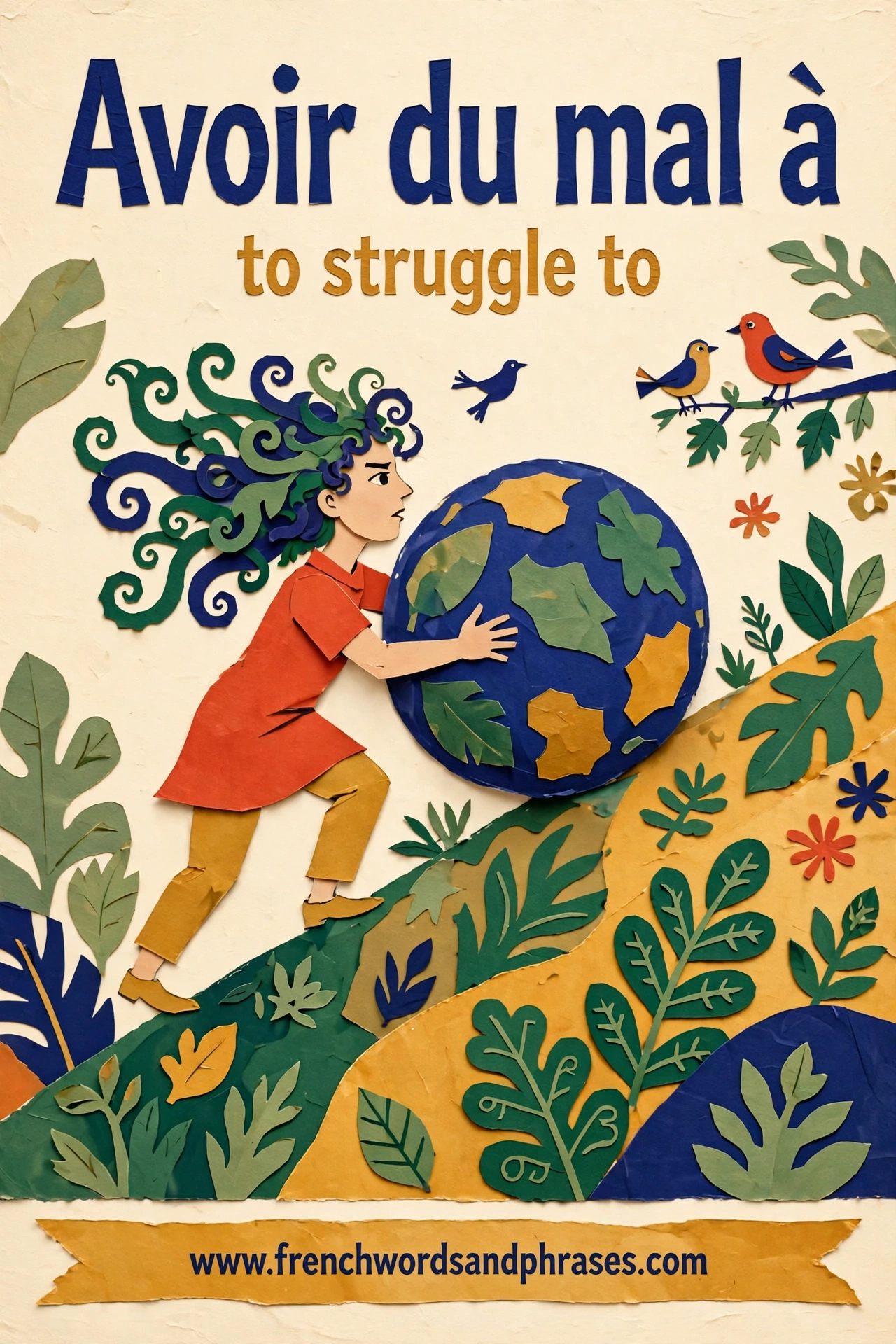
A French Word to Live By
Translate Avoir du mal à to English
/a.vwaʁ dy mal a/
Avoir du mal à means to struggle to — to have trouble doing something.
The jar of jam has defeated three people already. Your grandfather takes it, twists with all his strength, shakes his head and hands it back with a laugh: « J’ai du mal à l’ouvrir. » The lid has won, and French has the honest phrase for it.
Let’s explore how avoir du mal à works in French, beginning with the whole phrase on one card.
Understanding the French Phrase Avoir du mal à
Avoir du mal à is a French expression built from avoir (to have), du mal (some difficulty, some pain) and à plus an infinitive. It is the standard French way to say you are struggling to do something — the task is possible, but it costs you real effort.
It means to struggle to do something, to have trouble doing it. English says ‘I’m having trouble opening this’ or ‘I struggle to concentrate’; French reaches for du mal — a little parcel of difficulty that you carry while you work. The phrase is sympathetic, not dramatic: the thing gets done, but not easily.
Type: Expression — difficulty (avoir + du mal + à + infinitive)
Answers the need: Saying a task is hard for you, that you are struggling with it
Register: Neutral — safe everywhere, in speech and in writing
Strength: Moderate — real effort, real difficulty, but the task is not impossible
One important usage detail: avoir du mal à is always followed by an infinitive — j’ai du mal à dormir, elle a du mal à marcher. For a person you have trouble with, French switches the construction: avoir du mal avec quelqu’un. And watch the near-twin avoir mal à, which means a body part hurts: j’ai mal à la tête, my head hurts.
Experience the Word
Avoir du mal à is the sound of effort admitted out loud — no shame in it, just honesty about the weight of the task.
Imagine a student in a night class in Lyon, staring at the subjunctive for the third week running. Around her, heads are bent over the same page. She is not failing; she is doing the thing slowly, with du mal, and the teacher’s nod says that is exactly how French is learned.
French separates trying from succeeding with great care. Avoir du mal à is the phrase for the honest middle: not giving up, not there yet.
How to Use Avoir du mal à in French: Complete Guide
Let’s explore how avoir du mal à works in French, beginning with the whole phrase on one card.
Avoir du mal à at a Glance
The Whole Phrase on One Card
Real meaning, literal picture, English twin and register — avoir du mal à in five lines.
| Point | Avoir du mal à |
|---|---|
| What it really means | to struggle to do something — to have trouble doing it |
| Word for word | to have some difficulty at (doing) |
| English equivalent | to struggle to / to have trouble -ing / to find it hard to |
| Register | neutral — safe everywhere, speech and writing |
| Use it for | hard tasks, slow learning, heavy lids and stubborn zips |
Example
J’ai du mal à ouvrir ce bocal.
I’m struggling to open this jar.
Word by Word: Building the Difficulty
Four small pieces — take them one by one and the effort builds itself.
| Word | Literal meaning | Its job in the phrase |
|---|---|---|
| avoir | to have | the verb that holds the difficulty — you carry it with you |
| du | some (partitive) | a portion of difficulty, not the whole world’s supply |
| mal | pain, trouble, difficulty | the hard core of the phrase — the same mal as in mal à la tête, a headache |
| à | to, at | the hinge that points the difficulty at a verb: à + infinitive |
Example
Elle a du mal à se lever le matin.
She struggles to get up in the morning.
Quick Quiz 1
What must follow avoir du mal à — a noun or an infinitive?
Reveal the answer
An infinitive — the difficulty always points at an action: avoir du mal à dormir, à comprendre, à choisir.
Il a du mal à choisir entre les deux.
He is struggling to choose between the two.
When You Say It: The Struggle Moments
Avoir du mal à fires at moments like these — the task is under way, and it is costing you.
| Situation | Example |
|---|---|
| A physical task | j’ai du mal à porter cette valise — I’m struggling to carry this suitcase |
| Learning something | elle a du mal à apprendre ses verbes — she is having trouble learning her verbs |
| Sleep and rest | il a du mal à dormir depuis le déménagement — he has struggled to sleep since the move |
| Understanding | nous avons du mal à comprendre son accent — we have trouble understanding his accent |
| Believing something | j’ai du mal à le croire — I struggle to believe it, I can hardly believe it |
Example
Au début, j’avais du mal à comprendre les annonces dans le métro.
At first, I struggled to understand the announcements on the metro.
Make It Yours: The Struggle for Every Person
Avoir conjugates as usual — and the phrase softens or strengthens with a few small adverbs.
| Form | French | In English |
|---|---|---|
| I struggle to | j’ai du mal à | I struggle to, I have trouble |
| She has trouble | elle a du mal à se concentrer | she has trouble concentrating |
| In the past | j’avais du mal à marcher | I had trouble walking |
| A lot of trouble | avoir beaucoup de mal à | to have a great deal of trouble |
| With a person | avoir du mal avec quelqu’un | to have trouble with someone, to not get on with them |
| Question | tu as du mal à respirer ? | are you having trouble breathing? |
Example
Après l’opération, il avait du mal à marcher sans canne.
After the operation, he had trouble walking without a stick.
Quick Quiz 2
Your head hurts. Is it j’ai du mal à la tête or j’ai mal à la tête?
Reveal the answer
J’ai mal à la tête — avoir mal à names a pain in a body part. Avoir du mal à is about struggling to do something.
J’ai mal à la tête, et en plus j’ai du mal à travailler.
My head hurts, and on top of that I’m struggling to work.
Everyday Expressions: Building on the Difficulty
Avoir du mal à slots into these everyday frames — each one ready to use as it stands.
| Frame | In English |
|---|---|
| avoir du mal à + infinitive | to struggle to do something |
| avoir du mal à y croire | to struggle to believe it, to find it hard to believe |
| avoir du mal à s’y faire | to struggle to get used to it |
| avoir beaucoup de mal à | to have a great deal of trouble doing |
| avoir du mal avec quelqu’un | to have trouble with someone (a person, not a task) |
Example
Elle a du mal à s’y faire, ce nouveau rythme.
She is struggling to get used to this new routine.
Close Cousins: The Other Ways to Struggle
French grades difficulty carefully — avoir du mal à is the honest middle; its cousins are lighter, heavier or more colourful.
| Expression | The difference |
|---|---|
| avoir du mal à | to struggle to — real difficulty, neutral, the everyday choice |
| avoir de la peine à | to have trouble doing — a close twin, slightly gentler and a touch literary |
| peiner à | to labour to, to toil — the difficulty is heavier, almost physical effort |
| galérer | to struggle, to have a hard time of it — very informal, the slang of hard days |
| ne pas y arriver | to not manage it, to be unable to do it — the struggle tips into failure |
Example
Il peine à finir son rapport avant vendredi.
He is labouring to finish his report before Friday.
Quick Quiz 3
Which cousin says the struggle ended in failure — avoir du mal à or ne pas y arriver?
Reveal the answer
Ne pas y arriver — with du mal, you are still managing, slowly; with ne pas y arriver, the thing is not getting done.
J’ai beau essayer, je n’y arrive pas.
However hard I try, I just can’t manage it.
Avoir du mal à and Its Neighbours
The effort shelf around the phrase — from the first difficulty to the final success.
| French | In English |
|---|---|
| être difficile | to be difficult (the task itself) |
| faire des efforts | to make an effort |
| s’en sortir | to manage, to get through it |
| y arriver | to manage it, to succeed at it |
| les doigts dans le nez | hands down, effortlessly — the triumphant opposite |
| un jeu d’enfant | child’s play — as easy as it gets |
Example
Au début il avait du mal, mais il s’en est très bien sorti.
At first he struggled, but he came through it very well.
Watch Out: The Traps Around Avoir du mal à
The traps: a headache hiding in the phrase, a person where a verb should be, and an English word-for-word that breaks.
| Trap | The truth |
|---|---|
| mal à vs du mal à | j’ai mal au dos is a bad back — a pain; j’ai du mal à me lever is struggling to get up — an effort. The little word du changes everything |
| people take avec | for difficulty with a person, say avoir du mal avec lui — à is reserved for the infinitive that follows |
| no noun after à | avoir du mal à needs a verb: avoir du mal à dormir, never avoir du mal à le sommeil |
| word for word in English | ‘to have evil to’ means nothing — English says struggle to, have trouble, find it hard to |
Example
J’ai mal au genou, alors j’ai du mal à monter les escaliers.
My knee hurts, so I struggle to climb the stairs.
Quick Quiz 4
True or false: avoir du mal à means the task is impossible.
Reveal the answer
False — it means the task is hard and costs effort, but it is still being done. Impossible is impossible or ne pas y arriver.
Il a du mal à courir, mais il finit toujours la course.
He struggles to run, but he always finishes the race.
Avoir du mal à in Everyday French: Real-Life Examples
Now that you know the word, let’s see how avoir du mal à appears in everyday French.
Example 1 — The heavy suitcase
J’ai du mal à fermer cette valise, assieds-toi dessus !
I’m struggling to close this suitcase — sit on it!
Example 2 — In class
Les élèves ont du mal à distinguer le passé composé de l’imparfait.
The pupils are having trouble telling the passé composé from the imparfait.
Example 3 — After the move
Il a du mal à dormir dans le nouvel appartement.
He is struggling to sleep in the new flat.
Example 4 — On the phone
Pardon, j’ai du mal à vous entendre, la ligne est mauvaise.
Sorry, I’m having trouble hearing you, the line is bad.
Example 5 — Hard to believe
Tu as gagné ? J’ai du mal à y croire !
You won? I can hardly believe it!
Example 6 — The old car
Le matin, la voiture a du mal à démarrer.
In the morning, the car struggles to start.
Beyond Translation: The Meaning of Avoir du mal à
English struggles — a fighter’s word, all resistance and wrestling. French has du mal: a little weight of trouble that you hold in your hands while you work. The picture is quieter, and kinder — the difficulty is a thing you carry, not an enemy you fight.
To avoir du mal à is to admit the weight honestly and keep carrying it anyway.
That honesty is why the phrase is heard so often in French staffrooms and kitchens: it asks for patience, not rescue.
How to Remember the French Phrase Avoir du mal à
Remember it this way: Avoir du mal à is difficulty carried in the hands — a small, honest weight of trouble between you and the task.
- You keep the twins apart — mal à la tête is a headache; du mal à travailler is struggling to work.
- You always aim it at a verb — du mal à dormir, à comprendre, à choisir: an infinitive follows, never a noun.
- You switch for people — trouble with a person is du mal avec quelqu’un.
The key idea is avoir du mal à means to struggle to do something — difficulty you carry, with an infinitive after à.
Test Your Knowledge of Avoir du mal à
Let’s see how much you’ve learned. Try answering these questions before revealing the answers.
Question 1
What does avoir du mal à mean?
Reveal the answer
To struggle to do something — to have trouble doing it, with real effort.
Question 2
What kind of word must follow the à?
Reveal the answer
An infinitive — avoir du mal à dormir, à comprendre, à marcher.
Question 3
How do you say ‘she has trouble concentrating’?
Reveal the answer
Elle a du mal à se concentrer — avoir conjugates, and the infinitive follows à.
Question 4
What is the difference between j’ai mal à la tête and j’ai du mal à travailler?
Reveal the answer
The first is a pain, the second is an effort — mal à la tête is a headache; du mal à travailler is struggling to work.
Question 5
Complete the sentence:
Je ______ du mal à ouvrir cette porte. (I am struggling to open this door.)
Reveal the answer
j’ai
J’ai du mal à ouvrir cette porte.
I am struggling to open this door.
Your Final Challenge
Can You Use It?
How would you say this in French?
“I am struggling to understand this lesson.”
Reveal the answer
J’ai du mal à comprendre cette leçon.
I am struggling to understand this lesson.
A little French. A little curiosity. A richer everyday life.
LEARN FRENCH ONE WORD AT A TIME