A French Word to Live By
Translate Avoir du charme to English
/a.vwaʁ dy ʃaʁm/
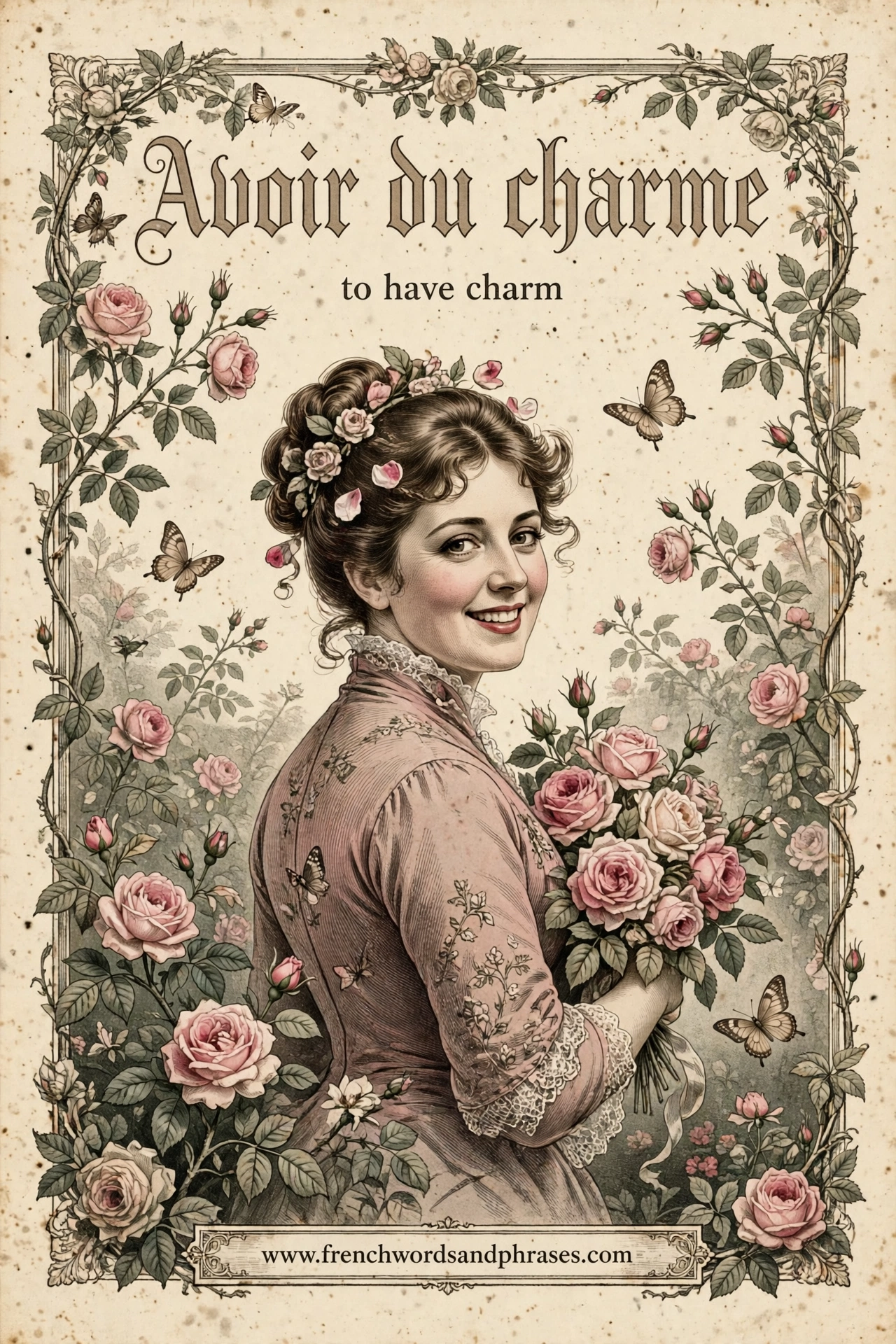
Avoir du charme means to have charm — the quiet attractiveness of a person, a place or a voice.
The little café in Provence has mismatched chairs, a menu of four dishes, and a queue at weekends. The owner remembers every name, asks after every grandmother, and laughs like a doorbell. A visitor, searching for the reason, gives up analysing and says it in three words: « Il a du charme, ce café. » It has charm — he has charm — the place and the man share one portion between them.
Let’s explore how avoir du charme works in French, beginning with the whole phrase on one card.
Understanding the French Phrase Avoir du charme
Avoir du charme is a French set phrase built from avoir (to have), du (some — the partitive) and charme (charm, a masculine noun). Like luck, charm comes in portions: du charme is some of the substance, and the substance itself once meant a magic spell — un charme was an enchantment before it was a compliment, and the word has never quite lost the glitter.
It means to have charm. The phrase serves two kingdoms: people — il a du charme, his smile and ease attract you — and places: ce village a du charme, this village has charm, its stones and light hold you. It is gentler than beauty and warmer than elegance: beauty is measured, elegance is judged, but charm is felt, and usually by surprise.
Type: Set phrase — attraction (avoir + du + charme)
Answers the need: Saying a person, place or thing attracts without quite saying why
Register: Neutral — complimentary in speech and writing alike
Strength: Warm and genuine — stronger than pretty, softer than dazzling
One important usage detail: the partitive is du, because charme is masculine — avoir du charme, never de la charme. And the phrase covers places as happily as people, which English ‘charming’ shares but ‘he has charm’ hides: in French, une maison, un village, une voix can all avoir du charme with exactly the same words.
Experience the Word
Avoir du charme is the compliment French gives when beauty is not the point and everybody is won over anyway.
Imagine the bookshop with the bell over the door, the grandmother whose kitchen draws the whole street, the old quarter where every lane bends like it is keeping a secret. None of them would win a contest. All of them hold their visitors a little longer than planned.
Charm is the portion that cannot be photographed. Beauty stops the eye; du charme keeps the guest.
How to Use Avoir du charme in French: Complete Guide
Let’s explore how avoir du charme works in French, beginning with the whole phrase on one card.
Avoir du charme at a Glance
The Whole Phrase on One Card
Real meaning, literal building blocks, English twin and register — avoir du charme in five lines.
| Point | Avoir du charme |
|---|---|
| What it really means | to have charm — to attract quietly, beyond mere good looks |
| Word for word | to have some charm — charme once meant a magic spell |
| English equivalent | to have charm / to be charming |
| Register | neutral — a true compliment, safe in any company |
| Use it for | people, villages, houses, voices, cafés — anything that holds you |
Example
Ce petit village a beaucoup de charme.
This little village has a lot of charm.
Word by Word: Building the Charm
Three pieces — a holding verb, the partitive of portions, and a word that used to be a spell.
| Word | Literal meaning | Its job in the phrase |
|---|---|---|
| avoir | to have | the holding verb — charm as a portion possessed |
| du | some (of the) | the masculine partitive: charm in measures, like luck and bread |
| charme | charm | a masculine noun: le charme — once a magic spell, now an attraction |
Example
Elle a du charme et un sourire qui rassure.
She has charm and a smile that reassures.
Quick Quiz 1
Is it avoir du charme or avoir de la charme?
Reveal the answer
Avoir du charme — charme is masculine: le charme, du charme.
Cette maison a du charme, malgré sa taille.
This house has charm, despite its size.
When You Say It: The Charming Moments
Avoir du charme fires at moments like these — the attraction is real, and the reason is delightfully unclear.
| Situation | Example |
|---|---|
| Of a person | il a du charme, tout le monde l’écoute — he has charm, everyone listens to him |
| Of a village | ce village a du charme, regardez ces ruelles — this village has charm, look at these lanes |
| Of a house | la maison est petite, mais elle a du charme — the house is small, but it has charm |
| Of a voice | elle a une voix qui a du charme — she has a voice with charm |
| Of an old café | ce café a du charme, on y reste des heures — this café has charm, you stay for hours |
Example
Ce quartier a du charme le soir, avec ses lampadaires.
This neighbourhood has charm in the evening, with its street lamps.
Make It Yours: The Charm for Every Subject
Avoir bends for people and places alike, and degree words pour the charm thicker.
| Form | French | In English |
|---|---|---|
| He has charm | il a du charme | he has charm |
| She has charm | elle a du charme | she has charm |
| A lot of charm | avoir beaucoup de charme | to have a lot of charm |
| Full of charm | plein de charme | full of charm — the adjective-style twin |
| In the past | ce café avait du charme | this café had charm |
| Lacking it | manquer de charme | to lack charm |
Example
L’ancien café avait du charme, le nouveau est trop froid.
The old café had charm, the new one is too cold.
Quick Quiz 2
Can a house avoir du charme, or is the phrase for people only?
Reveal the answer
A house can — places, voices and objects take the phrase exactly like people do.
Cette vieille maison a du charme, avec son jardin secret.
This old house has charm, with its secret garden.
Everyday Expressions: Building on the Charm
Avoir du charme slots into these everyday frames — each one ready to use as it stands.
| Frame | In English |
|---|---|
| avoir du charme | to have charm |
| avoir beaucoup de charme | to have a lot of charm |
| plein de charme | full of charm — for places above all |
| un charme fou | a mad, irresistible charm |
| manquer de charme | to lack charm — the polite disappointment |
Example
Ce jardin a un charme fou au printemps.
This garden has an irresistible charm in spring.
Close Cousins: The Other Attractions
French attracts at several temperatures — du charme is the warm middle; its cousins judge, dazzle or seduce.
| Expression | The difference |
|---|---|
| avoir du charme | to have charm — quiet attraction, for people and places |
| être charmant | to be charming — the adjective twin, slightly more about manners |
| être séduisant | to be seductive, attractive — stronger, aimed at a person, with desire in it |
| avoir du caractère | to have character — of a place: distinctive, not necessarily charming |
| pittoresque | picturesque — of a place: pretty as a picture, seen rather than felt |
Example
Le village est pittoresque, mais c’est son marché qui a du charme.
The village is picturesque, but it’s its market that has the charm.
Quick Quiz 3
Which cousin adds desire and is too strong for a village — avoir du charme or être séduisant?
Reveal the answer
Être séduisant — seductive belongs to people and attraction; a village has du charme.
Il est séduisant, et son village natal a du charme.
He is attractive, and his home village has charm.
Avoir du charme and Its Neighbours
The attraction shelf around the phrase — smiles, welcomes, and the old magic underneath.
| French | In English |
|---|---|
| charmant | charming — the adjective of the family |
| charmer | to charm, to delight — the verb of the family |
| un sourire | a smile — charm’s usual instrument |
| accueillant | welcoming — charm’s effect on a place |
| un charme (ancien) | a spell, an enchantment — the word’s magical ancestor |
Example
Son sourire charme tout le quartier.
Her smile charms the whole neighbourhood.
Watch Out: The Traps Around Avoir du charme
The traps: the wrong partitive, a bracelet that is not a spell, and charm confused with beauty.
| Trap | The truth |
|---|---|
| de la charme | charme is masculine — du charme, le charme; the feminine article is the classic slip |
| a charm bracelet | English ‘charm’ for jewellery is une breloque in French — un bracelet à breloques; charme never hangs from a wrist |
| charm is not beauty | on peut avoir du charme sans être beau: charm is effect, not measurements — that is its kindness |
| charme as a spell | in tales and old texts, un charme is an enchantment: la fée jette un charme, the fairy casts a spell |
Example
Dans le conte, la fée jette un charme sur le château.
In the tale, the fairy casts a spell on the castle.
Quick Quiz 4
True or false: avoir du charme means exactly the same as être très beau.
Reveal the answer
False — charm is the effect you have on people, not the beauty of your features; the two often travel apart.
Il n’est pas beau, mais il a un charme fou.
He isn’t handsome, but he has enormous charm.
Avoir du charme in Everyday French: Real-Life Examples
Now that you know the word, let’s see how avoir du charme appears in everyday French.
Example 1 — The café owner
Il a du charme, ce patron, les clients reviennent pour lui.
He has charm, this owner — the customers come back for him.
Example 2 — The village
Ce petit village a beaucoup de charme.
This little village has a lot of charm.
Example 3 — The old house
La maison a du charme, avec ses volets bleus.
The house has charm, with its blue shutters.
Example 4 — The voice
Elle chante avec une voix qui a du charme.
She sings with a voice that has charm.
Example 5 — The compliment
Tu as du charme quand tu ris.
You have charm when you laugh.
Example 6 — The bookshop
Cette librairie a un charme fou, on ne veut plus partir.
This bookshop has irresistible charm, you never want to leave.
Beyond Translation: The Meaning of Avoir du charme
Charm began as magic: the Latin carmen was a song that bound, then a spell, and French charme kept both lives — the fairy’s enchantment and the café owner’s smile. The compliment still carries the old suspicion that attraction is a kind of sorcery, pleasant and unexplained.
Avoir du charme is the spell at room temperature: nobody is bewitched, exactly — they simply stay longer than they meant to.
That is why the phrase is French’s kindest compliment. Beauty can be envied; charm can only be enjoyed.
How to Remember the French Phrase Avoir du charme
Remember it this way: Avoir du charme keeps a little of the old magic — charme was a spell before it was a compliment, and the portion is still measured with du.
- You measure with du — charme is masculine: avoir du charme, never de la.
- You give it to places freely — un village, une maison, une voix can avoir du charme like any person.
- You separate it from beauty — charm is the effect, not the features; it survives where beauty cannot help.
The key idea is avoir du charme means to have charm — the quiet attraction of a person, a place or a voice.
Test Your Knowledge of Avoir du charme
Let’s see how much you’ve learned. Try answering these questions before revealing the answers.
Question 1
What does il a du charme mean?
Reveal the answer
He has charm — he attracts quietly, beyond his looks.
Question 2
Is charme masculine or feminine?
Reveal the answer
Masculine — le charme, and the partitive is du charme.
Question 3
Can a place avoir du charme?
Reveal the answer
Yes — villages, houses, cafés and voices take the phrase exactly like people.
Question 4
What did un charme mean in old tales?
Reveal the answer
A spell, an enchantment — la fée jette un charme, the fairy casts a spell.
Question 5
Complete the sentence:
Ce village a beaucoup ______ charme. (This village has a lot of charm.)
Reveal the answer
de
Ce village a beaucoup de charme.
This village has a lot of charm.
Your Final Challenge
Can You Use It?
How would you say this in French?
“This little village has a lot of charm.”
Reveal the answer
Ce petit village a beaucoup de charme.
This little village has a lot of charm.
A little French. A little curiosity. A richer everyday life.
LEARN FRENCH ONE WORD AT A TIME