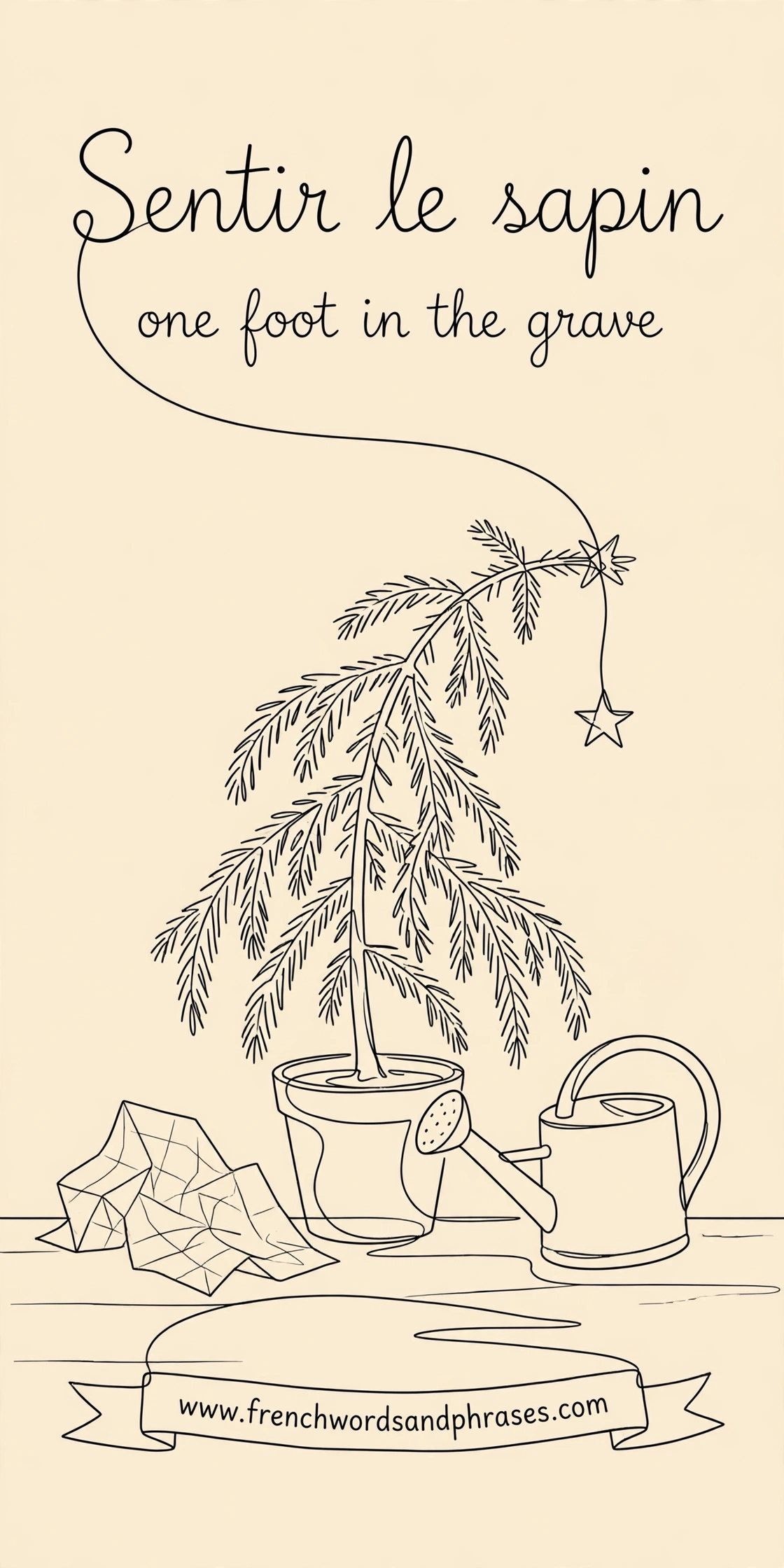
A French Word to Live By
Translate Sentir le sapin to English
/sɑ̃.tiʁ lə sa.pɛ̃/
Sentir le sapin means to have one foot in the grave — to be doomed, on the way out.
The little bookshop on the corner has been losing customers for a year. This morning a ‘for rent’ sign appeared on the café next door, and the baker, glancing at the bookshop’s dusty window, shakes his head: « Ce magasin, il sent le sapin. » No one needs the reason explained — cheap fir wood once meant one thing: coffins.
Let’s explore how sentir le sapin works in French, beginning with the whole phrase on one card.
Understanding the French Phrase Sentir le sapin
Sentir le sapin is a French idiom built from sentir (to smell, to feel) and le sapin (the fir tree). Fir and pine were the cheap woods of coffin-making, so to smell of fir is to smell of the coffin: a person is near death, or a shop, a project or an institution is doomed and on its way out. It is dark humour, and French handles it with care.
It means to have one foot in the grave — or, of a thing, to be doomed. An old car, a failing café, a government in its last weeks: anything that clearly will not last can sentir le sapin. English covers the same ground with ‘to have one foot in the grave’, ‘to be on its last legs’ and ‘to be doomed’.
Type: Idiom — sentir (to smell) + le sapin (the fir tree, coffin wood)
Answers the need: Saying a person is near the end, or a thing is doomed and won’t last
Register: Informal and darkly humorous — handle with care around real illness and grief
Strength: Final — it pronounces a death sentence, gently for things, delicately for people
One important usage detail: sentir le sapin is said about the person or thing from the outside — il sent le sapin, ce projet sent le sapin. With things (shops, cars, projects, governments) it is freely used and often funny; with people it belongs to gallows humour among intimates, never to a hospital corridor or a grieving family.
Experience the Word
Sentir le sapin is the phrase French lowers its voice for — half joke, half verdict — when a familiar thing begins its last season.
Imagine an old fisherman in a port in Brittany looking at the last wooden boat of the fleet, her paint gone grey, her seams open to the rain. He has known her forty years. He does not say she is finished; he says something sadder and more precise, and everyone on the quay understands both the boat and the man are being talked about.
French gives doom a smell because doom announces itself quietly. Sentir le sapin is the nose’s verdict: the end is close enough to catch its scent.
How to Use Sentir le sapin in French: Complete Guide
Let’s explore how sentir le sapin works in French, beginning with the whole phrase on one card.
Sentir le sapin at a Glance
The Whole Phrase on One Card
Real meaning, literal building blocks, English twin and register — sentir le sapin in five lines.
| Point | Sentir le sapin |
|---|---|
| What it really means | to have one foot in the grave; of a thing, to be doomed |
| Word for word | to smell of fir (the cheap wood of coffins) |
| English equivalent | to have one foot in the grave / to be on its last legs |
| Register | informal, dark humour — free for things, delicate for people |
| Use it for | failing shops, dying projects, old cars, and — carefully — people near the end |
Example
Ce vieux café sent le sapin.
That old café has one foot in the grave.
Word by Word: Building the Verdict
Two pieces — a verb of the senses and the most funereal tree in France.
| Word | Literal meaning | Its job in the phrase |
|---|---|---|
| sentir | to smell, to feel | the verb of scent: the end is not seen or heard, it is smelled — sensed early |
| le sapin | the fir tree | fir and pine were the cheap woods for coffins; their smell is the smell of the end |
Example
Son vieux tracteur sent le sapin.
His old tractor is on its last legs.
Quick Quiz 1
Why the fir tree, of all trees?
Reveal the answer
Because fir and pine were the cheap coffin woods — to smell of sapin is to smell of the coffin being made.
À l’odeur du sapin, on devinait l’atelier du menuisier.
From the smell of fir, you could guess the carpenter’s workshop.
When You Say It: Last Seasons
Sentir le sapin belongs to endings you can sense coming — each scene pronounces a quiet death sentence.
| Situation | Example |
|---|---|
| A failing shop | cette boutique sent le sapin — this shop is doomed |
| An old car | ta voiture sent le sapin — your car is on its last legs |
| A dying project | ce projet sent le sapin depuis des mois — this project has been doomed for months |
| An institution in decline | ce journal sent le sapin — this newspaper is on its way out |
| A person, with gallows humour | le vieux Martin sent le sapin, dit-on au village — old Martin has one foot in the grave, they say in the village |
Example
Cette entreprise sent le sapin, cherche un autre travail.
That company is doomed, look for another job.
Make It Yours: Bending the Verdict
Sentir conjugates like a regular -ir verb — change the subject, the tense, and the degree of doom.
| Form | French | In English |
|---|---|---|
| About a thing | ça sent le sapin | it’s doomed, it smells of the end |
| In the past | le magasin sentait le sapin | the shop was on its way out |
| Beginning to | il commence à sentir le sapin | it’s starting to be on its last legs |
| Stronger | il sent vraiment le sapin | it’s truly doomed |
| As a warning question | tu ne trouves pas que ça sent le sapin ? | don’t you think it’s doomed? |
Example
Le vieux pont commence à sentir le sapin.
The old bridge is starting to be on its last legs.
Quick Quiz 2
How do you say ‘This project is doomed’ with the idiom?
Reveal the answer
Ce projet sent le sapin — projects, shops and cars take the phrase freely; only people require tact.
Ce projet sent le sapin, personne n’y croit plus.
This project is doomed, nobody believes in it anymore.
Everyday Expressions: Frames Built on the Phrase
Sentir le sapin slots into these everyday frames — each one ready to use as it stands.
| Frame | In English |
|---|---|
| sentir le sapin | to have one foot in the grave, to be doomed |
| ça sent le sapin | it’s doomed, it’s on its way out |
| commencer à sentir le sapin | to start being on its last legs |
| sentir le sapin depuis longtemps | to have been doomed for a long time |
Example
Ça sent le sapin pour cette équipe.
It’s looking doomed for this team.
Close Cousins: Other Ways to Approach the End
French approaches the end from several sides — sentir le sapin is the scented one; its cousins differ in directness and tact.
| Expression | The difference |
|---|---|
| sentir le sapin | to smell of the coffin — doomed, sensed early; dark humour |
| avoir un pied dans la tombe | to have one foot in the grave — the direct twin, mostly for people, equally blunt |
| être sur la fin | to be nearing the end — gentler, for people and things alike |
| être au bout du rouleau | to be at the end of the roll — exhausted, worn out; for people, energy rather than life itself |
| être condamné | to be condemned, doomed — sober and official, the word of reports and doctors |
Example
Après cette saison, le gardien est au bout du rouleau.
After this season, the caretaker is worn out.
Quick Quiz 3
Which cousin is the sober, official choice?
Reveal the answer
Être condamné — doomed without the joke; the word for reports, diagnoses and official announcements.
Le bâtiment est condamné, il sera démoli.
The building is condemned, it will be demolished.
Sentir le sapin and Its Neighbours
The end-of-the-road shelf around the phrase — decline on one side, survival on the other.
| French | In English |
|---|---|
| tirer à sa fin | to be drawing to its end |
| ne pas en avoir pour longtemps | not to have long left |
| battre de l’aile | to be in trouble, faltering (literally: to flap one wing) |
| tenir encore debout | to still be standing — survival, the hopeful opposite |
| repartir de plus belle | to start again stronger than ever — the resurrection |
Example
La vieille maison tient encore debout.
The old house is still standing.
Watch Out: The Traps Around Sentir le sapin
The traps: Christmas trees, real grief, and a verb that also means to feel.
| Trap | The truth |
|---|---|
| using it at a real Christmas tree | a fresh tree genuinely smells of fir — le sapin sent bon is a compliment to the tree; the idiom needs a doomed subject and the right tone |
| saying it to a grieving family | the phrase is gallows humour for intimates and a free verdict for things — around real illness, choose être sur la fin or silence |
| confusing sentir’s meanings | sentir means both to smell and to feel: je sens une odeur (I smell a smell), je me sens fatigué (I feel tired) — in the idiom it is the smelling sense |
| translating it word for word | ‘to smell of fir’ puzzles English ears — translate the verdict: one foot in the grave, on its last legs, doomed |
Example
Le sapin de Noël sent bon dans le salon.
The Christmas tree smells lovely in the living room.
Quick Quiz 4
True or false: sentir le sapin is a kind thing to say about a colleague’s sick father.
Reveal the answer
False — it is dark humour; around real illness, French chooses gentler words or none.
Son atelier sent le sapin depuis la fermeture de l’usine.
His workshop has been doomed since the factory closed.
Sentir le sapin in Everyday French: Real-Life Examples
Now that you know the word, let’s see how sentir le sapin appears in everyday French.
Example 1 — The corner shop
La petite librairie du coin sent le sapin, elle ouvre à peine trois jours par semaine.
The little bookshop on the corner is doomed, it barely opens three days a week.
Example 2 — An old car
Ta voiture sent le sapin, elle a trois cent mille kilomètres.
Your car is on its last legs, it has three hundred thousand kilometres on it.
Example 3 — A project at work
Ce projet sent le sapin, la direction ne le mentionne même plus.
This project is doomed, management doesn’t even mention it anymore.
Example 4 — A local newspaper
Le journal de la ville sent le sapin, il ne reste que deux journalistes.
The town newspaper is on its way out, only two journalists are left.
Example 5 — The old bridge
Le vieux pont sent le sapin, les camions n’ont plus le droit de passer.
The old bridge is on its last legs, lorries are no longer allowed over it.
Example 6 — Village talk
Au village, on dit que la vieille poste sent le sapin.
In the village, they say the old post office is doomed.
Beyond Translation: The Meaning of Sentir le sapin
Before undertakers had showrooms, the coffin was built by the village carpenter, and everyone knew the wood: sapin, fir or pine, pale, light and cheap — the timber of those who could afford nothing better. A workshop smelling of fresh-cut fir was a workshop building a coffin, and the whole street understood the smell.
To say something sent le sapin is to hear the carpenter’s saw before the bell tolls.
Modern French keeps the phrase mostly for things — shops, cars, projects, governments — where its dark perfume can still raise a smile: the doom is real, but nobody has to be buried for the joke to work.
How to Remember the French Phrase Sentir le sapin
Remember it this way: Picture the village carpenter’s workshop: pale fir planks, fresh sawdust, a coffin taking shape. When a shop or a car starts to smell of that workshop, its end is being built.
- You hear sapin and think coffin wood — cheap, pale fir was the timber of last things.
- You use it freely for things — shops, cars, projects — and carefully, if ever, for people.
- You translate the verdict, not the tree: one foot in the grave, on its last legs, doomed.
The key idea is sentir le sapin means to have one foot in the grave — to smell of the coffin wood is to be doomed.
Test Your Knowledge of Sentir le sapin
Let’s see how much you’ve learned. Try answering these questions before revealing the answers.
Question 1
What does sentir le sapin mean?
Reveal the answer
To have one foot in the grave; of a thing, to be doomed — the end is near enough to smell.
Question 2
Why does the fir tree stand for death?
Reveal the answer
Fir and pine were the cheap woods for coffins — the smell of sapin was the smell of the coffin-maker’s workshop.
Question 3
With what subjects is the phrase used freely?
Reveal the answer
Things — shops, cars, projects, institutions. With people it is gallows humour for intimates only.
Question 4
Translate: That old café is on its last legs.
Reveal the answer
Ce vieux café sent le sapin.
Question 5
Complete the sentence:
Cette entreprise sent le ______. (This company is doomed.)
Reveal the answer
sapin
Cette entreprise sent le sapin.
This company is doomed.
Your Final Challenge
Can You Use It?
How would you say this in French?
“This project is doomed, nobody believes in it anymore.”
Reveal the answer
Ce projet sent le sapin, personne n’y croit plus.
This project is doomed, nobody believes in it anymore.
A little French. A little curiosity. A richer everyday life.
LEARN FRENCH ONE WORD AT A TIME