A French Word to Live By
Translate Tout craché to English
/tu kʁa.ʃe/
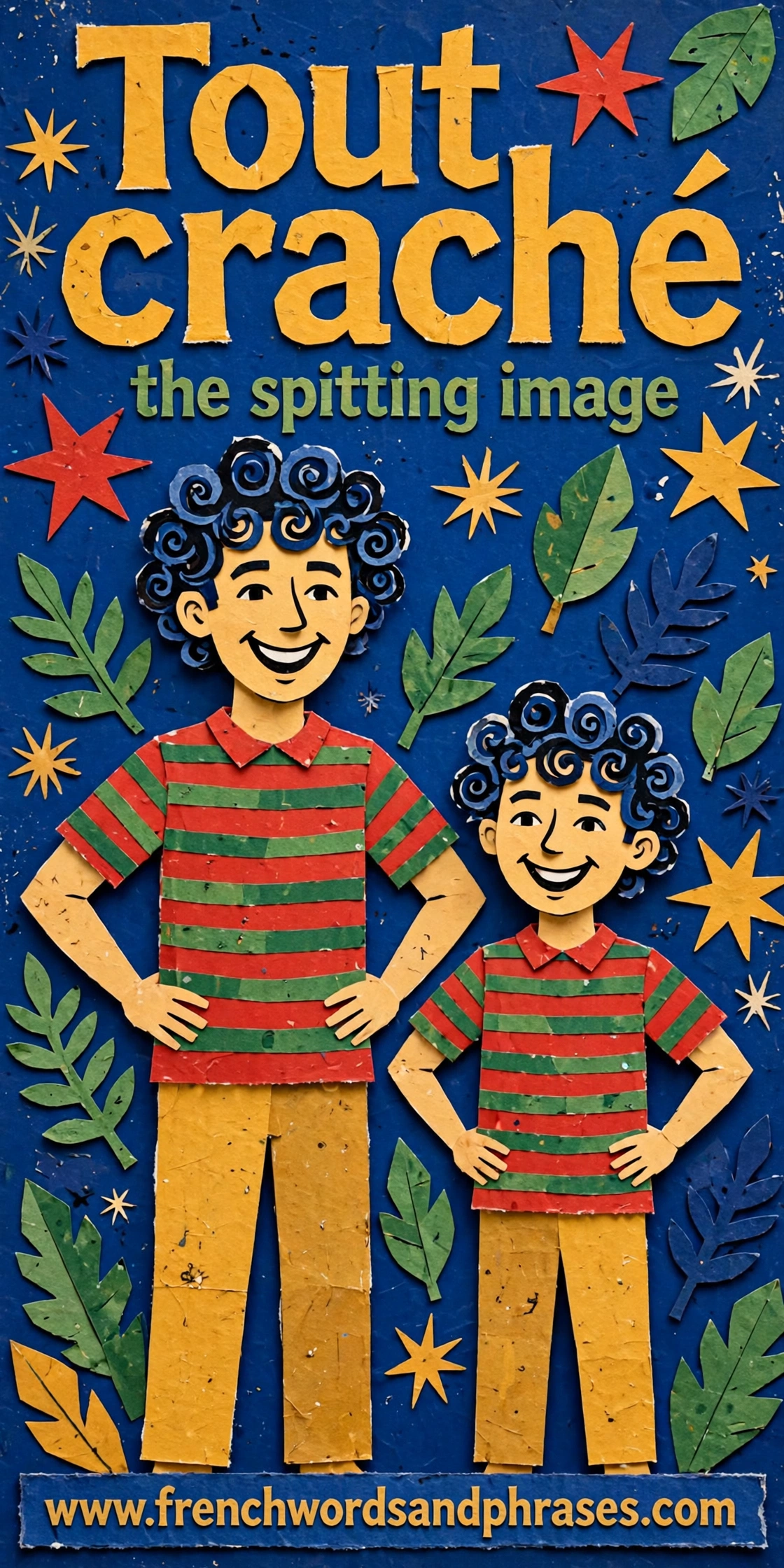
Tout craché means the spitting image — an exact likeness (c’est lui tout craché).
At a family lunch in Dijon, an uncle studies his nephew across the table, then turns to the boy’s father with a grin: « C’est toi tout craché à son âge ! » Same eyes, same grin, same way of holding a fork — the resemblance is total, and French has a wonderfully rude little phrase for it.
Let’s explore how tout craché works in French, beginning with the whole phrase on one card.
Understanding the French Phrase Tout craché
Tout craché is a French idiom built from tout (all, completely) and craché, the past participle of cracher, to spit. It lives in one frame: c’est lui tout craché, c’est elle toute crachée — he or she is the spitting image. The likeness it names is usually between family members, and it is always total.
It means the spitting image — an exact, unmistakable likeness. English and French arrived at the same rude picture independently: a copy so perfect it might have been spat out by the original. A son who is his father tout craché does not merely resemble him; he reproduces him, face, gestures and all.
Type: Idiom — tout + past participle of cracher (to spit), in the frame c’est lui/elle tout craché
Answers the need: Saying someone is the exact double of another person, usually a parent
Register: Informal and affectionate — family talk, friendly teasing; slightly cheeky
Strength: Total — not a resemblance, a reproduction; use it only when the likeness is striking
One important usage detail: agreement. Tout craché follows the person described — c’est lui tout craché for a man, but c’est elle toute crachée for a woman, and ce sont eux tout crachés for a group. The frame is nearly always c’est…: the phrase cannot wander far from the person it doubles.
Experience the Word
Tout craché is the phrase of family gatherings — it gets said over photograph albums, at christenings, and across lunch tables when a child pulls a grandparent’s exact face.
Imagine a grandmother in a farmhouse in Burgundy opening a tin of old photographs. She holds a sepia portrait of her own father beside her great-grandson’s school photo, and the whole table laughs before she even speaks — the ears alone would settle it.
French says resemblance with a spit and a grin. Tout craché is heredity announced as a joke — the family face, reissued without a single change.
How to Use Tout craché in French: Complete Guide
Let’s explore how tout craché works in French, beginning with the whole phrase on one card.
Tout craché at a Glance
The Whole Phrase on One Card
Real meaning, literal building blocks, English twin and register — tout craché in five lines.
| Point | Tout craché |
|---|---|
| What it really means | the spitting image — an exact likeness of another person |
| Word for word | all spat (cracher = to spit) |
| English equivalent | the spitting image of / the very picture of |
| Register | informal and affectionate — family talk and friendly teasing |
| Use it for | children who reproduce a parent, relatives who share a face across generations |
Example
Ce bébé, c’est sa mère toute crachée !
That baby is the spitting image of her mother!
Word by Word: Building the Double
Two pieces — a totaliser and a very rude past participle.
| Word | Literal meaning | Its job in the phrase |
|---|---|---|
| c’est lui / c’est elle | it’s him / it’s her | the frame that presents the copy — the phrase always hangs on c’est |
| tout | all, completely | the totaliser: not partly like the original, but entirely |
| craché | spat (from cracher, to spit) | the past participle: the copy is so exact it seems spat out by the original |
Example
C’est son grand-père tout craché.
He’s the spitting image of his grandfather.
Quick Quiz 1
What verb hides inside craché?
Reveal the answer
Cracher — to spit. The copy is imagined as spat out by the original, which is why English’s ‘spitting image’ matches so exactly.
Ce garçon, c’est son père tout craché.
That boy is the spitting image of his father.
When You Say It: Faces Across Generations
Tout craché belongs to family resemblance — each scene below matches a copy to its original.
| Situation | Example |
|---|---|
| A son like his father | c’est son père tout craché — he’s the spitting image of his father |
| A daughter like her mother | c’est sa mère toute crachée — she’s the spitting image of her mother |
| A baby at a christening | ce bébé, c’est sa grand-mère toute crachée — that baby is her grandmother all over |
| Old photographs | sur cette photo, c’est toi tout craché — in this photo, he’s you all over |
| Mannerisms as well as looks | il rit comme elle, c’est elle tout craché — he laughs like her, he’s her all over |
Example
Regarde cette vieille photo : c’est toi tout craché !
Look at this old photo: he’s the spitting image of you!
Make It Yours: Agreement Is Everything
The phrase bends with the person described — craché agrees in gender and number, and tout follows.
| Form | French | In English |
|---|---|---|
| For a man or boy | c’est lui tout craché | he’s the spitting image |
| For a woman or girl | c’est elle toute crachée | she’s the spitting image |
| For a group | ce sont eux tout crachés | they’re the spitting images |
| Naming the original | c’est sa mère toute crachée | she’s the spitting image of her mother |
| In the past | enfant, c’était son père tout craché | as a child, he was his father all over |
Example
Ce sont les jumeaux de leur oncle, tout crachés.
They are the spitting images of their uncle, the twins.
Quick Quiz 2
How do you say ‘She is the spitting image of her grandmother’?
Reveal the answer
C’est sa grand-mère toute crachée — for a woman, toute crachée, with the agreement in both words.
Avec ces lunettes, c’est sa grand-mère toute crachée.
With those glasses, she’s the spitting image of her grandmother.
Everyday Expressions: Frames Built on the Phrase
Tout craché slots into these everyday frames — each one ready to use as it stands.
| Frame | In English |
|---|---|
| c’est lui tout craché | he’s the spitting image |
| c’est elle toute crachée | she’s the spitting image |
| c’est son père tout craché | he’s the spitting image of his father |
| c’est toi tout craché à son âge | he’s you all over at his age |
| le portrait tout craché de… | the spitting image of… (portrait = likeness) |
Example
C’est le portrait tout craché de sa tante.
She’s the spitting image of her aunt.
Close Cousins: Other Ways to Double Someone
French doubles people in several ways — tout craché is the total, cheeky one; its cousins differ in politeness and precision.
| Expression | The difference |
|---|---|
| tout craché | the spitting image — total likeness, informal and affectionate |
| le portrait de… | the very picture of… — c’est le portrait de son père; a touch more elegant |
| ressembler à | to look like — the plain verb, for any degree of resemblance |
| être le sosie de quelqu’un | to be someone’s double — used for celebrity lookalikes and striking strangers |
| tenir de quelqu’un | to take after someone — resemblance in character as much as looks |
Example
Il tient de son grand-père pour la patience.
He takes after his grandfather for patience.
Quick Quiz 3
Which cousin is used for a celebrity lookalike?
Reveal the answer
Être le sosie de quelqu’un — a sosie is a double, the word for professional lookalikes and uncanny strangers.
Ce chanteur est le sosie du président.
That singer is the president’s double.
Tout craché and Its Neighbours
The family-resemblance shelf around tout craché — likeness on one side, difference on the other.
| French | In English |
|---|---|
| comme deux gouttes d’eau | like two drops of water — as alike as twins |
| le même en plus jeune | the same, only younger |
| il a ses yeux | he has her eyes — resemblance piece by piece |
| il ne lui ressemble pas du tout | he doesn’t look like her at all — the opposite verdict |
| c’est le jour et la nuit | it’s day and night — total difference, the anti-tout craché |
Example
Ces deux sœurs se ressemblent comme deux gouttes d’eau.
Those two sisters are as alike as two drops of water.
Watch Out: The Traps Around Tout craché
The traps: forgetting the agreement, dropping the frame, and spitting where no likeness is meant.
| Trap | The truth |
|---|---|
| forgetting the agreement | for a woman it must be toute crachée — c’est elle tout craché is a classic learner error |
| using it without c’est | tout craché cannot float alone; it needs its frame: c’est lui tout craché |
| using it for objects | the phrase doubles people (and occasionally animals); for identical objects, French says exactement pareil or le même |
| taking the spit literally | nobody is being rude about hygiene — the image is a joke about reproduction, and English’s ‘spitting image’ works the same way |
Example
Ces deux vélos sont exactement pareils.
Those two bikes are exactly the same.
Quick Quiz 4
True or false: tout craché works for two identical bicycles.
Reveal the answer
False — the phrase doubles people; identical objects are exactement pareils.
Ces jumeaux, ce sont leur père tout crachés.
Those twins are the spitting images of their father.
Tout craché in Everyday French: Real-Life Examples
Now that you know the word, let’s see how tout craché appears in everyday French.
Example 1 — At a christening
Ce bébé, c’est son père tout craché, regarde ses oreilles !
That baby is the spitting image of his father, look at his ears!
Example 2 — Over old photos
Sur cette photo de classe, c’est toi tout craché à douze ans.
In this class photo, he’s you all over at twelve years old.
Example 3 — Meeting a daughter
Je n’avais jamais vu ta fille : c’est toi toute crachée !
I’d never seen your daughter: she’s the spitting image of you!
Example 4 — Mannerisms too
Il hausse les épaules comme son grand-père, c’est lui tout craché.
He shrugs like his grandfather, he’s him all over.
Example 5 — Two brothers
Les deux frères, ce sont leur mère tout crachés.
The two brothers are the spitting images of their mother.
Example 6 — At the market
La marchande a souri : « C’est votre fils ? C’est vous tout craché ! »
The stallholder smiled: ‘Is that your son? He’s the spitting image of you!’
Beyond Translation: The Meaning of Tout craché
Two languages, one rude little picture: English says spitting image, French says tout craché, and neither is really about spit. Both imagine a copy so faithful it seems physically produced by the original — resemblance not painted, but secreted.
To call someone tout craché is to say the family printed a second edition without changing a line.
That is why the phrase always lands warmly. It teases, but what it really announces is continuity: the grandfather’s ears, the mother’s laugh, still in circulation.
How to Remember the French Phrase Tout craché
Remember it this way: Picture a photocopier with a sense of humour: it doesn’t copy the father, it spits him out again, smaller. Tout — completely; craché — spat. Total copy.
- You hear craché and think cracher, to spit — the same rude root as English’s spitting image.
- You never drop the frame: c’est lui tout craché, c’est elle toute crachée.
- You make it agree: a woman is toute crachée, a group is tout crachés.
The key idea is tout craché means the spitting image — c’est lui tout craché, c’est elle toute crachée.
Test Your Knowledge of Tout craché
Let’s see how much you’ve learned. Try answering these questions before revealing the answers.
Question 1
What does c’est lui tout craché mean?
Reveal the answer
He is the spitting image — an exact, total likeness of someone, usually a parent.
Question 2
From what verb does craché come, and what does it mean?
Reveal the answer
Cracher — to spit. The copy is pictured as spat out by the original.
Question 3
What changes when the person described is a woman?
Reveal the answer
Toute crachée — both tout and craché agree: c’est elle toute crachée.
Question 4
Translate: She is the spitting image of her aunt.
Reveal the answer
C’est sa tante toute crachée.
Question 5
Complete the sentence:
Ce garçon, c’est son oncle ______ craché. (That boy is the spitting image of his uncle.)
Reveal the answer
tout
Ce garçon, c’est son oncle tout craché.
That boy is the spitting image of his uncle.
Your Final Challenge
Can You Use It?
How would you say this in French?
“Your son is the spitting image of you at his age!”
Reveal the answer
Ton fils, c’est toi tout craché à son âge !
Your son is the spitting image of you at his age!
A little French. A little curiosity. A richer everyday life.
LEARN FRENCH ONE WORD AT A TIME