A French Word to Live By
Translate Partir en fumée to English
/paʁtiʁ ɑ̃ fyme/
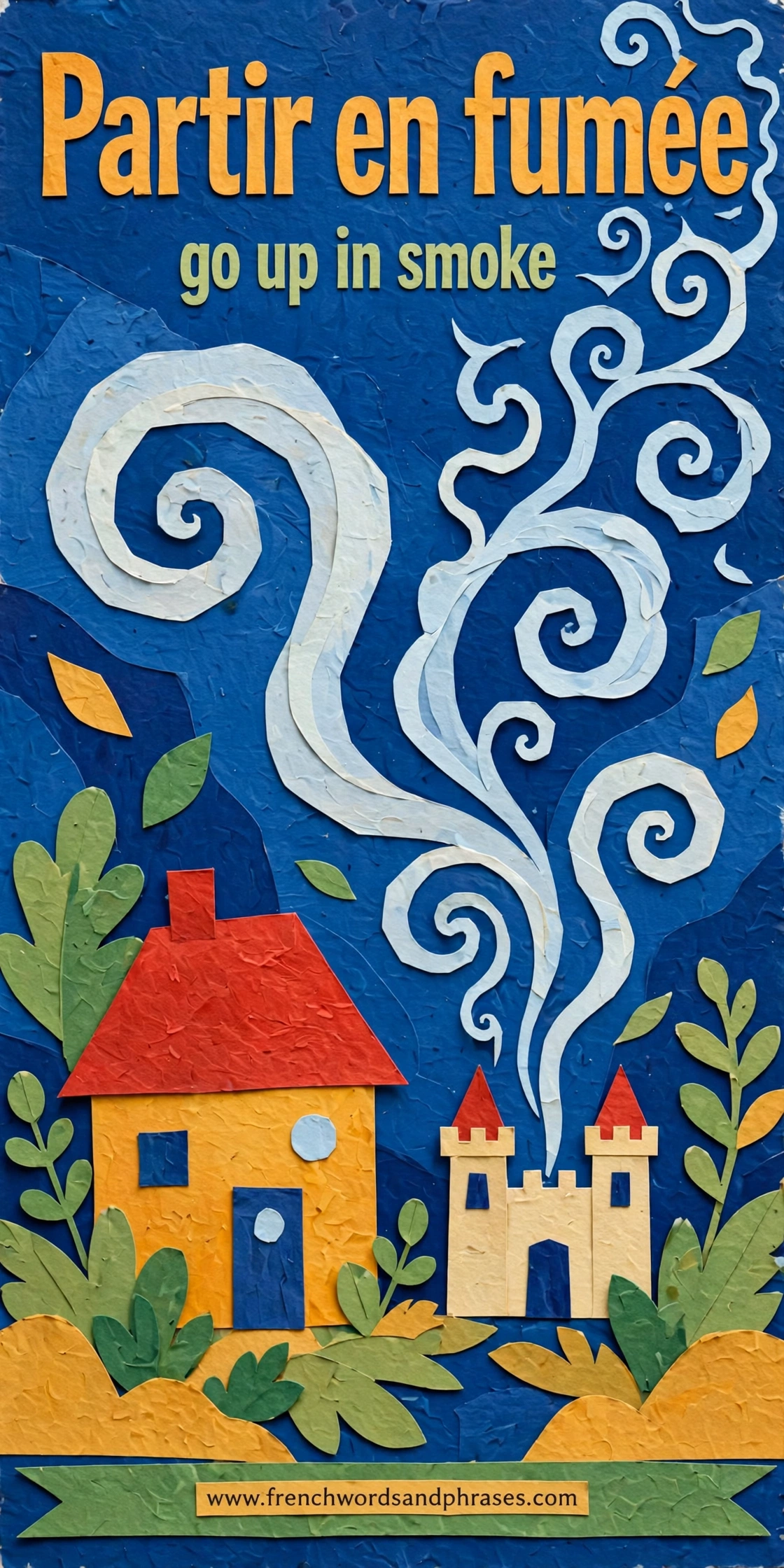
Partir en fumée means to go up in smoke — to vanish completely or come to nothing.
For two years the little theatre company saved for its own stage: every ticket, every raffle, every coin in the jar. Then the landlord sold the building, the replacement hall fell through, and the savings went on storage and refunds. At the last meeting, the treasurer closed the notebook and said quietly: « Tout est parti en fumée. »
Let’s explore how partir en fumée works in French, beginning with the whole phrase on one card.
Understanding the French Phrase Partir en fumée
Partir en fumée is a French idiom — a verb phrase built on partir (to go off, to leave) and fumée (smoke). The picture is of something turning into smoke and drifting away: what was solid a moment ago is suddenly untouchable, then gone. Its subjects are almost always things — plans, hopes, money, efforts — never people.
It means to go up in smoke — to disappear entirely or to come to nothing. English uses exactly the same picture, which makes this one of the friendliest idioms on the page: les projets partent en fumée just as plans go up in smoke. The French phrase covers both senses — the physical vanishing (savings, stock, a harvest) and the collapse of something hoped for.
Type: Idiom — verb phrase (partir + en fumée), subject usually a thing
Answers the need: Saying a plan, hope, fortune or effort vanished or came to nothing
Register: Neutral — everyday French, speech and writing alike
Strength: Total — nothing is left; that finality is the point of the phrase
One important usage detail: in the passé composé the participle agrees with the subject — « ses économies sont parties en fumée », « sa carrière est partie en fumée ». And keep the subject a thing: a person who ‘part en fumée’ would sound as if they had literally dissolved.
Experience the Word
Partir en fumée is the idiom of the cancelled festival, the lost deposit, the startup that folded in a spring.
Imagine a market gardener watching a late frost take the blossom off every apricot tree in one night. A whole year’s income, present at breakfast, absent by lunch — not damaged, not reduced: gone, like breath on cold air.
French reaches for smoke because smoke cannot be argued with or gathered back. What has gone up in smoke is not hidden — it has stopped existing.
How to Use Partir en fumée in French: Complete Guide
Let’s explore how partir en fumée works in French, beginning with the whole phrase on one card.
Partir en fumée at a Glance
The Whole Phrase on One Card
Real meaning, literal building blocks, English twin and register — partir en fumée in five lines.
| Point | Partir en fumée |
|---|---|
| What it really means | to vanish completely, to come to nothing |
| Word for word | to go off in smoke |
| English equivalent | to go up in smoke |
| Register | neutral — speech and writing |
| Use it for | plans, hopes, money, efforts and work that disappear or collapse |
Example
Avec l’annulation du festival, tous nos projets sont partis en fumée.
With the festival cancelled, all our plans went up in smoke.
Word by Word: Building the Smoke Picture
Three pieces — take them one by one and the vanishing act adds up.
| Word | Literal meaning | Its job in the phrase |
|---|---|---|
| partir | to go off, to leave | the verb — the thing departs, it does not fade slowly |
| en | into, in the form of | the transformation word — the thing leaves AS smoke |
| fumée | smoke | the heart of the image — visible for a moment, impossible to hold |
Example
Tout son héritage est parti en fumée en deux ans.
His whole inheritance went up in smoke in two years.
Quick Quiz 1
What kinds of subjects does partir en fumée normally take?
Reveal the answer
Things, not people — plans, hopes, money, efforts. A person ‘going up in smoke’ would sound literal and strange.
Ses espoirs sont partis en fumée.
His hopes went up in smoke.
When You Say It: The Vanishing Moments
Partir en fumée belongs to the moment you realise nothing can be saved.
| Situation | Example |
|---|---|
| A cancelled project | le financement est tombé, le projet est parti en fumée — the funding fell through, the project went up in smoke |
| Money lost | il a tout mis dans cette affaire et tout est parti en fumée — he put everything into that business and it all went up in smoke |
| Hopes dashed | voir ses espoirs partir en fumée — to watch your hopes go up in smoke |
| Work destroyed | des mois de travail partis en fumée à cause d’une panne — months of work gone up in smoke because of a breakdown |
| A dream ending | son rêve de restaurant est parti en fumée — her dream of a restaurant went up in smoke |
Example
Quand le bail a été annulé, notre projet de café est parti en fumée.
When the lease was cancelled, our café project went up in smoke.
Make It Yours: Tenses and Agreement
The phrase lives mostly in the passé composé — and the participle agrees with its subject.
| Form | French | In English |
|---|---|---|
| Present | tout part en fumée | everything is going up in smoke |
| Past (masculine) | son argent est parti en fumée | his money went up in smoke |
| Past (feminine) | sa carrière est partie en fumée | her career went up in smoke |
| Past (plural) | nos économies sont parties en fumée | our savings went up in smoke |
| Watching it happen | il a vu ses projets partir en fumée | he watched his plans go up in smoke |
| Future warning | sinon, tout partira en fumée | otherwise, everything will go up in smoke |
Example
Elle a vu des années d’efforts partir en fumée en une soirée.
She watched years of effort go up in smoke in one evening.
Quick Quiz 2
Fix the agreement: « Sa boutique est parti en fumée. »
Reveal the answer
« Sa boutique est partie en fumée » — boutique is feminine, so parti becomes partie in the passé composé.
Sa boutique est partie en fumée après l’incendie.
Her shop went up in smoke after the fire.
Everyday Expressions: Frames Built on the Phrase
The set frames French speakers actually reach for when things vanish.
| Frame | What it does |
|---|---|
| Tout est parti en fumée | the classic summary — everything is gone |
| Voir quelque chose partir en fumée | watching it happen, helpless |
| Parti en fumée ! | the short headline form — gone up in smoke! |
| Des années de travail parties en fumée | the written, journalistic form with the participle first |
| Ne laissez pas tout partir en fumée | the warning form — don’t let it all go up in smoke |
Example
Sauvegardez vos fichiers, ou des mois de travail partiront en fumée.
Back up your files, or months of work will go up in smoke.
Close Cousins Compared
Several French phrases live near this one — here is exactly how they differ.
| Cousin | How it differs |
|---|---|
| tomber à l’eau | to fall through — for plans and arrangements specifically; the plan drowns rather than burns |
| s’envoler | to fly away, to vanish — lighter and quicker; prices and money s’envolent without total ruin |
| disparaître | the plain verb ‘to disappear’ — no picture, no drama |
| être réduit en cendres | to be reduced to ashes — physical destruction, or very dramatic writing |
| s’évaporer | to evaporate — money and crowds s’évaporent, quietly and gradually |
Example
Le mariage est tombé à l’eau, et avec lui, tous nos projets sont partis en fumée.
The wedding fell through, and with it, all our plans went up in smoke.
Quick Quiz 3
Which cousin is used specifically when a plan or arrangement falls through?
Reveal the answer
Tomber à l’eau — literally ‘to fall into the water’. Partir en fumée is wider and more final.
La sortie est tombée à l’eau à cause de la pluie.
The outing fell through because of the rain.
Partir en fumée and Its Neighbours
Same family — collapse, loss and disappearance — plus the opposites.
| Neighbour | Meaning |
|---|---|
| tout s’écroule | everything collapses — the building image, for lives and plans |
| partir en vrille | to go off the rails, to spiral — a situation getting out of control |
| faire faillite | to go bankrupt — the business version, official |
| se réaliser | OPPOSITE — to come true (a dream, a project) |
| tenir bon | OPPOSITE — to hold firm, to survive |
| aboutir | OPPOSITE — to succeed, to come to fruition (a project aboutit) |
Example
Leur projet n’est pas parti en fumée : il a fini par aboutir.
Their project didn’t go up in smoke: it ended up coming to fruition.
Watch Out: The Traps Around Partir en fumée
Three traps: agreement, the wrong subject, and smoke that is really steam.
| Trap | The truth |
|---|---|
| Agreement in the past | parti / partie / partis / parties must match the subject — ses économies sont parties en fumée |
| A person as subject | people do not partent en fumée in this idiom — plans, money and hopes do |
| fumée vs vapeur | fumée is smoke from fire; vapeur is steam or vapour — a kettle does not make fumée |
| Literal fires | for a real fire French usually says brûler or être détruit par les flammes — partir en fumée is at its best for the figurative vanishing |
Example
On ne dit pas « il est parti en fumée » pour une personne : ce sont ses projets qui partent en fumée.
You don’t say ‘il est parti en fumée’ for a person: it’s his plans that go up in smoke.
Quick Quiz 4
True or false: « fumée » can also mean the steam from a kettle?
Reveal the answer
False — steam is vapeur. Fumée is smoke, from something burning.
La fumée du feu de bois montait dans le ciel du soir.
The smoke from the wood fire rose into the evening sky.
Partir en fumée in Everyday French: Real-Life Examples
Now that you know the word, let’s see how partir en fumée appears in everyday French.
Example 1 — The lost savings
Il a placé toutes ses économies dans cette affaire et tout est parti en fumée.
He put all his savings into that business and everything went up in smoke.
Example 2 — The cancelled tour
La tournée est annulée : six mois de préparation partis en fumée.
The tour is cancelled: six months of preparation gone up in smoke.
Example 3 — Watching hopes vanish
Elle a vu son rêve de médaille partir en fumée après sa blessure.
She watched her dream of a medal go up in smoke after her injury.
Example 4 — The computer crash
Sans sauvegarde, tout son mémoire serait parti en fumée.
Without a backup, her whole dissertation would have gone up in smoke.
Example 5 — A warning
Travaille sérieusement, sinon tes efforts partiront en fumée.
Work seriously, or your efforts will go up in smoke.
Example 6 — The inheritance
En trois ans, tout l’héritage était parti en fumée.
In three years, the whole inheritance had gone up in smoke.
Beyond Translation: The Meaning of Partir en fumée
Smoke is the oldest image of disappearance humans have: the offering on the altar, the letter burned in the grate, the house after the fire. What turns into smoke cannot be taxed, repaired, inherited or argued with — it crosses into the past in front of your eyes.
Partir en fumée therefore carries a small ceremony of mourning inside it.
That is why French prefers it to a plain disparaître when something that took years to build vanishes in a day.
How to Remember the French Phrase Partir en fumée
Remember it this way: Watch a banknote in a fire — one second it is solid, the next it is a grey ribbon rising and thinning into nothing. You cannot catch smoke, and you cannot un-burn the note. That is exactly the feeling the phrase keeps.
- You picture smoke — visible for a moment, impossible to hold, then gone.
- You give it a thing for a subject — plans, hopes, money, never a person.
- You agree the participle — parti, partie, parties — with whatever vanished.
The key idea is partir en fumée means to go up in smoke — plans, hopes or money vanishing completely and coming to nothing.
Test Your Knowledge of Partir en fumée
Let’s see how much you’ve learned. Try answering these questions before revealing the answers.
Question 1
What does partir en fumée mean?
Reveal the answer
To go up in smoke — to vanish completely or come to nothing.
Question 2
What kind of subject does the phrase take?
Reveal the answer
A thing — plans, hopes, money, efforts. Not a person.
Question 3
Translate: Our savings went up in smoke.
Reveal the answer
Nos économies sont parties en fumée.
Question 4
Which cousin means a plan falling through?
Reveal the answer
Tomber à l’eau — literally, to fall into the water.
Question 5
Complete the sentence:
Sa carrière est ______ en fumée. (Her career went up in smoke.)
Reveal the answer
partie
Sa carrière est partie en fumée.
Her career went up in smoke.
Your Final Challenge
Can You Use It?
How would you say this in French?
“When the shop closed, all her plans went up in smoke.”
Reveal the answer
Quand la boutique a fermé, tous ses projets sont partis en fumée.
When the shop closed, all her plans went up in smoke.
A little French. A little curiosity. A richer everyday life.
LEARN FRENCH ONE WORD AT A TIME