A French Word to Live By
Translate Prendre au pied de la lettre to English
/pʁɑ̃dʁ o pje də la lɛtʁ/
Prendre au pied de la lettre means to take something literally — exactly as written or said, word for word.
The recipe card says: « Laissez reposer la pâte une nuit. » — let the dough rest overnight. Your nephew, helping in the kitchen, tucks the bowl under a blanket on the sofa ‘so it can sleep properly’. He followed the words perfectly and the sense not at all. In French, he took the recipe « au pied de la lettre ».
Let’s explore how prendre au pied de la lettre works in French, beginning with the whole phrase on one card.
Understanding the French Phrase Prendre au pied de la lettre
Prendre au pied de la lettre is a French idiom — a verb phrase built on prendre (to take), pied (foot) and lettre (letter, the written word). The picture is of someone crouching right down at the foot of the written words, following them exactly and looking at nothing else.
It means to take something literally — to follow or understand words exactly as written, with no room for sense, context or humour. English says ‘to take it literally’ or ‘to the letter’; French plants you at the foot of the letter itself. The phrase is neutral in itself, but it often carries a raised eyebrow: taking words au pied de la lettre can make you miss what they were really for.
Type: Idiom — verb phrase (prendre + au pied de la lettre)
Answers the need: Saying someone followed or understood words exactly, word for word
Register: Neutral — everyday French, at home in speech and writing
Strength: Exact, sometimes too exact — often a gentle criticism of missing the point
One important usage detail: the thing being taken literally usually slips in between prendre and au pied de la lettre — « prendre une consigne au pied de la lettre », « prendre mes paroles au pied de la lettre ». The short form « prendre quelque chose au pied de la lettre » is how the phrase is quoted.
Experience the Word
Prendre au pied de la lettre is the world of literal children, careful lawyers and instructions followed so exactly that they go wrong.
Imagine a new assistant told to ‘keep an eye on the shop’. A customer finds him at closing time with one eye pressed theatrically to the shop window, watching it. He obeyed every word. He understood none of them.
French sets the trap and the warning in the same phrase. The foot of the letter is a good place to start reading — and a bad place to stop.
How to Use Prendre au pied de la lettre in French: Complete Guide
Let’s explore how prendre au pied de la lettre works in French, beginning with the whole phrase on one card.
Prendre au pied de la lettre at a Glance
The Whole Phrase on One Card
Real meaning, literal building blocks, English twin and register — prendre au pied de la lettre in five lines.
| Point | Prendre au pied de la lettre |
|---|---|
| What it really means | to take words literally, exactly as written or said |
| Word for word | to take (something) at the foot of the letter |
| English equivalent | to take literally / to the letter |
| Register | neutral — speech and writing |
| Use it for | instructions, promises, jokes and remarks followed or understood word for word |
Example
Ne prends pas tout au pied de la lettre, c’était une blague.
Don’t take everything literally, it was a joke.
Word by Word: Down at the Foot of the Letter
Four pieces — take them one by one and the reading picture adds up.
| Word | Literal meaning | Its job in the phrase |
|---|---|---|
| prendre | to take | the verb — you take the words in a certain way |
| au pied de | at the foot of | the position — right down at the base of the text, as close as possible |
| la lettre | the letter | the written word itself, the exact wording |
| (the thing taken) | instructions, words, a remark | usually named between prendre and au pied: prendre une consigne au pied de la lettre |
Example
Il a pris la consigne au pied de la lettre et il a tout refait.
He took the instruction literally and redid everything.
Quick Quiz 1
Where does the thing being taken literally usually go in the sentence?
Reveal the answer
Between prendre and au pied de la lettre — prendre une remarque au pied de la lettre, prendre ses paroles au pied de la lettre.
Ne prends pas mes paroles au pied de la lettre.
Don’t take my words literally.
When You Say It: The Literal Moments
Prendre au pied de la lettre belongs to moments where words and meaning come apart.
| Situation | Example |
|---|---|
| A joke misunderstood | c’était de l’humour, ne le prends pas au pied de la lettre — it was humour, don’t take it literally |
| Instructions followed too exactly | elle a pris la recette au pied de la lettre, même l’erreur d’impression — she followed the recipe to the letter, even the misprint |
| A promise held to the word | tu l’as promis, je te prends au pied de la lettre — you promised, I’m holding you to your exact words |
| Children and language | les enfants prennent tout au pied de la lettre — children take everything literally |
| Legal exactness | le contrat doit être lu au pied de la lettre — the contract must be read literally |
Example
Attention, ce mode d’emploi ne se prend pas au pied de la lettre.
Careful, this manual is not meant to be taken literally.
Make It Yours: Persons, Negatives and Objects
Prendre conjugates as usual; the rest of the phrase is fixed — bend it with objects, negatives and questions.
| Form | French | In English |
|---|---|---|
| I / me | je prends tout au pied de la lettre | I take everything literally |
| Advice (tu) | ne prends pas ça au pied de la lettre | don’t take that literally |
| Past | il a pris ma remarque au pied de la lettre | he took my remark literally |
| Formal (vous) | prenez-le au pied de la lettre | take it to the letter (this one is meant exactly) |
| Question | tu prends vraiment ça au pied de la lettre ? | are you really taking that literally? |
| With a named object | elle prend chaque mot au pied de la lettre | she takes every word literally |
Example
Je te connais : tu vas encore prendre ma plaisanterie au pied de la lettre.
I know you: you’re going to take my joke literally again.
Quick Quiz 2
How do you warn a friend: ‘Don’t take it literally’?
Reveal the answer
« Ne prends pas ça au pied de la lettre » — the negative wraps prendre, and ça names the remark.
Ne prends pas ça au pied de la lettre, je plaisantais.
Don’t take that literally, I was joking.
Everyday Expressions: Frames Built on the Phrase
The set frames French speakers actually reach for around literal reading.
| Frame | What it does |
|---|---|
| Ne prends pas tout au pied de la lettre | the classic softener after a joke or an exaggeration |
| Prendre quelqu’un au mot | close frame — to take someone at their word (see cousins) |
| À prendre au pied de la lettre | describing a text: ‘to be taken literally’ — contracts, safety notices |
| Il prend tout au pied de la lettre | describing a literal-minded person |
| Ce n’est pas à prendre au pied de la lettre | warning that words are figurative, ironic or exaggerated |
Example
Cette vieille affiche n’est pas à prendre au pied de la lettre, c’est de la publicité.
That old poster isn’t to be taken literally, it’s advertising.
Close Cousins Compared
Several French phrases live near this one — here is exactly how they differ.
| Cousin | How it differs |
|---|---|
| prendre au premier degré | to take at face value — the closest twin, about missing irony or the second degree |
| prendre quelqu’un au mot | to take someone at their word — about holding them to a promise or an offer, not about wording |
| prendre au sérieux | to take seriously — about attitude, not about literal meaning |
| à la lettre | the short form — suivre une recette à la lettre, to follow a recipe to the letter |
| littéralement | the plain adverb ‘literally’ — no picture, no idiom |
Example
Il m’a pris au mot quand j’ai proposé de l’aider à déménager.
He took me at my word when I offered to help him move.
Quick Quiz 3
Which cousin means ‘to take someone at their word’ about a promise?
Reveal the answer
Prendre quelqu’un au mot — au pied de la lettre is about exact wording; au mot is about holding someone to what they offered.
Tu as dit que tu paierais le café, je te prends au mot.
You said you’d pay for the coffee, I’m taking you at your word.
Prendre au pied de la lettre and Its Neighbours
Same family — words, senses and readings — plus the opposites.
| Neighbour | Meaning |
|---|---|
| au sens propre | in the literal sense — the dictionary sense of a word |
| au sens figuré | in the figurative sense — the opposite direction |
| mot pour mot | word for word — translations and quotations |
| lire entre les lignes | OPPOSITE — to read between the lines |
| prendre avec des pincettes | OPPOSITE — to take with a pinch of salt, with caution |
| comprendre à demi-mot | OPPOSITE — to understand from a half-word, without needing everything spelled out |
Example
Elle ne prend rien au pied de la lettre : elle lit toujours entre les lignes.
She takes nothing literally: she always reads between the lines.
Watch Out: The Traps Around Prendre au pied de la lettre
Three traps: a foot that is not a footstep, a neighbour phrase with a very different meaning, and jokes that die at the foot of the letter.
| Trap | The truth |
|---|---|
| pied = a step or a measurement | here pied places you at the foot — the base — of the written words; no walking is involved |
| prendre son pied | a completely different, slang phrase meaning to have a great time — do not mix the two at the dinner table |
| Using it of yourself proudly | the phrase often criticises — saying someone takes things au pied de la lettre can mean they miss irony and common sense |
| lettre = a letter you post | la lettre here is the letter of the text — the exact wording — not an envelope |
Example
Prendre son pied et prendre au pied de la lettre n’ont rien à voir.
Prendre son pied and prendre au pied de la lettre have nothing to do with each other.
Quick Quiz 4
True or false: « prendre son pied » is just a shorter form of this idiom?
Reveal the answer
False — prendre son pied is slang for having a great time. Our idiom is about reading words exactly as written.
Ne confonds pas : ici, le pied est au bas de la lettre.
Don’t mix them up: here, the foot is at the base of the letter.
Prendre au pied de la lettre in Everyday French: Real-Life Examples
Now that you know the word, let’s see how prendre au pied de la lettre appears in everyday French.
Example 1 — The misunderstood joke
Ne prends pas ma remarque au pied de la lettre, je plaisantais.
Don’t take my remark literally, I was joking.
Example 2 — The exact recipe
Elle a pris la recette au pied de la lettre et le gâteau est parfait.
She followed the recipe to the letter and the cake is perfect.
Example 3 — A literal child
Mon fils prend tout au pied de la lettre, même les comptines.
My son takes everything literally, even nursery rhymes.
Example 4 — The contract
Ce contrat se prend au pied de la lettre, relis-le lentement.
This contract is to be taken literally, read it again slowly.
Example 5 — Held to a promise
Tu as dit « quand tu veux » ; je te prends au pied de la lettre, je passe demain.
You said ‘any time’; I’m taking you literally, I’ll come by tomorrow.
Example 6 — A warning about irony
Attention, son compliment ne se prend pas au pied de la lettre.
Careful, his compliment is not to be taken literally.
Beyond Translation: The Meaning of Prendre au pied de la lettre
The image is old — older than print. In medieval schools, the student sat at the foot of the master’s text and followed the letter before daring to interpret it; the ‘letter’ was the sacred starting point, and glosses grew in the margins around it.
Prendre au pied de la lettre still carries that schoolroom posture: nose down, finger on the exact words.
French uses it with affection for children and with a sigh for adults — the letter is a beginning, but grown-up reading is supposed to lift its eyes.
How to Remember the French Phrase Prendre au pied de la lettre
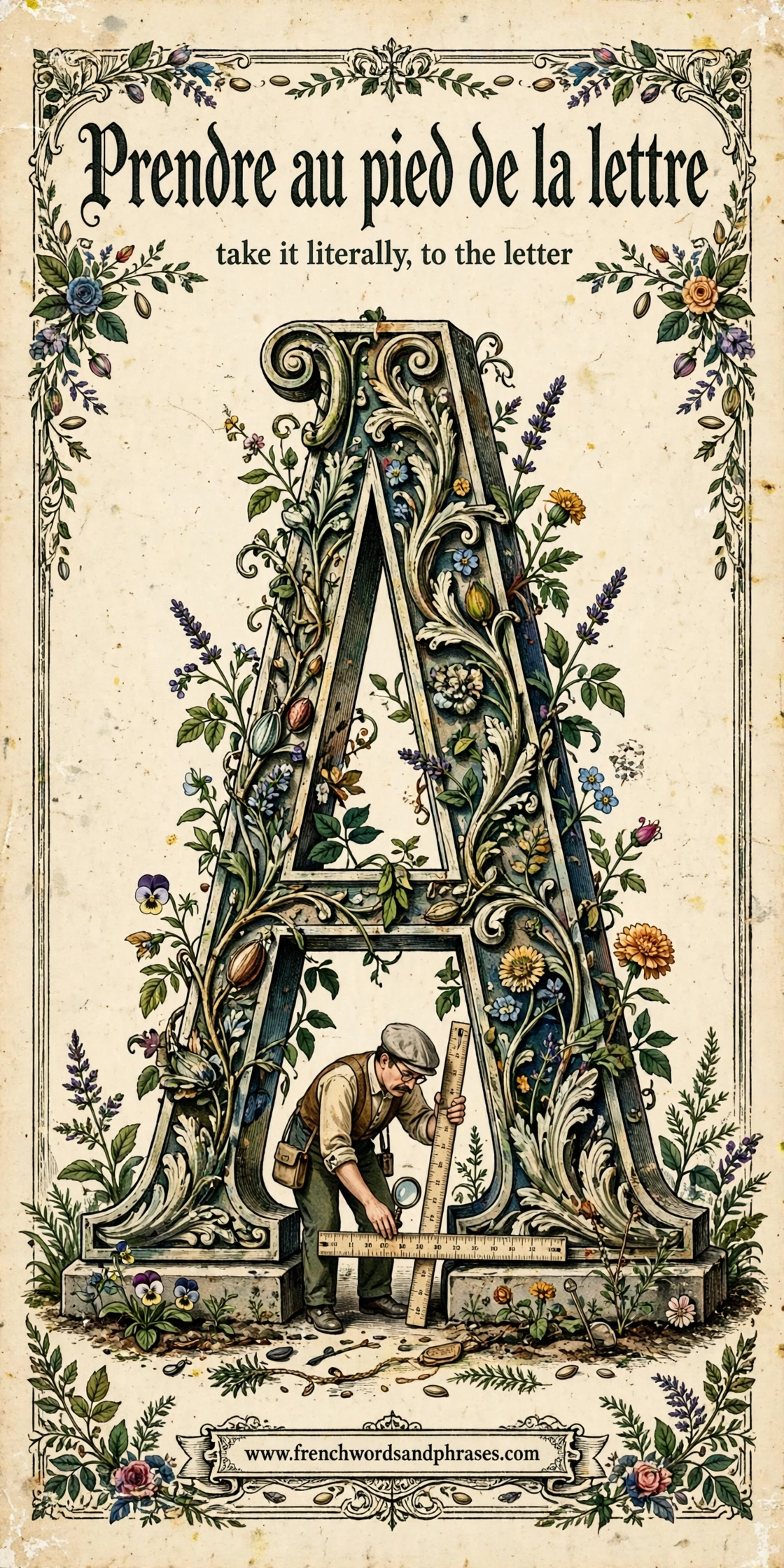
Remember it this way: Picture a small student crouching at the very foot of a giant letter A, reading the words carved at its base and nothing else. That is the posture of the phrase: as close to the exact wording as it is possible to get.
- You see the lettre as a monument — and yourself standing at its foot, reading exactly what is carved there.
- You slip the object in the middle — prendre une consigne au pied de la lettre.
- You keep it for wording, not promises — promises are prendre quelqu’un au mot.
The key idea is prendre au pied de la lettre means to take something literally — to follow the exact wording, standing at the foot of the letter.
Test Your Knowledge of Prendre au pied de la lettre
Let’s see how much you’ve learned. Try answering these questions before revealing the answers.
Question 1
What does prendre au pied de la lettre mean?
Reveal the answer
To take something literally — exactly as written or said, word for word.
Question 2
Where does the object usually go in the phrase?
Reveal the answer
Between prendre and au pied de la lettre — prendre une consigne au pied de la lettre.
Question 3
Translate: Don’t take everything literally!
Reveal the answer
Ne prends pas tout au pied de la lettre !
Question 4
How is prendre au premier degré different?
Reveal the answer
It is the near-twin about tone — taking something at face value and missing the irony or second degree.
Question 5
Complete the sentence:
Il a ______ ma blague au pied de la lettre. (He took my joke literally.)
Reveal the answer
pris
Il a pris ma blague au pied de la lettre.
He took my joke literally.
Your Final Challenge
Can You Use It?
How would you say this in French?
“She took my joke literally and left the room in tears.”
Reveal the answer
Elle a pris ma blague au pied de la lettre et elle a quitté la pièce en larmes.
She took my joke literally and left the room in tears.
A little French. A little curiosity. A richer everyday life.
LEARN FRENCH ONE WORD AT A TIME