A French Word to Live By
Translate Un froid de canard to English
/œ̃ fʁwa də kanaʁ/
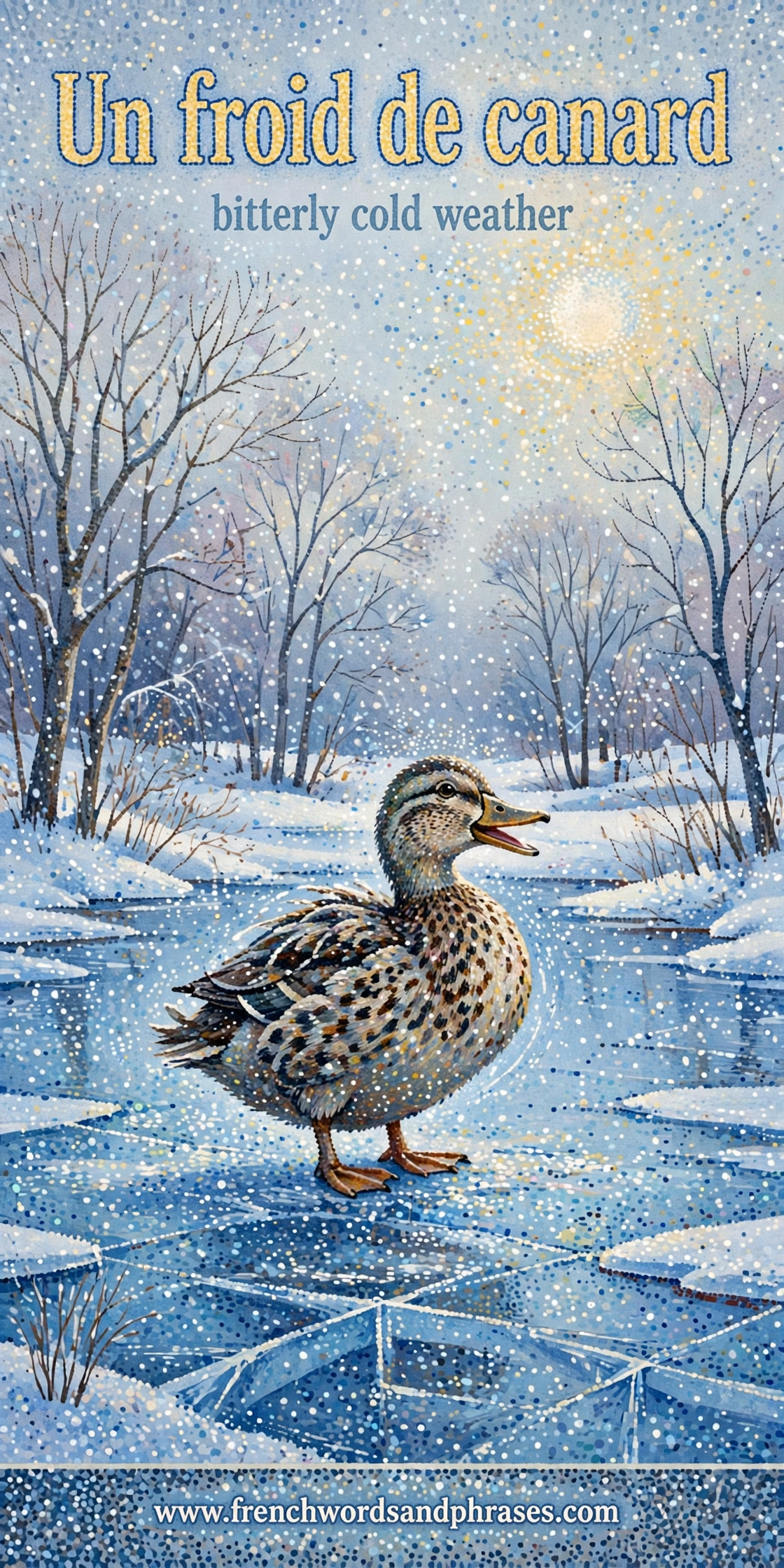
Un froid de canard means bitterly cold weather — a freezing cold that cuts through everything, in the frame il fait un froid de canard.
It is seven in the morning in the Jura mountains and the thermometer reads minus nine. Your neighbour scrapes ice off his windscreen, breath smoking in the air, and greets you through chattering teeth: « Il fait un froid de canard aujourd’hui, hein ! »
Let’s explore how un froid de canard works in French, beginning with the whole phrase on one card.
Understanding the French Phrase Un froid de canard
Un froid de canard is a French idiom — a noun phrase built from un froid (a cold, cold weather) and de canard (of duck). It lives almost always inside one frame, il fait un froid de canard — it is bitterly cold. The usual story ties it to duck-hunting season, when hunters stood motionless in freezing marsh water at dawn.
It means bitterly, piercingly cold weather — the kind of cold that gets through coats and gloves. English says ‘bitterly cold’ or ‘freezing cold’; French adds a duck. The phrase describes the weather and the air, never a person’s feelings, and it carries a small shiver of exaggeration that makes it perfect for morning greetings.
Type: Idiom — noun phrase, used in the frame il fait un froid de canard
Answers the need: Saying the weather is bitterly, painfully cold
Register: Neutral to informal — vivid everyday speech, safe almost anywhere
Strength: Strong — this is serious cold, not a fresh breeze
One important usage detail: froid is a noun here, not an adjective. You do not say the day ‘is froid de canard’; you say il fait un froid de canard, with faire, the weather verb. The phrase also stays singular and fixed — the duck never multiplies, whatever the temperature.
Experience the Word
Un froid de canard is the greeting of frozen mornings — at bus stops, market stalls and school gates from November to February.
Imagine the hunter of the old story, standing still in icy water before sunrise, waiting for ducks. However cold you are this morning, he was colder — and the phrase remembers him.
French weather talk loves a picture. A duck in the cold turns a temperature into a story.
How to Use Un froid de canard in French: Complete Guide
Let’s explore how un froid de canard works in French, beginning with the whole phrase on one card.
Un froid de canard at a Glance
The Whole Phrase on One Card
Real meaning, literal building blocks, English twin and register — un froid de canard in five lines.
| Point | Un froid de canard |
|---|---|
| What it really means | bitterly cold weather — freezing, cutting cold |
| Word for word | a duck cold (froid = cold, canard = duck) |
| English equivalent | bitterly cold / freezing cold |
| Register | neutral to informal — vivid and everyday |
| Use it for | frozen mornings, icy wind, serious winter days |
Example
Il fait un froid de canard ce matin, couvre-toi bien.
It’s bitterly cold this morning, wrap up well.
Word by Word: The Frozen Duck
Three building blocks — the last one brings the hunting story with it.
| Word | Literal meaning | Its job in the phrase |
|---|---|---|
| un | a | the article — froid here is a noun, so it takes un |
| froid | cold (the noun) | cold weather as a thing in the air; as an adjective it means ‘cold’ too, but here it is a noun |
| canard | duck | the picture: the cold of duck-hunting season, hunters standing in icy water at dawn |
Example
Un froid de canard régnait sur la plaine.
A bitter cold reigned over the plain.
Quick Quiz 1
Why a duck in a phrase about cold?
Reveal the answer
The usual story points to duck-hunting season — hunters waited motionless in freezing marshes at dawn, in the worst cold of the year.
Les chasseurs attendaient les canards dans l’eau glacée.
The hunters waited for the ducks in the icy water.
When You Say It: Frozen Mornings
Un froid de canard belongs to serious winter — the situation chooses the words.
| Situation | Example |
|---|---|
| A morning greeting | il fait un froid de canard aujourd’hui ! — it’s bitterly cold today! |
| Warning a visitor | mets un manteau, il fait un froid de canard dehors — wear a coat, it’s bitterly cold outside |
| Remembering a winter | cet hiver-là, il faisait un froid de canard tous les jours — that winter, it was bitterly cold every day |
| Going out anyway | malgré le froid de canard, ils sont allés au marché — despite the bitter cold, they went to the market |
| At the mountains | en montagne, un froid de canard nous attendait — in the mountains, a bitter cold awaited us |
Example
Sors le bonnet, il fait un froid de canard.
Get your woolly hat out, it’s bitterly cold.
Make It Yours: The Il fait Frame
The phrase travels inside one frame — il fait — and that frame bends through the tenses.
| Form | French | In English |
|---|---|---|
| Present | il fait un froid de canard | it is bitterly cold |
| Past | hier, il a fait un froid de canard | yesterday it was bitterly cold |
| Imperfect | il faisait un froid de canard ce matin-là | it was bitterly cold that morning |
| With a place | à Lille, il fait un froid de canard en janvier | in Lille, it’s bitterly cold in January |
| Despite it | malgré ce froid de canard, on sort | despite this bitter cold, we’re going out |
Example
Il a fait un froid de canard toute la semaine.
It was bitterly cold all week.
Quick Quiz 2
How do you say ‘It was bitterly cold yesterday’?
Reveal the answer
Hier, il a fait un froid de canard — the frame is il fait, and fait goes into the past as il a fait.
Hier, il a fait un froid de canard, on est restés à la maison.
Yesterday it was bitterly cold, we stayed at home.
Everyday Expressions: Frames Around the Cold
Un froid de canard slots into these everyday frames — each one ready to use as it stands.
| Frame | In English |
|---|---|
| il fait un froid de canard | it’s bitterly cold |
| un froid de canard ce matin | a bitter cold this morning |
| malgré le froid de canard | despite the bitter cold |
| sortir par un froid de canard | to go out in bitter cold |
| un vent et un froid de canard | a wind and a bitter cold |
Example
Elle est sortie courir par un froid de canard.
She went out running in bitter cold.
Close Cousins: Other Ways to Freeze
French winters have several cold phrases — un froid de canard is the duck one; its cousins freeze with wolves, dogs and ice.
| Expression | The difference |
|---|---|
| un froid de canard | the duck cold — bitter weather, with the hunting story inside |
| un froid de loup | a wolf cold — a close twin, equally bitter, different animal |
| un froid glacial | an icy cold — the plain, neutral version, safe in writing |
| ça caille | it’s freezing — very informal slang, what young speakers shout |
| un froid à ne pas mettre un chien dehors | too cold to put a dog out — the long, comic exaggeration |
Example
Un froid glacial régnait sur la ville ce matin.
An icy cold reigned over the town this morning.
Quick Quiz 3
Which cousin swaps the duck for a wolf?
Reveal the answer
Un froid de loup — a wolf cold. Same bitter weather, same strength, different animal in the picture.
En janvier, il faisait un froid de loup dans les champs.
In January, it was bitterly cold in the fields.
Un froid de canard and Its Neighbours
The winter shelf around the phrase — bad weather, downpours and cold snaps.
| French | In English |
|---|---|
| il fait un temps de chien | the weather is awful — dog weather, any season |
| pleuvoir des cordes | to rain cats and dogs — the wet neighbour |
| une vague de froid | a cold snap, a cold wave — the newsreader’s term |
| un froid mordant | a biting cold — literary and vivid |
| geler | to freeze — les routes gèlent, the roads are freezing over |
Example
Avec cette vague de froid, il fait un froid de canard partout.
With this cold snap, it’s bitterly cold everywhere.
Watch Out: The Traps Around Un froid de canard
The traps: a noun dressed as an adjective, and a duck with two other careers.
| Trap | The truth |
|---|---|
| treating froid as an adjective here | in this phrase froid is a noun — say il fait un froid de canard, never ‘le jour est froid de canard’ |
| canard has other meanings | un canard is also slang for a newspaper, and faire un canard is hitting a wrong note in music — context rules |
| using it for a cold person | the phrase is about weather and air — a distant, chilly person is froid as an adjective, not a canard |
| pluralising the duck | the phrase is fixed in the singular: un froid de canard, whatever the temperature |
Example
Ce n’est pas un petit froid, c’est un froid de canard.
This isn’t a little cold, it’s a bitter cold.
Quick Quiz 4
True or false: you can describe a distant, unfriendly person as un froid de canard.
Reveal the answer
False — the phrase describes bitterly cold weather only. A chilly personality is simply froid or froide as an adjective.
Il fait un froid de canard, mais l’accueil était chaleureux.
It was bitterly cold, but the welcome was warm.
Un froid de canard in Everyday French: Real-Life Examples
Now that you know the word, let’s see how un froid de canard appears in everyday French.
Example 1 — Morning greeting
Il fait un froid de canard ce matin, tu as vu ?
It’s bitterly cold this morning, have you seen?
Example 2 — Coat warning
Mets ton écharpe, il fait un froid de canard dehors.
Put your scarf on, it’s bitterly cold outside.
Example 3 — Last winter
L’hiver dernier, il a fait un froid de canard pendant un mois.
Last winter, it was bitterly cold for a month.
Example 4 — Market trip
Malgré le froid de canard, le marché était plein.
Despite the bitter cold, the market was full.
Example 5 — Mountain holiday
À la montagne, un vrai froid de canard nous attendait.
In the mountains, a real bitter cold awaited us.
Example 6 — Going out anyway
Elle est sortie promener le chien par un froid de canard.
She went out to walk the dog in bitter cold.
Beyond Translation: The Meaning of Un froid de canard
Weather is France’s safest conversation and its most decorated one — a plain temperature would be a wasted opportunity. Un froid de canard carries a whole dawn inside it: dark water, patient hunters, breath in the air. Nobody who says it is thinking about ducks, yet the picture warms the complaint, the way all good idioms do.
The duck turns a forecast into a small story you can shiver along with.
That is why the phrase survives every modern forecast: minus nine is information, but un froid de canard is company.
How to Remember the French Phrase Un froid de canard
Remember it this way: Picture the duck hunter at dawn, standing still in icy marsh water in the coldest weeks of the year — that is the cold the phrase remembers.
- You hear canard and think duck — and the duck thinks of hunting season, icy water, frozen dawns.
- You keep the frame whole — il fait un froid de canard, with faire doing the weather work.
- You keep it for weather only — never for a cold-hearted person.
The key idea is un froid de canard means bitterly cold weather — il fait un froid de canard, it is bitterly cold.
Test Your Knowledge of Un froid de canard
Let’s see how much you’ve learned. Try answering these questions before revealing the answers.
Question 1
What does un froid de canard mean?
Reveal the answer
Bitterly cold weather — a freezing cold that cuts through everything.
Question 2
Which verb frame carries the phrase?
Reveal the answer
Il fait — il fait un froid de canard, because froid is a noun here.
Question 3
Where does the duck come from, in the usual story?
Reveal the answer
Duck-hunting season — hunters stood motionless in icy water at dawn, in the coldest weather of the year.
Question 4
Translate: It’s bitterly cold outside this morning.
Reveal the answer
Il fait un froid de canard dehors ce matin.
Question 5
Complete the sentence:
Il ______ un froid de canard aujourd’hui. (It is bitterly cold today.)
Reveal the answer
fait
Il fait un froid de canard aujourd’hui.
It is bitterly cold today.
Your Final Challenge
Can You Use It?
How would you say this in French?
“Bundle up — it’s bitterly cold outside this morning.”
Reveal the answer
Couvre-toi bien — il fait un froid de canard dehors ce matin.
Bundle up — it’s bitterly cold outside this morning.
A little French. A little curiosity. A richer everyday life.
LEARN FRENCH ONE WORD AT A TIME