A French Word to Live By
Translate S’envoyer en l’air to English
/sɑ̃.vwa.je ɑ̃ lɛʁ/
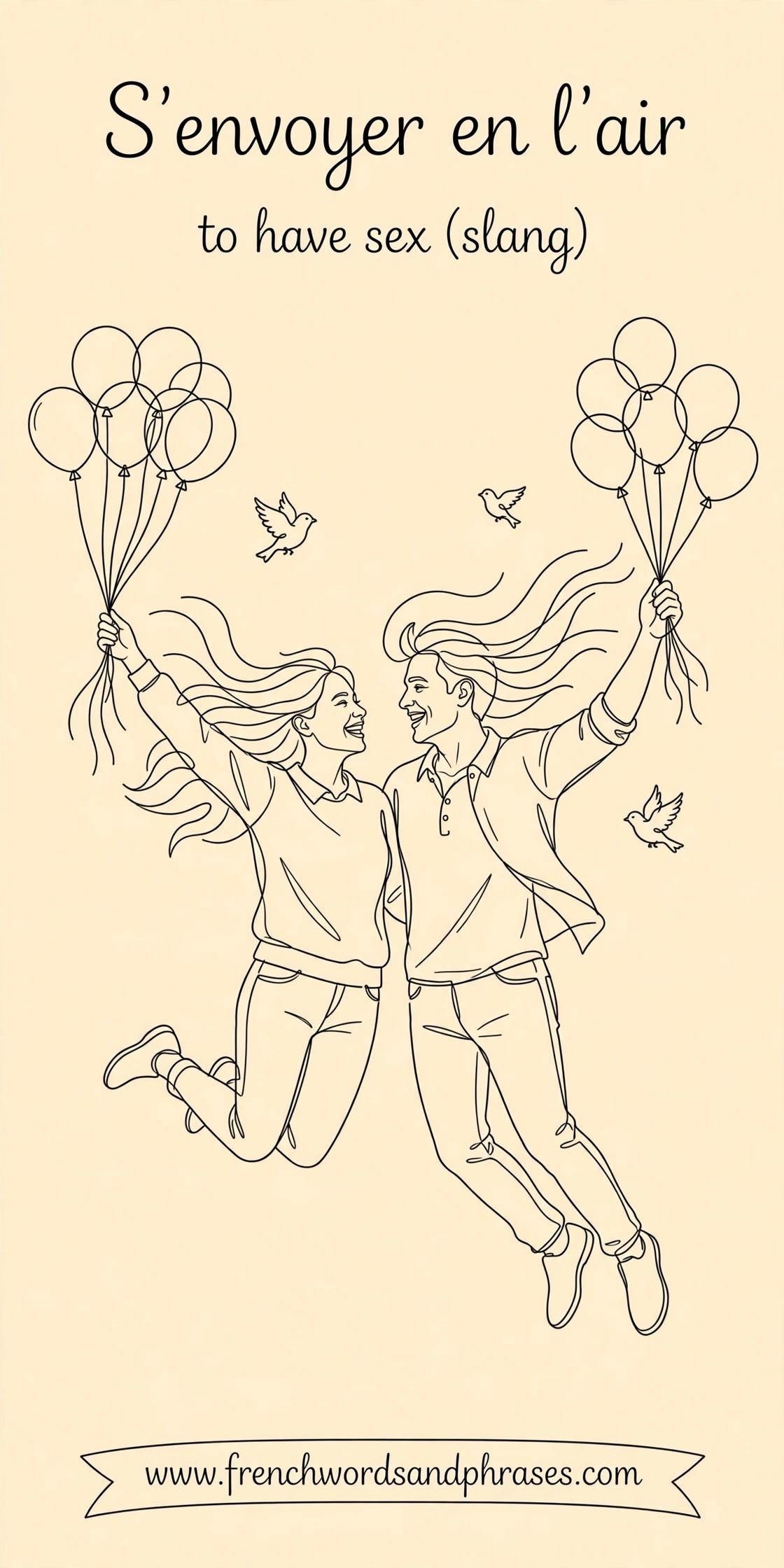
S’envoyer en l’air means to have sex — vulgar slang, said plainly.
Two old friends are gossiping over coffee about a colleague and the new intern, who keep vanishing from the office party together. One of them lowers her voice, grins, and uses the phrase French saves for exactly this — cheerful, a bit crude, and impossible to misunderstand: « À mon avis, ils s’envoient en l’air. »
Let’s explore how s’envoyer en l’air works in French, beginning with the whole phrase on one card.
Understanding the French Phrase S’envoyer en l’air
S’envoyer en l’air is a French vulgar slang expression built from s’envoyer (to throw or send oneself) and en l’air (into the air). It means to have sex — casually, bluntly, and with a grin. There is no polite reading of this phrase, and this page will not pretend otherwise.
It means to have sex — ‘to get laid’, in the same register as the English. The picture is of being tossed into the air, and the phrase keeps that throwaway energy: it talks about sex as fun and physical, never romantic. Said between friends it raises a laugh; said in the wrong company, it shocks.
Type: Slang idiom — sex (reflexive verb + en l’air)
Answers the need: Saying two people are having sex — bluntly, between friends
Register: Vulgar slang — never at work, never with elders, never in formal writing
Strength: Blunt and casual — sex as a lark, with zero romance
One important usage detail: this phrase belongs to jokes and gossip between people who know each other very well. For anything neutral, French says coucher avec quelqu’un (to sleep with someone) or faire l’amour (to make love). The phrase you choose says as much about you as it does about them.
Experience the Word
S’envoyer en l’air is French slang at its most theatrical — the whole act tossed up into the air like a hat at a party.
Imagine two grandmothers on a park bench — no. Imagine two students outside the faculty at midnight, reconstructing a party in whispers and laughter. That is where this phrase lives: young, late, among friends, and absolutely not in front of the professor who has just walked up behind them.
Every language keeps a drawer of phrases it only opens among its own. This one is in the bottom drawer, and French speakers know it.
How to Use S’envoyer en l’air in French: Complete Guide
Let’s explore how s’envoyer en l’air works in French, beginning with the whole phrase on one card.
S’envoyer en l’air at a Glance
The Whole Phrase on One Card
Real meaning, literal picture, English twin and register — s’envoyer en l’air in five lines.
| Point | S’envoyer en l’air |
|---|---|
| What it really means | to have sex — casually, for fun |
| Word for word | to throw oneself into the air |
| English equivalent | to get laid / to hook up |
| Register | vulgar slang — friends only, never formal |
| Use it for | gossip and jokes about other people’s sex lives — or your own, if you dare |
Example
Il paraît qu’ils s’envoient en l’air depuis un mois.
Apparently they’ve been getting laid for a month.
Word by Word: Building the Toss
Four small pieces — take them one by one and the phrase takes off.
| Word | Literal meaning | Its job in the phrase |
|---|---|---|
| s’ | oneself | the reflexive — the action is done with, and to, yourselves |
| envoyer | to send, to throw | the same verb as envoyer une lettre, to send a letter — here it throws people, not post |
| en | in, into | the direction word — into what follows |
| l’air | the air | up there: weightless, carefree, feet off the ground |
Example
Ils ne pensent qu’à s’envoyer en l’air.
All they think about is getting laid.
Quick Quiz 1
What does envoyer mean outside this phrase?
Reveal the answer
To send, to throw — envoyer une lettre, to send a letter. The slang phrase throws people into the air instead.
Elle a envoyé la balle en l’air.
She threw the ball into the air.
When You Say It: The Gossip Moments
S’envoyer en l’air fires at moments like these — always in whispers, always among friends.
| Situation | Example |
|---|---|
| Gossip about colleagues | à mon avis, ils s’envoient en l’air — in my opinion, they’re at it |
| Teasing a friend | alors, tu t’es envoyé en l’air ce week-end ? — so, did you get laid this weekend? |
| A holiday romance | en vacances, ils se sont envoyés en l’air — on holiday, they got laid |
| About film characters | dans le film, ils finissent par s’envoyer en l’air — in the film, they end up getting laid |
| As a life philosophy (joking) | il ne vit que pour s’envoyer en l’air — he lives only for getting laid |
Example
Les voisins s’envoient en l’air, et les murs sont très fins.
The neighbours are at it, and the walls are very thin.
Make It Yours: The Phrase in Other Forms
Envoyer conjugates like a regular -er verb with a y-to-i change — je m’envoie, nous nous envoyons.
| Form | French | In English |
|---|---|---|
| They’re at it | ils s’envoient en l’air | they’re having sex |
| The rumour form | il paraît qu’ils s’envoient en l’air | apparently they’re at it |
| With a partner named | s’envoyer en l’air avec quelqu’un | to have sex with someone |
| Past — they did it | ils se sont envoyés en l’air | they had sex, they got laid |
| Teasing question | tu t’es envoyé en l’air ? | did you get laid? |
| Only thinking of it | ne penser qu’à s’envoyer en l’air | to think only of getting laid |
Example
Ils se sont envoyés en l’air pendant les vacances.
They got laid during the holidays.
Quick Quiz 2
Which form is correct: je m’envoie or je m’envoye en l’air?
Reveal the answer
Je m’envoie — envoyer changes its y to i before a silent ending, like je paie from payer.
Je m’envoie en l’air, tu t’envoies en l’air, il s’envoie en l’air.
I get laid, you get laid, he gets laid.
Everyday Expressions: Building on the Phrase
S’envoyer en l’air slots into these everyday frames — each one as slangy as the phrase itself.
| Frame | In English |
|---|---|
| s’envoyer en l’air avec quelqu’un | to have sex with someone |
| ne penser qu’à s’envoyer en l’air | to think only of getting laid |
| s’envoyer en l’air en vacances | to get laid on holiday |
| il paraît qu’ils s’envoient en l’air | apparently they’re at it |
| des voisins qui s’envoient en l’air | neighbours who are at it — the thin-walls joke |
Example
Il paraît qu’ils s’envoient en l’air depuis la soirée de Noël.
Apparently they’ve been at it since the Christmas party.
Close Cousins: The Other Ways to Say It
French has a whole shelf for this subject, from the clinical to the unspeakable — our phrase sits near the rude end.
| Expression | The difference |
|---|---|
| s’envoyer en l’air | to get laid — vulgar slang, joking, between friends |
| faire l’amour | to make love — the standard, tender expression; the safe default |
| coucher avec quelqu’un | to sleep with someone — informal-neutral, the everyday gossip verb |
| avoir des rapports | to have relations — formal and clinical, the official register |
| baiser | to fuck — even more vulgar than our phrase; a verb to recognise, not to use lightly |
Example
Entre eux, ce n’est pas que s’envoyer en l’air : ils font l’amour et ils s’aiment.
Between them, it’s not just getting laid: they make love and they love each other.
Quick Quiz 3
You must mention a couple’s relationship in a polite conversation. Which do you choose — s’envoyer en l’air or coucher ensemble?
Reveal the answer
Coucher ensemble — informal but decent. S’envoyer en l’air is vulgar slang and would embarrass everyone at the table.
Ils couchent ensemble depuis le printemps.
They’ve been sleeping together since spring.
S’envoyer en l’air and Its Neighbours
The shelf around the phrase — the stages before, and the innocent neighbour that shares its air.
| French | In English |
|---|---|
| draguer | to chat up — the stage before |
| une aventure d’un soir | a one-night stand |
| un coup d’un soir | a one-night stand — the blunt version |
| tromper quelqu’un | to cheat on someone — when a partner already exists |
| s’envoyer en l’air | to get laid (vulgar slang) |
| la tête en l’air | head in the clouds, absent-minded — the innocent neighbour |
Example
Après des semaines à draguer, ils ont eu une aventure d’un soir.
After weeks of flirting, they had a one-night stand.
Watch Out: The Traps Around S’envoyer en l’air
The traps: a register that can wreck a dinner, a kiss that is not a kiss, and a flying verb that is not this one.
| Trap | The truth |
|---|---|
| the register trap | this is pub-and-playground French — with a boss, a grandmother or a stranger, say coucher or faire l’amour, or say nothing at all |
| the baiser trap | un baiser is a kiss, but the verb baiser is far ruder than our phrase — learners mix them up at their peril |
| not about flying | to fly away is s’envoler — nothing in s’envoyer en l’air leaves the ground except reputations |
| everything in the air | tout envoyer en l’air means to chuck the whole lot in — the job, the plans, everything; it is the little s’ that turns the phrase to sex |
Example
Il a tout envoyé en l’air et il est parti vivre à la campagne.
He chucked everything in and went off to live in the country.
Quick Quiz 4
True or false: un baiser and the verb baiser are equally safe to use.
Reveal the answer
False — un baiser is an innocent kiss; the verb baiser is one of the rudest words in French. The noun is safe, the verb is not.
Elle lui a donné un baiser sur la joue.
She gave him a kiss on the cheek.
S’envoyer en l’air in Everyday French: Real-Life Examples
Now that you know the word, let’s see how s’envoyer en l’air appears in everyday French.
Example 1 — Office gossip
À mon avis, le stagiaire et la comptable s’envoient en l’air.
In my opinion, the intern and the accountant are at it.
Example 2 — The rumour
Il paraît qu’ils s’envoient en l’air depuis un mois.
Apparently they’ve been getting laid for a month.
Example 3 — Thin walls
Les voisins s’envoient en l’air tous les samedis soir.
The neighbours are at it every Saturday night.
Example 4 — Teasing a friend
Alors, ce week-end, tu t’es envoyé en l’air ?
So, this weekend, did you get laid?
Example 5 — On holiday
Ils se sont envoyés en l’air pendant leurs vacances en Grèce.
They got laid during their holiday in Greece.
Example 6 — Only one idea
À son âge, il ne pense qu’à s’envoyer en l’air.
At his age, all he thinks about is getting laid.
Beyond Translation: The Meaning of S’envoyer en l’air
French slang often works by lift and lightness — en l’air, up in the air, is where the language puts everything careless and free: la tête en l’air for the dreamer, des promesses en l’air for empty promises. Our phrase takes that same weightlessness and applies it, grinning, to sex.
To s’envoyer en l’air is to treat the act as a party trick — which is exactly why it must never leave the circle of friends.
Know it, laugh at it, recognise it in films — and reach for faire l’amour everywhere else.
How to Remember the French Phrase S’envoyer en l’air
Remember it this way: S’envoyer en l’air is the bottom-drawer phrase — tossed into the air like a hat, and only ever among friends.
- You picture the toss — envoyer is to throw, and the phrase throws people joyfully into the air.
- You respect the register — it is vulgar slang: gossip and jokes only, never work, elders or writing.
- You keep the safe pair ready — coucher for gossip, faire l’amour for everything polite.
The key idea is s’envoyer en l’air means to have sex — vulgar slang, ‘to get laid’, for friends’ ears only.
Test Your Knowledge of S’envoyer en l’air
Let’s see how much you’ve learned. Try answering these questions before revealing the answers.
Question 1
What does s’envoyer en l’air mean?
Reveal the answer
To have sex — to get laid. It is vulgar slang, said jokingly between friends.
Question 2
What is the literal, word-for-word meaning?
Reveal the answer
To throw oneself into the air — envoyer is to send or throw, en l’air is into the air.
Question 3
Which polite expressions should replace it in decent company?
Reveal the answer
Faire l’amour (to make love) and coucher avec quelqu’un (to sleep with someone).
Question 4
What is the trap with the word baiser?
Reveal the answer
Un baiser is a kiss, but the verb baiser is extremely vulgar — the noun is innocent, the verb is not.
Question 5
Complete the sentence:
Il paraît qu’ils s’______ en l’air. (Apparently they’re at it.)
Reveal the answer
envoient
Il paraît qu’ils s’envoient en l’air.
Apparently they’re at it.
Your Final Challenge
Can You Use It?
How would you say this in French?
“Apparently, they’re getting laid.”
Reveal the answer
Il paraît qu’ils s’envoient en l’air.
Apparently, they’re getting laid.
A little French. A little curiosity. A richer everyday life.
LEARN FRENCH ONE WORD AT A TIME