A French Word to Live By
How to Conjugate Vassaliser in French
/va.sa.li.ze/
Vassaliser means to subjugate — to reduce a people or a state to the status of a vassal.
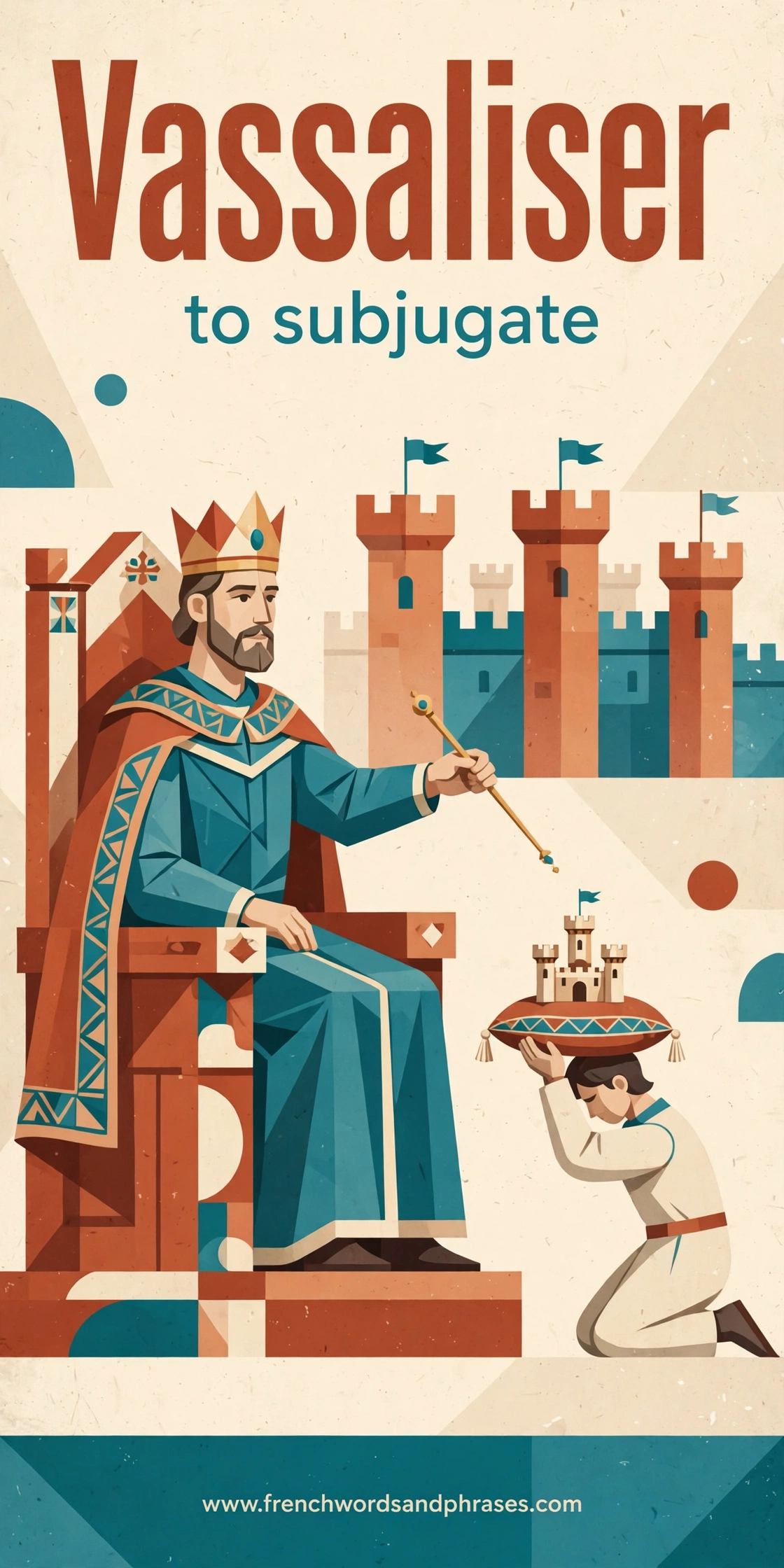
A defeated prince kneels, places his joined hands between the hands of his conqueror, and swears homage — vassaliser is the feudal verb of domination, the moment a free lord or a free country becomes someone’s vassal, bound to obey and to pay.
In this guide, you’ll learn how to conjugate vassaliser in all the major French tenses and moods. Explore complete conjugation tables, French examples, English translations, and practice quizzes.
Understanding the French Verb Vassaliser
Vassaliser is a regular French verb belonging to the first group of verbs, those ending in -er.
It means to subjugate. It is commonly used in history writing for kings and empires reducing neighbouring lands to vassal status, and figuratively in political commentary for a state, a company or an institution brought under another’s domination.
Verb classification: First group (-er)
Auxiliary verb: Avoir
Past participle: vassalisé
Present participle: vassalisant
English equivalents: To subjugate, to reduce to vassalage; vassaliser un peuple — to subjugate a people; un vassal — a vassal; un État vassal — a vassal state; rendre hommage — to pay homage.
One important detail: vassaliser is built on un vassal — the feudal follower who held his land from a lord in exchange for service and loyalty — with the productive suffix -iser, to make into. It is perfectly regular: je vassalise, nous vassalisons, past participle vassalisé. Born in the Middle Ages for counts and duchies, the verb now serves historians and journalists for any power that reduces another to obedient dependence: vassaliser un pays, vassaliser une économie.
Experience the Word
Vassaliser is the verb of the kneeling prince — domination sealed with an oath of homage.
Imagine a great hall in the year 1200. One by one, the defeated lords come forward, kneel, and place their hands in the king’s hands. No chains, no prison — just an oath, a tribute to pay each year, and soldiers to supply in wartime. Le roi les a vassalisés: they keep their castles, but they are his men now.
The lords ride home still wearing their swords. But their lands have been brought into vassalage — vassalisées — and everyone knows it.
How to Conjugate Vassaliser: Complete French Conjugation Guide
Let’s explore every major conjugation of vassaliser, beginning with the indicative mood.
How to Conjugate Vassaliser in the Indicative Mood
The indicative mood is used to express facts, observations, actions, and events.
How to Conjugate Vassaliser in the Present Tense (Présent)
Used for actions happening now, habitual actions, and general truths.
| Subject | Conjugation |
|---|---|
| je | vassalise |
| tu | vassalises |
| il / elle | vassalise |
| nous | vassalisons |
| vous | vassalisez |
| ils / elles | vassalisent |
Example
Le roi vassalise les petits seigneurs de la frontière.
The king subjugates the petty lords of the border.
Quick Quiz 1
Complete the sentence:
Nous ______ les petits seigneurs de la frontière.
Reveal the answer
vassalisons
Nous vassalisons les petits seigneurs de la frontière.
We subjugate the petty lords of the border.
How to Conjugate Vassaliser in the Passé Composé
Used for completed actions in the past. Vassaliser takes the auxiliary verb avoir.
| Subject | Conjugation |
|---|---|
| j’ | ai vassalisé |
| tu | as vassalisé |
| il / elle | a vassalisé |
| nous | avons vassalisé |
| vous | avez vassalisé |
| ils / elles | ont vassalisé |
Example
L’empire a vassalisé tous les royaumes voisins.
The empire subjugated all the neighbouring kingdoms.
How to Conjugate Vassaliser in the Imparfait (Imperfect Tense)
Used for habitual past actions, descriptions, and ongoing situations in the past.
| Subject | Conjugation |
|---|---|
| je | vassalisais |
| tu | vassalisais |
| il / elle | vassalisait |
| nous | vassalisions |
| vous | vassalisiez |
| ils / elles | vassalisaient |
Example
Les grands rois vassalisaient les terres conquises.
The great kings used to reduce conquered lands to vassalage.
Quick Quiz 2
Choose the correct form:
The empire subjugated the kingdoms.
L’empire ______ les royaumes. (a vassalisé / est vassalisé)
Reveal the answer
a vassalisé
L’empire a vassalisé les royaumes.
Vassaliser takes avoir.
How to Conjugate Vassaliser in the Plus-que-parfait
Used to describe an action that had already been completed before another past event.
| Subject | Conjugation |
|---|---|
| j’ | avais vassalisé |
| tu | avais vassalisé |
| il / elle | avait vassalisé |
| nous | avions vassalisé |
| vous | aviez vassalisé |
| ils / elles | avaient vassalisé |
Example
Il avait vassalisé la province avant la révolte.
He had subjugated the province before the revolt.
How to Conjugate Vassaliser in the Passé Simple
Primarily used in formal writing, literature, and historical narratives. It is rarely used in everyday conversation.
| Subject | Conjugation |
|---|---|
| je | vassalisai |
| tu | vassalisas |
| il / elle | vassalisa |
| nous | vassalisâmes |
| vous | vassalisâtes |
| ils / elles | vassalisèrent |
Example
Le conquérant vassalisa les princes vaincus.
The conqueror reduced the defeated princes to vassals.
How to Conjugate Vassaliser in the Passé Antérieur
A literary tense used to express an action completed immediately before another past action, generally in the passé simple.
| Subject | Conjugation |
|---|---|
| j’ | eus vassalisé |
| tu | eus vassalisé |
| il / elle | eut vassalisé |
| nous | eûmes vassalisé |
| vous | eûtes vassalisé |
| ils / elles | eurent vassalisé |
Example
Quand il eut vassalisé la région, il y installa ses garnisons.
When he had subjugated the region, he installed his garrisons there.
How to Conjugate Vassaliser in the Future Tense (Futur Simple)
Used to describe actions that will take place in the future.
| Subject | Conjugation |
|---|---|
| je | vassaliserai |
| tu | vassaliseras |
| il / elle | vassalisera |
| nous | vassaliserons |
| vous | vassaliserez |
| ils / elles | vassaliseront |
Example
Ce traité vassalisera les petits États de la région.
This treaty will reduce the small states of the region to vassals.
How to Conjugate Vassaliser in the Futur Antérieur (Future Perfect)
Used for an action that will have been completed before a particular point in the future.
| Subject | Conjugation |
|---|---|
| j’ | aurai vassalisé |
| tu | auras vassalisé |
| il / elle | aura vassalisé |
| nous | aurons vassalisé |
| vous | aurez vassalisé |
| ils / elles | auront vassalisé |
Example
En dix ans, l’empire aura vassalisé toute la côte.
In ten years, the empire will have subjugated the whole coast.
How to Conjugate Vassaliser in the Near Future (Futur Proche)
Used to describe something that is going to happen soon. Formed with aller + infinitive.
| Subject | Conjugation |
|---|---|
| je | vais vassaliser |
| tu | vas vassaliser |
| il / elle | va vassaliser |
| nous | allons vassaliser |
| vous | allez vassaliser |
| ils / elles | vont vassaliser |
Example
Ce mariage va vassaliser le duché voisin.
This marriage is going to bring the neighbouring duchy into vassalage.
How to Conjugate Vassaliser in the Conditional Mood
The conditional mood expresses what would happen under certain circumstances. It is also frequently used to make polite requests or express wishes.
How to Conjugate Vassaliser in the Present Conditional
| Subject | Conjugation |
|---|---|
| je | vassaliserais |
| tu | vassaliserais |
| il / elle | vassaliserait |
| nous | vassaliserions |
| vous | vassaliseriez |
| ils / elles | vassaliseraient |
Example
Un empire plus fort vassaliserait ce petit royaume en une saison.
A stronger empire would subjugate this little kingdom in one season.
How to Conjugate Vassaliser in the Past Conditional
| Subject | Conjugation |
|---|---|
| j’ | aurais vassalisé |
| tu | aurais vassalisé |
| il / elle | aurait vassalisé |
| nous | aurions vassalisé |
| vous | auriez vassalisé |
| ils / elles | auraient vassalisé |
Example
Il aurait vassalisé le comté si la révolte n’avait pas éclaté.
He would have subjugated the county if the revolt had not broken out.
Vassaliser in the Literary Past Conditional Form
This less common literary form uses the imperfect subjunctive of avoir.
| Subject | Conjugation |
|---|---|
| j’ | eusse vassalisé |
| tu | eusses vassalisé |
| il / elle | eût vassalisé |
| nous | eussions vassalisé |
| vous | eussiez vassalisé |
| ils / elles | eussent vassalisé |
Example
Le roi eût vassalisé la province entière.
The king would have subjugated the whole province.
How to Conjugate Vassaliser in the Subjunctive Mood
The subjunctive is used to express wishes, emotions, doubts, necessity, and uncertainty. It frequently follows expressions such as il faut que (it is necessary that) or bien que (although).
How to Conjugate Vassaliser in the Present Subjunctive
| Subject | Conjugation |
|---|---|
| que je | vassalise |
| que tu | vassalises |
| qu’il / qu’elle | vassalise |
| que nous | vassalisions |
| que vous | vassalisiez |
| qu’ils / qu’elles | vassalisent |
Example
Il ne faut pas qu’une puissance vassalise ses voisins.
A power must not subjugate its neighbours.
Quick Quiz 3
Complete the sentence using the subjunctive:
Il ne faut pas qu’une puissance ______ ses voisins.
Reveal the answer
vassalise
Il ne faut pas qu’une puissance vassalise ses voisins.
A power must not subjugate its neighbours.
How to Conjugate Vassaliser in the Imperfect Subjunctive
A literary tense, rarely encountered in modern spoken French.
| Subject | Conjugation |
|---|---|
| que je | vassalisasse |
| que tu | vassalisasses |
| qu’il / qu’elle | vassalisât |
| que nous | vassalisassions |
| que vous | vassalisassiez |
| qu’ils / qu’elles | vassalisassent |
Example
Les barons craignaient que le roi ne vassalisât leurs terres.
The barons feared that the king would reduce their lands to vassalage.
How to Conjugate Vassaliser in the Pluperfect Subjunctive
A literary construction used to express an action completed before another past action.
| Subject | Conjugation |
|---|---|
| que j’ | eusse vassalisé |
| que tu | eusses vassalisé |
| qu’il / qu’elle | eût vassalisé |
| que nous | eussions vassalisé |
| que vous | eussiez vassalisé |
| qu’ils / qu’elles | eussent vassalisé |
Example
Les chroniques racontent qu’il eût vassalisé trois royaumes.
The chronicles tell that he had subjugated three kingdoms.
How to Conjugate Vassaliser in the Past Subjunctive
| Subject | Conjugation |
|---|---|
| que j’ | aie vassalisé |
| que tu | aies vassalisé |
| qu’il / qu’elle | ait vassalisé |
| que nous | ayons vassalisé |
| que vous | ayez vassalisé |
| qu’ils / qu’elles | aient vassalisé |
Example
Il est honteux qu’ils aient vassalisé ce peuple libre.
It is shameful that they subjugated this free people.
How to Conjugate Vassaliser in the Imperative
The imperative is used to give commands, instructions, invitations, or suggestions. Subject pronouns are omitted.
How to Conjugate Vassaliser in the Present Imperative
| Person | Conjugation |
|---|---|
| (tu) | vassalise |
| (nous) | vassalisons |
| (vous) | vassalisez |
Example
Ne vassalise pas tes voisins, fais-en des alliés !
Do not subjugate your neighbours, make allies of them!
Quick Quiz 4
How would you say Do not subjugate your neighbours (tu form)?
Reveal the answer
Ne vassalise pas tes voisins !
French Participles of Vassaliser
Participles are verb forms that can be used in compound tenses and other grammatical constructions.
Present Participle of Vassaliser
vassalisant
En vassalisant les petits États, l’empire préparait sa propre chute.
By subjugating the small states, the empire was preparing its own fall.
Past Participle of Vassaliser
vassalisé
Vassalisés par le traité, les petits États payaient tribut chaque année.
Reduced to vassals by the treaty, the small states paid tribute every year.
Vassaliser in Everyday French: Real-Life Examples
Now that you know the conjugations, let’s see how vassaliser appears in everyday French.
Example 1 — Present
Le roi vassalise les seigneurs de la frontière.
The king subjugates the lords of the border.
Example 2 — Passé composé
L’empire a vassalisé les royaumes voisins.
The empire subjugated the neighbouring kingdoms.
Example 3 — Imparfait
Les rois vassalisaient les terres conquises.
Kings used to reduce conquered lands to vassalage.
Example 4 — Future
Ce traité vassalisera les petits États.
This treaty will reduce the small states to vassals.
Example 5 — Conditional
Un empire plus fort vassaliserait ce royaume.
A stronger empire would subjugate this kingdom.
Example 6 — Imperative
Ne vassalise pas tes voisins !
Do not subjugate your neighbours!
Beyond Translation: The Meaning of Vassaliser
English kept the noun — a vassal state — but never made a common verb of it; French vassaliser does the whole feudal ceremony in one word.
Domination without annexation.
That is the precision of the verb: the vassal keeps his castle, his title and his sword — he has not been conquered outright, he has been bound. Modern French reaches for vassaliser whenever domination wears that same polite mask, from client states to dependent economies.
How to Remember the French Verb Vassaliser
Remember it this way: Vassaliser is about a defeated prince kneeling, his joined hands placed in the king’s hands.
- Built from un vassal plus -iser, to make into: vassaliser is to make vassals of people.
- Perfectly regular: je vassalise, nous vassalisons, past participle vassalisé.
- Not destroyed, bound: the vassal keeps his castle but owes homage, tribute and soldiers.
The key idea is a defeated prince kneeling, his joined hands placed in the king’s hands.
Test Your Knowledge of Vassaliser
Let’s see how much you’ve learned. Try answering these questions before revealing the answers.
Question 1
How do you say The empire subjugated the neighbouring kingdoms in French?
Reveal the answer
L’empire a vassalisé les royaumes voisins.
Question 2
What is un État vassal?
Reveal the answer
A vassal state — a state reduced to dependence on a stronger power.
Question 3
Translate: The conqueror reduced the defeated princes to vassals.
Reveal the answer
Le conquérant vassalisa les princes vaincus.
Question 4
What is the past participle of vassaliser?
Reveal the answer
Vassalisé.
Question 5
Complete the sentence:
Il ne faut pas qu’une puissance ______ ses voisins.
Reveal the answer
vassalise
Il ne faut pas qu’une puissance vassalise ses voisins.
A power must not subjugate its neighbours.
Your Final Challenge
Can You Use It?
How would you say this in French?
In one season, the king subjugated the princes of the border and received their homage.
Reveal the answer
En une saison, le roi vassalisa les princes de la frontière et reçut leur hommage.
In one season, the king subjugated the princes of the border and received their homage.
A little French. A little curiosity. A richer everyday life.
LEARN FRENCH ONE WORD AT A TIME