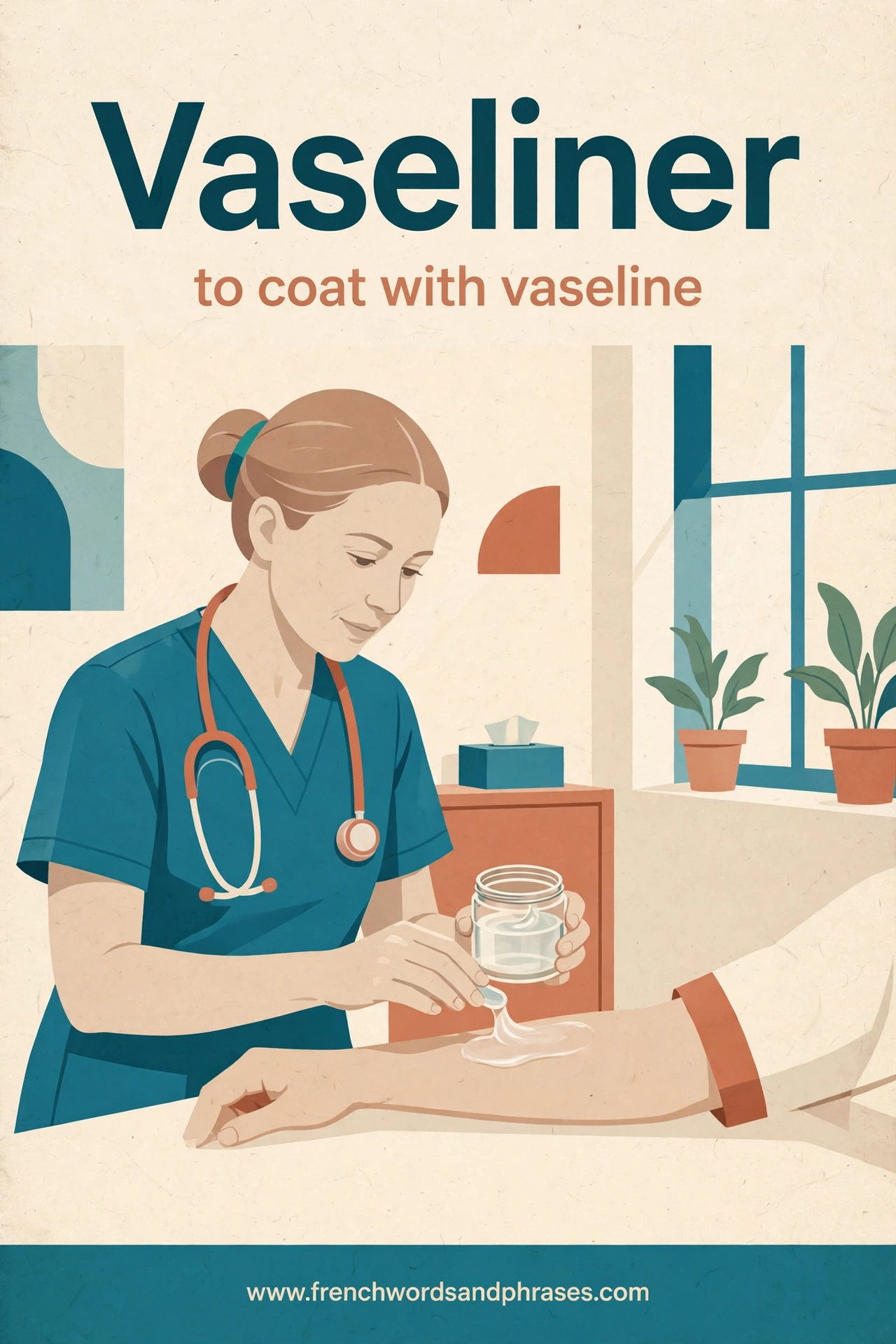
A French Word to Live By
How to Conjugate Vaseliner in French
/vaz.li.ne/
Vaseliner means to coat with vaseline — to spread petroleum jelly over skin, lips or metal to protect it.
Winter wind on a mountain path, lips cracking in the cold — out comes the little round tin, and vaseliner is the humble, practical verb of spreading petroleum jelly wherever skin, leather or metal needs a protective film.
In this guide, you’ll learn how to conjugate vaseliner in all the major French tenses and moods. Explore complete conjugation tables, French examples, English translations, and practice quizzes.
Understanding the French Verb Vaseliner
Vaseliner is a regular French verb belonging to the first group of verbs, those ending in -er.
It means to coat with vaseline. It is commonly used for protecting chapped lips and hands in winter, for babies’ skin, in medicine for coating instruments and skin before dressings, and by mechanics for protecting battery terminals and threads from corrosion.
Verb classification: First group (-er)
Auxiliary verb: Avoir
Past participle: vaseliné
Present participle: vaselinant
English equivalents: To coat with vaseline, to smear with petroleum jelly; vaseliner ses lèvres — to put vaseline on one’s lips; vaseliner les bornes d’une batterie — to coat battery terminals; la vaseline — petroleum jelly, Vaseline.
One important detail: vaseliner is the verb of the substance — la vaseline, petroleum jelly, whose name began life as a brand and became the everyday French word. The verb is perfectly regular: je vaseline, nous vaselinons, past participle vaseliné. Note the s sounds like a z between the vowels — the same soft buzz you hear in la vaseline itself.
Experience the Word
Vaseliner is the verb of the little tin that lives in every bathroom cabinet and every toolbox in France.
Imagine a cyclist at the top of a frozen pass. The wind has split her lips and burned her cheeks, so she stops, digs out the small tin with numb fingers, and vaseline ses lèvres before the long descent — a two-second ritual that saves her face.
The descent is cold but bearable. Her lips were protected — vaselinées — before the wind could bite.
How to Conjugate Vaseliner: Complete French Conjugation Guide
Let’s explore every major conjugation of vaseliner, beginning with the indicative mood.
How to Conjugate Vaseliner in the Indicative Mood
The indicative mood is used to express facts, observations, actions, and events.
How to Conjugate Vaseliner in the Present Tense (Présent)
Used for actions happening now, habitual actions, and general truths.
| Subject | Conjugation |
|---|---|
| je | vaseline |
| tu | vaselines |
| il / elle | vaseline |
| nous | vaselinons |
| vous | vaselinez |
| ils / elles | vaselinent |
Example
L’infirmière vaseline la peau avant le pansement.
The nurse coats the skin with vaseline before the dressing.
Quick Quiz 1
Complete the sentence:
Nous ______ les bornes de la batterie.
Reveal the answer
vaselinons
Nous vaselinons les bornes de la batterie.
We coat the battery terminals with vaseline.
How to Conjugate Vaseliner in the Passé Composé
Used for completed actions in the past. Vaseliner takes the auxiliary verb avoir.
| Subject | Conjugation |
|---|---|
| j’ | ai vaseliné |
| tu | as vaseliné |
| il / elle | a vaseliné |
| nous | avons vaseliné |
| vous | avez vaseliné |
| ils / elles | ont vaseliné |
Example
Elle a vaseliné ses lèvres gercées.
She coated her chapped lips with vaseline.
How to Conjugate Vaseliner in the Imparfait (Imperfect Tense)
Used for habitual past actions, descriptions, and ongoing situations in the past.
| Subject | Conjugation |
|---|---|
| je | vaselinais |
| tu | vaselinais |
| il / elle | vaselinait |
| nous | vaselinions |
| vous | vaseliniez |
| ils / elles | vaselinaient |
Example
Chaque soir, elle vaselinait ses mains abîmées par le froid.
Every evening, she used to coat her cold-damaged hands with vaseline.
Quick Quiz 2
Choose the correct form:
She coated her chapped lips.
Elle ______ ses lèvres gercées. (a vaseliné / est vaselinée)
Reveal the answer
a vaseliné
Elle a vaseliné ses lèvres gercées.
Vaseliner takes avoir.
How to Conjugate Vaseliner in the Plus-que-parfait
Used to describe an action that had already been completed before another past event.
| Subject | Conjugation |
|---|---|
| j’ | avais vaseliné |
| tu | avais vaseliné |
| il / elle | avait vaseliné |
| nous | avions vaseliné |
| vous | aviez vaseliné |
| ils / elles | avaient vaseliné |
Example
Il avait vaseliné le joint avant de le visser.
He had coated the seal with vaseline before screwing it in.
How to Conjugate Vaseliner in the Passé Simple
Primarily used in formal writing, literature, and historical narratives. It is rarely used in everyday conversation.
| Subject | Conjugation |
|---|---|
| je | vaselinai |
| tu | vaselinas |
| il / elle | vaselina |
| nous | vaselinâmes |
| vous | vaselinâtes |
| ils / elles | vaselinèrent |
Example
Le médecin vaselina l’instrument avant l’examen.
The doctor coated the instrument with vaseline before the examination.
How to Conjugate Vaseliner in the Passé Antérieur
A literary tense used to express an action completed immediately before another past action, generally in the passé simple.
| Subject | Conjugation |
|---|---|
| j’ | eus vaseliné |
| tu | eus vaseliné |
| il / elle | eut vaseliné |
| nous | eûmes vaseliné |
| vous | eûtes vaseliné |
| ils / elles | eurent vaseliné |
Example
Quand elle eut vaseliné ses lèvres, elle sortit dans le froid.
When she had coated her lips with vaseline, she went out into the cold.
How to Conjugate Vaseliner in the Future Tense (Futur Simple)
Used to describe actions that will take place in the future.
| Subject | Conjugation |
|---|---|
| je | vaselinerai |
| tu | vaselineras |
| il / elle | vaselinera |
| nous | vaselinerons |
| vous | vaselinerez |
| ils / elles | vaselineront |
Example
Ce soir, je vaselinerai mes talons avant de me coucher.
Tonight, I will coat my heels with vaseline before going to bed.
How to Conjugate Vaseliner in the Futur Antérieur (Future Perfect)
Used for an action that will have been completed before a particular point in the future.
| Subject | Conjugation |
|---|---|
| j’ | aurai vaseliné |
| tu | auras vaseliné |
| il / elle | aura vaseliné |
| nous | aurons vaseliné |
| vous | aurez vaseliné |
| ils / elles | auront vaseliné |
Example
À l’arrivée, les coureurs auront vaseliné leurs pieds endoloris.
By the finish, the runners will have coated their sore feet with vaseline.
How to Conjugate Vaseliner in the Near Future (Futur Proche)
Used to describe something that is going to happen soon. Formed with aller + infinitive.
| Subject | Conjugation |
|---|---|
| je | vais vaseliner |
| tu | vas vaseliner |
| il / elle | va vaseliner |
| nous | allons vaseliner |
| vous | allez vaseliner |
| ils / elles | vont vaseliner |
Example
Je vais vaseliner le pas de vis, il forcera moins.
I am going to coat the thread with vaseline, it will turn more easily.
How to Conjugate Vaseliner in the Conditional Mood
The conditional mood expresses what would happen under certain circumstances. It is also frequently used to make polite requests or express wishes.
How to Conjugate Vaseliner in the Present Conditional
| Subject | Conjugation |
|---|---|
| je | vaselinerais |
| tu | vaselinerais |
| il / elle | vaselinerait |
| nous | vaselinerions |
| vous | vaselineriez |
| ils / elles | vaselineraient |
Example
Sans crème, tu vaselinerais tes mains gercées.
Without cream, you would coat your chapped hands with vaseline.
How to Conjugate Vaseliner in the Past Conditional
| Subject | Conjugation |
|---|---|
| j’ | aurais vaseliné |
| tu | aurais vaseliné |
| il / elle | aurait vaseliné |
| nous | aurions vaseliné |
| vous | auriez vaseliné |
| ils / elles | auraient vaseliné |
Example
Elle aurait vaseliné ses lèvres si elle avait eu son tube.
She would have coated her lips with vaseline if she had had her tube.
Vaseliner in the Literary Past Conditional Form
This less common literary form uses the imperfect subjunctive of avoir.
| Subject | Conjugation |
|---|---|
| j’ | eusse vaseliné |
| tu | eusses vaseliné |
| il / elle | eût vaseliné |
| nous | eussions vaseliné |
| vous | eussiez vaseliné |
| ils / elles | eussent vaseliné |
Example
Il eût vaseliné le joint avant l’hiver.
He would have coated the seal with vaseline before winter.
How to Conjugate Vaseliner in the Subjunctive Mood
The subjunctive is used to express wishes, emotions, doubts, necessity, and uncertainty. It frequently follows expressions such as il faut que (it is necessary that) or bien que (although).
How to Conjugate Vaseliner in the Present Subjunctive
| Subject | Conjugation |
|---|---|
| que je | vaseline |
| que tu | vaselines |
| qu’il / qu’elle | vaseline |
| que nous | vaselinions |
| que vous | vaseliniez |
| qu’ils / qu’elles | vaselinent |
Example
Il faut que tu vaselines les bornes de la batterie.
You must coat the battery terminals with vaseline.
Quick Quiz 3
Complete the sentence using the subjunctive:
Il faut que tu ______ les bornes de la batterie.
Reveal the answer
vaselines
Il faut que tu vaselines les bornes de la batterie.
You must coat the battery terminals with vaseline.
How to Conjugate Vaseliner in the Imperfect Subjunctive
A literary tense, rarely encountered in modern spoken French.
| Subject | Conjugation |
|---|---|
| que je | vaselinasse |
| que tu | vaselinasses |
| qu’il / qu’elle | vaselinât |
| que nous | vaselinassions |
| que vous | vaselinassiez |
| qu’ils / qu’elles | vaselinassent |
Example
Le mécanicien voulait que l’apprenti vaselinât les bornes.
The mechanic wanted the apprentice to coat the terminals with vaseline.
How to Conjugate Vaseliner in the Pluperfect Subjunctive
A literary construction used to express an action completed before another past action.
| Subject | Conjugation |
|---|---|
| que j’ | eusse vaseliné |
| que tu | eusses vaseliné |
| qu’il / qu’elle | eût vaseliné |
| que nous | eussions vaseliné |
| que vous | eussiez vaseliné |
| qu’ils / qu’elles | eussent vaseliné |
Example
On regrettait qu’elle n’eût pas vaseliné ses mains avant les travaux.
People regretted that she had not coated her hands with vaseline before the work.
How to Conjugate Vaseliner in the Past Subjunctive
| Subject | Conjugation |
|---|---|
| que j’ | aie vaseliné |
| que tu | aies vaseliné |
| qu’il / qu’elle | ait vaseliné |
| que nous | ayons vaseliné |
| que vous | ayez vaseliné |
| qu’ils / qu’elles | aient vaseliné |
Example
Je suis content que tu aies vaseliné la serrure, elle ne grince plus.
I am glad you coated the lock with vaseline, it no longer squeaks.
How to Conjugate Vaseliner in the Imperative
The imperative is used to give commands, instructions, invitations, or suggestions. Subject pronouns are omitted.
How to Conjugate Vaseliner in the Present Imperative
| Person | Conjugation |
|---|---|
| (tu) | vaseline |
| (nous) | vaselinons |
| (vous) | vaselinez |
Example
Vaseline tes lèvres avant de sortir dans le vent !
Coat your lips with vaseline before going out in the wind!
Quick Quiz 4
How would you say Coat your lips with vaseline (tu form)?
Reveal the answer
Vaseline tes lèvres !
French Participles of Vaseliner
Participles are verb forms that can be used in compound tenses and other grammatical constructions.
Present Participle of Vaseliner
vaselinant
En vaselinant les bornes, on protège la batterie de la corrosion.
By coating the terminals with vaseline, you protect the battery from corrosion.
Past Participle of Vaseliner
vaseliné
Vaselinées chaque soir, ses mains ont retrouvé leur douceur.
Coated with vaseline every evening, her hands regained their softness.
Vaseliner in Everyday French: Real-Life Examples
Now that you know the conjugations, let’s see how vaseliner appears in everyday French.
Example 1 — Present
L’infirmière vaseline la peau avant le pansement.
The nurse coats the skin with vaseline before the dressing.
Example 2 — Passé composé
Elle a vaseliné ses lèvres gercées.
She coated her chapped lips with vaseline.
Example 3 — Imparfait
Elle vaselinait ses mains chaque soir.
She used to coat her hands with vaseline every evening.
Example 4 — Future
Je vaselinerai mes talons ce soir.
I will coat my heels with vaseline tonight.
Example 5 — Conditional
Tu vaselinerais tes mains sans cette crème.
You would coat your hands with vaseline without this cream.
Example 6 — Imperative
Vaselinez les bornes de la batterie !
Coat the battery terminals with vaseline!
Beyond Translation: The Meaning of Vaseliner
Some verbs are born from great events; vaseliner was born from a tin. La vaseline — petroleum jelly, launched in the 1870s under a brand name built from German Wasser and Greek elaion, oil — became so universal that French simply turned the product into a verb.
A brand name became an action.
Like scotcher (to tape) or klaxonner (to honk), vaseliner shows how French absorbs the objects of daily life and conjugates them.
How to Remember the French Verb Vaseliner
Remember it this way: Vaseliner is about a cyclist at a frozen pass, digging out the little tin for her lips.
- The verb is the tin: la vaseline, petroleum jelly — vaseliner, to coat with it.
- Perfectly regular: je vaseline, nous vaselinons, past participle vaseliné.
- From chapped lips to battery terminals: if it needs a protective film, on le vaseline.
The key idea is a cyclist at a frozen pass, digging out the little tin for her lips.
Test Your Knowledge of Vaseliner
Let’s see how much you’ve learned. Try answering these questions before revealing the answers.
Question 1
How do you say to coat your lips with vaseline in French?
Reveal the answer
Vaseliner ses lèvres.
Question 2
How do you say The nurse coats the skin with vaseline in French?
Reveal the answer
L’infirmière vaseline la peau.
Question 3
Translate: She coated her chapped lips with vaseline.
Reveal the answer
Elle a vaseliné ses lèvres gercées.
Question 4
What is the past participle of vaseliner?
Reveal the answer
Vaseliné.
Question 5
Complete the sentence:
Il faut que tu ______ les bornes de la batterie.
Reveal the answer
vaselines
Il faut que tu vaselines les bornes de la batterie.
You must coat the battery terminals with vaseline.
Your Final Challenge
Can You Use It?
How would you say this in French?
Before the icy descent, the cyclist coats her lips with vaseline and puts her gloves back on.
Reveal the answer
Avant la descente glacée, la cycliste vaseline ses lèvres et remet ses gants.
Before the icy descent, the cyclist coats her lips with vaseline and puts her gloves back on.
A little French. A little curiosity. A richer everyday life.
LEARN FRENCH ONE WORD AT A TIME