A French Word to Live By
How to Conjugate Vaquer in French
/va.ke/
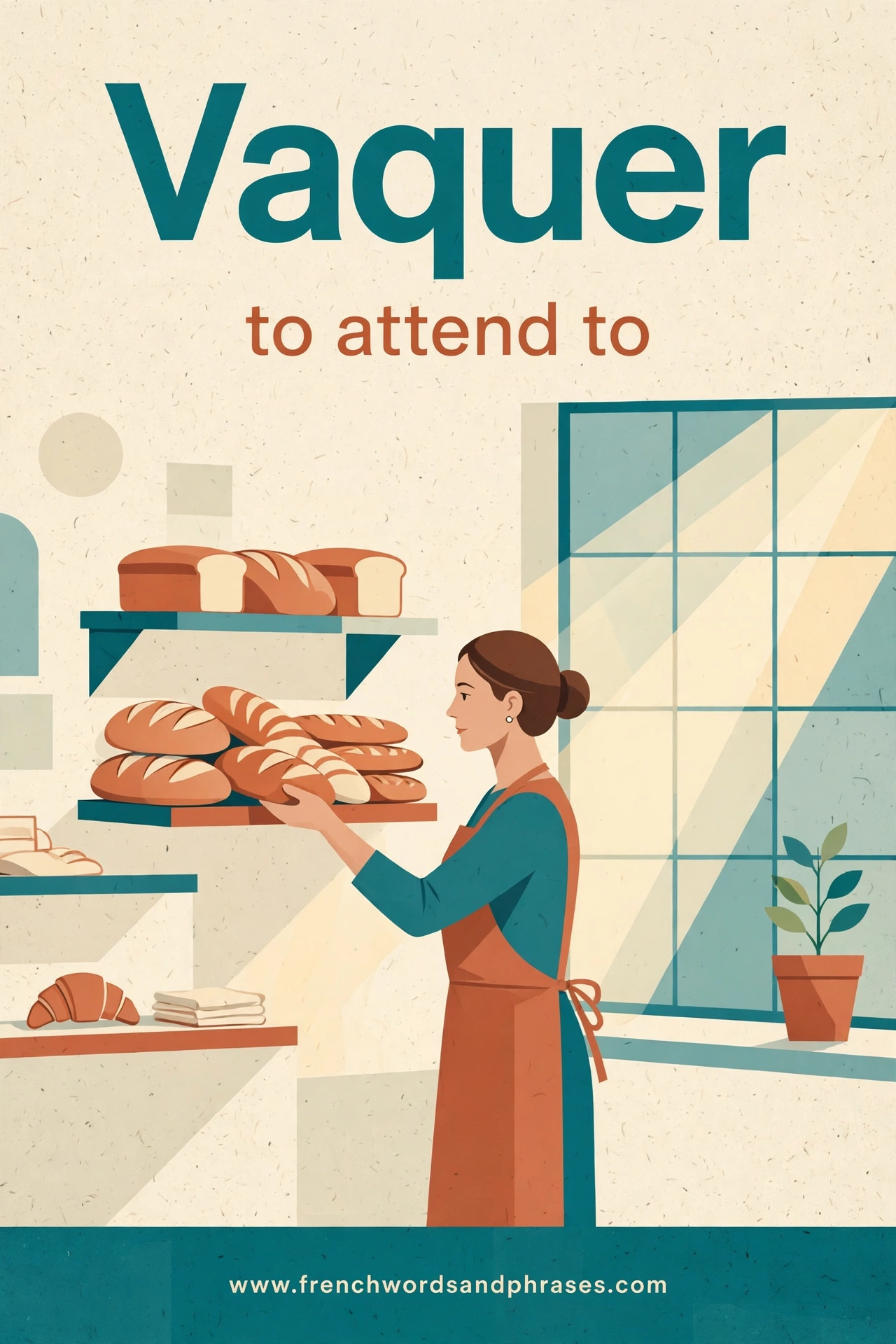
Vaquer means to attend to — to go about your business and get on with your occupations.
Shutters opening over a quiet village square, the mayor unlocking the mairie, the clerk setting out his registers — vaquer is the calm, slightly old-fashioned verb of people getting on with their day’s business, each at their own desk, each in their own shop.
In this guide, you’ll learn how to conjugate vaquer in all the major French tenses and moods. Explore complete conjugation tables, French examples, English translations, and practice quizzes.
Understanding the French Verb Vaquer
Vaquer is a regular French verb belonging to the first group of verbs, those ending in -er.
It means to attend to. It is commonly used in formal and written French for attending to one’s daily business, one’s affairs or one’s duties — vaquer à ses occupations is the classic phrase — and in legal French for courts in recess and posts left vacant.
Verb classification: First group (-er)
Auxiliary verb: Avoir
Past participle: vaqué
Present participle: vaquant
English equivalents: To attend to, to go about (one’s business); vaquer à ses occupations — to attend to one’s business; vaquer à ses affaires — to see to one’s affairs; le tribunal vaque — the court is in recess.
One important detail: vaquer is almost never used without à — you vaquez à your occupations, your affairs, your business. The -qu- keeps the hard k sound in every form: je vaque, nous vaquons, past participle vaqué. The same verb has a second, legal life: when a court stops sitting, le tribunal vaque — it is in recess, and the break itself is called les vacations. And when a post falls empty, French says un emploi vaque — a job is vacant.
Experience the Word
Vaquer is the verb of the working day quietly beginning — no drama, just everyone at their task.
Imagine a small town at eight in the morning. The baker is already at his oven, the postwoman sets off on her round, the mayor opens the mairie — chacun vaque à ses occupations, everyone attends to their own business, and the whole village hums into life.
Nothing grand has happened. Everyone has simply gone about their day — ils ont vaqué à leurs affaires.
How to Conjugate Vaquer: Complete French Conjugation Guide
Let’s explore every major conjugation of vaquer, beginning with the indicative mood.
How to Conjugate Vaquer in the Indicative Mood
The indicative mood is used to express facts, observations, actions, and events.
How to Conjugate Vaquer in the Present Tense (Présent)
Used for actions happening now, habitual actions, and general truths.
| Subject | Conjugation |
|---|---|
| je | vaque |
| tu | vaques |
| il / elle | vaque |
| nous | vaquons |
| vous | vaquez |
| ils / elles | vaquent |
Example
Le maire vaque à ses occupations dès huit heures.
The mayor attends to his business from eight o’clock.
Quick Quiz 1
Complete the sentence:
Nous ______ à nos occupations.
Reveal the answer
vaquons
Nous vaquons à nos occupations.
We attend to our business.
How to Conjugate Vaquer in the Passé Composé
Used for completed actions in the past. Vaquer takes the auxiliary verb avoir.
| Subject | Conjugation |
|---|---|
| j’ | ai vaqué |
| tu | as vaqué |
| il / elle | a vaqué |
| nous | avons vaqué |
| vous | avez vaqué |
| ils / elles | ont vaqué |
Example
Toute la matinée, elle a vaqué à ses affaires.
All morning, she attended to her business.
How to Conjugate Vaquer in the Imparfait (Imperfect Tense)
Used for habitual past actions, descriptions, and ongoing situations in the past.
| Subject | Conjugation |
|---|---|
| je | vaquais |
| tu | vaquais |
| il / elle | vaquait |
| nous | vaquions |
| vous | vaquiez |
| ils / elles | vaquaient |
Example
Le notaire vaquait à ses dossiers dans son étude silencieuse.
The notary used to attend to his files in his quiet office.
Quick Quiz 2
Choose the correct form:
She attended to her business.
Elle ______ à ses affaires. (a vaqué / est vaquée)
Reveal the answer
a vaqué
Elle a vaqué à ses affaires.
Vaquer takes avoir.
How to Conjugate Vaquer in the Plus-que-parfait
Used to describe an action that had already been completed before another past event.
| Subject | Conjugation |
|---|---|
| j’ | avais vaqué |
| tu | avais vaqué |
| il / elle | avait vaqué |
| nous | avions vaqué |
| vous | aviez vaqué |
| ils / elles | avaient vaqué |
Example
Il avait vaqué à ses occupations avant de partir en vacances.
He had attended to his business before leaving on holiday.
How to Conjugate Vaquer in the Passé Simple
Primarily used in formal writing, literature, and historical narratives. It is rarely used in everyday conversation.
| Subject | Conjugation |
|---|---|
| je | vaquai |
| tu | vaquas |
| il / elle | vaqua |
| nous | vaquâmes |
| vous | vaquâtes |
| ils / elles | vaquèrent |
Example
Le greffier vaqua à ses registres jusqu’au soir.
The clerk attended to his registers until evening.
How to Conjugate Vaquer in the Passé Antérieur
A literary tense used to express an action completed immediately before another past action, generally in the passé simple.
| Subject | Conjugation |
|---|---|
| j’ | eus vaqué |
| tu | eus vaqué |
| il / elle | eut vaqué |
| nous | eûmes vaqué |
| vous | eûtes vaqué |
| ils / elles | eurent vaqué |
Example
Quand il eut vaqué à ses affaires, il ferma le bureau.
When he had attended to his business, he closed the office.
How to Conjugate Vaquer in the Future Tense (Futur Simple)
Used to describe actions that will take place in the future.
| Subject | Conjugation |
|---|---|
| je | vaquerai |
| tu | vaqueras |
| il / elle | vaquera |
| nous | vaquerons |
| vous | vaquerez |
| ils / elles | vaqueront |
Example
Demain, je vaquerai à mes occupations sans me presser.
Tomorrow, I will attend to my business without hurrying.
How to Conjugate Vaquer in the Futur Antérieur (Future Perfect)
Used for an action that will have been completed before a particular point in the future.
| Subject | Conjugation |
|---|---|
| j’ | aurai vaqué |
| tu | auras vaqué |
| il / elle | aura vaqué |
| nous | aurons vaqué |
| vous | aurez vaqué |
| ils / elles | auront vaqué |
Example
À midi, elle aura vaqué à toutes ses corvées.
By noon, she will have attended to all her chores.
How to Conjugate Vaquer in the Near Future (Futur Proche)
Used to describe something that is going to happen soon. Formed with aller + infinitive.
| Subject | Conjugation |
|---|---|
| je | vais vaquer |
| tu | vas vaquer |
| il / elle | va vaquer |
| nous | allons vaquer |
| vous | allez vaquer |
| ils / elles | vont vaquer |
Example
Je vais vaquer à mes affaires, ne m’attends pas.
I am going to attend to my business, do not wait for me.
How to Conjugate Vaquer in the Conditional Mood
The conditional mood expresses what would happen under certain circumstances. It is also frequently used to make polite requests or express wishes.
How to Conjugate Vaquer in the Present Conditional
| Subject | Conjugation |
|---|---|
| je | vaquerais |
| tu | vaquerais |
| il / elle | vaquerait |
| nous | vaquerions |
| vous | vaqueriez |
| ils / elles | vaqueraient |
Example
Sans ce dossier urgent, il vaquerait tranquillement à son jardin.
Without this urgent file, he would quietly attend to his garden.
How to Conjugate Vaquer in the Past Conditional
| Subject | Conjugation |
|---|---|
| j’ | aurais vaqué |
| tu | aurais vaqué |
| il / elle | aurait vaqué |
| nous | aurions vaqué |
| vous | auriez vaqué |
| ils / elles | auraient vaqué |
Example
Elle aurait vaqué à ses occupations si le téléphone n’avait pas sonné sans arrêt.
She would have attended to her business if the phone had not kept ringing.
Vaquer in the Literary Past Conditional Form
This less common literary form uses the imperfect subjunctive of avoir.
| Subject | Conjugation |
|---|---|
| j’ | eusse vaqué |
| tu | eusses vaqué |
| il / elle | eût vaqué |
| nous | eussions vaqué |
| vous | eussiez vaqué |
| ils / elles | eussent vaqué |
Example
Il eût vaqué à ses affaires avant la nuit.
He would have attended to his business before nightfall.
How to Conjugate Vaquer in the Subjunctive Mood
The subjunctive is used to express wishes, emotions, doubts, necessity, and uncertainty. It frequently follows expressions such as il faut que (it is necessary that) or bien que (although).
How to Conjugate Vaquer in the Present Subjunctive
| Subject | Conjugation |
|---|---|
| que je | vaque |
| que tu | vaques |
| qu’il / qu’elle | vaque |
| que nous | vaquions |
| que vous | vaquiez |
| qu’ils / qu’elles | vaquent |
Example
Il faut que chacun vaque à ses occupations.
Everyone must attend to their own business.
Quick Quiz 3
Complete the sentence using the subjunctive:
Il faut que chacun ______ à ses occupations.
Reveal the answer
vaque
Il faut que chacun vaque à ses occupations.
Everyone must attend to their own business.
How to Conjugate Vaquer in the Imperfect Subjunctive
A literary tense, rarely encountered in modern spoken French.
| Subject | Conjugation |
|---|---|
| que je | vaquasse |
| que tu | vaquasses |
| qu’il / qu’elle | vaquât |
| que nous | vaquassions |
| que vous | vaquassiez |
| qu’ils / qu’elles | vaquassent |
Example
Le directeur voulait que le greffier vaquât à ses registres.
The director wanted the clerk to attend to his registers.
How to Conjugate Vaquer in the Pluperfect Subjunctive
A literary construction used to express an action completed before another past action.
| Subject | Conjugation |
|---|---|
| que j’ | eusse vaqué |
| que tu | eusses vaqué |
| qu’il / qu’elle | eût vaqué |
| que nous | eussions vaqué |
| que vous | eussiez vaqué |
| qu’ils / qu’elles | eussent vaqué |
Example
On regrettait qu’il eût vaqué à d’autres affaires ce jour-là.
People regretted that he had attended to other business that day.
How to Conjugate Vaquer in the Past Subjunctive
| Subject | Conjugation |
|---|---|
| que j’ | aie vaqué |
| que tu | aies vaqué |
| qu’il / qu’elle | ait vaqué |
| que nous | ayons vaqué |
| que vous | ayez vaqué |
| qu’ils / qu’elles | aient vaqué |
Example
Je suis content que tu aies vaqué à tes affaires ce matin.
I am glad you attended to your business this morning.
How to Conjugate Vaquer in the Imperative
The imperative is used to give commands, instructions, invitations, or suggestions. Subject pronouns are omitted.
How to Conjugate Vaquer in the Present Imperative
| Person | Conjugation |
|---|---|
| (tu) | vaque |
| (nous) | vaquons |
| (vous) | vaquez |
Example
Vaque à tes occupations et laisse-moi tranquille !
Attend to your own business and leave me alone!
Quick Quiz 4
How would you say Attend to your business (tu form)?
Reveal the answer
Vaque à tes occupations !
French Participles of Vaquer
Participles are verb forms that can be used in compound tenses and other grammatical constructions.
Present Participle of Vaquer
vaquant
Vaquant à ses occupations, elle n’entendit pas la cloche.
Attending to her business, she did not hear the bell.
Past Participle of Vaquer
vaqué
Vaqué à ses occupations dès l’aube, le maire ne vit pas passer la matinée.
Busy attending to his business from dawn, the mayor did not notice the morning go by.
Vaquer in Everyday French: Real-Life Examples
Now that you know the conjugations, let’s see how vaquer appears in everyday French.
Example 1 — Present
Elle vaque à ses occupations.
She attends to her business.
Example 2 — Passé composé
J’ai vaqué à mes affaires toute la journée.
I attended to my business all day.
Example 3 — Imparfait
Il vaquait à ses dossiers.
He used to attend to his files.
Example 4 — Future
Nous vaquerons à nos occupations demain.
We will attend to our business tomorrow.
Example 5 — Conditional
Tu vaquerais à ton jardin sans ce travail.
You would attend to your garden without this work.
Example 6 — Imperative
Vaquons à nos affaires !
Let us attend to our business!
Beyond Translation: The Meaning of Vaquer
Vaquer comes from the Latin vacare — to be empty, to be free — and the whole family still carries the idea: les vacances are the days emptied of work, a poste vacant is an empty job, and les vacations judiciaires are the weeks when the courts stand empty.
To vaquer à something is to give it your free, unhurried attention.
That is why vaquer à ses occupations feels calmer than travailler: it is business attended to at walking pace, the rhythm of a village morning.
How to Remember the French Verb Vaquer
Remember it this way: Vaquer is about everyone in the village quietly going about their morning business.
- Vaquer never travels alone: it is vaquer à — vaquer à ses occupations, à ses affaires.
- The -qu- keeps the hard k sound everywhere: je vaque, nous vaquons, vaqué.
- Cousin of vacances and vacant: when the court vaque, it stands empty — in recess.
The key idea is everyone in the village quietly going about their morning business.
Test Your Knowledge of Vaquer
Let’s see how much you’ve learned. Try answering these questions before revealing the answers.
Question 1
How do you say to attend to one’s business in French?
Reveal the answer
Vaquer à ses occupations.
Question 2
How do you say The mayor attends to his business in French?
Reveal the answer
Le maire vaque à ses occupations.
Question 3
Translate: She attended to her affairs all morning.
Reveal the answer
Elle a vaqué à ses affaires toute la matinée.
Question 4
What is the past participle of vaquer?
Reveal the answer
Vaqué.
Question 5
Complete the sentence:
Il faut que chacun ______ à ses occupations.
Reveal the answer
vaque
Il faut que chacun vaque à ses occupations.
Everyone must attend to their own business.
Your Final Challenge
Can You Use It?
How would you say this in French?
The clerk attends to his registers, and the whole village attends to its business.
Reveal the answer
Le greffier vaque à ses registres, et le village entier vaque à ses affaires.
The clerk attends to his registers, and the whole village attends to its business.
A little French. A little curiosity. A richer everyday life.
LEARN FRENCH ONE WORD AT A TIME