A French Word to Live By
How to Conjugate Vaporiser in French
/va.pɔ.ʁi.ze/
Vaporiser means to spray — to send out liquid as a fine mist, or to turn a liquid into vapour.
A cloud of perfume blooming in the air of a Paris boutique, droplets finer than dust settling on a wrist — vaporiser is the verb of the fine mist: water on roses, scent on skin, cleaner on glass, anything liquid persuaded to travel as a cloud.
In this guide, you’ll learn how to conjugate vaporiser in all the major French tenses and moods. Explore complete conjugation tables, French examples, English translations, and practice quizzes.
Understanding the French Verb Vaporiser
Vaporiser is a regular French verb belonging to the first group of verbs, those ending in -er.
It means to spray. It is commonly used for spraying perfume, water on plants, cleaning products and paints, in beauty and gardening, and in science for liquids turning into vapour under heat.
Verb classification: First group (-er)
Auxiliary verb: Avoir
Past participle: vaporisé
Present participle: vaporisant
English equivalents: To spray, to vaporize, to mist; un vaporisateur — a spray bottle, an atomizer; vaporiser du parfum — to spray perfume; se vaporiser — to turn into vapour, to evaporate.
One important detail: vaporiser is a regular -er verb built on la vapeur, vapour or steam. Its tool is famous in every French bathroom: un vaporisateur, the spray bottle or atomizer — often shortened to un vapo. The reflexive se vaporiser belongs to the physics lesson: it means to turn into vapour, and takes être — l’eau s’est vaporisée au soleil. Do not confuse it with évaporer (s’évaporer), its close cousin for liquids disappearing into the air.
Experience the Word
Vaporiser is the verb of liquid become cloud — a thousand droplets doing together what one drop cannot.
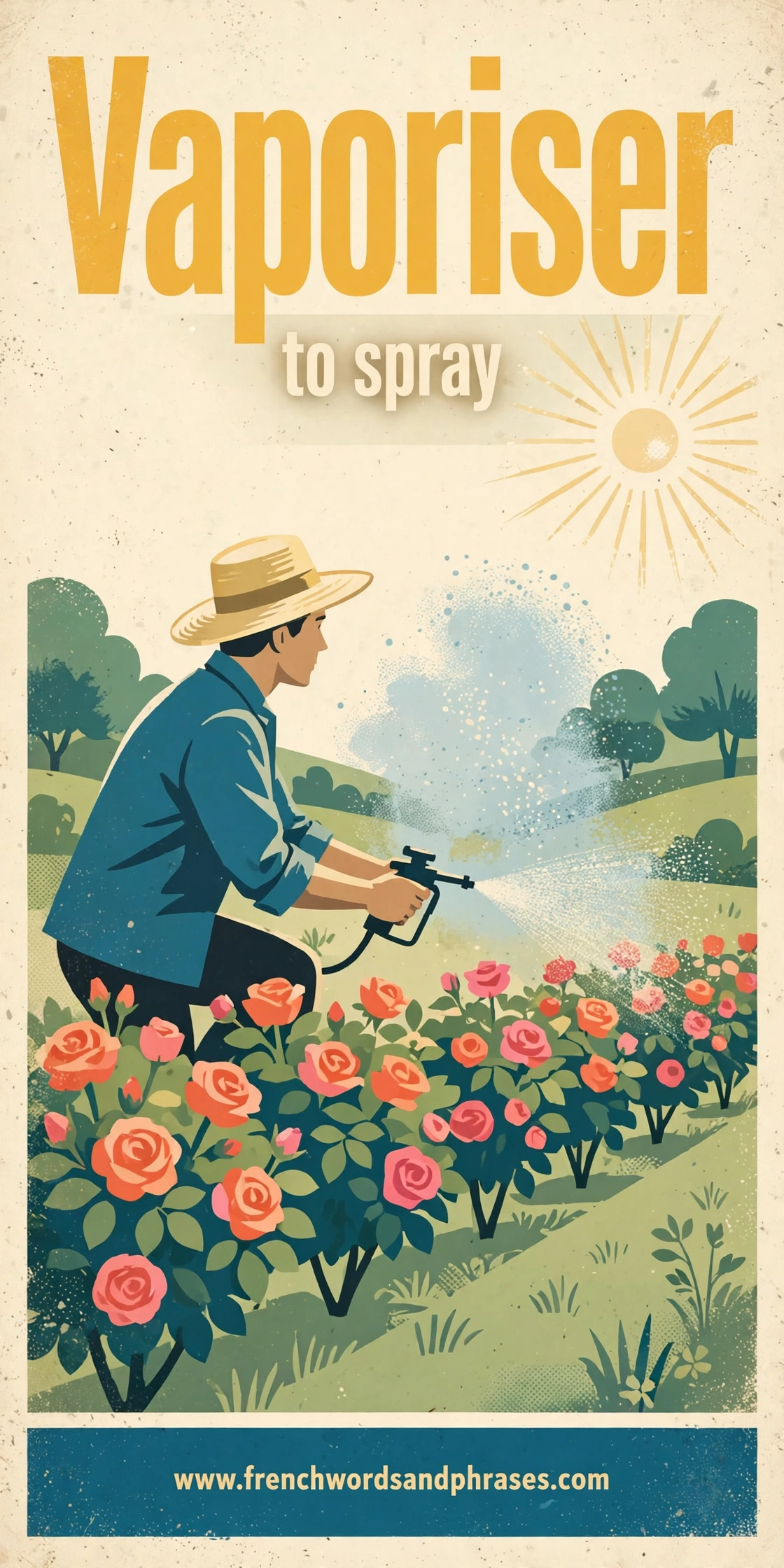
Imagine a gardener at dawn with a brass sprayer, moving along the roses. Each squeeze sends out a shining mist that hangs for a second in the first light — elle vaporise de l’eau sur les feuilles — and the garden drinks without a single puddle. Indoors, the same gesture perfumes a wrist; in the laboratory, the same verb describes the water itself vanishing into steam.
Mist on the roses, scent on the skin, water into air. Vaporiser turns the liquid world into weather.
How to Conjugate Vaporiser: Complete French Conjugation Guide
Let’s explore every major conjugation of vaporiser, beginning with the indicative mood.
How to Conjugate Vaporiser in the Indicative Mood
The indicative mood is used to express facts, observations, actions, and events.
How to Conjugate Vaporiser in the Present Tense (Présent)
Used for actions happening now, habitual actions, and general truths.
| Subject | Conjugation |
|---|---|
| je | vaporise |
| tu | vaporises |
| il / elle | vaporise |
| nous | vaporisons |
| vous | vaporisez |
| ils / elles | vaporisent |
Example
Elle vaporise un peu de parfum sur son poignet.
She sprays a little perfume on her wrist.
Quick Quiz 1
Complete the sentence:
Nous ______ les rosiers chaque semaine.
Reveal the answer
vaporisons
Nous vaporisons les rosiers chaque semaine.
We spray the roses every week.
How to Conjugate Vaporiser in the Passé Composé
Used for completed actions in the past. Vaporiser takes the auxiliary verb avoir.
| Subject | Conjugation |
|---|---|
| j’ | ai vaporisé |
| tu | as vaporisé |
| il / elle | a vaporisé |
| nous | avons vaporisé |
| vous | avez vaporisé |
| ils / elles | ont vaporisé |
Example
J’ai vaporisé de l’eau sur les plantes ce matin.
I sprayed water on the plants this morning.
How to Conjugate Vaporiser in the Imparfait (Imperfect Tense)
Used for habitual past actions, descriptions, and ongoing situations in the past.
| Subject | Conjugation |
|---|---|
| je | vaporisais |
| tu | vaporisais |
| il / elle | vaporisait |
| nous | vaporisions |
| vous | vaporisiez |
| ils / elles | vaporisaient |
Example
Le jardinier vaporisait un produit naturel sur les rosiers.
The gardener used to spray a natural product on the roses.
Quick Quiz 2
Choose the correct form:
She sprayed the window.
Elle ______ la vitre. (a vaporisé / est vaporisée)
Reveal the answer
a vaporisé
Elle a vaporisé la vitre.
Vaporiser takes avoir.
How to Conjugate Vaporiser in the Plus-que-parfait
Used to describe an action that had already been completed before another past event.
| Subject | Conjugation |
|---|---|
| j’ | avais vaporisé |
| tu | avais vaporisé |
| il / elle | avait vaporisé |
| nous | avions vaporisé |
| vous | aviez vaporisé |
| ils / elles | avaient vaporisé |
Example
Elle avait vaporisé la vitre avant de l’essuyer.
She had sprayed the window before wiping it.
How to Conjugate Vaporiser in the Passé Simple
Primarily used in formal writing, literature, and historical narratives. It is rarely used in everyday conversation.
| Subject | Conjugation |
|---|---|
| je | vaporisai |
| tu | vaporisas |
| il / elle | vaporisa |
| nous | vaporisâmes |
| vous | vaporisâtes |
| ils / elles | vaporisèrent |
Example
Le coiffeur vaporisa une brume légère sur la coiffure.
The hairdresser sprayed a light mist over the hairstyle.
How to Conjugate Vaporiser in the Passé Antérieur
A literary tense used to express an action completed immediately before another past action, generally in the passé simple.
| Subject | Conjugation |
|---|---|
| j’ | eus vaporisé |
| tu | eus vaporisé |
| il / elle | eut vaporisé |
| nous | eûmes vaporisé |
| vous | eûtes vaporisé |
| ils / elles | eurent vaporisé |
Example
Quand il eut vaporisé le désinfectant, il ouvrit les fenêtres.
When he had sprayed the disinfectant, he opened the windows.
How to Conjugate Vaporiser in the Future Tense (Futur Simple)
Used to describe actions that will take place in the future.
| Subject | Conjugation |
|---|---|
| je | vaporiserai |
| tu | vaporiseras |
| il / elle | vaporisera |
| nous | vaporiserons |
| vous | vaporiserez |
| ils / elles | vaporiseront |
Example
Demain, nous vaporiserons les tomates contre le mildiou.
Tomorrow, we will spray the tomatoes against mildew.
How to Conjugate Vaporiser in the Futur Antérieur (Future Perfect)
Used for an action that will have been completed before a particular point in the future.
| Subject | Conjugation |
|---|---|
| j’ | aurai vaporisé |
| tu | auras vaporisé |
| il / elle | aura vaporisé |
| nous | aurons vaporisé |
| vous | aurez vaporisé |
| ils / elles | auront vaporisé |
Example
À midi, elle aura vaporisé toutes les vitrines du magasin.
By noon, she will have sprayed all the shop windows.
How to Conjugate Vaporiser in the Near Future (Futur Proche)
Used to describe something that is going to happen soon. Formed with aller + infinitive.
| Subject | Conjugation |
|---|---|
| je | vais vaporiser |
| tu | vas vaporiser |
| il / elle | va vaporiser |
| nous | allons vaporiser |
| vous | allez vaporiser |
| ils / elles | vont vaporiser |
Example
Je vais vaporiser un peu d’eau sur le linge avant de le repasser.
I am going to spray a little water on the laundry before ironing it.
How to Conjugate Vaporiser in the Conditional Mood
The conditional mood expresses what would happen under certain circumstances. It is also frequently used to make polite requests or express wishes.
How to Conjugate Vaporiser in the Present Conditional
| Subject | Conjugation |
|---|---|
| je | vaporiserais |
| tu | vaporiserais |
| il / elle | vaporiserait |
| nous | vaporiserions |
| vous | vaporiseriez |
| ils / elles | vaporiseraient |
Example
Avec un meilleur vaporisateur, tu vaporiserais plus finement.
With a better sprayer, you would spray more finely.
How to Conjugate Vaporiser in the Past Conditional
| Subject | Conjugation |
|---|---|
| j’ | aurais vaporisé |
| tu | aurais vaporisé |
| il / elle | aurait vaporisé |
| nous | aurions vaporisé |
| vous | auriez vaporisé |
| ils / elles | auraient vaporisé |
Example
Il aurait vaporisé les plantes si la canicule avait continué.
He would have sprayed the plants if the heatwave had continued.
Vaporiser in the Literary Past Conditional Form
This less common literary form uses the imperfect subjunctive of avoir.
| Subject | Conjugation |
|---|---|
| j’ | eusse vaporisé |
| tu | eusses vaporisé |
| il / elle | eût vaporisé |
| nous | eussions vaporisé |
| vous | eussiez vaporisé |
| ils / elles | eussent vaporisé |
Example
La servante eût vaporisé le parfum dans la chambre.
The maid would have sprayed the perfume in the bedroom.
How to Conjugate Vaporiser in the Subjunctive Mood
The subjunctive is used to express wishes, emotions, doubts, necessity, and uncertainty. It frequently follows expressions such as il faut que (it is necessary that) or bien que (although).
How to Conjugate Vaporiser in the Present Subjunctive
| Subject | Conjugation |
|---|---|
| que je | vaporise |
| que tu | vaporises |
| qu’il / qu’elle | vaporise |
| que nous | vaporisions |
| que vous | vaporisiez |
| qu’ils / qu’elles | vaporisent |
Example
Il faut que vous vaporisiez l’eau sans mouiller les fleurs.
You must spray the water without wetting the flowers.
Quick Quiz 3
Complete the sentence using the subjunctive:
Il faut que vous ______ doucement.
Reveal the answer
vaporisiez
Il faut que vous vaporisiez doucement.
You must spray gently.
How to Conjugate Vaporiser in the Imperfect Subjunctive
A literary tense, rarely encountered in modern spoken French.
| Subject | Conjugation |
|---|---|
| que je | vaporisasse |
| que tu | vaporisasses |
| qu’il / qu’elle | vaporisât |
| que nous | vaporisassions |
| que vous | vaporisassiez |
| qu’ils / qu’elles | vaporisassent |
Example
Le médecin voulait qu’on vaporisât le produit trois fois par jour.
The doctor wanted the product sprayed three times a day.
How to Conjugate Vaporiser in the Pluperfect Subjunctive
A literary construction used to express an action completed before another past action.
| Subject | Conjugation |
|---|---|
| que j’ | eusse vaporisé |
| que tu | eusses vaporisé |
| qu’il / qu’elle | eût vaporisé |
| que nous | eussions vaporisé |
| que vous | eussiez vaporisé |
| qu’ils / qu’elles | eussent vaporisé |
Example
On racontait que l’eau se fût vaporisée en quelques minutes.
People told how the water had turned to vapour in a few minutes.
How to Conjugate Vaporiser in the Past Subjunctive
| Subject | Conjugation |
|---|---|
| que j’ | aie vaporisé |
| que tu | aies vaporisé |
| qu’il / qu’elle | ait vaporisé |
| que nous | ayons vaporisé |
| que vous | ayez vaporisé |
| qu’ils / qu’elles | aient vaporisé |
Example
Je suis content que tu aies vaporisé les rosiers à temps.
I am glad you sprayed the roses in time.
How to Conjugate Vaporiser in the Imperative
The imperative is used to give commands, instructions, invitations, or suggestions. Subject pronouns are omitted.
How to Conjugate Vaporiser in the Present Imperative
| Person | Conjugation |
|---|---|
| (tu) | vaporise |
| (nous) | vaporisons |
| (vous) | vaporisez |
Example
Vaporisez légèrement, jamais de près !
Spray lightly, never from close up!
Quick Quiz 4
How would you say Spray a little water (tu form)?
Reveal the answer
Vaporise un peu d’eau !
French Participles of Vaporiser
Participles are verb forms that can be used in compound tenses and other grammatical constructions.
Present Participle of Vaporiser
vaporisant
En vaporisant le parfum, elle a fermé les yeux.
While spraying the perfume, she closed her eyes.
Past Participle of Vaporiser
vaporisé
Vaporisée sur les feuilles, l’eau les rafraîchit sans les noyer.
Sprayed on the leaves, the water refreshes them without drowning them.
Vaporiser in Everyday French: Real-Life Examples
Now that you know the conjugations, let’s see how vaporiser appears in everyday French.
Example 1 — Present
Elle vaporise du parfum sur son poignet.
She sprays perfume on her wrist.
Example 2 — Passé composé
J’ai vaporisé de l’eau sur les plantes.
I sprayed water on the plants.
Example 3 — Imparfait
Le jardinier vaporisait les rosiers chaque semaine.
The gardener used to spray the roses every week.
Example 4 — Future
Nous vaporiserons les tomates demain.
We will spray the tomatoes tomorrow.
Example 5 — Conditional
Tu vaporiserais plus finement avec un vapo neuf.
You would spray more finely with a new spray bottle.
Example 6 — Imperative
Vaporise un peu d’eau sur le linge !
Spray a little water on the laundry!
Beyond Translation: The Meaning of Vaporiser
English vaporize sounds like science fiction — ray guns and disappearing acts; French vaporiser is a bathroom-and-garden word, as everyday as the bottle it comes from.
Un vapo in every home.
The noun vaporisateur is so familiar that French shortens it to un vapo — the little bottle that turns perfume, water and cleaner into weather you can aim.
How to Remember the French Verb Vaporiser
Remember it this way: Vaporiser is about liquid become cloud — perfume, rose-water and steam in one verb.
- La vapeur is vapour; vaporiser turns liquid into a travelling mist of it.
- Un vaporisateur — a spray bottle, un vapo for short; se vaporiser — to turn into vapour.
- Regular -er: je vaporise, nous vaporisons, past participle vaporisé.
The key idea is liquid become cloud — perfume, rose-water and steam in one verb.
Test Your Knowledge of Vaporiser
Let’s see how much you’ve learned. Try answering these questions before revealing the answers.
Question 1
How do you say a spray bottle in French?
Reveal the answer
Un vaporisateur.
Question 2
How do you say She sprays perfume on her wrist in French?
Reveal the answer
Elle vaporise du parfum sur son poignet.
Question 3
Translate: I sprayed water on the plants this morning.
Reveal the answer
J’ai vaporisé de l’eau sur les plantes ce matin.
Question 4
What is the past participle of vaporiser?
Reveal the answer
Vaporisé.
Question 5
Complete the sentence:
Il faut que vous ______ l’eau sans mouiller les fleurs.
Reveal the answer
vaporisiez
Il faut que vous vaporisiez l’eau sans mouiller les fleurs.
You must spray the water without wetting the flowers.
Your Final Challenge
Can You Use It?
How would you say this in French?
She sprays a mist of perfume, and the whole room smells sweet.
Reveal the answer
Elle vaporise une brume de parfum, et la pièce entière embaume.
She sprays a mist of perfume, and the whole room smells sweet.
A little French. A little curiosity. A richer everyday life.
LEARN FRENCH ONE WORD AT A TIME