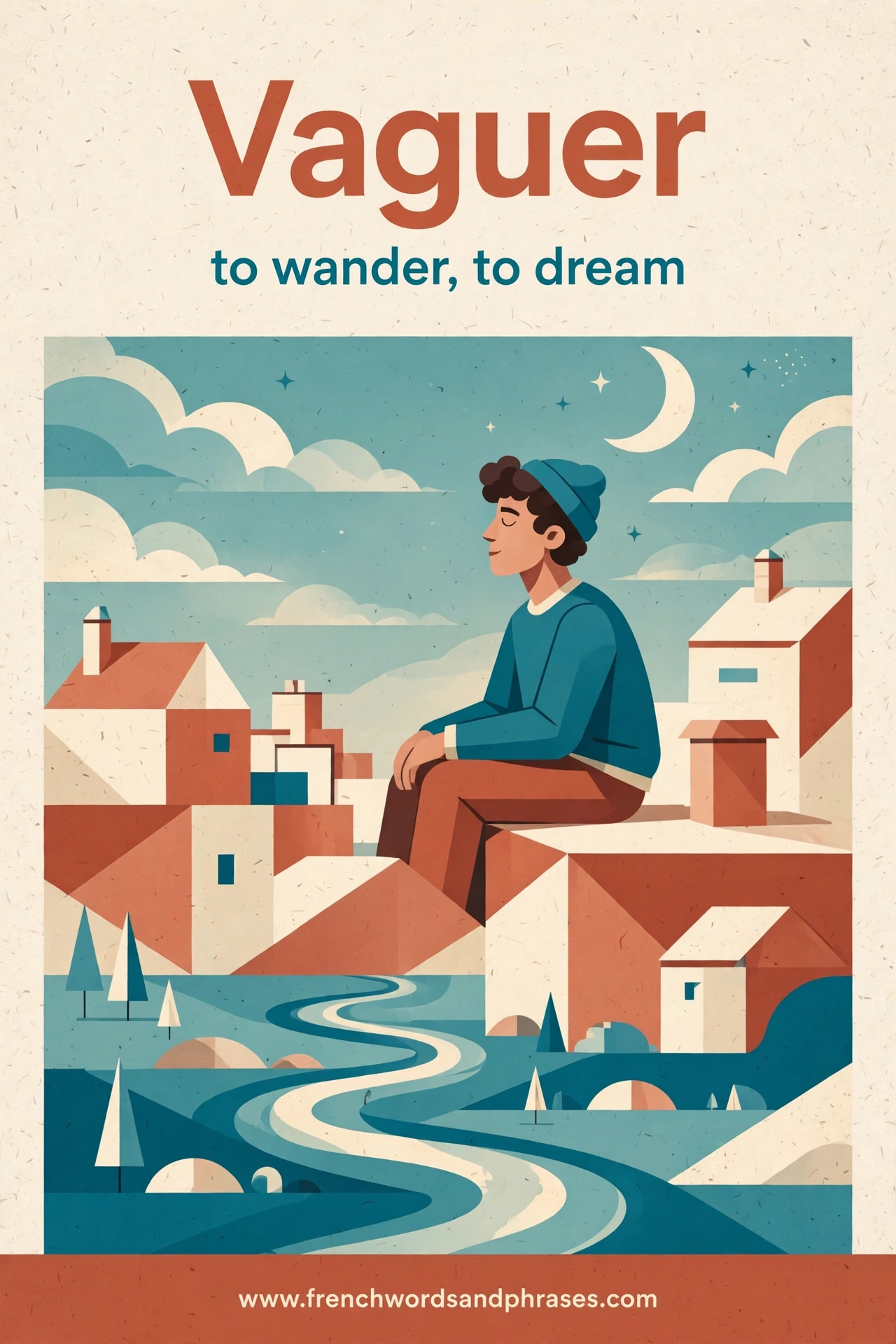
A French Word to Live By
How to Conjugate Vaguer in French
/va.ɡe/
Vaguer means to wander and to dream — to drift without a goal, in your feet or in your thoughts.
A mind slipping its leash during a long sermon, eyes drifting over the hills while the body walks a lane it knows by heart — vaguer is the gentle, dreamy verb of wandering: of feet with nowhere to go and thoughts with everywhere to go.
In this guide, you’ll learn how to conjugate vaguer in all the major French tenses and moods. Explore complete conjugation tables, French examples, English translations, and practice quizzes.
Understanding the French Verb Vaguer
Vaguer is a regular French verb belonging to the first group of verbs, those ending in -er.
It means to wander, to dream. It is commonly used for thoughts, eyes and imaginations drifting during lectures, journeys and long afternoons, and more rarely for people wandering the countryside without a route — it is a literary, unhurried verb.
Verb classification: First group (-er)
Auxiliary verb: Avoir
Past participle: vagué
Present participle: vaguant
English equivalents: To wander, to drift, to daydream; laisser vaguer son esprit — to let one’s mind wander; laisser vaguer son imagination — to let one’s imagination roam; vaguer à l’aventure — to wander at random.
One important detail: vaguer keeps its gu wherever the ending begins with e or i, so the hard g sound survives: je vague, but nous vaguons, vous vaguez, en vaguant — never nous vagons, which would read as if the g had gone soft. Watch out for its lookalikes: une vague is a wave of the sea, and vague the adjective means vague — the verb vaguer is the dreamy cousin of the family.
Experience the Word
Vaguer is wandering at its softest — no road, no errand, just drift.
Imagine a slow train crossing the plains in the late afternoon. A traveller watches the fields unroll, stops reading, stops thinking in straight lines, and lets his mind vaguer from the clouds to childhood to dinner — arriving, somehow, more rested than sleep would have made him.
He went nowhere and travelled far. His thoughts have wandered — elles ont vagué — and brought him back refreshed.
How to Conjugate Vaguer: Complete French Conjugation Guide
Let’s explore every major conjugation of vaguer, beginning with the indicative mood.
How to Conjugate Vaguer in the Indicative Mood
The indicative mood is used to express facts, observations, actions, and events.
How to Conjugate Vaguer in the Present Tense (Présent)
Used for actions happening now, habitual actions, and general truths.
| Subject | Conjugation |
|---|---|
| je | vague |
| tu | vagues |
| il / elle | vague |
| nous | vaguons |
| vous | vaguez |
| ils / elles | vaguent |
Example
Son esprit vague pendant les longs discours.
His mind wanders during long speeches.
Quick Quiz 1
Complete the sentence:
Nous ______ dans les prés le dimanche.
Reveal the answer
vaguons
Nous vaguons dans les prés le dimanche.
We wander in the meadows on Sundays.
How to Conjugate Vaguer in the Passé Composé
Used for completed actions in the past. Vaguer takes the auxiliary verb avoir.
| Subject | Conjugation |
|---|---|
| j’ | ai vagué |
| tu | as vagué |
| il / elle | a vagué |
| nous | avons vagué |
| vous | avez vagué |
| ils / elles | ont vagué |
Example
Mes pensées ont vagué toute la soirée.
My thoughts wandered all evening.
How to Conjugate Vaguer in the Imparfait (Imperfect Tense)
Used for habitual past actions, descriptions, and ongoing situations in the past.
| Subject | Conjugation |
|---|---|
| je | vaguais |
| tu | vaguais |
| il / elle | vaguait |
| nous | vaguions |
| vous | vaguiez |
| ils / elles | vaguaient |
Example
Enfant, il vaguait dans les champs derrière la maison.
As a child, he used to wander in the fields behind the house.
Quick Quiz 2
Choose the correct form:
His eyes wandered over the crowd.
Ses yeux ______ sur la foule. (ont vagué / sont vagués)
Reveal the answer
ont vagué
Ses yeux ont vagué sur la foule.
Vaguer takes avoir.
How to Conjugate Vaguer in the Plus-que-parfait
Used to describe an action that had already been completed before another past event.
| Subject | Conjugation |
|---|---|
| j’ | avais vagué |
| tu | avais vagué |
| il / elle | avait vagué |
| nous | avions vagué |
| vous | aviez vagué |
| ils / elles | avaient vagué |
Example
Son imagination avait vagué bien loin de la salle de classe.
His imagination had wandered far away from the classroom.
How to Conjugate Vaguer in the Passé Simple
Primarily used in formal writing, literature, and historical narratives. It is rarely used in everyday conversation.
| Subject | Conjugation |
|---|---|
| je | vaguai |
| tu | vaguas |
| il / elle | vagua |
| nous | vaguâmes |
| vous | vaguâtes |
| ils / elles | vaguèrent |
Example
Le poète vagua dans la campagne jusqu’au soir.
The poet wandered in the countryside until evening.
How to Conjugate Vaguer in the Passé Antérieur
A literary tense used to express an action completed immediately before another past action, generally in the passé simple.
| Subject | Conjugation |
|---|---|
| j’ | eus vagué |
| tu | eus vagué |
| il / elle | eut vagué |
| nous | eûmes vagué |
| vous | eûtes vagué |
| ils / elles | eurent vagué |
Example
Quand son regard eut vagué un moment, il reprit son discours.
When his gaze had wandered for a moment, he resumed his speech.
How to Conjugate Vaguer in the Future Tense (Futur Simple)
Used to describe actions that will take place in the future.
| Subject | Conjugation |
|---|---|
| je | vaguerai |
| tu | vagueras |
| il / elle | vaguera |
| nous | vaguerons |
| vous | vaguerez |
| ils / elles | vagueront |
Example
Ce soir, je laisserai vaguer mon imagination.
Tonight, I will let my imagination wander.
How to Conjugate Vaguer in the Futur Antérieur (Future Perfect)
Used for an action that will have been completed before a particular point in the future.
| Subject | Conjugation |
|---|---|
| j’ | aurai vagué |
| tu | auras vagué |
| il / elle | aura vagué |
| nous | aurons vagué |
| vous | aurez vagué |
| ils / elles | auront vagué |
Example
À la fin du voyage, ses pensées auront vagué sur trois continents.
By the end of the journey, his thoughts will have wandered over three continents.
How to Conjugate Vaguer in the Near Future (Futur Proche)
Used to describe something that is going to happen soon. Formed with aller + infinitive.
| Subject | Conjugation |
|---|---|
| je | vais vaguer |
| tu | vas vaguer |
| il / elle | va vaguer |
| nous | allons vaguer |
| vous | allez vaguer |
| ils / elles | vont vaguer |
Example
Attention, ton esprit va vaguer encore.
Careful, your mind is going to wander again.
How to Conjugate Vaguer in the Conditional Mood
The conditional mood expresses what would happen under certain circumstances. It is also frequently used to make polite requests or express wishes.
How to Conjugate Vaguer in the Present Conditional
| Subject | Conjugation |
|---|---|
| je | vaguerais |
| tu | vaguerais |
| il / elle | vaguerait |
| nous | vaguerions |
| vous | vagueriez |
| ils / elles | vagueraient |
Example
Sans ce bruit, mes idées vagueraient moins.
Without this noise, my ideas would wander less.
How to Conjugate Vaguer in the Past Conditional
| Subject | Conjugation |
|---|---|
| j’ | aurais vagué |
| tu | aurais vagué |
| il / elle | aurait vagué |
| nous | aurions vagué |
| vous | auriez vagué |
| ils / elles | auraient vagué |
Example
Il aurait vagué plus longtemps sans la nuit tombante.
He would have wandered longer if night had not been falling.
Vaguer in the Literary Past Conditional Form
This less common literary form uses the imperfect subjunctive of avoir.
| Subject | Conjugation |
|---|---|
| j’ | eusse vagué |
| tu | eusses vagué |
| il / elle | eût vagué |
| nous | eussions vagué |
| vous | eussiez vagué |
| ils / elles | eussent vagué |
Example
Elle eût vagué volontiers dans les collines.
She would gladly have wandered in the hills.
How to Conjugate Vaguer in the Subjunctive Mood
The subjunctive is used to express wishes, emotions, doubts, necessity, and uncertainty. It frequently follows expressions such as il faut que (it is necessary that) or bien que (although).
How to Conjugate Vaguer in the Present Subjunctive
| Subject | Conjugation |
|---|---|
| que je | vague |
| que tu | vagues |
| qu’il / qu’elle | vague |
| que nous | vaguions |
| que vous | vaguiez |
| qu’ils / qu’elles | vaguent |
Example
Il est normal que l’esprit vague parfois.
It is normal for the mind to wander sometimes.
Quick Quiz 3
Complete the sentence using the subjunctive:
Il est normal que l’esprit ______ parfois.
Reveal the answer
vague
Il est normal que l’esprit vague parfois.
It is normal for the mind to wander sometimes.
How to Conjugate Vaguer in the Imperfect Subjunctive
A literary tense, rarely encountered in modern spoken French.
| Subject | Conjugation |
|---|---|
| que je | vaguasse |
| que tu | vaguasses |
| qu’il / qu’elle | vaguât |
| que nous | vaguassions |
| que vous | vaguassiez |
| qu’ils / qu’elles | vaguassent |
Example
Le professeur souriait que nos regards vaguassent par la fenêtre.
The teacher smiled that our gazes wandered out of the window.
How to Conjugate Vaguer in the Pluperfect Subjunctive
A literary construction used to express an action completed before another past action.
| Subject | Conjugation |
|---|---|
| que j’ | eusse vagué |
| que tu | eusses vagué |
| qu’il / qu’elle | eût vagué |
| que nous | eussions vagué |
| que vous | eussiez vagué |
| qu’ils / qu’elles | eussent vagué |
Example
On sentait que sa pensée eût vagué très loin.
You could feel his thought had wandered very far.
How to Conjugate Vaguer in the Past Subjunctive
| Subject | Conjugation |
|---|---|
| que j’ | aie vagué |
| que tu | aies vagué |
| qu’il / qu’elle | ait vagué |
| que nous | ayons vagué |
| que vous | ayez vagué |
| qu’ils / qu’elles | aient vagué |
Example
Je suis content que ton imagination ait vagué si librement.
I am glad your imagination wandered so freely.
How to Conjugate Vaguer in the Imperative
The imperative is used to give commands, instructions, invitations, or suggestions. Subject pronouns are omitted.
How to Conjugate Vaguer in the Present Imperative
| Person | Conjugation |
|---|---|
| (tu) | vague |
| (nous) | vaguons |
| (vous) | vaguez |
Example
Vague un peu, laisse tes pensées respirer !
Wander a little, let your thoughts breathe!
Quick Quiz 4
How would you say Wander a little (tu form)?
Reveal the answer
Vague un peu !
French Participles of Vaguer
Participles are verb forms that can be used in compound tenses and other grammatical constructions.
Present Participle of Vaguer
vaguant
En vaguant dans les prés, il composait des vers.
While wandering in the meadows, he composed verses.
Past Participle of Vaguer
vagué
Ses yeux ont vagué sur la foule sans s’arrêter.
His eyes wandered over the crowd without settling.
Vaguer in Everyday French: Real-Life Examples
Now that you know the conjugations, let’s see how vaguer appears in everyday French.
Example 1 — Present
Son esprit vague pendant la réunion.
His mind wanders during the meeting.
Example 2 — Passé composé
Mes pensées ont vagué toute la soirée.
My thoughts wandered all evening.
Example 3 — Imparfait
Il vaguait dans les champs, enfant.
He used to wander in the fields as a child.
Example 4 — Future
Je laisserai vaguer mon imagination ce soir.
I will let my imagination wander tonight.
Example 5 — Conditional
Sans ce bruit, mes idées vagueraient moins.
Without this noise, my ideas would wander less.
Example 6 — Imperative
Vaguez un moment dans le jardin !
Wander a while in the garden!
Beyond Translation: The Meaning of Vaguer
English wander does the feet and the mind at once, and so does vaguer — but vaguer is the most literary of the French drift-verbs, the one poets choose when the wandering is really dreaming with your eyes open.
Its home phrase is laisser vaguer.
Laisser vaguer son esprit, ses pensées, son imagination — to let your mind, your thoughts, your imagination wander. French treats daydreaming not as idleness but as something you permit, like opening a gate.
How to Remember the French Verb Vaguer
Remember it this way: Vaguer is about the mind slipping its leash on a slow train — drifting, dreaming, going nowhere on purpose.
- Vaguer is dreamy wandering — of feet sometimes, of thoughts most often.
- The gu never drops: nous vaguons, en vaguant — the hard g must survive.
- Regular -er: je vague, nous vaguons, past participle vagué.
The key idea is the mind slipping its leash on a slow train — drifting, dreaming, going nowhere on purpose.
Test Your Knowledge of Vaguer
Let’s see how much you’ve learned. Try answering these questions before revealing the answers.
Question 1
How do you say to let one’s mind wander in French?
Reveal the answer
Laisser vaguer son esprit.
Question 2
How do you say My thoughts wandered all evening in French?
Reveal the answer
Mes pensées ont vagué toute la soirée.
Question 3
Translate: His mind wanders during the meeting.
Reveal the answer
Son esprit vague pendant la réunion.
Question 4
What is the past participle of vaguer?
Reveal the answer
Vagué.
Question 5
Complete the sentence:
Il est normal que l’esprit ______ parfois.
Reveal the answer
vague
Il est normal que l’esprit vague parfois.
It is normal for the mind to wander sometimes.
Your Final Challenge
Can You Use It?
How would you say this in French?
Seated by the window, he lets his thoughts wander above the golden fields.
Reveal the answer
Assis près de la fenêtre, il laisse vaguer ses pensées au-dessus des champs dorés.
Seated by the window, he lets his thoughts wander above the golden fields.
A little French. A little curiosity. A richer everyday life.
LEARN FRENCH ONE WORD AT A TIME