A French Word to Live By
How to Conjugate Vacciner in French
/vak.si.ne/
Vacciner means to vaccinate — to give someone a vaccine so their body learns to fight a disease.
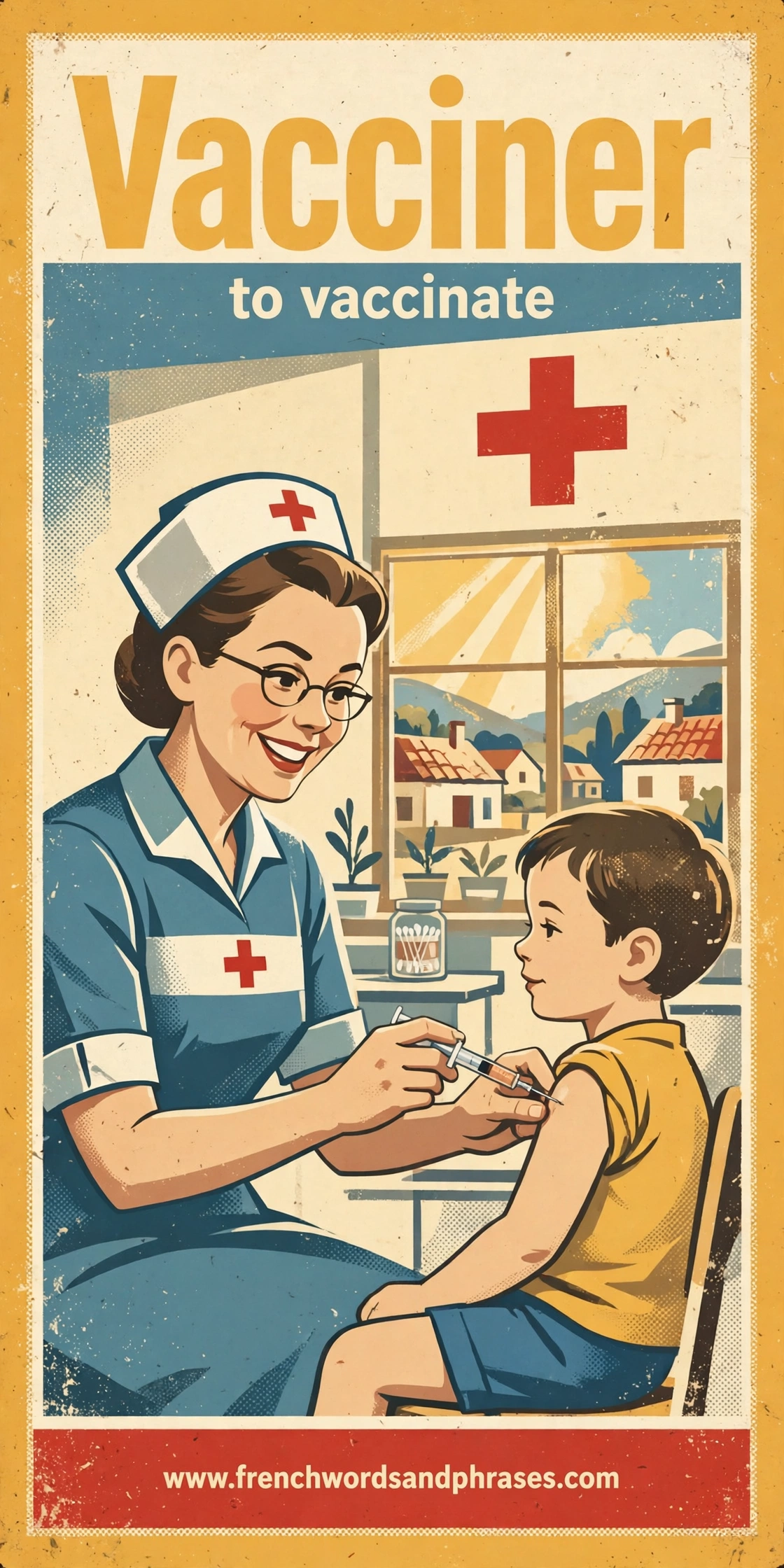
A small vial, a cool swab on the arm, one quick sting — vacciner is the verb of the jab that teaches the body to defend itself, from the village nurse’s surgery to the great vaccination halls of a pandemic year.
In this guide, you’ll learn how to conjugate vacciner in all the major French tenses and moods. Explore complete conjugation tables, French examples, English translations, and practice quizzes.
Understanding the French Verb Vacciner
Vacciner is a regular French verb belonging to the first group of verbs, those ending in -er.
It means to vaccinate. It is commonly used at the doctor’s, at school medical visits, before travel to far-off countries, every autumn for the flu campaign, and for pets at the vet — un chien vacciné contre la rage, a dog vaccinated against rabies.
Verb classification: First group (-er)
Auxiliary verb: Avoir
Past participle: vacciné
Present participle: vaccinant
English equivalents: To vaccinate, to immunize; se faire vacciner — to get vaccinated; un vaccin — a vaccine; la vaccination — vaccination; être vacciné contre la grippe — to be vaccinated against flu.
One important detail: in real life you rarely vaccinate yourself, so the living construction is se faire vacciner — je me suis fait vacciner, I got vaccinated, literally I had myself vaccinated. The doctor or nurse is the one who vaccine: le médecin vaccine les enfants. The word itself comes from Latin vacca, a cow — Edward Jenner used cowpox to protect against smallpox, and French kept the cow in the word: un vaccin.
Experience the Word
Vacciner is the verb of protection given in advance — a tiny, controlled lesson the body never forgets.
Imagine the village hall on a Saturday morning in October. A queue of neighbours, sleeves rolled up, a nurse moving down the line: elle vaccine, elle vaccine, elle vaccine. Each person leaves with a sore arm and an invisible shield against the winter flu.
One small sting, and the body has learned. It has been vaccinated — vacciné — before the enemy ever arrives.
How to Conjugate Vacciner: Complete French Conjugation Guide
Let’s explore every major conjugation of vacciner, beginning with the indicative mood.
How to Conjugate Vacciner in the Indicative Mood
The indicative mood is used to express facts, observations, actions, and events.
How to Conjugate Vacciner in the Present Tense (Présent)
Used for actions happening now, habitual actions, and general truths.
| Subject | Conjugation |
|---|---|
| je | vaccine |
| tu | vaccines |
| il / elle | vaccine |
| nous | vaccinons |
| vous | vaccinez |
| ils / elles | vaccinent |
Example
L’infirmière vaccine les enfants de l’école.
The nurse vaccinates the schoolchildren.
Quick Quiz 1
Complete the sentence:
Nous ______ les chiots demain matin.
Reveal the answer
vaccinerons
Nous vaccinerons les chiots demain matin.
We will vaccinate the puppies tomorrow morning.
How to Conjugate Vacciner in the Passé Composé
Used for completed actions in the past. Vacciner takes the auxiliary verb avoir.
| Subject | Conjugation |
|---|---|
| j’ | ai vacciné |
| tu | as vacciné |
| il / elle | a vacciné |
| nous | avons vacciné |
| vous | avez vacciné |
| ils / elles | ont vacciné |
Example
Le médecin a vacciné mon fils contre la rougeole.
The doctor vaccinated my son against measles.
How to Conjugate Vacciner in the Imparfait (Imperfect Tense)
Used for habitual past actions, descriptions, and ongoing situations in the past.
| Subject | Conjugation |
|---|---|
| je | vaccinais |
| tu | vaccinais |
| il / elle | vaccinait |
| nous | vaccinions |
| vous | vacciniez |
| ils / elles | vaccinaient |
Example
Autrefois, on vaccinait les enfants dès la naissance.
In the old days, children were vaccinated from birth.
Quick Quiz 2
Choose the correct form:
I got vaccinated.
Je ______ vacciner. (me suis fait / me suis)
Reveal the answer
me suis fait
Je me suis fait vacciner.
For your own jab, French uses se faire vacciner.
How to Conjugate Vacciner in the Plus-que-parfait
Used to describe an action that had already been completed before another past event.
| Subject | Conjugation |
|---|---|
| j’ | avais vacciné |
| tu | avais vacciné |
| il / elle | avait vacciné |
| nous | avions vacciné |
| vous | aviez vacciné |
| ils / elles | avaient vacciné |
Example
Elle avait vacciné tout le village avant l’hiver.
She had vaccinated the whole village before winter.
How to Conjugate Vacciner in the Passé Simple
Primarily used in formal writing, literature, and historical narratives. It is rarely used in everyday conversation.
| Subject | Conjugation |
|---|---|
| je | vaccinai |
| tu | vaccinas |
| il / elle | vaccina |
| nous | vaccinâmes |
| vous | vaccinâtes |
| ils / elles | vaccinèrent |
Example
Le docteur vaccina les soldats avant leur départ.
The doctor vaccinated the soldiers before their departure.
How to Conjugate Vacciner in the Passé Antérieur
A literary tense used to express an action completed immediately before another past action, generally in the passé simple.
| Subject | Conjugation |
|---|---|
| j’ | eus vacciné |
| tu | eus vacciné |
| il / elle | eut vacciné |
| nous | eûmes vacciné |
| vous | eûtes vacciné |
| ils / elles | eurent vacciné |
Example
Quand il eut vacciné le dernier patient, il rangea ses fioles.
When he had vaccinated the last patient, he put away his vials.
How to Conjugate Vacciner in the Future Tense (Futur Simple)
Used to describe actions that will take place in the future.
| Subject | Conjugation |
|---|---|
| je | vaccinerai |
| tu | vaccineras |
| il / elle | vaccinera |
| nous | vaccinerons |
| vous | vaccinerez |
| ils / elles | vaccineront |
Example
Demain, nous vaccinerons les chiots contre la rage.
Tomorrow, we will vaccinate the puppies against rabies.
How to Conjugate Vacciner in the Futur Antérieur (Future Perfect)
Used for an action that will have been completed before a particular point in the future.
| Subject | Conjugation |
|---|---|
| j’ | aurai vacciné |
| tu | auras vacciné |
| il / elle | aura vacciné |
| nous | aurons vacciné |
| vous | aurez vacciné |
| ils / elles | auront vacciné |
Example
À la fin du mois, ils auront vacciné toute la commune.
By the end of the month, they will have vaccinated the whole district.
How to Conjugate Vacciner in the Near Future (Futur Proche)
Used to describe something that is going to happen soon. Formed with aller + infinitive.
| Subject | Conjugation |
|---|---|
| je | vais vacciner |
| tu | vas vacciner |
| il / elle | va vacciner |
| nous | allons vacciner |
| vous | allez vacciner |
| ils / elles | vont vacciner |
Example
Je vais vacciner le chat cet après-midi.
I am going to vaccinate the cat this afternoon.
How to Conjugate Vacciner in the Conditional Mood
The conditional mood expresses what would happen under certain circumstances. It is also frequently used to make polite requests or express wishes.
How to Conjugate Vacciner in the Present Conditional
| Subject | Conjugation |
|---|---|
| je | vaccinerais |
| tu | vaccinerais |
| il / elle | vaccinerait |
| nous | vaccinerions |
| vous | vaccineriez |
| ils / elles | vaccineraient |
Example
Avec plus de doses, on vaccinerait deux fois plus de monde.
With more doses, we would vaccinate twice as many people.
How to Conjugate Vacciner in the Past Conditional
| Subject | Conjugation |
|---|---|
| j’ | aurais vacciné |
| tu | aurais vacciné |
| il / elle | aurait vacciné |
| nous | aurions vacciné |
| vous | auriez vacciné |
| ils / elles | auraient vacciné |
Example
Il aurait vacciné les voyageurs si le stock n’avait pas manqué.
He would have vaccinated the travellers if the stock had not run out.
Vacciner in the Literary Past Conditional Form
This less common literary form uses the imperfect subjunctive of avoir.
| Subject | Conjugation |
|---|---|
| j’ | eusse vacciné |
| tu | eusses vacciné |
| il / elle | eût vacciné |
| nous | eussions vacciné |
| vous | eussiez vacciné |
| ils / elles | eussent vacciné |
Example
Elle eût vacciné tout le régiment en une semaine.
She would have vaccinated the whole regiment in a week.
How to Conjugate Vacciner in the Subjunctive Mood
The subjunctive is used to express wishes, emotions, doubts, necessity, and uncertainty. It frequently follows expressions such as il faut que (it is necessary that) or bien que (although).
How to Conjugate Vacciner in the Present Subjunctive
| Subject | Conjugation |
|---|---|
| que je | vaccine |
| que tu | vaccines |
| qu’il / qu’elle | vaccine |
| que nous | vaccinions |
| que vous | vacciniez |
| qu’ils / qu’elles | vaccinent |
Example
Il faut que le vétérinaire vaccine les chiots à huit semaines.
The vet must vaccinate the puppies at eight weeks.
Quick Quiz 3
Complete the sentence using the subjunctive:
Il faut que le vétérinaire ______ les chiots.
Reveal the answer
vaccine
Il faut que le vétérinaire vaccine les chiots.
The vet must vaccinate the puppies.
How to Conjugate Vacciner in the Imperfect Subjunctive
A literary tense, rarely encountered in modern spoken French.
| Subject | Conjugation |
|---|---|
| que je | vaccinasse |
| que tu | vaccinasses |
| qu’il / qu’elle | vaccinât |
| que nous | vaccinassions |
| que vous | vaccinassiez |
| qu’ils / qu’elles | vaccinassent |
Example
Le préfet ordonna qu’on vaccinât les écoliers.
The prefect ordered that the schoolchildren be vaccinated.
How to Conjugate Vacciner in the Pluperfect Subjunctive
A literary construction used to express an action completed before another past action.
| Subject | Conjugation |
|---|---|
| que j’ | eusse vacciné |
| que tu | eusses vacciné |
| qu’il / qu’elle | eût vacciné |
| que nous | eussions vacciné |
| que vous | eussiez vacciné |
| qu’ils / qu’elles | eussent vacciné |
Example
On craignait qu’elle n’eût vacciné personne avant l’épidémie.
People feared she had vaccinated no one before the epidemic.
How to Conjugate Vacciner in the Past Subjunctive
| Subject | Conjugation |
|---|---|
| que j’ | aie vacciné |
| que tu | aies vacciné |
| qu’il / qu’elle | ait vacciné |
| que nous | ayons vacciné |
| que vous | ayez vacciné |
| qu’ils / qu’elles | aient vacciné |
Example
Je suis content que tu aies vacciné les enfants à temps.
I am glad you vaccinated the children in time.
How to Conjugate Vacciner in the Imperative
The imperative is used to give commands, instructions, invitations, or suggestions. Subject pronouns are omitted.
How to Conjugate Vacciner in the Present Imperative
| Person | Conjugation |
|---|---|
| (tu) | vaccine |
| (nous) | vaccinons |
| (vous) | vaccinez |
Example
Vaccine les chiots avant de les donner !
Vaccinate the puppies before giving them away!
Quick Quiz 4
How would you say Vaccinate the puppies (vous form)?
Reveal the answer
Vaccinez les chiots !
French Participles of Vacciner
Participles are verb forms that can be used in compound tenses and other grammatical constructions.
Present Participle of Vacciner
vaccinant
En vaccinant les voyageurs, elle a découvert une allergie.
While vaccinating the travellers, she discovered an allergy.
Past Participle of Vacciner
vacciné
Vaccinés dès l’enfance, ils n’ont jamais attrapé la maladie.
Vaccinated from childhood, they never caught the disease.
Vacciner in Everyday French: Real-Life Examples
Now that you know the conjugations, let’s see how vacciner appears in everyday French.
Example 1 — Present
Le médecin vaccine les enfants chaque automne.
The doctor vaccinates the children every autumn.
Example 2 — Passé composé
Je me suis fait vacciner contre la grippe.
I got vaccinated against flu.
Example 3 — Imparfait
On vaccinait les bébés à la maternité.
Babies used to be vaccinated at the maternity hospital.
Example 4 — Future
Nous vaccinerons le chien la semaine prochaine.
We will vaccinate the dog next week.
Example 5 — Conditional
Tu vaccinerais plus vite avec une deuxième infirmière.
You would vaccinate faster with a second nurse.
Example 6 — Imperative
Vaccinez les chiots à huit semaines !
Vaccinate the puppies at eight weeks!
Beyond Translation: The Meaning of Vacciner
English vaccinate and French vacciner are the same word wearing two coats — both carry the Latin cow, vacca, inside them, a souvenir of Jenner’s cowpox.
The construction that matters most is se faire vacciner.
French speakers almost never say je me vaccine for their own jab; they say je me fais vacciner — I get myself vaccinated — because someone else holds the syringe. Learn that one phrase and you can handle any clinic in France.
How to Remember the French Verb Vacciner
Remember it this way: Vacciner is about the quick sting that teaches the body to defend itself — and se faire vacciner for your own jab.
- Un vaccin is a vaccine; vacciner is to give it — and the word hides vacca, the Latin cow.
- For your own jab, say se faire vacciner: je me suis fait vacciner.
- Regular -er: je vaccine, nous vaccinons, past participle vacciné.
The key idea is the quick sting that teaches the body to defend itself — and se faire vacciner for your own jab.
Test Your Knowledge of Vacciner
Let’s see how much you’ve learned. Try answering these questions before revealing the answers.
Question 1
How do you say I got vaccinated against flu in French?
Reveal the answer
Je me suis fait vacciner contre la grippe.
Question 2
How do you say The nurse vaccinates the children in French?
Reveal the answer
L’infirmière vaccine les enfants.
Question 3
Translate: The doctor vaccinated my son against measles.
Reveal the answer
Le médecin a vacciné mon fils contre la rougeole.
Question 4
What is the past participle of vacciner?
Reveal the answer
Vacciné.
Question 5
Complete the sentence:
Il faut que le vétérinaire ______ les chiots à huit semaines.
Reveal the answer
vaccine
Il faut que le vétérinaire vaccine les chiots à huit semaines.
The vet must vaccinate the puppies at eight weeks.
Your Final Challenge
Can You Use It?
How would you say this in French?
Every autumn, she gets vaccinated against flu, then she vaccinates the whole village in her turn.
Reveal the answer
Chaque automne, elle se fait vacciner contre la grippe, puis elle vaccine à son tour tout le village.
Every autumn, she gets vaccinated against flu, then she vaccinates the whole village in her turn.
A little French. A little curiosity. A richer everyday life.
LEARN FRENCH ONE WORD AT A TIME