A French Word to Live By
How to Conjugate Typer in French
/ti.pe/
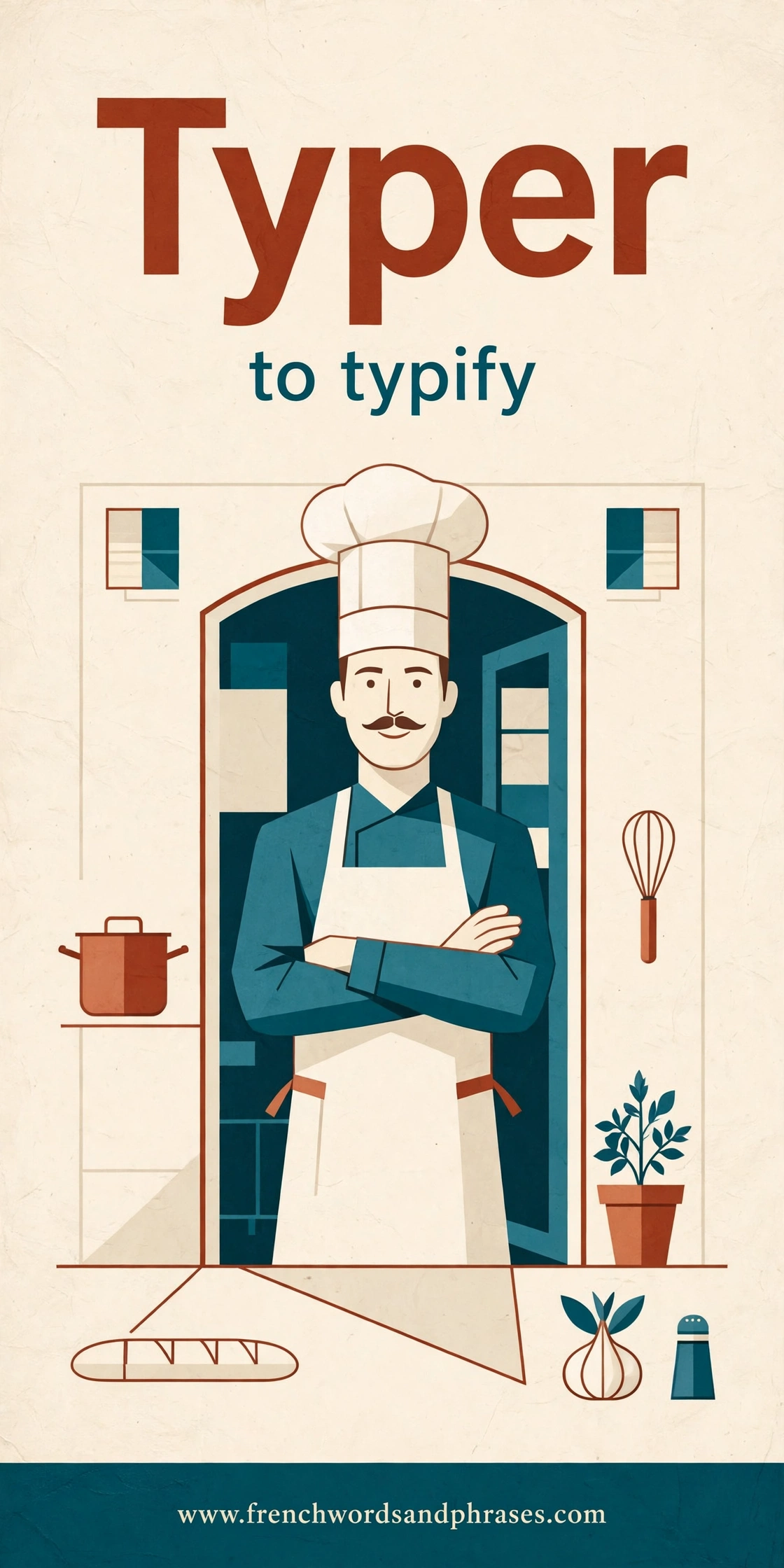
Typer means to typify — and at the casting office, to typecast an actor in one kind of role.
One hit film as the charming rogue, and the offers that arrive for ten years are all charming rogues — typer is the verb of the label that sticks, the role that becomes a cage, in a word that also serves writers fixing the type of a character.
In this guide, you’ll learn how to conjugate typer in all the major French tenses and moods. Explore complete conjugation tables, French examples, English translations, and practice quizzes.
Understanding the French Verb Typer
Typer is a regular French verb belonging to the first group of verbs, those ending in -er.
It means to typify. It is commonly used in film and theatre for typecasting, in literature for fixing the type of a character, and anywhere a single role, look or success pins a label on someone for good.
Verb classification: First group (-er)
Auxiliary verb: Avoir
Past participle: typé
Present participle: typant
English equivalents: To typify, to typecast; typer un acteur — to typecast an actor; un rôle qui type — a role that labels you for good; un personnage typé — a strongly typed character; un visage typé — a distinctive face.
One important detail: typer is the theatre and cinema member of a twin pair — its brother typiser works in laboratories and classifications. On stage and screen, typer un acteur means his face and his fame assign him one kind of part for ever; a writer type ses personnages when he gives each one a clear, recognisable type. The past participle typé also lives as an adjective: un visage typé, a face with distinctive features.
Experience the Word
Typer is the verb of the label that will not come off — one type, assigned early, repeated for ever.
Imagine a young actor whose first film makes him France’s favourite villain. The telephone rings with offers — all villains. He dreams of playing a lover, a fool, a king; the industry only sees the scar and the sneer. The film did not just employ him; it l’a typé.
The role made him famous. It also fenced him in — typé, typed, for the rest of his career.
How to Conjugate Typer: Complete French Conjugation Guide
Let’s explore every major conjugation of typer, beginning with the indicative mood.
How to Conjugate Typer in the Indicative Mood
The indicative mood is used to express facts, observations, actions, and events.
How to Conjugate Typer in the Present Tense (Présent)
Used for actions happening now, habitual actions, and general truths.
| Subject | Conjugation |
|---|---|
| je | type |
| tu | types |
| il / elle | type |
| nous | typons |
| vous | typez |
| ils / elles | typent |
Example
Ce réalisateur type toujours ses méchants de la même façon.
This director always typecasts his villains the same way.
Quick Quiz 1
Complete the sentence:
Ce réalisateur ______ toujours ses méchants de la même façon.
Reveal the answer
type
Ce réalisateur type toujours ses méchants de la même façon.
This director always typecasts his villains the same way.
How to Conjugate Typer in the Passé Composé
Used for completed actions in the past. Typer takes the auxiliary verb avoir.
| Subject | Conjugation |
|---|---|
| j’ | ai typé |
| tu | as typé |
| il / elle | a typé |
| nous | avons typé |
| vous | avez typé |
| ils / elles | ont typé |
Example
Le succès du film l’a typé en héros romantique pour toujours.
The film’s success typecast him as a romantic hero for ever.
How to Conjugate Typer in the Imparfait (Imperfect Tense)
Used for habitual past actions, descriptions, and ongoing situations in the past.
| Subject | Conjugation |
|---|---|
| je | typais |
| tu | typais |
| il / elle | typait |
| nous | typions |
| vous | typiez |
| ils / elles | typaient |
Example
Les studios typaient les acteurs dès leur premier rôle.
The studios used to typecast actors from their very first role.
Quick Quiz 2
Choose the correct form:
The film typecast him.
Le film l’______. (a typé / est typé)
Reveal the answer
a typé
Le film l’a typé.
Typer takes avoir.
How to Conjugate Typer in the Plus-que-parfait
Used to describe an action that had already been completed before another past event.
| Subject | Conjugation |
|---|---|
| j’ | avais typé |
| tu | avais typé |
| il / elle | avait typé |
| nous | avions typé |
| vous | aviez typé |
| ils / elles | avaient typé |
Example
Elle avait typé son personnage avant même d’écrire le dialogue.
She had fixed her character’s type before even writing the dialogue.
How to Conjugate Typer in the Passé Simple
Primarily used in formal writing, literature, and historical narratives. It is rarely used in everyday conversation.
| Subject | Conjugation |
|---|---|
| je | typai |
| tu | typas |
| il / elle | typa |
| nous | typâmes |
| vous | typâtes |
| ils / elles | typèrent |
Example
Ce rôle le typa définitivement en séducteur.
That role typecast him for good as a seducer.
How to Conjugate Typer in the Passé Antérieur
A literary tense used to express an action completed immediately before another past action, generally in the passé simple.
| Subject | Conjugation |
|---|---|
| j’ | eus typé |
| tu | eus typé |
| il / elle | eut typé |
| nous | eûmes typé |
| vous | eûtes typé |
| ils / elles | eurent typé |
Example
Quand le casting eut typé tous les personnages, le tournage commença.
When the casting had settled the type of every character, filming began.
How to Conjugate Typer in the Future Tense (Futur Simple)
Used to describe actions that will take place in the future.
| Subject | Conjugation |
|---|---|
| je | typerai |
| tu | typeras |
| il / elle | typera |
| nous | typerons |
| vous | typerez |
| ils / elles | typeront |
Example
Attention, ce rôle te typera pour le reste de ta carrière.
Careful, this role will typecast you for the rest of your career.
How to Conjugate Typer in the Futur Antérieur (Future Perfect)
Used for an action that will have been completed before a particular point in the future.
| Subject | Conjugation |
|---|---|
| j’ | aurai typé |
| tu | auras typé |
| il / elle | aura typé |
| nous | aurons typé |
| vous | aurez typé |
| ils / elles | auront typé |
Example
Après ce film, on l’aura typé une fois pour toutes.
After this film, he will have been typecast once and for all.
How to Conjugate Typer in the Near Future (Futur Proche)
Used to describe something that is going to happen soon. Formed with aller + infinitive.
| Subject | Conjugation |
|---|---|
| je | vais typer |
| tu | vas typer |
| il / elle | va typer |
| nous | allons typer |
| vous | allez typer |
| ils / elles | vont typer |
Example
Je vais typer chaque personnage avant d’écrire la pièce.
I am going to fix the type of each character before writing the play.
How to Conjugate Typer in the Conditional Mood
The conditional mood expresses what would happen under certain circumstances. It is also frequently used to make polite requests or express wishes.
How to Conjugate Typer in the Present Conditional
| Subject | Conjugation |
|---|---|
| je | typerais |
| tu | typerais |
| il / elle | typerait |
| nous | typerions |
| vous | typeriez |
| ils / elles | typeraient |
Example
Un bon agent ne typerait jamais son acteur dans un seul genre.
A good agent would never typecast his actor in a single genre.
How to Conjugate Typer in the Past Conditional
| Subject | Conjugation |
|---|---|
| j’ | aurais typé |
| tu | aurais typé |
| il / elle | aurait typé |
| nous | aurions typé |
| vous | auriez typé |
| ils / elles | auraient typé |
Example
Elle n’aurait pas typé le héros si le roman ne l’y avait pas forcée.
She would not have made the hero such a fixed type if the novel had not forced her to.
Typer in the Literary Past Conditional Form
This less common literary form uses the imperfect subjunctive of avoir.
| Subject | Conjugation |
|---|---|
| j’ | eusse typé |
| tu | eusses typé |
| il / elle | eût typé |
| nous | eussions typé |
| vous | eussiez typé |
| ils / elles | eussent typé |
Example
Le romancier eût typé son héros avec plus de nuances.
The novelist would have drawn his hero’s type with more nuance.
How to Conjugate Typer in the Subjunctive Mood
The subjunctive is used to express wishes, emotions, doubts, necessity, and uncertainty. It frequently follows expressions such as il faut que (it is necessary that) or bien que (although).
How to Conjugate Typer in the Present Subjunctive
| Subject | Conjugation |
|---|---|
| que je | type |
| que tu | types |
| qu’il / qu’elle | type |
| que nous | typions |
| que vous | typiez |
| qu’ils / qu’elles | typent |
Example
Il faut que tu types tes personnages sans tomber dans le cliché.
You must type your characters without falling into cliché.
Quick Quiz 3
Complete the sentence using the subjunctive:
Le metteur en scène refusait que l’on ______ l’actrice en ingénue.
Reveal the answer
typât
Le metteur en scène refusait que l’on typât l’actrice en ingénue.
The director refused to have the actress typecast as an ingénue.
How to Conjugate Typer in the Imperfect Subjunctive
A literary tense, rarely encountered in modern spoken French.
| Subject | Conjugation |
|---|---|
| que je | typasse |
| que tu | typasses |
| qu’il / qu’elle | typât |
| que nous | typassions |
| que vous | typassiez |
| qu’ils / qu’elles | typassent |
Example
Le metteur en scène refusait que l’on typât l’actrice en ingénue.
The director refused to have the actress typecast as an ingénue.
How to Conjugate Typer in the Pluperfect Subjunctive
A literary construction used to express an action completed before another past action.
| Subject | Conjugation |
|---|---|
| que j’ | eusse typé |
| que tu | eusses typé |
| qu’il / qu’elle | eût typé |
| que nous | eussions typé |
| que vous | eussiez typé |
| qu’ils / qu’elles | eussent typé |
Example
On craignait qu’il eût typé tous ses rôles de la même manière.
People feared he had typecast all his roles in the same way.
How to Conjugate Typer in the Past Subjunctive
| Subject | Conjugation |
|---|---|
| que j’ | aie typé |
| que tu | aies typé |
| qu’il / qu’elle | ait typé |
| que nous | ayons typé |
| que vous | ayez typé |
| qu’ils / qu’elles | aient typé |
Example
Je regrette que ce succès t’ait typé si jeune.
I regret that this success typecast you so young.
How to Conjugate Typer in the Imperative
The imperative is used to give commands, instructions, invitations, or suggestions. Subject pronouns are omitted.
How to Conjugate Typer in the Present Imperative
| Person | Conjugation |
|---|---|
| (tu) | type |
| (nous) | typons |
| (vous) | typez |
Example
Type tes personnages, mais laisse-leur une part de mystère !
Give your characters a clear type, but leave them some mystery!
Quick Quiz 4
How would you say Give your characters a type, but avoid clichés! (tu form)?
Reveal the answer
Type tes personnages, mais évite les clichés !
French Participles of Typer
Participles are verb forms that can be used in compound tenses and other grammatical constructions.
Present Participle of Typer
typant
En typant ses héros, l’auteur crée des figures inoubliables.
By giving his heroes a strong type, the author creates unforgettable figures.
Past Participle of Typer
typé
Typé en méchant dès son premier film, il n’a jamais joué les amoureux.
Typecast as a villain from his first film, he never played lovers.
Typer in Everyday French: Real-Life Examples
Now that you know the conjugations, let’s see how typer appears in everyday French.
Example 1 — Present
Ce rôle type l’acteur en gangster pour toujours.
This role typecasts the actor as a gangster for ever.
Example 2 — Passé composé
Le film l’a typé en héros romantique.
The film typecast him as a romantic hero.
Example 3 — Imparfait
Les studios typaient leurs stars dès le premier contrat.
The studios used to typecast their stars from the first contract.
Example 4 — Future
Ce personnage te typera si tu n’y prends pas garde.
This character will typecast you if you are not careful.
Example 5 — Conditional
Un bon réalisateur ne typerait pas ainsi ses acteurs.
A good director would not typecast his actors like that.
Example 6 — Imperative
Type tes personnages, mais évite les clichés !
Give your characters a type, but avoid clichés!
Beyond Translation: The Meaning of Typer
English to typecast comes from the printer’s term for setting type; French typer works the same way — the actor is set in type, printed once, and reprinted in every film.
One success, set in lead.
Its twin typiser does the classifying work in science, while typer keeps the human version: the label pinned on a face.
How to Remember the French Verb Typer
Remember it this way: Typer is about one famous role, set in type for ever.
- Typer un acteur = to typecast him; the label sticks after one famous role.
- Typer is the stage-and-screen twin; typiser is the laboratory twin.
- Regular -er: je type, nous typons, past participle typé.
The key idea is one famous role, set in type for ever.
Test Your Knowledge of Typer
Let’s see how much you’ve learned. Try answering these questions before revealing the answers.
Question 1
How do you say to typecast an actor in French?
Reveal the answer
Typer un acteur.
Question 2
How do you say The film typecast him as a romantic hero in French?
Reveal the answer
Le film l’a typé en héros romantique.
Question 3
Translate: The studios used to typecast their stars.
Reveal the answer
Les studios typaient leurs stars.
Question 4
What is the past participle of typer?
Reveal the answer
Typé.
Question 5
Complete the sentence:
Il faut que tu ______ tes personnages sans tomber dans le cliché.
Reveal the answer
types
Il faut que tu types tes personnages sans tomber dans le cliché.
You must type your characters without falling into cliché.
Your Final Challenge
Can You Use It?
How would you say this in French?
A single villain’s role typecast him for ever, and he still dreams of playing lovers.
Reveal the answer
Un seul rôle de méchant l’a typé pour toujours, et il rêve encore de jouer les amoureux.
A single villain’s role typecast him for ever, and he still dreams of playing lovers.
A little French. A little curiosity. A richer everyday life.
LEARN FRENCH ONE WORD AT A TIME