A French Word to Live By
How to Conjugate Tutoyer in French
/ty.twa.je/
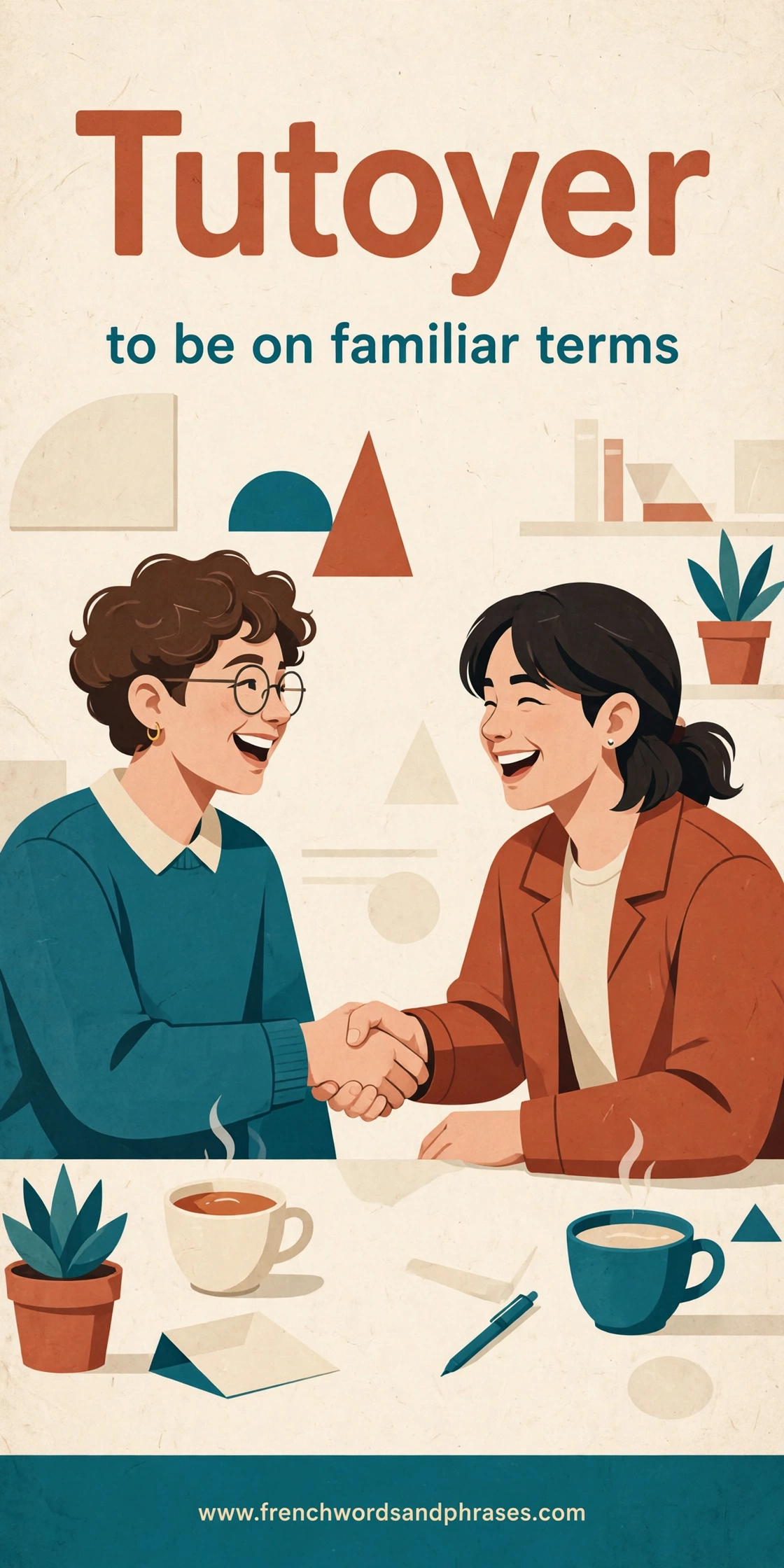
Tutoyer means to be on familiar terms — to say tu to someone instead of the formal vous.
The new colleague has been vou-ed for a week — « Vous prendrez un café ? » — and then, one morning by the machine, she smiles: « On peut se tutoyer, non ? » A whole relationship changes in that sentence: tutoyer is the verb of the moment French drops its guard.
In this guide, you’ll learn how to conjugate tutoyer in all the major French tenses and moods. Explore complete conjugation tables, French examples, English translations, and practice quizzes.
Understanding the French Verb Tutoyer
Tutoyer is a regular French verb belonging to the first group of verbs, those ending in -er.
It means to be on familiar terms. It is commonly used for the moment colleagues drop the formal vous, between neighbours, in families and clubs, and in the classic question « On peut se tutoyer ? » — Shall we use tu? — that marks a friendship beginning.
Verb classification: First group (-er)
Auxiliary verb: Avoir
Past participle: tutoyé
Present participle: tutoyant
English equivalents: To address someone as tu, to be on familiar terms with; tutoyer un collègue — to use tu with a colleague; se tutoyer — to use tu with each other; le tutoiement — the practice of using tu.
One important detail: tutoyer belongs to the -oyer family, and its y turns into i before a mute e: je tutoie, tu tutoies, il tutoie, ils tutoient — but the y stays where the ending is sounded: nous tutoyons, vous tutoyez, and through the future and conditional: je tutoierai. The subjunctive follows the present: que je tutoie, que nous tutoyions. Behind the spelling stands a social choice: tu is the pronoun of family, friends and equals, vous of distance and respect — and passing from one to the other is a small ceremony in French life.
Experience the Word
Tutoyer is less a grammar point than a social handshake — the verb that records the exact moment formality ends.
Imagine an office in Lyon. For months the young engineer has said vous to the director, carefully, at a distance. Then they finish a hard project together, he laughs, holds out his hand: « Tu peux me tutoyer, tu sais. » The wall is down; from now on, work will be warmer.
Nothing in the contract changed. Only the pronoun changed — and everything changed with it.
How to Conjugate Tutoyer: Complete French Conjugation Guide
Let’s explore every major conjugation of tutoyer, beginning with the indicative mood.
How to Conjugate Tutoyer in the Indicative Mood
The indicative mood is used to express facts, observations, actions, and events.
How to Conjugate Tutoyer in the Present Tense (Présent)
Used for actions happening now, habitual actions, and general truths.
| Subject | Conjugation |
|---|---|
| je | tutoie |
| tu | tutoies |
| il / elle | tutoie |
| nous | tutoyons |
| vous | tutoyez |
| ils / elles | tutoient |
Example
Dans cette entreprise, tout le monde tutoie le directeur.
In this company, everyone addresses the director as tu.
Quick Quiz 1
Complete the sentence:
Nous ______ le directeur depuis lundi.
Reveal the answer
tutoyons
Nous tutoyons le directeur depuis lundi.
We have been on tu terms with the director since Monday.
How to Conjugate Tutoyer in the Passé Composé
Used for completed actions in the past. Tutoyer takes the auxiliary verb avoir.
| Subject | Conjugation |
|---|---|
| j’ | ai tutoyé |
| tu | as tutoyé |
| il / elle | a tutoyé |
| nous | avons tutoyé |
| vous | avez tutoyé |
| ils / elles | ont tutoyé |
Example
Après deux verres, il a tutoyé le préfet.
After two drinks, he started using tu with the prefect.
How to Conjugate Tutoyer in the Imparfait (Imperfect Tense)
Used for habitual past actions, descriptions, and ongoing situations in the past.
| Subject | Conjugation |
|---|---|
| je | tutoyais |
| tu | tutoyais |
| il / elle | tutoyait |
| nous | tutoyions |
| vous | tutoyiez |
| ils / elles | tutoyaient |
Example
Autrefois, on ne tutoyait jamais ses professeurs.
In the old days, you never used tu with your teachers.
Quick Quiz 2
Choose the correct form:
She used tu with him at once.
Elle l’______ tout de suite. (a tutoyé / est tutoyée)
Reveal the answer
a tutoyé
Elle l’a tutoyé tout de suite.
Tutoyer takes avoir.
How to Conjugate Tutoyer in the Plus-que-parfait
Used to describe an action that had already been completed before another past event.
| Subject | Conjugation |
|---|---|
| j’ | avais tutoyé |
| tu | avais tutoyé |
| il / elle | avait tutoyé |
| nous | avions tutoyé |
| vous | aviez tutoyé |
| ils / elles | avaient tutoyé |
Example
Elle l’avait tutoyé dès leur première rencontre.
She had used tu with him from their very first meeting.
How to Conjugate Tutoyer in the Passé Simple
Primarily used in formal writing, literature, and historical narratives. It is rarely used in everyday conversation.
| Subject | Conjugation |
|---|---|
| je | tutoyai |
| tu | tutoyas |
| il / elle | tutoya |
| nous | tutoyâmes |
| vous | tutoyâtes |
| ils / elles | tutoyèrent |
Example
Le vieux marin tutoya l’amiral comme un frère.
The old sailor addressed the admiral as tu, like a brother.
How to Conjugate Tutoyer in the Passé Antérieur
A literary tense used to express an action completed immediately before another past action, generally in the passé simple.
| Subject | Conjugation |
|---|---|
| j’ | eus tutoyé |
| tu | eus tutoyé |
| il / elle | eut tutoyé |
| nous | eûmes tutoyé |
| vous | eûtes tutoyé |
| ils / elles | eurent tutoyé |
Example
Quand ils se furent tutoyés, la glace fut rompue.
When they had started using tu with each other, the ice was broken.
How to Conjugate Tutoyer in the Future Tense (Futur Simple)
Used to describe actions that will take place in the future.
| Subject | Conjugation |
|---|---|
| je | tutoierai |
| tu | tutoieras |
| il / elle | tutoiera |
| nous | tutoierons |
| vous | tutoierez |
| ils / elles | tutoieront |
Example
Un jour, tu tutoieras tes beaux-parents, patience.
One day you will use tu with your in-laws, be patient.
How to Conjugate Tutoyer in the Futur Antérieur (Future Perfect)
Used for an action that will have been completed before a particular point in the future.
| Subject | Conjugation |
|---|---|
| j’ | aurai tutoyé |
| tu | auras tutoyé |
| il / elle | aura tutoyé |
| nous | aurons tutoyé |
| vous | aurez tutoyé |
| ils / elles | auront tutoyé |
Example
À la fin du stage, vous aurez tutoyé toute l’équipe.
By the end of the internship, you will be on tu terms with the whole team.
How to Conjugate Tutoyer in the Near Future (Futur Proche)
Used to describe something that is going to happen soon. Formed with aller + infinitive.
| Subject | Conjugation |
|---|---|
| je | vais tutoyer |
| tu | vas tutoyer |
| il / elle | va tutoyer |
| nous | allons tutoyer |
| vous | allez tutoyer |
| ils / elles | vont tutoyer |
Example
Je vais tutoyer mon nouveau patron, tout le monde le fait ici.
I am going to use tu with my new boss; everyone does it here.
How to Conjugate Tutoyer in the Conditional Mood
The conditional mood expresses what would happen under certain circumstances. It is also frequently used to make polite requests or express wishes.
How to Conjugate Tutoyer in the Present Conditional
| Subject | Conjugation |
|---|---|
| je | tutoierais |
| tu | tutoierais |
| il / elle | tutoierait |
| nous | tutoierions |
| vous | tutoieriez |
| ils / elles | tutoieraient |
Example
Sans l’accord du client, je ne le tutoierais jamais.
Without the client’s agreement, I would never use tu with him.
How to Conjugate Tutoyer in the Past Conditional
| Subject | Conjugation |
|---|---|
| j’ | aurais tutoyé |
| tu | aurais tutoyé |
| il / elle | aurait tutoyé |
| nous | aurions tutoyé |
| vous | auriez tutoyé |
| ils / elles | auraient tutoyé |
Example
Il l’aurait tutoyé si le ton avait été moins formel.
He would have used tu with him if the tone had been less formal.
Tutoyer in the Literary Past Conditional Form
This less common literary form uses the imperfect subjunctive of avoir.
| Subject | Conjugation |
|---|---|
| j’ | eusse tutoyé |
| tu | eusses tutoyé |
| il / elle | eût tutoyé |
| nous | eussions tutoyé |
| vous | eussiez tutoyé |
| ils / elles | eussent tutoyé |
Example
Elle eût tutoyé le roi lui-même sans trembler.
She would have addressed the king himself as tu without trembling.
How to Conjugate Tutoyer in the Subjunctive Mood
The subjunctive is used to express wishes, emotions, doubts, necessity, and uncertainty. It frequently follows expressions such as il faut que (it is necessary that) or bien que (although).
How to Conjugate Tutoyer in the Present Subjunctive
| Subject | Conjugation |
|---|---|
| que je | tutoie |
| que tu | tutoies |
| qu’il / qu’elle | tutoie |
| que nous | tutoyions |
| que vous | tutoyiez |
| qu’ils / qu’elles | tutoient |
Example
Le directeur préfère que nous le tutoyions dès maintenant.
The director prefers that we use tu with him from now on.
Quick Quiz 3
Complete the sentence using the subjunctive:
Il faut que tu le ______ dès demain.
Reveal the answer
tutoies
Il faut que tu le tutoies dès demain.
You must use tu with him from tomorrow.
How to Conjugate Tutoyer in the Imperfect Subjunctive
A literary tense, rarely encountered in modern spoken French.
| Subject | Conjugation |
|---|---|
| que je | tutoyasse |
| que tu | tutoyasses |
| qu’il / qu’elle | tutoyât |
| que nous | tutoyassions |
| que vous | tutoyassiez |
| qu’ils / qu’elles | tutoyassent |
Example
Il aurait fallu qu’elle le tutoyât pour détendre l’atmosphère.
She would have had to use tu with him to lighten the atmosphere.
How to Conjugate Tutoyer in the Pluperfect Subjunctive
A literary construction used to express an action completed before another past action.
| Subject | Conjugation |
|---|---|
| que j’ | eusse tutoyé |
| que tu | eusses tutoyé |
| qu’il / qu’elle | eût tutoyé |
| que nous | eussions tutoyé |
| que vous | eussiez tutoyé |
| qu’ils / qu’elles | eussent tutoyé |
Example
On s’étonnait qu’ils se fussent tutoyés si vite.
People were surprised that they had started using tu with each other so quickly.
How to Conjugate Tutoyer in the Past Subjunctive
| Subject | Conjugation |
|---|---|
| que j’ | aie tutoyé |
| que tu | aies tutoyé |
| qu’il / qu’elle | ait tutoyé |
| que nous | ayons tutoyé |
| que vous | ayez tutoyé |
| qu’ils / qu’elles | aient tutoyé |
Example
Je suis ravi que tu aies tutoyé le directeur sans hésiter.
I am delighted that you used tu with the director without hesitating.
How to Conjugate Tutoyer in the Imperative
The imperative is used to give commands, instructions, invitations, or suggestions. Subject pronouns are omitted.
How to Conjugate Tutoyer in the Present Imperative
| Person | Conjugation |
|---|---|
| (tu) | tutoie |
| (nous) | tutoyons |
| (vous) | tutoyez |
Example
Tutoie-moi, voyons, nous avons le même âge !
Use tu with me, come on, we are the same age!
Quick Quiz 4
How would you say Use tu with me! (tu form)?
Reveal the answer
Tutoie-moi !
French Participles of Tutoyer
Participles are verb forms that can be used in compound tenses and other grammatical constructions.
Present Participle of Tutoyer
tutoyant
En tutoyant tout le monde, il met ses invités à l’aise.
By using tu with everyone, he puts his guests at ease.
Past Participle of Tutoyer
tutoyé
Tutoyé par tout le village, le nouveau maire se sent chez lui.
Addressed as tu by the whole village, the new mayor feels at home.
Tutoyer in Everyday French: Real-Life Examples
Now that you know the conjugations, let’s see how tutoyer appears in everyday French.
Example 1 — Present
Ici, on tutoie le patron sans problème.
Here, people use tu with the boss without any problem.
Example 2 — Passé composé
Nous nous sommes tutoyés dès la première semaine.
We started using tu with each other in the first week.
Example 3 — Imparfait
À l’école, on tutoyait ses camarades mais jamais les maîtres.
At school, you used tu with classmates but never with teachers.
Example 4 — Future
Vous tutoyerez vos collègues après quelque temps.
You will use tu with your colleagues after a while.
Example 5 — Conditional
Je ne tutoierais pas un client au premier rendez-vous.
I would not use tu with a client at the first meeting.
Example 6 — Imperative
Tutoyez-moi, je vous en prie !
Please, use tu with me!
Beyond Translation: The Meaning of Tutoyer
English lost this distinction centuries ago — thou vanished and you serves everyone; French kept both pronouns and built a verb for crossing from one to the other: tutoyer.
Se tutoyer is a milestone.
French even has a noun for the practice, le tutoiement, and its opposite, le vouvoiement — proof of how seriously a single letter, tu versus vous, is taken.
How to Remember the French Verb Tutoyer
Remember it this way: Tutoyer is about the handshake hidden in a pronoun.
- Tutoyer = to say tu; vouvoyer = to say vous — the verb names the pronoun you use.
- The y becomes i before a mute e: je tutoie, ils tutoient, but nous tutoyons and future je tutoierai keep the y.
- « On peut se tutoyer ? » — the classic question that turns colleagues into friends.
The key idea is the handshake hidden in a pronoun.
Test Your Knowledge of Tutoyer
Let’s see how much you’ve learned. Try answering these questions before revealing the answers.
Question 1
How do you ask Shall we use tu with each other? in French?
Reveal the answer
On peut se tutoyer ?
Question 2
How do you say In this office, everyone uses tu with the boss in French?
Reveal the answer
Dans ce bureau, tout le monde tutoie le patron.
Question 3
Translate: We started using tu with each other in the first week.
Reveal the answer
Nous nous sommes tutoyés dès la première semaine.
Question 4
What is the opposite of tutoyer?
Reveal the answer
Vouvoyer — to address someone as vous.
Question 5
Complete the sentence:
Le directeur préfère que nous le ______ dès maintenant.
Reveal the answer
tutoyions
Le directeur préfère que nous le tutoyions dès maintenant.
The director prefers us to use tu with him from now on.
Your Final Challenge
Can You Use It?
How would you say this in French?
After years of polite vous, the two neighbours finally use tu with each other over the hedge.
Reveal the answer
Après des années de vouvoiement poli, les deux voisins se tutoient enfin par-dessus la haie.
After years of polite vous, the two neighbours finally use tu with each other over the hedge.
A little French. A little curiosity. A richer everyday life.
LEARN FRENCH ONE WORD AT A TIME