A French Word to Live By
How to Conjugate Turbiner in French
/tyʁ.bi.ne/
Turbiner means to slog away — to work flat out, in familiar slang.
Friday, six in the evening, and the office is still lit: keyboards clattering, coffee gone cold, deadlines breathing down every neck — turbiner is the slang verb of the worker spinning like a turbine, all energy and noise, until the job is done.
In this guide, you’ll learn how to conjugate turbiner in all the major French tenses and moods. Explore complete conjugation tables, French examples, English translations, and practice quizzes.
Understanding the French Verb Turbiner
Turbiner is a regular French verb belonging to the first group of verbs, those ending in -er.
It means to slog away (fam.). It is commonly used in spoken, familiar French for working very hard and fast — at the office before a deadline, in a kitchen during service, on a building site — wherever the pace feels like machinery at full speed.
Verb classification: First group (-er)
Auxiliary verb: Avoir
Past participle: turbiné
Present participle: turbinant
English equivalents: To slog away, to work flat out (familiar); turbiner dur — to slog really hard; on turbine depuis ce matin — we have been at it full tilt since this morning; la turbine — the turbine.
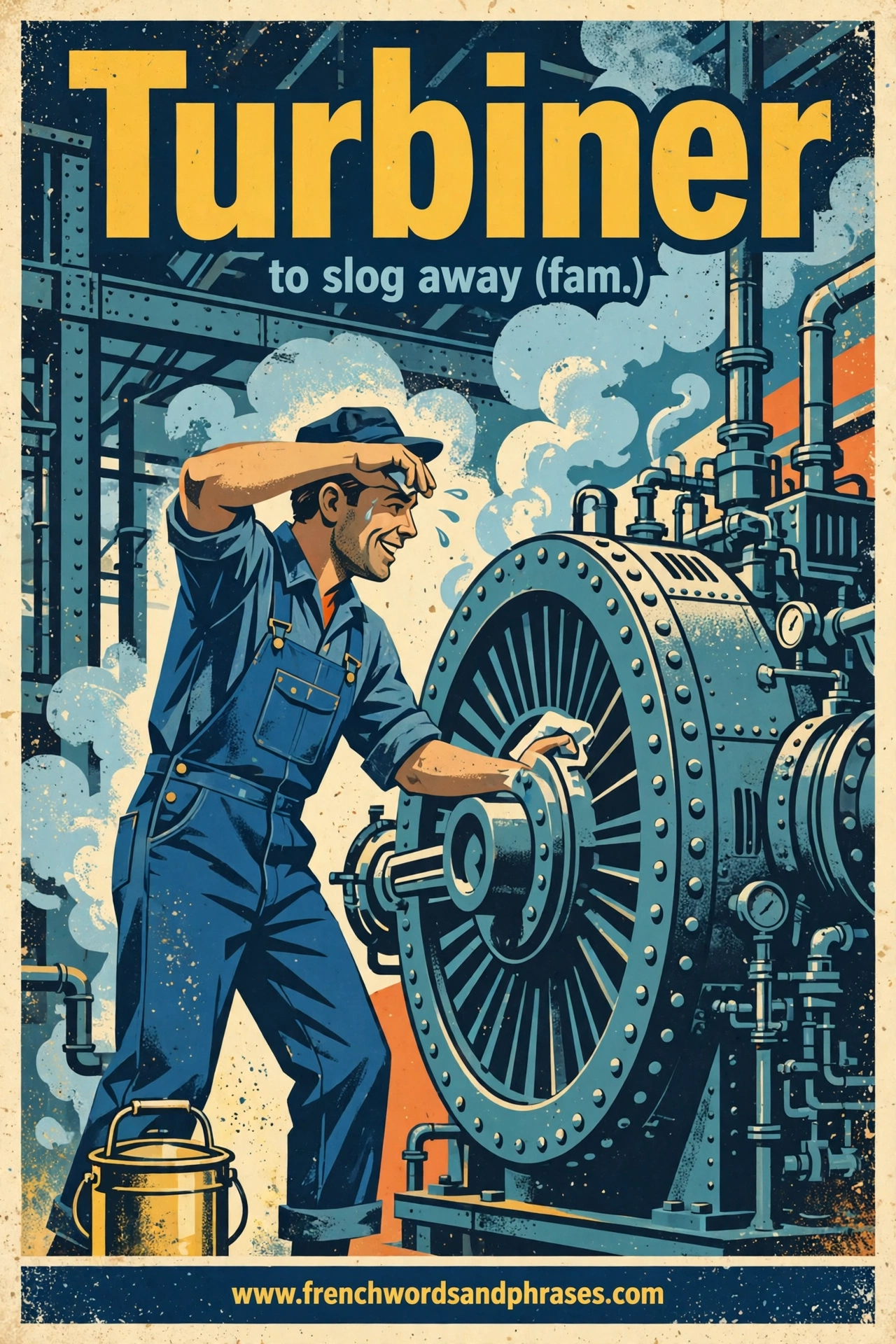
One important detail: turbiner is familiar slang, and its image is mechanical — une turbine spins at full speed without pausing, and so does the person who turbine. The conjugation could not be calmer: je turbine, nous turbinons, past participle turbiné, a perfectly regular -er verb wearing overalls. It belongs to the same slang family as trimer, to slave away, and bosser, to work — turbiner adds the idea of speed and roar: not just working, but working at full revolutions. Save it for friends and colleagues; in a formal letter, travailler dur is the dressed-up version.
Experience the Word
Turbiner is work with the throttle open — the slang of people who are proud and exhausted at the same time.
Imagine a small bakery at five in the morning in December. Orders for the holidays cover the wall, the ovens roar, and the whole team turbine — shaping, baking, wrapping, never stopping — because at eight the queue will be at the door.
At noon the last tray comes out and the bakers sit down at last, flour to the elbows. They have slaved at full speed — ils ont turbiné — and the shop is full.
How to Conjugate Turbiner: Complete French Conjugation Guide
Let’s explore every major conjugation of turbiner, beginning with the indicative mood.
How to Conjugate Turbiner in the Indicative Mood
The indicative mood is used to express facts, observations, actions, and events.
How to Conjugate Turbiner in the Present Tense (Présent)
Used for actions happening now, habitual actions, and general truths.
| Subject | Conjugation |
|---|---|
| je | turbine |
| tu | turbines |
| il / elle | turbine |
| nous | turbinons |
| vous | turbinez |
| ils / elles | turbinent |
Example
Je turbine depuis six heures du matin.
I have been slogging away since six in the morning.
Quick Quiz 1
Complete the sentence:
Nous ______ depuis ce matin sans pause.
Reveal the answer
turbinons
Nous turbinons depuis ce matin sans pause.
We have been slogging away since this morning without a break.
How to Conjugate Turbiner in the Passé Composé
Used for completed actions in the past. Turbiner takes the auxiliary verb avoir.
| Subject | Conjugation |
|---|---|
| j’ | ai turbiné |
| tu | as turbiné |
| il / elle | a turbiné |
| nous | avons turbiné |
| vous | avez turbiné |
| ils / elles | ont turbiné |
Example
On a turbiné toute la nuit pour finir le dossier.
We slogged away all night to finish the file.
How to Conjugate Turbiner in the Imparfait (Imperfect Tense)
Used for habitual past actions, descriptions, and ongoing situations in the past.
| Subject | Conjugation |
|---|---|
| je | turbinais |
| tu | turbinais |
| il / elle | turbinait |
| nous | turbinions |
| vous | turbiniez |
| ils / elles | turbinaient |
Example
À l’usine, on turbinait dix heures par jour.
At the factory, people used to slog away ten hours a day.
Quick Quiz 2
Choose the correct form:
We slogged away all night.
On ______ toute la nuit. (a turbiné / est turbiné)
Reveal the answer
a turbiné
On a turbiné toute la nuit.
Turbiner takes avoir.
How to Conjugate Turbiner in the Plus-que-parfait
Used to describe an action that had already been completed before another past event.
| Subject | Conjugation |
|---|---|
| j’ | avais turbiné |
| tu | avais turbiné |
| il / elle | avait turbiné |
| nous | avions turbiné |
| vous | aviez turbiné |
| ils / elles | avaient turbiné |
Example
Elle avait turbiné tout le week-end avant l’examen.
She had slogged away all weekend before the exam.
How to Conjugate Turbiner in the Passé Simple
Primarily used in formal writing, literature, and historical narratives. It is rarely used in everyday conversation.
| Subject | Conjugation |
|---|---|
| je | turbinai |
| tu | turbinas |
| il / elle | turbina |
| nous | turbinâmes |
| vous | turbinâtes |
| ils / elles | turbinèrent |
Example
Ce mois-là, l’équipe turbina sans un jour de repos.
That month, the team slogged away without a single day off.
How to Conjugate Turbiner in the Passé Antérieur
A literary tense used to express an action completed immediately before another past action, generally in the passé simple.
| Subject | Conjugation |
|---|---|
| j’ | eus turbiné |
| tu | eus turbiné |
| il / elle | eut turbiné |
| nous | eûmes turbiné |
| vous | eûtes turbiné |
| ils / elles | eurent turbiné |
Example
Quand ils eurent turbiné jusqu’à minuit, le patron ferma l’atelier.
When they had slogged away until midnight, the boss closed the workshop.
How to Conjugate Turbiner in the Future Tense (Futur Simple)
Used to describe actions that will take place in the future.
| Subject | Conjugation |
|---|---|
| je | turbinerai |
| tu | turbineras |
| il / elle | turbinera |
| nous | turbinerons |
| vous | turbinerez |
| ils / elles | turbineront |
Example
Demain, nous turbinerons pour rattraper le retard.
Tomorrow, we will slog away to catch up.
How to Conjugate Turbiner in the Futur Antérieur (Future Perfect)
Used for an action that will have been completed before a particular point in the future.
| Subject | Conjugation |
|---|---|
| j’ | aurai turbiné |
| tu | auras turbiné |
| il / elle | aura turbiné |
| nous | aurons turbiné |
| vous | aurez turbiné |
| ils / elles | auront turbiné |
Example
À la fin du mois, ils auront turbiné sur trois chantiers.
By the end of the month, they will have slogged away on three sites.
How to Conjugate Turbiner in the Near Future (Futur Proche)
Used to describe something that is going to happen soon. Formed with aller + infinitive.
| Subject | Conjugation |
|---|---|
| je | vais turbiner |
| tu | vas turbiner |
| il / elle | va turbiner |
| nous | allons turbiner |
| vous | allez turbiner |
| ils / elles | vont turbiner |
Example
Allez, je vais turbiner une heure et je rentre.
Come on, I am going to slog away for an hour and then go home.
How to Conjugate Turbiner in the Conditional Mood
The conditional mood expresses what would happen under certain circumstances. It is also frequently used to make polite requests or express wishes.
How to Conjugate Turbiner in the Present Conditional
| Subject | Conjugation |
|---|---|
| je | turbinerais |
| tu | turbinerais |
| il / elle | turbinerait |
| nous | turbinerions |
| vous | turbineriez |
| ils / elles | turbineraient |
Example
Avec une machine neuve, vous turbineriez moins longtemps.
With a new machine, you would not have to slog away for so long.
How to Conjugate Turbiner in the Past Conditional
| Subject | Conjugation |
|---|---|
| j’ | aurais turbiné |
| tu | aurais turbiné |
| il / elle | aurait turbiné |
| nous | aurions turbiné |
| vous | auriez turbiné |
| ils / elles | auraient turbiné |
Example
Il aurait turbiné davantage si le client avait payé d’avance.
He would have slogged away more if the client had paid in advance.
Turbiner in the Literary Past Conditional Form
This less common literary form uses the imperfect subjunctive of avoir.
| Subject | Conjugation |
|---|---|
| j’ | eusse turbiné |
| tu | eusses turbiné |
| il / elle | eût turbiné |
| nous | eussions turbiné |
| vous | eussiez turbiné |
| ils / elles | eussent turbiné |
Example
L’ouvrier eût turbiné jusqu’à la nuit pour finir.
The worker would have slogged away until nightfall to finish.
How to Conjugate Turbiner in the Subjunctive Mood
The subjunctive is used to express wishes, emotions, doubts, necessity, and uncertainty. It frequently follows expressions such as il faut que (it is necessary that) or bien que (although).
How to Conjugate Turbiner in the Present Subjunctive
| Subject | Conjugation |
|---|---|
| que je | turbine |
| que tu | turbines |
| qu’il / qu’elle | turbine |
| que nous | turbinions |
| que vous | turbiniez |
| qu’ils / qu’elles | turbinent |
Example
Il faut que tu turbines ce soir si tu veux finir.
You have to slog away tonight if you want to finish.
Quick Quiz 3
Complete the sentence using the subjunctive:
Il faut que tu ______ ce soir.
Reveal the answer
turbines
Il faut que tu turbines ce soir.
You have to slog away tonight.
How to Conjugate Turbiner in the Imperfect Subjunctive
A literary tense, rarely encountered in modern spoken French.
| Subject | Conjugation |
|---|---|
| que je | turbinasse |
| que tu | turbinasses |
| qu’il / qu’elle | turbinât |
| que nous | turbinassions |
| que vous | turbinassiez |
| qu’ils / qu’elles | turbinassent |
Example
Le chef exigeait que l’on turbinât avant les fêtes.
The boss demanded that everyone slog away before the holidays.
How to Conjugate Turbiner in the Pluperfect Subjunctive
A literary construction used to express an action completed before another past action.
| Subject | Conjugation |
|---|---|
| que j’ | eusse turbiné |
| que tu | eusses turbiné |
| qu’il / qu’elle | eût turbiné |
| que nous | eussions turbiné |
| que vous | eussiez turbiné |
| qu’ils / qu’elles | eussent turbiné |
Example
Elle raconta qu’ils eussent turbiné trois jours de suite.
She told how they had slogged away three days in a row.
How to Conjugate Turbiner in the Past Subjunctive
| Subject | Conjugation |
|---|---|
| que j’ | aie turbiné |
| que tu | aies turbiné |
| qu’il / qu’elle | ait turbiné |
| que nous | ayons turbiné |
| que vous | ayez turbiné |
| qu’ils / qu’elles | aient turbiné |
Example
Je suis crevé que tu aies turbiné tout le week-end.
I am sorry you slogged away all weekend.
How to Conjugate Turbiner in the Imperative
The imperative is used to give commands, instructions, invitations, or suggestions. Subject pronouns are omitted.
How to Conjugate Turbiner in the Present Imperative
| Person | Conjugation |
|---|---|
| (tu) | turbine |
| (nous) | turbinons |
| (vous) | turbinez |
Example
Allez, turbine encore une heure et on arrête !
Come on, slog away one more hour and we stop!
Quick Quiz 4
How would you say Slog away one more hour (tu form)?
Reveal the answer
Turbine encore une heure !
French Participles of Turbiner
Participles are verb forms that can be used in compound tenses and other grammatical constructions.
Present Participle of Turbiner
turbinant
En turbinant comme ça, tu vas t’épuiser.
Slogging away like that, you are going to exhaust yourself.
Past Participle of Turbiner
turbiné
Après avoir turbiné douze heures, ils ont enfin soufflé.
After slogging away for twelve hours, they finally took a breather.
Turbiner in Everyday French: Real-Life Examples
Now that you know the conjugations, let’s see how turbiner appears in everyday French.
Example 1 — Present
Je turbine depuis ce matin sans pause.
I have been slogging away since this morning without a break.
Example 2 — Passé composé
On a turbiné toute la nuit pour finir.
We slogged away all night to finish.
Example 3 — Imparfait
À l’usine, on turbinait dix heures par jour.
At the factory, people used to slog away ten hours a day.
Example 4 — Future
Nous turbinerons demain pour rattraper le retard.
We will slog away tomorrow to catch up.
Example 5 — Conditional
Vous turbineriez moins avec une machine neuve.
You would slog away less with a new machine.
Example 6 — Imperative
Turbine encore une heure, courage !
Slog away one more hour, hang in there!
Beyond Translation: The Meaning of Turbiner
English reaches for the steam engine — slog away, work flat out, beaver away; French slang reaches for the turbine.
A family of work slang.
Bosser is the neutral everyday word, trimer adds suffering — to slave away — and turbiner adds speed: the worker as a machine spinning at full revolutions. Pick your verb and you pick your complaint.
How to Remember the French Verb Turbiner
Remember it this way: Turbiner is about the worker spinning at full revolutions like a turbine.
- Turbiner is familiar slang: to work flat out, like a turbine spinning — je turbine, nous turbinons.
- Same family as trimer (to slave away) and bosser (to work); the formal version is travailler dur.
- Regular -er: past participle turbiné, auxiliary avoir.
The key idea is the worker spinning at full revolutions like a turbine.
Test Your Knowledge of Turbiner
Let’s see how much you’ve learned. Try answering these questions before revealing the answers.
Question 1
How do you say to slog away (familiar) in French?
Reveal the answer
Turbiner.
Question 2
How do you say We slogged away all night in French?
Reveal the answer
On a turbiné toute la nuit.
Question 3
Translate: I have been slogging away since six this morning.
Reveal the answer
Je turbine depuis six heures du matin.
Question 4
What is the past participle of turbiner?
Reveal the answer
Turbiné.
Question 5
Complete the sentence:
Il faut que tu ______ ce soir si tu veux finir.
Reveal the answer
turbines
Il faut que tu turbines ce soir si tu veux finir.
You have to slog away tonight if you want to finish.
Your Final Challenge
Can You Use It?
How would you say this in French?
They have been slogging away since dawn, and by noon the orders are finally ready.
Reveal the answer
Ils turbinent depuis l’aube, et à midi les commandes sont enfin prêtes.
They have been slogging away since dawn, and by noon the orders are finally ready.
A little French. A little curiosity. A richer everyday life.
LEARN FRENCH ONE WORD AT A TIME