A French Word to Live By
How to Conjugate Tuer in French
/tɥe/
Tuer means to kill — and French softens it every day for frost, engines, boredom and time.
One hard syllable, /tɥe/, and a verb French cannot do without: the frost kills the buds, the hunter kills the boar, the worker kills the engine at the gate, and the traveller kills time in the station café — tuer ranges from the gravest act in the language to its most ordinary small talk.
In this guide, you’ll learn how to conjugate tuer in all the major French tenses and moods. Explore complete conjugation tables, French examples, English translations, and practice quizzes.
Understanding the French Verb Tuer
Tuer is a regular French verb belonging to the first group of verbs, those ending in -er.
It means to kill. It is commonly used for killing in the literal sense, in news reports of accidents and crimes, and constantly in softened everyday senses — killing time, killing an engine, frost killing plants, and working oneself to death with se tuer à la tâche.
Verb classification: First group (-er)
Auxiliary verb: Avoir
Past participle: tué
Present participle: tuant
English equivalents: To kill; tuer le temps — to kill time; tuer le moteur — to kill (switch off) the engine; se tuer — to kill oneself, to die in an accident; se tuer à la tâche, se tuer au travail — to work oneself to death; être tué — to be killed.
One important detail: tuer conjugates with avoir — j’ai tué — but its reflexive twin se tuer conjugates with être: elle s’est tuée, with the participle agreeing. Se tuer means to kill oneself or to die in an accident (il s’est tué en moto), and French softens it into a workhorse exaggeration: se tuer à la tâche and se tuer au travail mean to work oneself to death, and a parent scolds with tu vas te tuer ! — you’ll kill yourself, be careful! The plain verb is just as busy in soft senses: the frost tue the buds, you tuez le moteur when you switch off at the barrier, and everyone tue le temps, kills time, while waiting.
Experience the Word
Tuer is the bluntest verb in French — and one of the most domesticated, because daily life borrows it for a hundred harmless killings.
Imagine a gardener in April reading the forecast with dread. One late frost can undo a month of work: le gel tue les bourgeons, the frost kills the buds, in a single night. No violence, no drama — just the verb doing its oldest job, ending a small life.
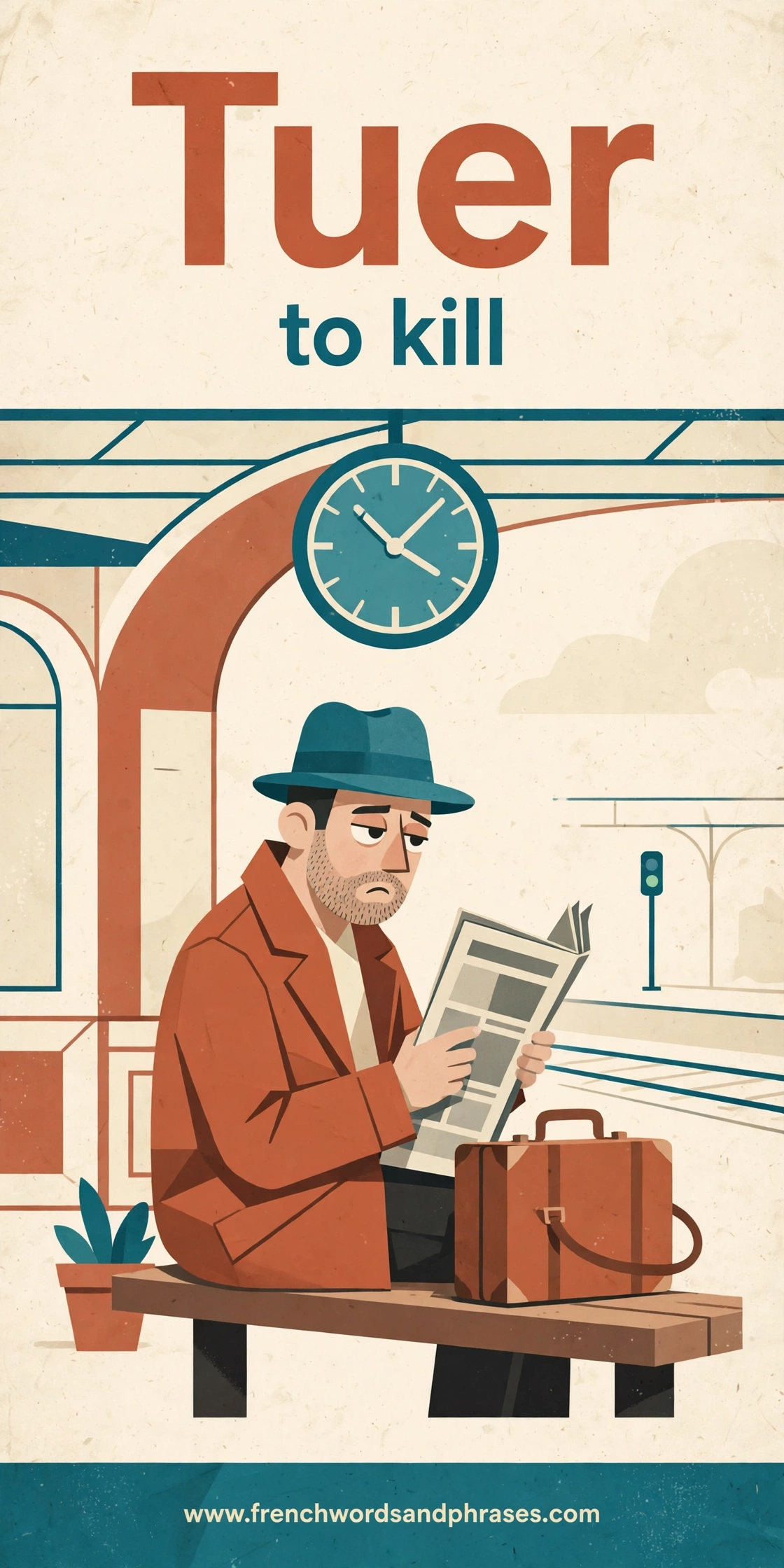
And at the station, a traveller with two hours to wait sighs and opens a novel. He is killing time — il tue le temps — with the same verb, and nobody is harmed.
How to Conjugate Tuer: Complete French Conjugation Guide
Let’s explore every major conjugation of tuer, beginning with the indicative mood.
How to Conjugate Tuer in the Indicative Mood
The indicative mood is used to express facts, observations, actions, and events.
How to Conjugate Tuer in the Present Tense (Présent)
Used for actions happening now, habitual actions, and general truths.
| Subject | Conjugation |
|---|---|
| je | tue |
| tu | tues |
| il / elle | tue |
| nous | tuons |
| vous | tuez |
| ils / elles | tuent |
Example
Le gel tue les jeunes pousses du jardin.
The frost kills the young shoots in the garden.
Quick Quiz 1
Complete the sentence:
Nous ______ le temps en jouant aux cartes.
Reveal the answer
tuons
Nous tuons le temps en jouant aux cartes.
We kill time by playing cards.
How to Conjugate Tuer in the Passé Composé
Used for completed actions in the past. Tuer takes the auxiliary verb avoir.
| Subject | Conjugation |
|---|---|
| j’ | ai tué |
| tu | as tué |
| il / elle | a tué |
| nous | avons tué |
| vous | avez tué |
| ils / elles | ont tué |
Example
La gelée a tué les tomates cette nuit.
The frost killed the tomatoes last night.
How to Conjugate Tuer in the Imparfait (Imperfect Tense)
Used for habitual past actions, descriptions, and ongoing situations in the past.
| Subject | Conjugation |
|---|---|
| je | tuais |
| tu | tuais |
| il / elle | tuait |
| nous | tuions |
| vous | tuiez |
| ils / elles | tuaient |
Example
Autrefois, on tuait le cochon à la ferme en hiver.
In the old days, the pig was killed on the farm in winter.
Quick Quiz 2
Choose the correct form:
She worked herself to death at the office.
Elle ______ à la tâche au bureau. (s’est tuée / a tué)
Reveal the answer
s’est tuée
Elle s’est tuée à la tâche au bureau.
Se tuer takes être, and the participle agrees.
How to Conjugate Tuer in the Plus-que-parfait
Used to describe an action that had already been completed before another past event.
| Subject | Conjugation |
|---|---|
| j’ | avais tué |
| tu | avais tué |
| il / elle | avait tué |
| nous | avions tué |
| vous | aviez tué |
| ils / elles | avaient tué |
Example
Il avait tué le moteur avant de descendre de voiture.
He had switched off the engine before getting out of the car.
How to Conjugate Tuer in the Passé Simple
Primarily used in formal writing, literature, and historical narratives. It is rarely used in everyday conversation.
| Subject | Conjugation |
|---|---|
| je | tuai |
| tu | tuas |
| il / elle | tua |
| nous | tuâmes |
| vous | tuâtes |
| ils / elles | tuèrent |
Example
Le chasseur tua le sanglier d’un seul coup.
The hunter killed the boar with a single shot.
How to Conjugate Tuer in the Passé Antérieur
A literary tense used to express an action completed immediately before another past action, generally in the passé simple.
| Subject | Conjugation |
|---|---|
| j’ | eus tué |
| tu | eus tué |
| il / elle | eut tué |
| nous | eûmes tué |
| vous | eûtes tué |
| ils / elles | eurent tué |
Example
Quand il eut tué le serpent, les enfants revinrent jouer.
When he had killed the snake, the children came back to play.
How to Conjugate Tuer in the Future Tense (Futur Simple)
Used to describe actions that will take place in the future.
| Subject | Conjugation |
|---|---|
| je | tuerai |
| tu | tueras |
| il / elle | tuera |
| nous | tuerons |
| vous | tuerez |
| ils / elles | tueront |
Example
Ce froid tuera les bourgeons si le vent continue.
This cold will kill the buds if the wind keeps up.
How to Conjugate Tuer in the Futur Antérieur (Future Perfect)
Used for an action that will have been completed before a particular point in the future.
| Subject | Conjugation |
|---|---|
| j’ | aurai tué |
| tu | auras tué |
| il / elle | aura tué |
| nous | aurons tué |
| vous | aurez tué |
| ils / elles | auront tué |
Example
À la tombée de la nuit, ils auront tué deux faisans.
By nightfall, they will have killed two pheasants.
How to Conjugate Tuer in the Near Future (Futur Proche)
Used to describe something that is going to happen soon. Formed with aller + infinitive.
| Subject | Conjugation |
|---|---|
| je | vais tuer |
| tu | vas tuer |
| il / elle | va tuer |
| nous | allons tuer |
| vous | allez tuer |
| ils / elles | vont tuer |
Example
Je vais tuer le temps en relisant mes lettres.
I am going to kill time by rereading my letters.
How to Conjugate Tuer in the Conditional Mood
The conditional mood expresses what would happen under certain circumstances. It is also frequently used to make polite requests or express wishes.
How to Conjugate Tuer in the Present Conditional
| Subject | Conjugation |
|---|---|
| je | tuerais |
| tu | tuerais |
| il / elle | tuerait |
| nous | tuerions |
| vous | tueriez |
| ils / elles | tueraient |
Example
Ce travail de nuit te tuerait en un mois.
That night work would kill you in a month.
How to Conjugate Tuer in the Past Conditional
| Subject | Conjugation |
|---|---|
| j’ | aurais tué |
| tu | aurais tué |
| il / elle | aurait tué |
| nous | aurions tué |
| vous | auriez tué |
| ils / elles | auraient tué |
Example
Sans l’antidote, le venin l’aurait tuée en une heure.
Without the antidote, the venom would have killed her within an hour.
Tuer in the Literary Past Conditional Form
This less common literary form uses the imperfect subjunctive of avoir.
| Subject | Conjugation |
|---|---|
| j’ | eusse tué |
| tu | eusses tué |
| il / elle | eût tué |
| nous | eussions tué |
| vous | eussiez tué |
| ils / elles | eussent tué |
Example
Le poison eût tué n’importe quel homme.
The poison would have killed any man.
How to Conjugate Tuer in the Subjunctive Mood
The subjunctive is used to express wishes, emotions, doubts, necessity, and uncertainty. It frequently follows expressions such as il faut que (it is necessary that) or bien que (although).
How to Conjugate Tuer in the Present Subjunctive
| Subject | Conjugation |
|---|---|
| que je | tue |
| que tu | tues |
| qu’il / qu’elle | tue |
| que nous | tuions |
| que vous | tuiez |
| qu’ils / qu’elles | tuent |
Example
Il faut que tu tues le moteur avant de descendre.
You must switch off the engine before getting out.
Quick Quiz 3
Complete the sentence using the subjunctive:
Il faut que tu ______ le moteur.
Reveal the answer
tues
Il faut que tu tues le moteur.
You must switch off the engine.
How to Conjugate Tuer in the Imperfect Subjunctive
A literary tense, rarely encountered in modern spoken French.
| Subject | Conjugation |
|---|---|
| que je | tuasse |
| que tu | tuasses |
| qu’il / qu’elle | tuât |
| que nous | tuassions |
| que vous | tuassiez |
| qu’ils / qu’elles | tuassent |
Example
Le médecin craignait que la fièvre ne tuât le vieil homme.
The doctor feared the fever might kill the old man.
How to Conjugate Tuer in the Pluperfect Subjunctive
A literary construction used to express an action completed before another past action.
| Subject | Conjugation |
|---|---|
| que j’ | eusse tué |
| que tu | eusses tué |
| qu’il / qu’elle | eût tué |
| que nous | eussions tué |
| que vous | eussiez tué |
| qu’ils / qu’elles | eussent tué |
Example
Les journaux racontaient qu’il eût tué pour un héritage.
The papers told how he had killed for an inheritance.
How to Conjugate Tuer in the Past Subjunctive
| Subject | Conjugation |
|---|---|
| que j’ | aie tué |
| que tu | aies tué |
| qu’il / qu’elle | ait tué |
| que nous | ayons tué |
| que vous | ayez tué |
| qu’ils / qu’elles | aient tué |
Example
Je regrette que le gel ait tué toutes les fleurs.
I am sorry the frost killed all the flowers.
How to Conjugate Tuer in the Imperative
The imperative is used to give commands, instructions, invitations, or suggestions. Subject pronouns are omitted.
How to Conjugate Tuer in the Present Imperative
| Person | Conjugation |
|---|---|
| (tu) | tue |
| (nous) | tuons |
| (vous) | tuez |
Example
Tue le moteur, on est arrivés !
Kill the engine, we are here!
Quick Quiz 4
How would you say Kill the engine (tu form)?
Reveal the answer
Tue le moteur !
French Participles of Tuer
Participles are verb forms that can be used in compound tenses and other grammatical constructions.
Present Participle of Tuer
tuant
En tuant le temps à la gare, elle a fini son roman.
While killing time at the station, she finished her novel.
Past Participle of Tuer
tué
Tuées par le gel, les vignes n’ont presque rien donné.
Killed by the frost, the vines yielded almost nothing.
Tuer in Everyday French: Real-Life Examples
Now that you know the conjugations, let’s see how tuer appears in everyday French.
Example 1 — Present
Le gel tue les bourgeons au printemps.
The frost kills the buds in spring.
Example 2 — Passé composé
La gelée a tué les tomates.
The frost killed the tomatoes.
Example 3 — Imparfait
On tuait le temps en jouant aux cartes.
People used to kill time by playing cards.
Example 4 — Future
Ce froid tuera les fleurs du jardin.
This cold will kill the garden flowers.
Example 5 — Conditional
Ce travail te tuerait en un mois.
That work would kill you in a month.
Example 6 — Imperative
Ne te tue pas à la tâche !
Do not work yourself to death!
Beyond Translation: The Meaning of Tuer
English kill and French tuer cover the same hard ground, but French pushes the soft senses further.
Se tuer à la tâche.
To work oneself to death is not suicide in French — it is the standard, slightly proud complaint of the overworked: je me tue au travail. And the reflexive also reports accidents with terrible economy: il s’est tué sur la route, he was killed on the road. One verb, three registers — crime, complaint and obituary.
How to Remember the French Verb Tuer
Remember it this way: Tuer is about one hard verb for frost, engines, time and toil.
- Tuer is regular -er: je tue, nous tuons, past participle tué — with avoir.
- Se tuer takes être: elle s’est tuée; and se tuer à la tâche means to work oneself to death.
- Soft everyday killings: tuer le temps (kill time), tuer le moteur (switch off the engine), le gel tue les plantes.
The key idea is one hard verb for frost, engines, time and toil.
Test Your Knowledge of Tuer
Let’s see how much you’ve learned. Try answering these questions before revealing the answers.
Question 1
How do you say to kill time in French?
Reveal the answer
Tuer le temps.
Question 2
How do you say The frost killed the tomatoes in French?
Reveal the answer
La gelée a tué les tomates.
Question 3
Translate: Do not work yourself to death!
Reveal the answer
Ne te tue pas à la tâche !
Question 4
What is the past participle of tuer, and which auxiliary does se tuer use?
Reveal the answer
Tué — and se tuer conjugates with être: elle s’est tuée.
Question 5
Complete the sentence:
Il faut que tu ______ le moteur avant de descendre.
Reveal the answer
tues
Il faut que tu tues le moteur avant de descendre.
You must switch off the engine before getting out.
Your Final Challenge
Can You Use It?
How would you say this in French?
The frost kills the buds at night, and the gardener kills time while waiting for spring.
Reveal the answer
Le gel tue les bourgeons la nuit, et le jardinier tue le temps en attendant le printemps.
The frost kills the buds at night, and the gardener kills time while waiting for spring.
A little French. A little curiosity. A richer everyday life.
LEARN FRENCH ONE WORD AT A TIME