A French Word to Live By
How to Conjugate Truander in French
/tʁɥɑ̃.de/
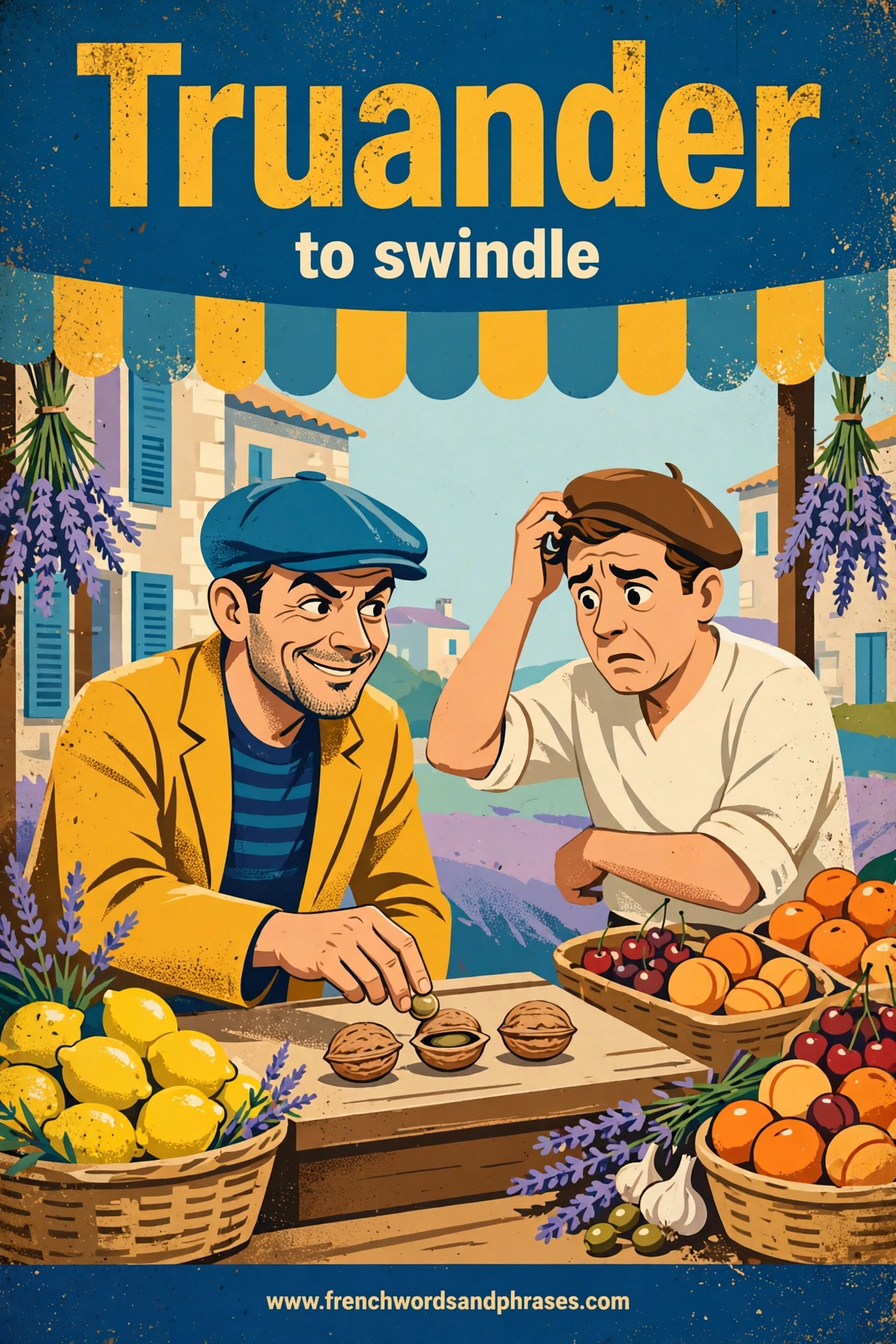
Truander means to swindle — an old underworld word for cheating people out of their money.
A smoky station buffet a century ago, a smooth talker with a deck of cards and a story too good to check — truander is the dated slang verb of the old Parisian underworld, when crooks fleeced travellers and cadged their way through the city.
In this guide, you’ll learn how to conjugate truander in all the major French tenses and moods. Explore complete conjugation tables, French examples, English translations, and practice quizzes.
Understanding the French Verb Truander
Truander is a regular French verb belonging to the first group of verbs, those ending in -er.
It means to swindle. It is commonly used today only with a wink — in historical fiction, in jokes about old-time gangsters, and in retellings of classic scams; its living legacy is the noun un truand, still at home in crime headlines.
Verb classification: First group (-er)
Auxiliary verb: Avoir
Past participle: truandé
Present participle: truandant
English equivalents: To swindle, to con (dated slang); un truand — a crook, a gangster; truander quelqu’un — to cheat someone out of money; in older texts, also to beg, to cadge.
One important detail: truander is dated slang — you will meet it in old crime novels and period films, not in a modern police report. It comes from un truand, a word that has survived much better: in today’s news, un truand is a gangster or career crook (un truand de la finance — a financial crook). In its oldest sense, truander also meant to beg or sponge — the medieval truand was a beggar before he was a bandit. For everyday modern French, say arnaquer or escroquer instead.
Experience the Word
Truander is a museum piece of a verb — the swindle wearing a flat cap and a 1930s overcoat.
Imagine a black-and-white film: rain on the boulevards, a card sharp at a café table, truandant one traveller after another with the same practised smile, while the audience grins because the word itself sounds like a wink.
The money is gone and so is he. The victim has been swindled — truandé — in the finest old style.
How to Conjugate Truander: Complete French Conjugation Guide
Let’s explore every major conjugation of truander, beginning with the indicative mood.
How to Conjugate Truander in the Indicative Mood
The indicative mood is used to express facts, observations, actions, and events.
How to Conjugate Truander in the Present Tense (Présent)
Used for actions happening now, habitual actions, and general truths.
| Subject | Conjugation |
|---|---|
| je | truande |
| tu | truandes |
| il / elle | truande |
| nous | truandons |
| vous | truandez |
| ils / elles | truandent |
Example
Dans les vieux romans, les voyous truandent les passants crédules.
In old novels, crooks swindle gullible passers-by.
Quick Quiz 1
Complete the sentence:
Les voyous ______ les passants crédules.
Reveal the answer
truandent
Les voyous truandent les passants crédules.
The crooks swindle gullible passers-by.
How to Conjugate Truander in the Passé Composé
Used for completed actions in the past. Truander takes the auxiliary verb avoir.
| Subject | Conjugation |
|---|---|
| j’ | ai truandé |
| tu | as truandé |
| il / elle | a truandé |
| nous | avons truandé |
| vous | avez truandé |
| ils / elles | ont truandé |
Example
Il a truandé quelques touristes avant d’être arrêté.
He swindled a few tourists before being arrested.
How to Conjugate Truander in the Imparfait (Imperfect Tense)
Used for habitual past actions, descriptions, and ongoing situations in the past.
| Subject | Conjugation |
|---|---|
| je | truandais |
| tu | truandais |
| il / elle | truandait |
| nous | truandions |
| vous | truandiez |
| ils / elles | truandaient |
Example
Autrefois, il truandait aux abords des gares.
In the old days, he used to swindle people around the stations.
Quick Quiz 2
Choose the correct form:
He swindled a few tourists.
Il ______ quelques touristes. (a truandé / est truandé)
Reveal the answer
a truandé
Il a truandé quelques touristes.
Truander takes avoir.
How to Conjugate Truander in the Plus-que-parfait
Used to describe an action that had already been completed before another past event.
| Subject | Conjugation |
|---|---|
| j’ | avais truandé |
| tu | avais truandé |
| il / elle | avait truandé |
| nous | avions truandé |
| vous | aviez truandé |
| ils / elles | avaient truandé |
Example
Elle avait truandé tout le quartier avant son arrestation.
She had swindled the whole neighbourhood before her arrest.
How to Conjugate Truander in the Passé Simple
Primarily used in formal writing, literature, and historical narratives. It is rarely used in everyday conversation.
| Subject | Conjugation |
|---|---|
| je | truandai |
| tu | truandas |
| il / elle | truanda |
| nous | truandâmes |
| vous | truandâtes |
| ils / elles | truandèrent |
Example
Le filou truanda un vieillard sur le marché.
The trickster swindled an old man at the market.
How to Conjugate Truander in the Passé Antérieur
A literary tense used to express an action completed immediately before another past action, generally in the passé simple.
| Subject | Conjugation |
|---|---|
| j’ | eus truandé |
| tu | eus truandé |
| il / elle | eut truandé |
| nous | eûmes truandé |
| vous | eûtes truandé |
| ils / elles | eurent truandé |
Example
Quand il eut truandé son dernier client, la police l’attendait.
When he had swindled his last customer, the police were waiting for him.
How to Conjugate Truander in the Future Tense (Futur Simple)
Used to describe actions that will take place in the future.
| Subject | Conjugation |
|---|---|
| je | truanderai |
| tu | truanderas |
| il / elle | truandera |
| nous | truanderons |
| vous | truanderez |
| ils / elles | truanderont |
Example
Un jour, il truandera la mauvaise personne.
One day, he will swindle the wrong person.
How to Conjugate Truander in the Futur Antérieur (Future Perfect)
Used for an action that will have been completed before a particular point in the future.
| Subject | Conjugation |
|---|---|
| j’ | aurai truandé |
| tu | auras truandé |
| il / elle | aura truandé |
| nous | aurons truandé |
| vous | aurez truandé |
| ils / elles | auront truandé |
Example
À la fin du mois, il aura truandé la moitié du village.
By the end of the month, he will have swindled half the village.
How to Conjugate Truander in the Near Future (Futur Proche)
Used to describe something that is going to happen soon. Formed with aller + infinitive.
| Subject | Conjugation |
|---|---|
| je | vais truander |
| tu | vas truander |
| il / elle | va truander |
| nous | allons truander |
| vous | allez truander |
| ils / elles | vont truander |
Example
Je crois qu’il va encore truander quelqu’un ce soir.
I think he is going to swindle someone again tonight.
How to Conjugate Truander in the Conditional Mood
The conditional mood expresses what would happen under certain circumstances. It is also frequently used to make polite requests or express wishes.
How to Conjugate Truander in the Present Conditional
| Subject | Conjugation |
|---|---|
| je | truanderais |
| tu | truanderais |
| il / elle | truanderait |
| nous | truanderions |
| vous | truanderiez |
| ils / elles | truanderaient |
Example
Sans la police, ces escrocs truanderaient en toute liberté.
Without the police, those con men would swindle freely.
How to Conjugate Truander in the Past Conditional
| Subject | Conjugation |
|---|---|
| j’ | aurais truandé |
| tu | aurais truandé |
| il / elle | aurait truandé |
| nous | aurions truandé |
| vous | auriez truandé |
| ils / elles | auraient truandé |
Example
Il aurait truandé le vieillard si un agent ne l’avait pas vu.
He would have swindled the old man if an officer had not seen him.
Truander in the Literary Past Conditional Form
This less common literary form uses the imperfect subjunctive of avoir.
| Subject | Conjugation |
|---|---|
| j’ | eusse truandé |
| tu | eusses truandé |
| il / elle | eût truandé |
| nous | eussions truandé |
| vous | eussiez truandé |
| ils / elles | eussent truandé |
Example
Il eût truandé le marchand sans aucun remords.
He would have swindled the merchant without any remorse.
How to Conjugate Truander in the Subjunctive Mood
The subjunctive is used to express wishes, emotions, doubts, necessity, and uncertainty. It frequently follows expressions such as il faut que (it is necessary that) or bien que (although).
How to Conjugate Truander in the Present Subjunctive
| Subject | Conjugation |
|---|---|
| que je | truande |
| que tu | truandes |
| qu’il / qu’elle | truande |
| que nous | truandions |
| que vous | truandiez |
| qu’ils / qu’elles | truandent |
Example
Il est honteux qu’ils truandent des personnes âgées.
It is shameful that they swindle elderly people.
Quick Quiz 3
Complete the sentence using the subjunctive:
Il est honteux qu’ils ______ des personnes âgées.
Reveal the answer
truandent
Il est honteux qu’ils truandent des personnes âgées.
It is shameful that they swindle elderly people.
How to Conjugate Truander in the Imperfect Subjunctive
A literary tense, rarely encountered in modern spoken French.
| Subject | Conjugation |
|---|---|
| que je | truandasse |
| que tu | truandasses |
| qu’il / qu’elle | truandât |
| que nous | truandassions |
| que vous | truandassiez |
| qu’ils / qu’elles | truandassent |
Example
La bande voulait qu’il truandât les voyageurs à la gare.
The gang wanted him to swindle travellers at the station.
How to Conjugate Truander in the Pluperfect Subjunctive
A literary construction used to express an action completed before another past action.
| Subject | Conjugation |
|---|---|
| que j’ | eusse truandé |
| que tu | eusses truandé |
| qu’il / qu’elle | eût truandé |
| que nous | eussions truandé |
| que vous | eussiez truandé |
| qu’ils / qu’elles | eussent truandé |
Example
On racontait qu’il eût truandé la moitié de la ville.
People said he had swindled half the town.
How to Conjugate Truander in the Past Subjunctive
| Subject | Conjugation |
|---|---|
| que j’ | aie truandé |
| que tu | aies truandé |
| qu’il / qu’elle | ait truandé |
| que nous | ayons truandé |
| que vous | ayez truandé |
| qu’ils / qu’elles | aient truandé |
Example
Je suis choqué qu’il ait truandé son propre oncle.
I am shocked that he swindled his own uncle.
How to Conjugate Truander in the Imperative
The imperative is used to give commands, instructions, invitations, or suggestions. Subject pronouns are omitted.
How to Conjugate Truander in the Present Imperative
| Person | Conjugation |
|---|---|
| (tu) | truande |
| (nous) | truandons |
| (vous) | truandez |
Example
Ne truande plus personne, change de vie !
Stop swindling people, turn your life around!
Quick Quiz 4
How would you say Stop swindling people (tu form)?
Reveal the answer
Ne truande plus personne !
French Participles of Truander
Participles are verb forms that can be used in compound tenses and other grammatical constructions.
Present Participle of Truander
truandant
En truandant les passants, il a fini par se faire prendre.
By swindling passers-by, he ended up getting caught.
Past Participle of Truander
truandé
Truandé par un faux plombier, le retraité a porté plainte.
Swindled by a fake plumber, the pensioner filed a complaint.
Truander in Everyday French: Real-Life Examples
Now that you know the conjugations, let’s see how truander appears in everyday French.
Example 1 — Present
Dans ce vieux film, les escrocs truandent les voyageurs.
In this old film, the con men swindle the travellers.
Example 2 — Passé composé
Il a truandé deux touristes à la gare.
He swindled two tourists at the station.
Example 3 — Imparfait
Autrefois, il truandait autour des marchés.
In the old days, he used to swindle people around the markets.
Example 4 — Future
Un jour, il truandera la mauvaise personne.
One day, he will swindle the wrong person.
Example 5 — Conditional
Sans témoins, ils truanderaient tout le quartier.
Without witnesses, they would swindle the whole neighbourhood.
Example 6 — Imperative
Ne truandez plus les personnes âgées !
Stop swindling elderly people!
Beyond Translation: The Meaning of Truander
Modern French has sharper, current words for this crime — arnaquer, escroquer — while truander has retired into novels and films.
But its noun never retired.
Un truand still walks the front pages: the gangster, the mobster, the crook with a past. Learn truander for the flavour of old Paris; keep un truand for the news.
How to Remember the French Verb Truander
Remember it this way: Truander is about an old-time con man in a flat cap, fleecing travellers.
- Truander is dated underworld slang — today, say arnaquer or escroquer.
- Un truand — a gangster, a crook — is the living word of the family.
- Regular -er: je truande, nous truandons, past participle truandé.
The key idea is an old-time con man in a flat cap, fleecing travellers.
Test Your Knowledge of Truander
Let’s see how much you’ve learned. Try answering these questions before revealing the answers.
Question 1
What register is truander?
Reveal the answer
Dated slang — the verb of old crime novels; modern French says arnaquer.
Question 2
How do you say He swindled two tourists in French (old-style)?
Reveal the answer
Il a truandé deux touristes.
Question 3
What does un truand mean in today’s news?
Reveal the answer
A gangster, a career crook — the noun is still fully alive.
Question 4
What is the past participle of truander?
Reveal the answer
Truandé.
Question 5
Complete the sentence:
Il est honteux qu’ils ______ des personnes âgées.
Reveal the answer
truandent
Il est honteux qu’ils truandent des personnes âgées.
It is shameful that they swindle elderly people.
Your Final Challenge
Can You Use It?
How would you say this in French?
In the old film, the trickster swindles a traveller, smiles, and disappears into the station crowd.
Reveal the answer
Dans le vieux film, le filou truande un voyageur, sourit, et disparaît dans la foule de la gare.
In the old film, the trickster swindles a traveller, smiles, and disappears into the station crowd.
A little French. A little curiosity. A richer everyday life.
LEARN FRENCH ONE WORD AT A TIME