
A French Word to Live By
How to Conjugate Trimbaler in French
/tʁɛ̃.ba.le/
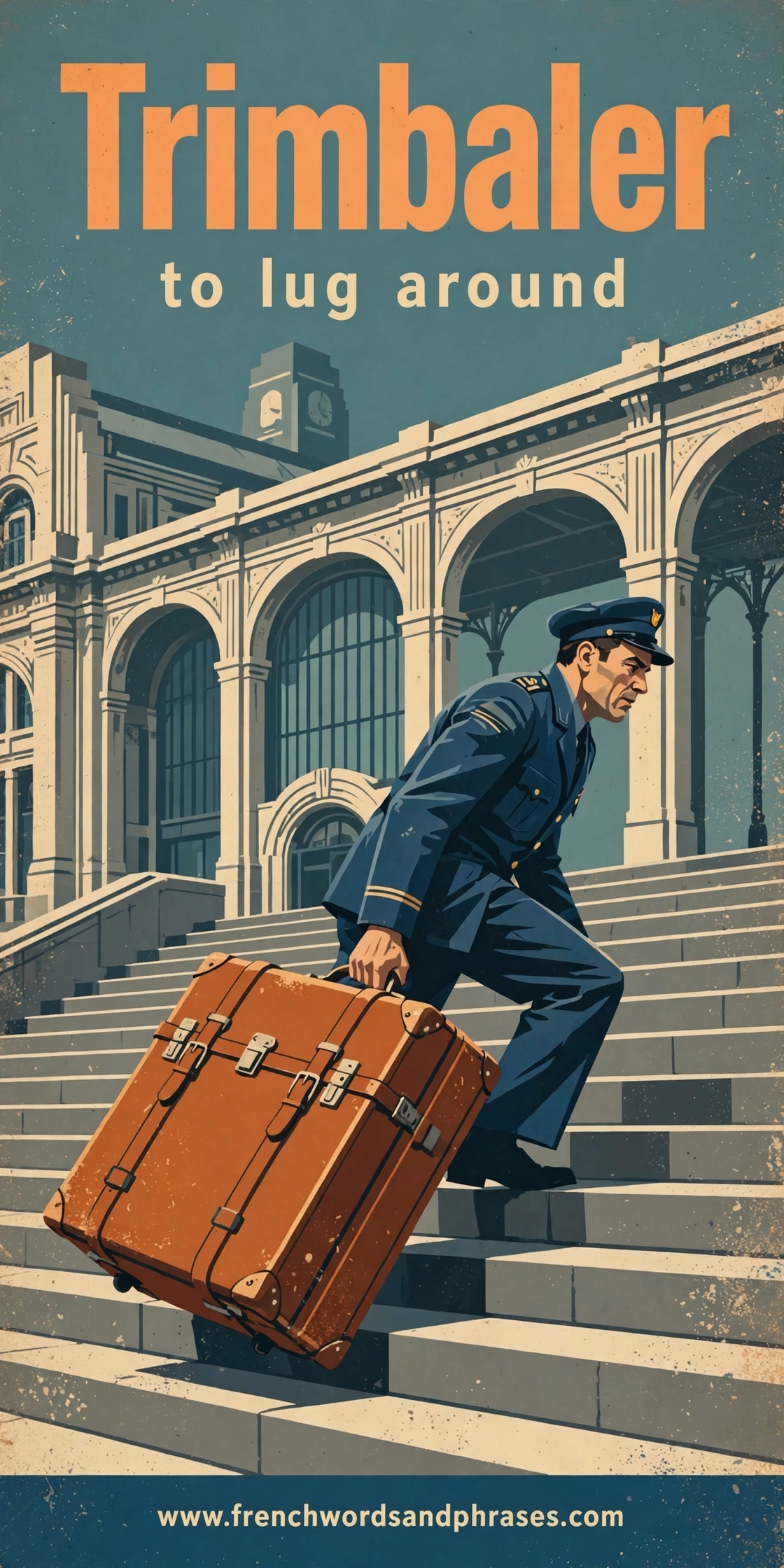
Trimbaler means to lug around — to drag or carry something bulky from place to place, and to trail around oneself.
A toddler hauling a teddy bear bigger than himself through every room of the house, a tourist dragging a broken suitcase across three stations — trimbaler is the verb of lugging: heavy, awkward things, and people, trailed around from place to place.
In this guide, you’ll learn how to conjugate trimbaler in all the major French tenses and moods. Explore complete conjugation tables, French examples, English translations, and practice quizzes.
Understanding the French Verb Trimbaler
Trimbaler is a regular French verb belonging to the first group of verbs, those ending in -er.
It means to lug around. It is commonly used for lugging suitcases, pushchairs, instruments and shopping from place to place, for dragging children or companions around shops and stations, and reflexively for trailing around town, exhibitions and waiting rooms with time to kill.
Verb classification: First group (-er)
Auxiliary verb: Avoir
Past participle: trimbalé
Present participle: trimbalant
English equivalents: To lug around, to drag around, to cart about; trimbaler une valise — to lug a suitcase around; se trimbaler — to trail around, to drag oneself about (with être in compound tenses); trimbaler quelqu’un partout — to drag someone everywhere.
One important detail: trimbaler is spelled with a single l in modern French, though older books print trimballer — the single l is the standard spelling today. Its reflexive twin is everywhere in spoken French: se trimbaler means to trail around from place to place — se trimbaler dans les magasins, se trimbaler avec un gros sac — and, like all reflexives, it takes être in compound tenses: elle s’est trimbalée partout.
Experience the Word
Trimbaler is the verb of the burden that comes with you — nothing about it is elegant, everything about it is heavy.
Imagine a father at a country fair. One hand hauls a pushchair, the other a bag of wonky goldfish prizes, a toddler rides his shoulders, and the whole caravan avance, se trimbale, from the merry-go-round to the candyfloss stall.
At the car, he sets everything down at last. He has lugged it all — tout trimbalé — and the fair comes home with him.
How to Conjugate Trimbaler: Complete French Conjugation Guide
Let’s explore every major conjugation of trimbaler, beginning with the indicative mood.
How to Conjugate Trimbaler in the Indicative Mood
The indicative mood is used to express facts, observations, actions, and events.
How to Conjugate Trimbaler in the Present Tense (Présent)
Used for actions happening now, habitual actions, and general truths.
| Subject | Conjugation |
|---|---|
| je | trimbale |
| tu | trimbales |
| il / elle | trimbale |
| nous | trimbalons |
| vous | trimbalez |
| ils / elles | trimbalent |
Example
Elle trimbale sa valise dans toutes les gares d’Europe.
She lugs her suitcase around every station in Europe.
Quick Quiz 1
Complete the sentence:
Nous ______ les cartons jusqu’au grenier.
Reveal the answer
trimbalons
Nous trimbalons les cartons jusqu’au grenier.
We are lugging the boxes up to the attic.
How to Conjugate Trimbaler in the Passé Composé
Used for completed actions in the past. Trimbaler takes the auxiliary verb avoir.
| Subject | Conjugation |
|---|---|
| j’ | ai trimbalé |
| tu | as trimbalé |
| il / elle | a trimbalé |
| nous | avons trimbalé |
| vous | avez trimbalé |
| ils / elles | ont trimbalé |
Example
J’ai trimbalé cette poussette dans tout le marché.
I lugged this pushchair all around the market.
How to Conjugate Trimbaler in the Imparfait (Imperfect Tense)
Used for habitual past actions, descriptions, and ongoing situations in the past.
| Subject | Conjugation |
|---|---|
| je | trimbalais |
| tu | trimbalais |
| il / elle | trimbalait |
| nous | trimbalions |
| vous | trimbaliez |
| ils / elles | trimbalaient |
Example
Enfant, il trimbalait son ours en peluche partout.
As a child, he used to drag his teddy bear everywhere.
Quick Quiz 2
Choose the correct form:
I lugged the shopping to the car.
J’______ les courses jusqu’à la voiture. (ai trimbalé / suis trimbalé)
Reveal the answer
ai trimbalé
J’ai trimbalé les courses jusqu’à la voiture.
Trimbaler takes avoir — but se trimbaler takes être.
How to Conjugate Trimbaler in the Plus-que-parfait
Used to describe an action that had already been completed before another past event.
| Subject | Conjugation |
|---|---|
| j’ | avais trimbalé |
| tu | avais trimbalé |
| il / elle | avait trimbalé |
| nous | avions trimbalé |
| vous | aviez trimbalé |
| ils / elles | avaient trimbalé |
Example
Nous avions trimbalé les instruments sur trois scènes avant le concert.
We had lugged the instruments across three stages before the concert.
How to Conjugate Trimbaler in the Passé Simple
Primarily used in formal writing, literature, and historical narratives. It is rarely used in everyday conversation.
| Subject | Conjugation |
|---|---|
| je | trimbalai |
| tu | trimbalas |
| il / elle | trimbala |
| nous | trimbalâmes |
| vous | trimbalâtes |
| ils / elles | trimbalèrent |
Example
Le voyageur trimbala sa malle de port en port.
The traveller lugged his trunk from port to port.
How to Conjugate Trimbaler in the Passé Antérieur
A literary tense used to express an action completed immediately before another past action, generally in the passé simple.
| Subject | Conjugation |
|---|---|
| j’ | eus trimbalé |
| tu | eus trimbalé |
| il / elle | eut trimbalé |
| nous | eûmes trimbalé |
| vous | eûtes trimbalé |
| ils / elles | eurent trimbalé |
Example
Quand elle eut trimbalé les cartons jusqu’au grenier, elle s’assit enfin.
When she had lugged the boxes up to the attic, she finally sat down.
How to Conjugate Trimbaler in the Future Tense (Futur Simple)
Used to describe actions that will take place in the future.
| Subject | Conjugation |
|---|---|
| je | trimbalerai |
| tu | trimbaleras |
| il / elle | trimbalera |
| nous | trimbalerons |
| vous | trimbalerez |
| ils / elles | trimbaleront |
Example
Tu trimbaleras encore ton sac partout si tu ne le ranges pas.
You will lug your bag around everywhere again if you don’t put it away.
How to Conjugate Trimbaler in the Futur Antérieur (Future Perfect)
Used for an action that will have been completed before a particular point in the future.
| Subject | Conjugation |
|---|---|
| j’ | aurai trimbalé |
| tu | auras trimbalé |
| il / elle | aura trimbalé |
| nous | aurons trimbalé |
| vous | aurez trimbalé |
| ils / elles | auront trimbalé |
Example
À ce soir, ils auront trimbalé les chaises dans toutes les salles.
By this evening, they will have lugged the chairs around every room.
How to Conjugate Trimbaler in the Near Future (Futur Proche)
Used to describe something that is going to happen soon. Formed with aller + infinitive.
| Subject | Conjugation |
|---|---|
| je | vais trimbaler |
| tu | vas trimbaler |
| il / elle | va trimbaler |
| nous | allons trimbaler |
| vous | allez trimbaler |
| ils / elles | vont trimbaler |
Example
Je vais trimbaler les courses jusqu’à la voiture.
I am going to lug the shopping to the car.
How to Conjugate Trimbaler in the Conditional Mood
The conditional mood expresses what would happen under certain circumstances. It is also frequently used to make polite requests or express wishes.
How to Conjugate Trimbaler in the Present Conditional
| Subject | Conjugation |
|---|---|
| je | trimbalerais |
| tu | trimbalerais |
| il / elle | trimbalerait |
| nous | trimbalerions |
| vous | trimbaleriez |
| ils / elles | trimbaleraient |
Example
Avec une voiture, nous ne trimbalerions pas tout ce matériel.
With a car, we would not lug all this equipment around.
How to Conjugate Trimbaler in the Past Conditional
| Subject | Conjugation |
|---|---|
| j’ | aurais trimbalé |
| tu | aurais trimbalé |
| il / elle | aurait trimbalé |
| nous | aurions trimbalé |
| vous | auriez trimbalé |
| ils / elles | auraient trimbalé |
Example
Elle aurait trimbalé moins de bagages si le voyage avait été plus court.
She would have lugged less luggage if the trip had been shorter.
Trimbaler in the Literary Past Conditional Form
This less common literary form uses the imperfect subjunctive of avoir.
| Subject | Conjugation |
|---|---|
| j’ | eusse trimbalé |
| tu | eusses trimbalé |
| il / elle | eût trimbalé |
| nous | eussions trimbalé |
| vous | eussiez trimbalé |
| ils / elles | eussent trimbalé |
Example
Il eût trimbalé sa malle jusqu’au bout du monde.
He would have lugged his trunk to the end of the world.
How to Conjugate Trimbaler in the Subjunctive Mood
The subjunctive is used to express wishes, emotions, doubts, necessity, and uncertainty. It frequently follows expressions such as il faut que (it is necessary that) or bien que (although).
How to Conjugate Trimbaler in the Present Subjunctive
| Subject | Conjugation |
|---|---|
| que je | trimbale |
| que tu | trimbales |
| qu’il / qu’elle | trimbale |
| que nous | trimbalions |
| que vous | trimbaliez |
| qu’ils / qu’elles | trimbalent |
Example
Je ne veux pas que tu trimbales ce sac lourd toute la journée.
I don’t want you to lug that heavy bag around all day.
Quick Quiz 3
Complete the sentence using the subjunctive:
Je ne veux pas que vous ______ ce sac lourd.
Reveal the answer
trimbaliez
Je ne veux pas que vous trimbaliez ce sac lourd.
I don’t want you to lug that heavy bag.
How to Conjugate Trimbaler in the Imperfect Subjunctive
A literary tense, rarely encountered in modern spoken French.
| Subject | Conjugation |
|---|---|
| que je | trimbalasse |
| que tu | trimbalasses |
| qu’il / qu’elle | trimbalât |
| que nous | trimbalassions |
| que vous | trimbalassiez |
| qu’ils / qu’elles | trimbalassent |
Example
Il fallait qu’elle trimbalât les enfants de magasin en magasin.
She had to drag the children from shop to shop.
How to Conjugate Trimbaler in the Pluperfect Subjunctive
A literary construction used to express an action completed before another past action.
| Subject | Conjugation |
|---|---|
| que j’ | eusse trimbalé |
| que tu | eusses trimbalé |
| qu’il / qu’elle | eût trimbalé |
| que nous | eussions trimbalé |
| que vous | eussiez trimbalé |
| qu’ils / qu’elles | eussent trimbalé |
Example
On plaignait ceux qui eussent trimbalé leurs valises sous la pluie.
People pitied those who had lugged their suitcases in the rain.
How to Conjugate Trimbaler in the Past Subjunctive
| Subject | Conjugation |
|---|---|
| que j’ | aie trimbalé |
| que tu | aies trimbalé |
| qu’il / qu’elle | ait trimbalé |
| que nous | ayons trimbalé |
| que vous | ayez trimbalé |
| qu’ils / qu’elles | aient trimbalé |
Example
Je suis fatigué que nous ayons trimbalé tout ce matériel pour rien.
I am fed up that we lugged all this equipment around for nothing.
How to Conjugate Trimbaler in the Imperative
The imperative is used to give commands, instructions, invitations, or suggestions. Subject pronouns are omitted.
How to Conjugate Trimbaler in the Present Imperative
| Person | Conjugation |
|---|---|
| (tu) | trimbale |
| (nous) | trimbalons |
| (vous) | trimbalez |
Example
Ne trimbale pas ce sac partout, pose-le ici !
Don’t lug that bag everywhere, put it down here!
Quick Quiz 4
How would you say Don’t lug that bag everywhere (tu form)?
Reveal the answer
Ne trimbale pas ce sac partout !
French Participles of Trimbaler
Participles are verb forms that can be used in compound tenses and other grammatical constructions.
Present Participle of Trimbaler
trimbalant
En trimbalant les cartons, il a fini par se faire mal au dos.
Lugging the boxes around, he ended up hurting his back.
Past Participle of Trimbaler
trimbalé
Trimbalée de gare en gare, la vieille valise a fini par lâcher.
Lugged from station to station, the old suitcase finally gave out.
Trimbaler in Everyday French: Real-Life Examples
Now that you know the conjugations, let’s see how trimbaler appears in everyday French.
Example 1 — Present
Elle trimbale sa valise partout.
She lugs her suitcase everywhere.
Example 2 — Passé composé
J’ai trimbalé la poussette dans tout le marché.
I lugged the pushchair all around the market.
Example 3 — Imparfait
Il trimbalait son ours en peluche partout.
He used to drag his teddy bear everywhere.
Example 4 — Future
Tu trimbaleras ton sac toute la journée.
You will lug your bag around all day.
Example 5 — Conditional
Nous ne trimbalerions pas tout ça avec une voiture.
We would not lug all that around with a car.
Example 6 — Imperative
Ne trimbalez pas ce sac partout !
Don’t lug that bag everywhere!
Beyond Translation: The Meaning of Trimbaler
English lug and drag split the work between them; French trimbaler does both, and then turns round on the carrier himself.
Se trimbaler is the verb of trailing around.
Half of spoken French life is in it: se trimbaler dans les magasins, se trimbaler d’un bureau à l’autre — to trail around the shops, to be dragged from office to office. The thing lugged and the person lugging end up, in French, in the same verb.
How to Remember the French Verb Trimbaler
Remember it this way: Trimbaler is about the broken suitcase, the teddy bear, the pushchair — everything heavy comes along.
- Spelled with one l: trimbaler (older books print trimballer).
- Se trimbaler — to trail around; it takes être: elle s’est trimbalée partout.
- Regular -er: je trimbale, nous trimbalons, past participle trimbalé.
The key idea is the broken suitcase, the teddy bear, the pushchair — everything heavy comes along.
Test Your Knowledge of Trimbaler
Let’s see how much you’ve learned. Try answering these questions before revealing the answers.
Question 1
How is trimbaler spelled in modern French?
Reveal the answer
With a single l — trimbaler; the double-l trimballer is the older spelling.
Question 2
How do you say I lugged this pushchair all around the market in French?
Reveal the answer
J’ai trimbalé cette poussette dans tout le marché.
Question 3
Translate: She lugs her suitcase around every station in Europe.
Reveal the answer
Elle trimbale sa valise dans toutes les gares d’Europe.
Question 4
What is the past participle of trimbaler?
Reveal the answer
Trimbalé.
Question 5
Complete the sentence:
Je ne veux pas que tu ______ ce sac lourd toute la journée.
Reveal the answer
trimbales
Je ne veux pas que tu trimbales ce sac lourd toute la journée.
I don’t want you to lug that heavy bag around all day.
Your Final Challenge
Can You Use It?
How would you say this in French?
She lugs her old suitcase from station to station, and every station adds a sticker to its story.
Reveal the answer
Elle trimbale sa vieille valise de gare en gare, et chaque gare ajoute un autocollant à son histoire.
She lugs her old suitcase from station to station, and every station adds a sticker to its story.
A little French. A little curiosity. A richer everyday life.
LEARN FRENCH ONE WORD AT A TIME




