A French Word to Live By
How to Conjugate Triller in French
/tʁi.je/
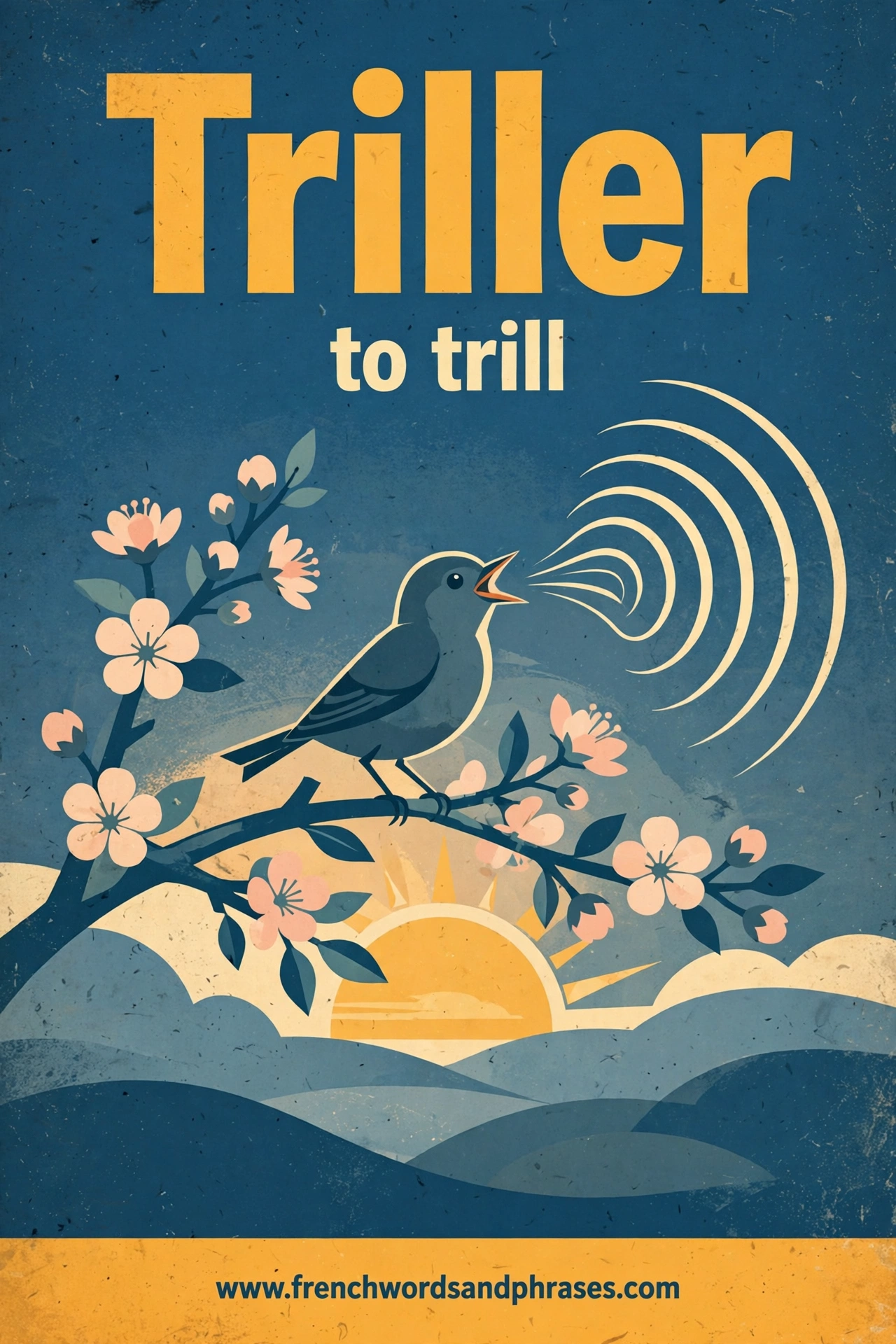
Triller means to trill — to sing or play with a rapid shaking of the voice or the fingers between two notes.
A soprano on a high note that shimmers like sunlight on water, a blackbird unreeling its dawn song from a chimney pot — triller is the verb of the trill, music’s quicksilver ornament, two notes blurring into one sparkling sound.
In this guide, you’ll learn how to conjugate triller in all the major French tenses and moods. Explore complete conjugation tables, French examples, English translations, and practice quizzes.
Understanding the French Verb Triller
Triller is a regular French verb belonging to the first group of verbs, those ending in -er.
It means to trill. It is commonly used in music for voices, flutes, violins and pianos executing the rapid alternation of two neighbouring notes, and in nature writing for the warbling songs of larks, blackbirds and other songbirds.
Verb classification: First group (-er)
Auxiliary verb: Avoir
Past participle: trillé
Present participle: trillant
English equivalents: To trill, to warble; un trille — a trill (the ornament itself); triller une note — to trill a note; l’alouette trille — the lark trills.
One important detail: triller is one of French’s happy coincidences — it sounds exactly like trier (to sort), and only the spelling separates the singer from the sorter. The ornament itself is a noun too: un trille. Singers and instrumentalists trillent on the penultimate note of a phrase, and birds — the lark, the blackbird, the nightingale — are the verb’s oldest performers.
Experience the Word
Triller is the verb of vibration turned into beauty — a note that refuses to sit still and sparkles instead.
Imagine an opera house in the last act. The soprano climbs to the top of her aria and holds the note, trillant, the sound shaking like a flame in a draught while the whole hall holds its breath below her.
The note has finally landed. But for one shining moment, it trilled — elle a trillé — and time stopped.
How to Conjugate Triller: Complete French Conjugation Guide
Let’s explore every major conjugation of triller, beginning with the indicative mood.
How to Conjugate Triller in the Indicative Mood
The indicative mood is used to express facts, observations, actions, and events.
How to Conjugate Triller in the Present Tense (Présent)
Used for actions happening now, habitual actions, and general truths.
| Subject | Conjugation |
|---|---|
| je | trille |
| tu | trilles |
| il / elle | trille |
| nous | trillons |
| vous | trillez |
| ils / elles | trillent |
Example
L’alouette trille au-dessus des champs dès l’aube.
The lark trills above the fields from dawn.
Quick Quiz 1
Complete the sentence:
Nous ______ comme des oiseaux au printemps.
Reveal the answer
trillons
Nous trillons comme des oiseaux au printemps.
We trill like birds in spring.
How to Conjugate Triller in the Passé Composé
Used for completed actions in the past. Triller takes the auxiliary verb avoir.
| Subject | Conjugation |
|---|---|
| j’ | ai trillé |
| tu | as trillé |
| il / elle | a trillé |
| nous | avons trillé |
| vous | avez trillé |
| ils / elles | ont trillé |
Example
La cantatrice a trillé la note finale pendant dix secondes.
The soprano trilled the final note for ten seconds.
How to Conjugate Triller in the Imparfait (Imperfect Tense)
Used for habitual past actions, descriptions, and ongoing situations in the past.
| Subject | Conjugation |
|---|---|
| je | trillais |
| tu | trillais |
| il / elle | trillait |
| nous | trillions |
| vous | trilliez |
| ils / elles | trillaient |
Example
Le rossignol trillait toute la nuit dans le jardin.
The nightingale used to trill all night in the garden.
Quick Quiz 2
Choose the correct form:
The soprano trilled the final note.
La cantatrice ______ la note finale. (a trillé / est trillée)
Reveal the answer
a trillé
La cantatrice a trillé la note finale.
Triller takes avoir.
How to Conjugate Triller in the Plus-que-parfait
Used to describe an action that had already been completed before another past event.
| Subject | Conjugation |
|---|---|
| j’ | avais trillé |
| tu | avais trillé |
| il / elle | avait trillé |
| nous | avions trillé |
| vous | aviez trillé |
| ils / elles | avaient trillé |
Example
Elle avait trillé si longtemps que l’orchestre s’était arrêté pour l’écouter.
She had trilled so long that the orchestra had stopped to listen to her.
How to Conjugate Triller in the Passé Simple
Primarily used in formal writing, literature, and historical narratives. It is rarely used in everyday conversation.
| Subject | Conjugation |
|---|---|
| je | trillai |
| tu | trillas |
| il / elle | trilla |
| nous | trillâmes |
| vous | trillâtes |
| ils / elles | trillèrent |
Example
Le merle trilla une dernière fois, puis s’envola.
The blackbird trilled one last time, then flew away.
How to Conjugate Triller in the Passé Antérieur
A literary tense used to express an action completed immediately before another past action, generally in the passé simple.
| Subject | Conjugation |
|---|---|
| j’ | eus trillé |
| tu | eus trillé |
| il / elle | eut trillé |
| nous | eûmes trillé |
| vous | eûtes trillé |
| ils / elles | eurent trillé |
Example
Quand la flûte eut trillé le thème, le violon le reprit doucement.
When the flute had trilled the theme, the violin took it up softly.
How to Conjugate Triller in the Future Tense (Futur Simple)
Used to describe actions that will take place in the future.
| Subject | Conjugation |
|---|---|
| je | trillerai |
| tu | trilleras |
| il / elle | trillera |
| nous | trillerons |
| vous | trillerez |
| ils / elles | trilleront |
Example
Demain, le chœur trillera moins fort dans le refrain.
Tomorrow, the choir will trill more softly in the refrain.
How to Conjugate Triller in the Futur Antérieur (Future Perfect)
Used for an action that will have been completed before a particular point in the future.
| Subject | Conjugation |
|---|---|
| j’ | aurai trillé |
| tu | auras trillé |
| il / elle | aura trillé |
| nous | aurons trillé |
| vous | aurez trillé |
| ils / elles | auront trillé |
Example
À la fin de l’air, elle aura trillé trois notes différentes.
By the end of the aria, she will have trilled three different notes.
How to Conjugate Triller in the Near Future (Futur Proche)
Used to describe something that is going to happen soon. Formed with aller + infinitive.
| Subject | Conjugation |
|---|---|
| je | vais triller |
| tu | vas triller |
| il / elle | va triller |
| nous | allons triller |
| vous | allez triller |
| ils / elles | vont triller |
Example
Écoute, l’alouette va triller.
Listen, the lark is going to trill.
How to Conjugate Triller in the Conditional Mood
The conditional mood expresses what would happen under certain circumstances. It is also frequently used to make polite requests or express wishes.
How to Conjugate Triller in the Present Conditional
| Subject | Conjugation |
|---|---|
| je | trillerais |
| tu | trillerais |
| il / elle | trillerait |
| nous | trillerions |
| vous | trilleriez |
| ils / elles | trilleraient |
Example
Avec plus de souffle, le flûtiste trillerait sans effort.
With more breath, the flautist would trill effortlessly.
How to Conjugate Triller in the Past Conditional
| Subject | Conjugation |
|---|---|
| j’ | aurais trillé |
| tu | aurais trillé |
| il / elle | aurait trillé |
| nous | aurions trillé |
| vous | auriez trillé |
| ils / elles | auraient trillé |
Example
Elle aurait trillé plus longtemps si sa voix ne l’avait pas trahie.
She would have trilled longer if her voice had not let her down.
Triller in the Literary Past Conditional Form
This less common literary form uses the imperfect subjunctive of avoir.
| Subject | Conjugation |
|---|---|
| j’ | eusse trillé |
| tu | eusses trillé |
| il / elle | eût trillé |
| nous | eussions trillé |
| vous | eussiez trillé |
| ils / elles | eussent trillé |
Example
Le rossignol eût trillé jusqu’à l’aube sans la pluie.
The nightingale would have trilled until dawn if not for the rain.
How to Conjugate Triller in the Subjunctive Mood
The subjunctive is used to express wishes, emotions, doubts, necessity, and uncertainty. It frequently follows expressions such as il faut que (it is necessary that) or bien que (although).
How to Conjugate Triller in the Present Subjunctive
| Subject | Conjugation |
|---|---|
| que je | trille |
| que tu | trilles |
| qu’il / qu’elle | trille |
| que nous | trillions |
| que vous | trilliez |
| qu’ils / qu’elles | trillent |
Example
Le professeur veut que tu trilles plus légèrement.
The teacher wants you to trill more lightly.
Quick Quiz 3
Complete the sentence using the subjunctive:
Le professeur veut que vous ______ plus légèrement.
Reveal the answer
trilliez
Le professeur veut que vous trilliez plus légèrement.
The teacher wants you to trill more lightly.
How to Conjugate Triller in the Imperfect Subjunctive
A literary tense, rarely encountered in modern spoken French.
| Subject | Conjugation |
|---|---|
| que je | trillasse |
| que tu | trillasses |
| qu’il / qu’elle | trillât |
| que nous | trillassions |
| que vous | trillassiez |
| qu’ils / qu’elles | trillassent |
Example
Le compositeur exigeait que la flûte trillât à cet endroit précis.
The composer required the flute to trill at that exact place.
How to Conjugate Triller in the Pluperfect Subjunctive
A literary construction used to express an action completed before another past action.
| Subject | Conjugation |
|---|---|
| que j’ | eusse trillé |
| que tu | eusses trillé |
| qu’il / qu’elle | eût trillé |
| que nous | eussions trillé |
| que vous | eussiez trillé |
| qu’ils / qu’elles | eussent trillé |
Example
On racontait qu’elle eût trillé devant la reine elle-même.
People told how she had trilled before the queen herself.
How to Conjugate Triller in the Past Subjunctive
| Subject | Conjugation |
|---|---|
| que j’ | aie trillé |
| que tu | aies trillé |
| qu’il / qu’elle | ait trillé |
| que nous | ayons trillé |
| que vous | ayez trillé |
| qu’ils / qu’elles | aient trillé |
Example
Je suis émerveillé qu’elle ait trillé si juste ce soir.
I am amazed that she trilled so truly this evening.
How to Conjugate Triller in the Imperative
The imperative is used to give commands, instructions, invitations, or suggestions. Subject pronouns are omitted.
How to Conjugate Triller in the Present Imperative
| Person | Conjugation |
|---|---|
| (tu) | trille |
| (nous) | trillons |
| (vous) | trillez |
Example
Trille doucement, comme un oiseau au matin !
Trill softly, like a bird in the morning!
Quick Quiz 4
How would you say Trill softly (tu form)?
Reveal the answer
Trille doucement !
French Participles of Triller
Participles are verb forms that can be used in compound tenses and other grammatical constructions.
Present Participle of Triller
trillant
En trillant, la cantatrice regardait le chef d’orchestre.
Trilling, the soprano watched the conductor.
Past Participle of Triller
trillé
Trillée avec légèreté, la note finale a fait frissonner la salle.
Trilled lightly, the final note made the hall shiver.
Triller in Everyday French: Real-Life Examples
Now that you know the conjugations, let’s see how triller appears in everyday French.
Example 1 — Present
L’alouette trille au-dessus des champs.
The lark trills above the fields.
Example 2 — Passé composé
La cantatrice a trillé la note finale.
The soprano trilled the final note.
Example 3 — Imparfait
Le rossignol trillait toute la nuit.
The nightingale used to trill all night.
Example 4 — Future
Le chœur trillera plus doucement demain.
The choir will trill more softly tomorrow.
Example 5 — Conditional
Le flûtiste trillerait sans effort avec plus de souffle.
The flautist would trill effortlessly with more breath.
Example 6 — Imperative
Trillez doucement, comme des oiseaux !
Trill softly, like birds!
Beyond Translation: The Meaning of Triller
English trill and French triller are close cousins, but French gives the verb to its birds as generously as to its singers.
The lark is France’s first soprano.
L’alouette trille — the lark trills — and the same verb serves the opera stage and the dawn field without changing a letter, as if French heard no difference between the two musics.
How to Remember the French Verb Triller
Remember it this way: Triller is about two notes shaken into one sparkle — the lark and the soprano share a verb.
- Un trille — a trill; triller is what sopranos, flutes and larks all do.
- Triller sounds exactly like trier (to sort) — spelling alone keeps them apart.
- Regular -er: je trille, nous trillons, past participle trillé.
The key idea is two notes shaken into one sparkle — the lark and the soprano share a verb.
Test Your Knowledge of Triller
Let’s see how much you’ve learned. Try answering these questions before revealing the answers.
Question 1
Which bird is famous in French for trilling at dawn?
Reveal the answer
L’alouette — the lark: l’alouette trille au-dessus des champs.
Question 2
How do you say The soprano trilled the final note in French?
Reveal the answer
La cantatrice a trillé la note finale.
Question 3
Translate: The nightingale used to trill all night.
Reveal the answer
Le rossignol trillait toute la nuit.
Question 4
What is the past participle of triller?
Reveal the answer
Trillé.
Question 5
Complete the sentence:
Le professeur veut que tu ______ plus légèrement.
Reveal the answer
trilles
Le professeur veut que tu trilles plus légèrement.
The teacher wants you to trill more lightly.
Your Final Challenge
Can You Use It?
How would you say this in French?
Above the wheat, the lark trills without pause, and the whole morning seems to fit inside its song.
Reveal the answer
Au-dessus des blés, l’alouette trille sans relâche, et tout le matin semble tenir dans sa chanson.
Above the wheat, the lark trills without pause, and the whole morning seems to fit inside its song.
A little French. A little curiosity. A richer everyday life.
LEARN FRENCH ONE WORD AT A TIME