A French Word to Live By
How to Conjugate Trembler in French
/tʁɑ̃.ble/
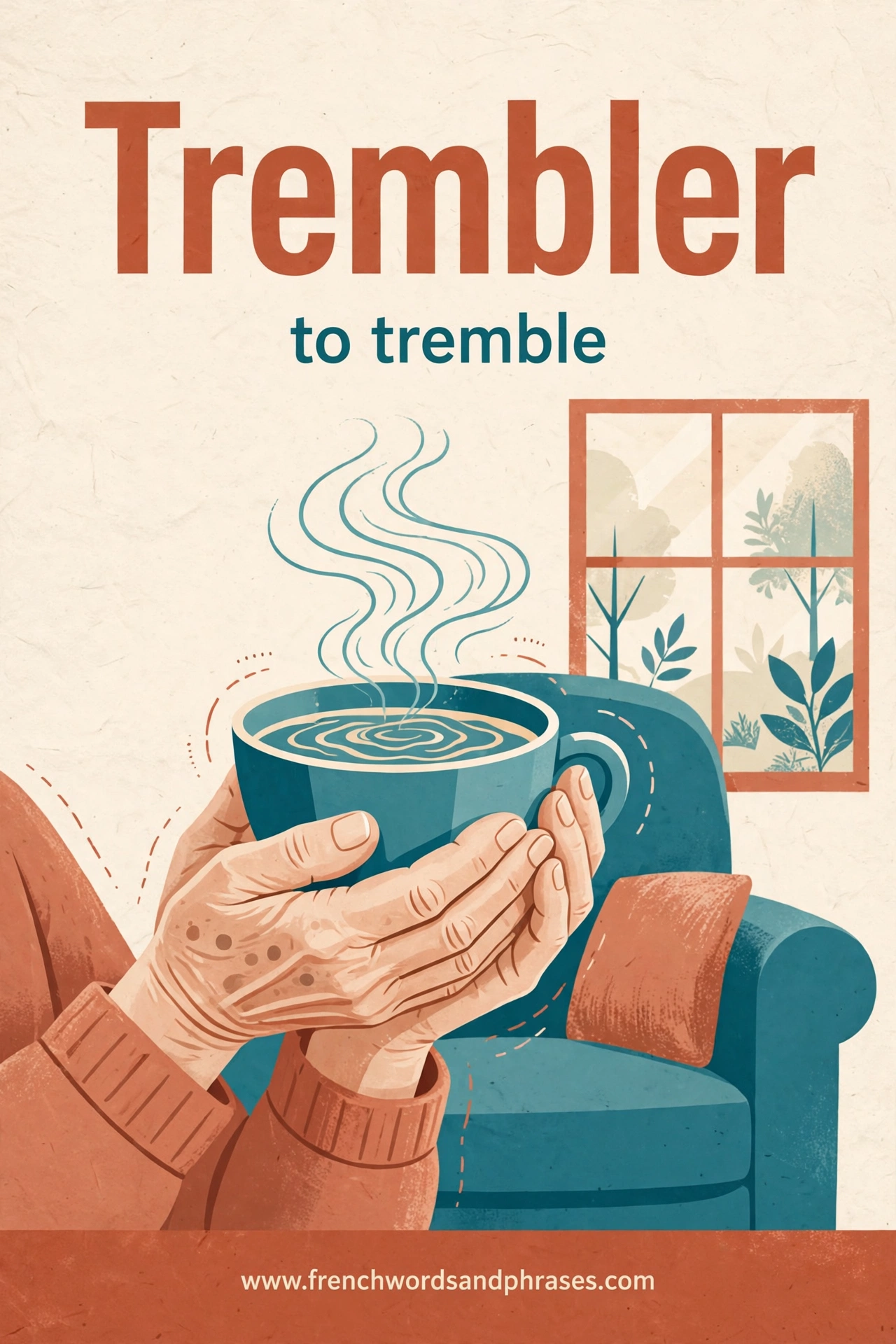
Trembler means to tremble — to shake with cold, fear, age or emotion, the way hands, voices, leaves and even the ground can shake.
Cold fingers that cannot hold a key, a voice that shakes on the first note, the floor moving softly under your feet in the night — trembler is the verb of everything that shakes without being asked: bodies, voices, buildings and the earth itself.
In this guide, you’ll learn how to conjugate trembler in all the major French tenses and moods. Explore complete conjugation tables, French examples, English translations, and practice quizzes.
Understanding the French Verb Trembler
Trembler is a regular French verb belonging to the first group of verbs, those ending in -er.
It means to tremble. It is commonly used for shivering with cold, shaking with fear or nerves, voices and hands that will not stay steady, leaves in the wind, and the ground itself in an earthquake — la terre a tremblé is the standard headline.
Verb classification: First group (-er)
Auxiliary verb: Avoir
Past participle: tremblé
Present participle: tremblant
English equivalents: To tremble, to shake, to shiver; trembler de froid — to shiver with cold; trembler de peur — to tremble with fear; trembler pour quelqu’un — to fear for someone; la terre tremble — the ground shakes; faire trembler — to make something shake.
One important detail: trembler is a perfectly regular -er verb — je tremble, nous tremblons, je tremblais — and its grammar lives in its preposition. What shakes you goes with de: trembler de froid, de peur, de joie, de colère. Who you are afraid for goes with pour: elle tremble pour son fils — she fears for her son, she is not shaking him. And before a clause it takes the subjunctive: je tremble qu’il ne tombe, I tremble at the thought he might fall.
Experience the Word
Trembler is the verb of the body telling the truth — cold, fear and joy all speak through it before words do.
Imagine a singer backstage at her first concert. Her hands tremble so much she cannot fasten her bracelet; her knees tremble; backstage, someone whispers that even the great ones tremblent before the curtain. Then the lights go down, the first note comes out steady — and the trembling turns into music.
The fear has not gone anywhere. It has simply tremblé — shaken through her, and passed into the song.
How to Conjugate Trembler: Complete French Conjugation Guide
Let’s explore every major conjugation of trembler, beginning with the indicative mood.
How to Conjugate Trembler in the Indicative Mood
The indicative mood is used to express facts, observations, actions, and events.
How to Conjugate Trembler in the Present Tense (Présent)
Used for actions happening now, habitual actions, and general truths.
| Subject | Conjugation |
|---|---|
| je | tremble |
| tu | trembles |
| il / elle | tremble |
| nous | tremblons |
| vous | tremblez |
| ils / elles | tremblent |
Example
Elle tremble de froid sur le quai de la gare.
She is shivering with cold on the station platform.
Quick Quiz 1
Complete the sentence:
Nous ______ de froid sans chauffage.
Reveal the answer
tremblons
Nous tremblons de froid sans chauffage.
We shiver with cold without heating.
How to Conjugate Trembler in the Passé Composé
Used for completed actions in the past. Trembler takes the auxiliary verb avoir.
| Subject | Conjugation |
|---|---|
| j’ | ai tremblé |
| tu | as tremblé |
| il / elle | a tremblé |
| nous | avons tremblé |
| vous | avez tremblé |
| ils / elles | ont tremblé |
Example
La terre a tremblé cette nuit dans toute la région.
The ground shook last night across the whole region.
How to Conjugate Trembler in the Imparfait (Imperfect Tense)
Used for habitual past actions, descriptions, and ongoing situations in the past.
| Subject | Conjugation |
|---|---|
| je | tremblais |
| tu | tremblais |
| il / elle | tremblait |
| nous | tremblions |
| vous | trembliez |
| ils / elles | tremblaient |
Example
Ses mains tremblaient quand il ouvrait l’enveloppe.
His hands were trembling as he opened the envelope.
Quick Quiz 2
Choose the correct form:
The ground shook last night.
La terre ______ cette nuit. (a tremblé / est tremblée)
Reveal the answer
a tremblé
La terre a tremblé cette nuit.
Trembler takes avoir, even for earthquakes.
How to Conjugate Trembler in the Plus-que-parfait
Used to describe an action that had already been completed before another past event.
| Subject | Conjugation |
|---|---|
| j’ | avais tremblé |
| tu | avais tremblé |
| il / elle | avait tremblé |
| nous | avions tremblé |
| vous | aviez tremblé |
| ils / elles | avaient tremblé |
Example
Il avait tremblé pour ses enfants pendant tout l’orage.
He had feared for his children throughout the storm.
How to Conjugate Trembler in the Passé Simple
Primarily used in formal writing, literature, and historical narratives. It is rarely used in everyday conversation.
| Subject | Conjugation |
|---|---|
| je | tremblai |
| tu | tremblas |
| il / elle | trembla |
| nous | tremblâmes |
| vous | tremblâtes |
| ils / elles | tremblèrent |
Example
À cette annonce, toute la salle trembla.
At that announcement, the whole hall shook.
How to Conjugate Trembler in the Passé Antérieur
A literary tense used to express an action completed immediately before another past action, generally in the passé simple.
| Subject | Conjugation |
|---|---|
| j’ | eus tremblé |
| tu | eus tremblé |
| il / elle | eut tremblé |
| nous | eûmes tremblé |
| vous | eûtes tremblé |
| ils / elles | eurent tremblé |
Example
Quand le sol eut tremblé, les gens sortirent dans la rue.
When the ground had shaken, people came out into the street.
How to Conjugate Trembler in the Future Tense (Futur Simple)
Used to describe actions that will take place in the future.
| Subject | Conjugation |
|---|---|
| je | tremblerai |
| tu | trembleras |
| il / elle | tremblera |
| nous | tremblerons |
| vous | tremblerez |
| ils / elles | trembleront |
Example
Tu trembleras de peur devant ce film, je te préviens.
You will tremble with fear at this film, I warn you.
How to Conjugate Trembler in the Futur Antérieur (Future Perfect)
Used for an action that will have been completed before a particular point in the future.
| Subject | Conjugation |
|---|---|
| j’ | aurai tremblé |
| tu | auras tremblé |
| il / elle | aura tremblé |
| nous | aurons tremblé |
| vous | aurez tremblé |
| ils / elles | auront tremblé |
Example
Quand les résultats tomberont, vous aurez tremblé toute la semaine pour rien.
When the results come out, you will have worried all week for nothing.
How to Conjugate Trembler in the Near Future (Futur Proche)
Used to describe something that is going to happen soon. Formed with aller + infinitive.
| Subject | Conjugation |
|---|---|
| je | vais trembler |
| tu | vas trembler |
| il / elle | va trembler |
| nous | allons trembler |
| vous | allez trembler |
| ils / elles | vont trembler |
Example
Je vais trembler de froid si je reste dehors sans manteau.
I am going to shiver with cold if I stay outside without a coat.
How to Conjugate Trembler in the Conditional Mood
The conditional mood expresses what would happen under certain circumstances. It is also frequently used to make polite requests or express wishes.
How to Conjugate Trembler in the Present Conditional
| Subject | Conjugation |
|---|---|
| je | tremblerais |
| tu | tremblerais |
| il / elle | tremblerait |
| nous | tremblerions |
| vous | trembleriez |
| ils / elles | trembleraient |
Example
Sans chauffage, nous tremblerions de froid tout l’hiver.
Without heating, we would shiver with cold all winter.
How to Conjugate Trembler in the Past Conditional
| Subject | Conjugation |
|---|---|
| j’ | aurais tremblé |
| tu | aurais tremblé |
| il / elle | aurait tremblé |
| nous | aurions tremblé |
| vous | auriez tremblé |
| ils / elles | auraient tremblé |
Example
Elle aurait tremblé pour son fils si elle avait su le danger.
She would have feared for her son if she had known the danger.
Trembler in the Literary Past Conditional Form
This less common literary form uses the imperfect subjunctive of avoir.
| Subject | Conjugation |
|---|---|
| j’ | eusse tremblé |
| tu | eusses tremblé |
| il / elle | eût tremblé |
| nous | eussions tremblé |
| vous | eussiez tremblé |
| ils / elles | eussent tremblé |
Example
Il eût tremblé devant le juge malgré son innocence.
He would have trembled before the judge despite his innocence.
How to Conjugate Trembler in the Subjunctive Mood
The subjunctive is used to express wishes, emotions, doubts, necessity, and uncertainty. It frequently follows expressions such as il faut que (it is necessary that) or bien que (although).
How to Conjugate Trembler in the Present Subjunctive
| Subject | Conjugation |
|---|---|
| que je | tremble |
| que tu | trembles |
| qu’il / qu’elle | tremble |
| que nous | tremblions |
| que vous | trembliez |
| qu’ils / qu’elles | tremblent |
Example
Je crains que les enfants tremblent de froid dehors.
I am afraid the children are shivering with cold outside.
Quick Quiz 3
Complete the sentence using the subjunctive:
Je crains que vous ______ de froid.
Reveal the answer
trembliez
Je crains que vous trembliez de froid.
I am afraid you are shivering with cold.
How to Conjugate Trembler in the Imperfect Subjunctive
A literary tense, rarely encountered in modern spoken French.
| Subject | Conjugation |
|---|---|
| que je | tremblasse |
| que tu | tremblasses |
| qu’il / qu’elle | tremblât |
| que nous | tremblassions |
| que vous | tremblassiez |
| qu’ils / qu’elles | tremblassent |
Example
Elle serrait les poings pour que ses mains ne tremblassent pas devant le public.
She clenched her fists so that her hands would not tremble in front of the audience.
How to Conjugate Trembler in the Pluperfect Subjunctive
A literary construction used to express an action completed before another past action.
| Subject | Conjugation |
|---|---|
| que j’ | eusse tremblé |
| que tu | eusses tremblé |
| qu’il / qu’elle | eût tremblé |
| que nous | eussions tremblé |
| que vous | eussiez tremblé |
| qu’ils / qu’elles | eussent tremblé |
Example
On racontait que la tour eût tremblé sous le vent d’hiver.
People told how the tower had shaken in the winter wind.
How to Conjugate Trembler in the Past Subjunctive
| Subject | Conjugation |
|---|---|
| que j’ | aie tremblé |
| que tu | aies tremblé |
| qu’il / qu’elle | ait tremblé |
| que nous | ayons tremblé |
| que vous | ayez tremblé |
| qu’ils / qu’elles | aient tremblé |
Example
Je suis désolé que vous ayez tremblé de peur pour rien.
I am sorry you trembled with fear for nothing.
How to Conjugate Trembler in the Imperative
The imperative is used to give commands, instructions, invitations, or suggestions. Subject pronouns are omitted.
How to Conjugate Trembler in the Present Imperative
| Person | Conjugation |
|---|---|
| (tu) | tremble |
| (nous) | tremblons |
| (vous) | tremblez |
Example
Ne tremble plus, le danger est passé !
Do not tremble any more, the danger is over!
Quick Quiz 4
How would you say Do not tremble (tu form)?
Reveal the answer
Ne tremble pas !
French Participles of Trembler
Participles are verb forms that can be used in compound tenses and other grammatical constructions.
Present Participle of Trembler
tremblant
En tremblant de joie, elle a annoncé la nouvelle à tout le monde.
Trembling with joy, she announced the news to everyone.
Past Participle of Trembler
tremblé
Après avoir tremblé de froid toute la nuit, le campeur a bu un café brûlant.
After shivering with cold all night, the camper drank a scalding coffee.
Trembler in Everyday French: Real-Life Examples
Now that you know the conjugations, let’s see how trembler appears in everyday French.
Example 1 — Present
Elle tremble de froid sur le quai.
She is shivering with cold on the platform.
Example 2 — Passé composé
La terre a tremblé cette nuit.
The ground shook last night.
Example 3 — Imparfait
Ses mains tremblaient d’émotion.
His hands were trembling with emotion.
Example 4 — Future
Vous tremblerez de peur devant ce film.
You will tremble with fear at this film.
Example 5 — Conditional
Nous tremblerions de froid sans chauffage.
We would shiver with cold without heating.
Example 6 — Imperative
Ne tremblez pas, tout est fini !
Do not tremble, it is all over!
Beyond Translation: The Meaning of Trembler
English splits this shaking between tremble, shake, shiver and quake; French trembler covers the whole family in one verb, from a leaf to an earthquake.
De for the cause, pour for the person.
That one small contrast — trembler de peur, to shake with fear; trembler pour son fils, to fear for one’s son — is the difference between shaking yourself and shaking for someone you love.
How to Remember the French Verb Trembler
Remember it this way: Trembler is about everything that shakes — hands, voices, leaves and the ground itself.
- Trembler de + the cause: de froid, de peur, de joie — what shakes you.
- Trembler pour + the person: to fear for someone — elle tremble pour son fils.
- Regular -er with avoir: je tremble, nous tremblons, la terre a tremblé.
The key idea is everything that shakes — hands, voices, leaves and the ground itself.
Test Your Knowledge of Trembler
Let’s see how much you’ve learned. Try answering these questions before revealing the answers.
Question 1
How do you say to shiver with cold in French?
Reveal the answer
Trembler de froid.
Question 2
How do you say She is shivering with cold in French?
Reveal the answer
Elle tremble de froid.
Question 3
Translate: The ground shook last night.
Reveal the answer
La terre a tremblé cette nuit.
Question 4
What is the past participle of trembler?
Reveal the answer
Tremblé.
Question 5
Complete the sentence:
Je crains que les enfants ______ de froid dehors.
Reveal the answer
tremblent
Je crains que les enfants tremblent de froid dehors.
I am afraid the children are shivering with cold outside.
Your Final Challenge
Can You Use It?
How would you say this in French?
She is shivering with cold on the platform, but the train is finally arriving.
Reveal the answer
Elle tremble de froid sur le quai, mais le train arrive enfin.
She is shivering with cold on the platform, but the train is finally arriving.
A little French. A little curiosity. A richer everyday life.
LEARN FRENCH ONE WORD AT A TIME