A French Word to Live By
How to Conjugate Trémater in French
/tʁe.ma.te/
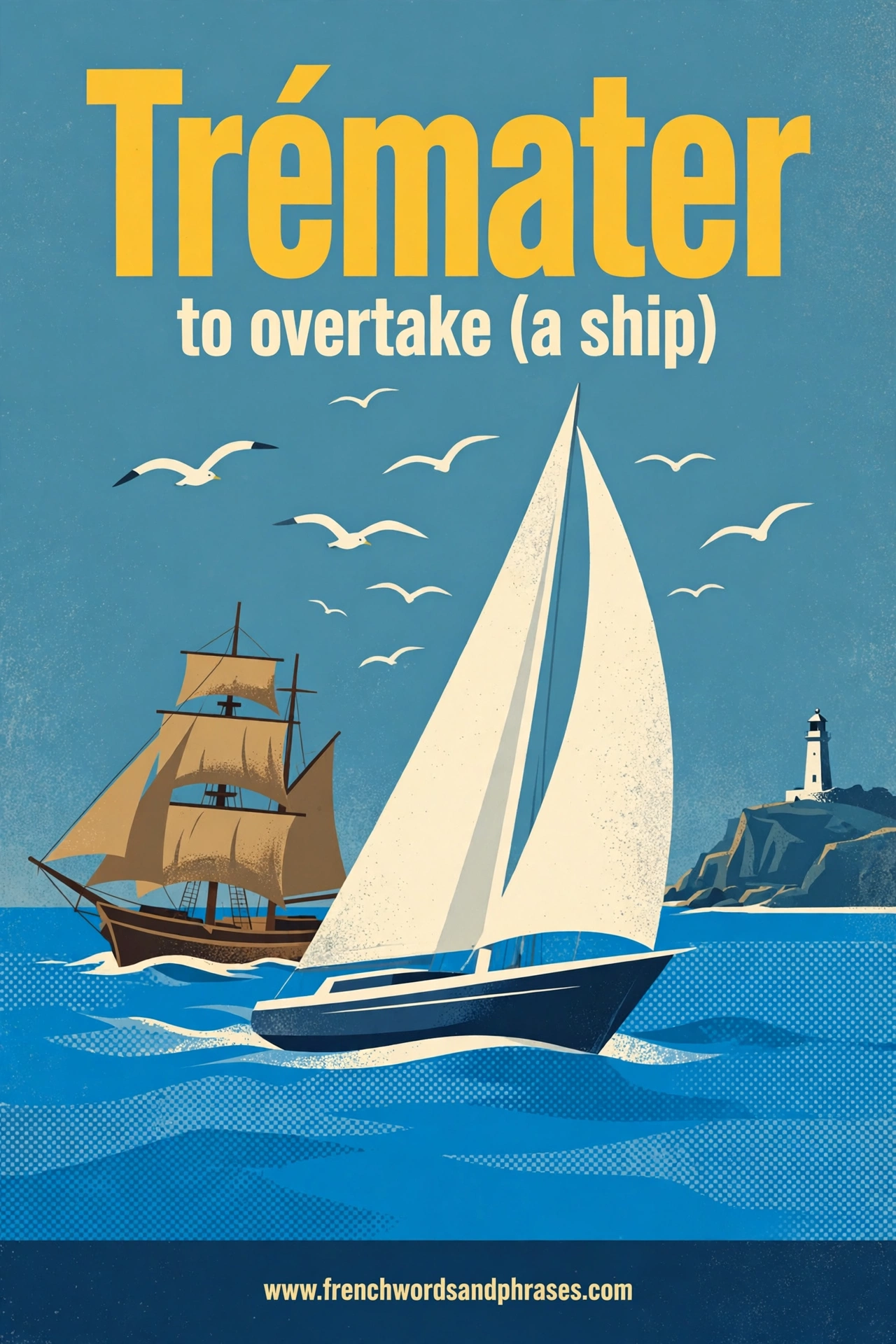
Trémater means to overtake a ship — to come up from behind another vessel at sea and pass it.
Two sails on the same course, one slowly eating up the other’s wind until it slides past — trémater is a sailor’s verb, known in harbours and sea stories, for the quiet duel of one ship overtaking another on the open water.
In this guide, you’ll learn how to conjugate trémater in all the major French tenses and moods. Explore complete conjugation tables, French examples, English translations, and practice quizzes.
Understanding the French Verb Trémater
Trémater is a regular French verb belonging to the first group of verbs, those ending in -er.
It means to overtake (a ship). It is commonly used in sailing and maritime writing when one vessel passes another — in race reports, logbooks and sea fiction — and hardly anywhere else, which is exactly its charm.
Verb classification: First group (-er)
Auxiliary verb: Avoir
Past participle: trématé
Present participle: trématant
English equivalents: To overtake, to pass (another vessel at sea); trémater un navire — to overtake a ship; être trématé — to be overtaken; on land, French says dépasser or doubler.
One important detail: trémater is a perfectly regular -er verb — je trémate, nous trématons, je trématais — and the é never changes, because the syllable after it is fully sounded. What is special is not its shape but its address: it lives at sea. On roads and in towns French overtakes with dépasser or doubler; trémater belongs to sailing reports, harbour talk and old sea novels, and using it on land would raise a smile.
Experience the Word
Trémater is the verb of the slow victory at sea — no horn, no flashing lights, just better canvas and patience.
Imagine a regatta off Brittany. For an hour the two yachts have run side by side, a cable’s length apart. Then the younger crew trims one sail by a hand’s breadth, the boat finds a whisper more speed — and slowly, beautifully, elle trémate her rival before the buoy.
Nothing dramatic has happened. One ship has simply trématé the other — overtaken her, sail by sail.
How to Conjugate Trémater: Complete French Conjugation Guide
Let’s explore every major conjugation of trémater, beginning with the indicative mood.
How to Conjugate Trémater in the Indicative Mood
The indicative mood is used to express facts, observations, actions, and events.
How to Conjugate Trémater in the Present Tense (Présent)
Used for actions happening now, habitual actions, and general truths.
| Subject | Conjugation |
|---|---|
| je | trémate |
| tu | trémates |
| il / elle | trémate |
| nous | trématons |
| vous | trématez |
| ils / elles | trématent |
Example
Le voilier trémate lentement le cargo près de la bouée.
The yacht slowly overtakes the cargo ship near the buoy.
Quick Quiz 1
Complete the sentence:
Nous ______ la flottille entière.
Reveal the answer
trématons
Nous trématons la flottille entière.
We overtake the whole flotilla.
How to Conjugate Trémater in the Passé Composé
Used for completed actions in the past. Trémater takes the auxiliary verb avoir.
| Subject | Conjugation |
|---|---|
| j’ | ai trématé |
| tu | as trématé |
| il / elle | a trématé |
| nous | avons trématé |
| vous | avez trématé |
| ils / elles | ont trématé |
Example
Notre ferry a trématé trois voiliers avant d’entrer au port.
Our ferry overtook three yachts before entering harbour.
How to Conjugate Trémater in the Imparfait (Imperfect Tense)
Used for habitual past actions, descriptions, and ongoing situations in the past.
| Subject | Conjugation |
|---|---|
| je | trématais |
| tu | trématais |
| il / elle | trématait |
| nous | trémations |
| vous | trématiez |
| ils / elles | trémataient |
Example
Par vent arrière, le clipper trématait tous les navires de la flotte.
Running before the wind, the clipper used to overtake every ship in the fleet.
Quick Quiz 2
Choose the correct form:
The ferry overtook the yacht.
Le ferry ______ le voilier. (a trématé / est trématé)
Reveal the answer
a trématé
Le ferry a trématé le voilier.
Trémater takes avoir.
How to Conjugate Trémater in the Plus-que-parfait
Used to describe an action that had already been completed before another past event.
| Subject | Conjugation |
|---|---|
| j’ | avais trématé |
| tu | avais trématé |
| il / elle | avait trématé |
| nous | avions trématé |
| vous | aviez trématé |
| ils / elles | avaient trématé |
Example
Il avait trématé le patrouilleur bien avant la nuit.
He had overtaken the patrol boat well before nightfall.
How to Conjugate Trémater in the Passé Simple
Primarily used in formal writing, literature, and historical narratives. It is rarely used in everyday conversation.
| Subject | Conjugation |
|---|---|
| je | trématai |
| tu | trématas |
| il / elle | trémata |
| nous | trématâmes |
| vous | trématâtes |
| ils / elles | trématèrent |
Example
Le trois-mâts trémata le brick au large des Açores.
The three-master overtook the brig off the Azores.
How to Conjugate Trémater in the Passé Antérieur
A literary tense used to express an action completed immediately before another past action, generally in the passé simple.
| Subject | Conjugation |
|---|---|
| j’ | eus trématé |
| tu | eus trématé |
| il / elle | eut trématé |
| nous | eûmes trématé |
| vous | eûtes trématé |
| ils / elles | eurent trématé |
Example
Quand il eut trématé le chalutier, il mit le cap sur Brest.
When he had overtaken the trawler, he set course for Brest.
How to Conjugate Trémater in the Future Tense (Futur Simple)
Used to describe actions that will take place in the future.
| Subject | Conjugation |
|---|---|
| je | trématerai |
| tu | trémateras |
| il / elle | trématera |
| nous | trématerons |
| vous | trématerez |
| ils / elles | trémateront |
Example
Demain, le paquebot trématera le remorqueur à la sortie du port.
Tomorrow, the liner will overtake the tug on the way out of harbour.
How to Conjugate Trémater in the Futur Antérieur (Future Perfect)
Used for an action that will have been completed before a particular point in the future.
| Subject | Conjugation |
|---|---|
| j’ | aurai trématé |
| tu | auras trématé |
| il / elle | aura trématé |
| nous | aurons trématé |
| vous | aurez trématé |
| ils / elles | auront trématé |
Example
À midi, nous aurons trématé toute la flottille.
By noon, we will have overtaken the whole flotilla.
How to Conjugate Trémater in the Near Future (Futur Proche)
Used to describe something that is going to happen soon. Formed with aller + infinitive.
| Subject | Conjugation |
|---|---|
| je | vais trémater |
| tu | vas trémater |
| il / elle | va trémater |
| nous | allons trémater |
| vous | allez trémater |
| ils / elles | vont trémater |
Example
Le yacht va trémater le ferry d’un moment à l’autre.
The yacht is going to overtake the ferry any moment now.
How to Conjugate Trémater in the Conditional Mood
The conditional mood expresses what would happen under certain circumstances. It is also frequently used to make polite requests or express wishes.
How to Conjugate Trémater in the Present Conditional
| Subject | Conjugation |
|---|---|
| je | trématerais |
| tu | trématerais |
| il / elle | trématerait |
| nous | trématerions |
| vous | trémateriez |
| ils / elles | trémateraient |
Example
Avec un peu plus de voile, tu trématerais ce catamaran.
With a little more sail, you would overtake that catamaran.
How to Conjugate Trémater in the Past Conditional
| Subject | Conjugation |
|---|---|
| j’ | aurais trématé |
| tu | aurais trématé |
| il / elle | aurait trématé |
| nous | aurions trématé |
| vous | auriez trématé |
| ils / elles | auraient trématé |
Example
Il aurait trématé le cargo si le vent n’était pas tombé.
He would have overtaken the cargo ship if the wind had not dropped.
Trémater in the Literary Past Conditional Form
This less common literary form uses the imperfect subjunctive of avoir.
| Subject | Conjugation |
|---|---|
| j’ | eusse trématé |
| tu | eusses trématé |
| il / elle | eût trématé |
| nous | eussions trématé |
| vous | eussiez trématé |
| ils / elles | eussent trématé |
Example
La frégate eût trématé l’escadre entière avant la tempête.
The frigate would have overtaken the whole squadron before the storm.
How to Conjugate Trémater in the Subjunctive Mood
The subjunctive is used to express wishes, emotions, doubts, necessity, and uncertainty. It frequently follows expressions such as il faut que (it is necessary that) or bien que (although).
How to Conjugate Trémater in the Present Subjunctive
| Subject | Conjugation |
|---|---|
| que je | trémate |
| que tu | trémates |
| qu’il / qu’elle | trémate |
| que nous | trémations |
| que vous | trématiez |
| qu’ils / qu’elles | trématent |
Example
Il faut que le voilier trémate le tanker avant le chenal.
The yacht must overtake the tanker before the channel.
Quick Quiz 3
Complete the sentence using the subjunctive:
Il faut que le voilier ______ le tanker.
Reveal the answer
trémate
Il faut que le voilier trémate le tanker.
The yacht must overtake the tanker.
How to Conjugate Trémater in the Imperfect Subjunctive
A literary tense, rarely encountered in modern spoken French.
| Subject | Conjugation |
|---|---|
| que je | trématasse |
| que tu | trématasses |
| qu’il / qu’elle | trématât |
| que nous | trématassions |
| que vous | trématassiez |
| qu’ils / qu’elles | trématassent |
Example
Le capitaine voulait que son navire trématât le concurrent.
The captain wanted his ship to overtake the rival.
How to Conjugate Trémater in the Pluperfect Subjunctive
A literary construction used to express an action completed before another past action.
| Subject | Conjugation |
|---|---|
| que j’ | eusse trématé |
| que tu | eusses trématé |
| qu’il / qu’elle | eût trématé |
| que nous | eussions trématé |
| que vous | eussiez trématé |
| qu’ils / qu’elles | eussent trématé |
Example
On racontait qu’ils eussent trématé la goélette au large.
People told how they had overtaken the schooner out at sea.
How to Conjugate Trémater in the Past Subjunctive
| Subject | Conjugation |
|---|---|
| que j’ | aie trématé |
| que tu | aies trématé |
| qu’il / qu’elle | ait trématé |
| que nous | ayons trématé |
| que vous | ayez trématé |
| qu’ils / qu’elles | aient trématé |
Example
Je suis fier que notre équipage ait trématé le favori.
I am proud that our crew overtook the favourite.
How to Conjugate Trémater in the Imperative
The imperative is used to give commands, instructions, invitations, or suggestions. Subject pronouns are omitted.
How to Conjugate Trémater in the Present Imperative
| Person | Conjugation |
|---|---|
| (tu) | trémate |
| (nous) | trématons |
| (vous) | trématez |
Example
Trémate ce voilier, mais garde tes distances !
Overtake that yacht, but keep your distance!
Quick Quiz 4
How would you say Overtake that yacht (tu form)?
Reveal the answer
Trémate ce voilier !
French Participles of Trémater
Participles are verb forms that can be used in compound tenses and other grammatical constructions.
Present Participle of Trémater
trématant
En trématant le cargo, il faut surveiller son sillage.
When overtaking the cargo ship, you must watch out for its wash.
Past Participle of Trémater
trématé
Trématé par le ferry, le petit voilier a changé de cap.
Overtaken by the ferry, the little yacht changed course.
Trémater in Everyday French: Real-Life Examples
Now that you know the conjugations, let’s see how trémater appears in everyday French.
Example 1 — Present
Le voilier trémate le cargo près de la bouée.
The yacht overtakes the cargo ship near the buoy.
Example 2 — Passé composé
Notre ferry a trématé trois voiliers ce matin.
Our ferry overtook three yachts this morning.
Example 3 — Imparfait
Le clipper trématait tous les navires par vent arrière.
The clipper used to overtake every ship running before the wind.
Example 4 — Future
Le paquebot trématera le remorqueur demain.
The liner will overtake the tug tomorrow.
Example 5 — Conditional
Tu trématerais ce catamaran avec plus de voile.
You would overtake that catamaran with more sail.
Example 6 — Imperative
Trémate ce voilier, mais garde tes distances !
Overtake that yacht, but keep your distance!
Beyond Translation: The Meaning of Trémater
English overtakes everything with one flat verb — cars, boats, runners, rumours; French keeps a specialist in reserve: trémater is for ships only, and it carries the smell of tar and salt water with it.
A verb with sea legs.
You will not meet it in a café or an office, but in a harbour town it is still the precise word for one sail passing another — precision is what sea language is for.
How to Remember the French Verb Trémater
Remember it this way: Trémater is about one ship slowly passing another at sea — the sailor’s word for overtaking.
- Trémater is nautical only: ships overtake with trémater, cars with dépasser or doubler.
- Perfectly regular -er, and the é never changes: je trémate, nous trématons.
- Picture two sails on one course: the faster one trémate the slower, sail by sail.
The key idea is one ship slowly passing another at sea — the sailor’s word for overtaking.
Test Your Knowledge of Trémater
Let’s see how much you’ve learned. Try answering these questions before revealing the answers.
Question 1
How do you say to overtake a ship in French?
Reveal the answer
Trémater un navire.
Question 2
How do you say The yacht overtakes the cargo ship in French?
Reveal the answer
Le voilier trémate le cargo.
Question 3
Translate: Our ferry overtook three yachts this morning.
Reveal the answer
Notre ferry a trématé trois voiliers ce matin.
Question 4
What is the past participle of trémater?
Reveal the answer
Trématé.
Question 5
Complete the sentence:
Il faut que le voilier ______ le tanker avant le chenal.
Reveal the answer
trémate
Il faut que le voilier trémate le tanker avant le chenal.
The yacht must overtake the tanker before the channel.
Your Final Challenge
Can You Use It?
How would you say this in French?
The yacht slowly overtakes the cargo ship, sail by sail, before the buoy.
Reveal the answer
Le voilier trémate le cargo lentement, voile après voile, avant la bouée.
The yacht slowly overtakes the cargo ship, sail by sail, before the buoy.
A little French. A little curiosity. A richer everyday life.
LEARN FRENCH ONE WORD AT A TIME