
A French Word to Live By
How to Conjugate Transsuder in French
/tʁɑ̃.sy.de/
Transsuder means to ooze through — to seep slowly through a surface, drop by drop.
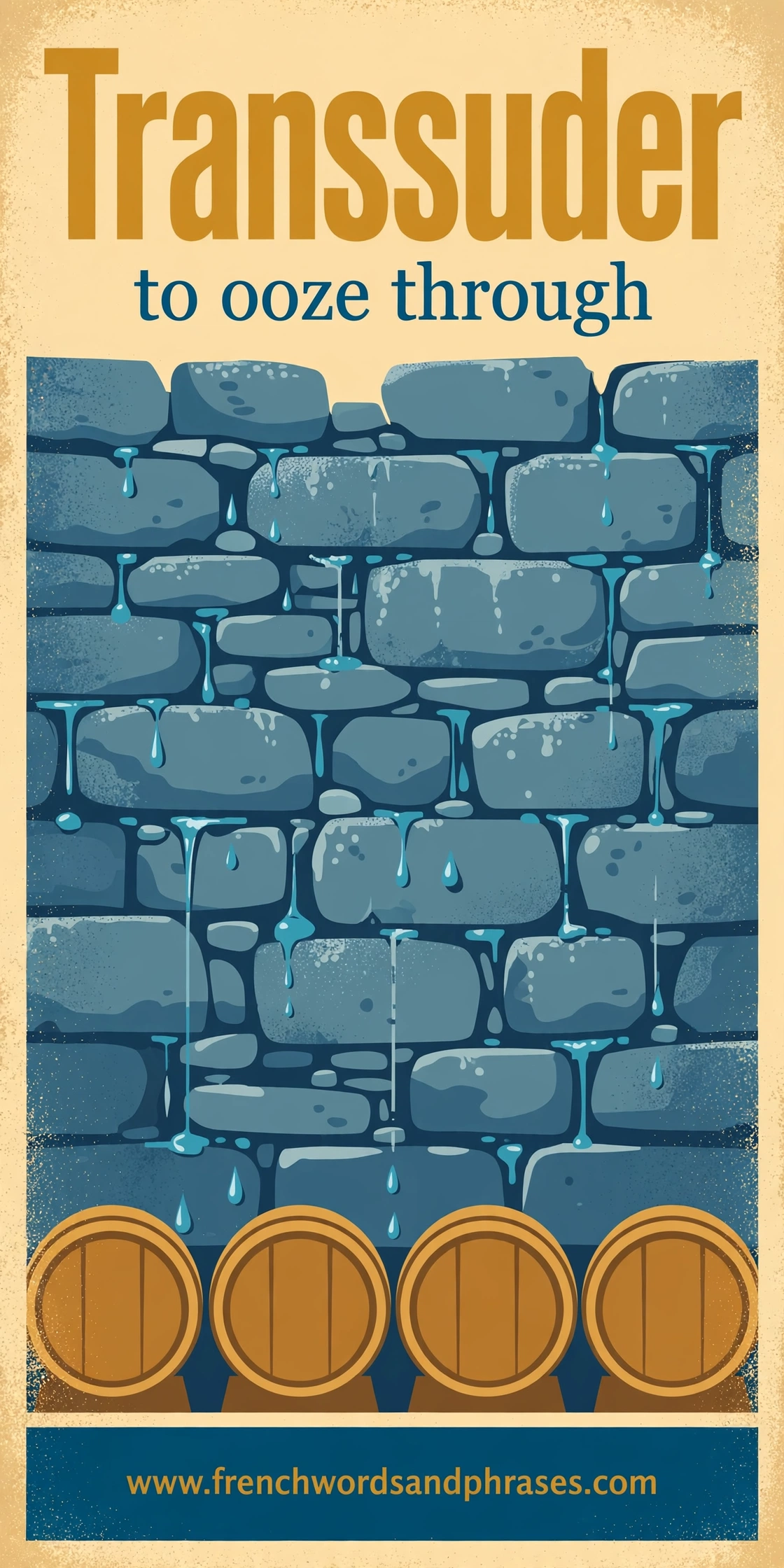
Down in the old cellar, a dark stain spreads across the stone wall, bead by bead, as damp finds its way through centuries of rock — transsuder is the verb of slow seeping, of liquid oozing through whatever tried to hold it back.
In this guide, you’ll learn how to conjugate transsuder in all the major French tenses and moods. Explore complete conjugation tables, French examples, English translations, and practice quizzes.
Understanding the French Verb Transsuder
Transsuder is a regular French verb belonging to the first group of verbs, those ending in -er.
It means to ooze through. It is commonly used for damp seeping through walls and ceilings, for sap and resin oozing through wood, for oil sweating through machinery, and figuratively for emotions — boredom, contempt, anxiety — that seep through someone’s words or manner despite their efforts to hide them.
Verb classification: First group (-er)
Auxiliary verb: Avoir
Past participle: transsudé
Present participle: transsudant
English equivalents: To ooze through, to seep through; l’humidité transsude — damp is oozing through; la résine transsude du bois — resin oozes from the wood; une angoisse qui transsude — an anxiety that seeps through.
One important detail: transsuder is written with a double s, because the prefix trans- meets the verb suder, an old cousin of suer (to sweat). Both s’s survive: transsuder, never with one. What sweats through is usually slow and unwelcome — damp through a wall, oil through an engine joint, resin through pine — and French loves the figurative use too: feelings transsudent through a voice, a letter, a silence.
Experience the Word
Transsuder is the verb of the slow leak — nothing bursts, everything seeps.
Imagine a stone farmhouse after a week of rain. Nothing drips, nothing flows, yet the cellar wall darkens a little more each day: the water is transsudant, finding the pores of the stone, patient as time itself.
No flood, no drama. It has simply oozed through — transsudé — drop by invisible drop.
How to Conjugate Transsuder: Complete French Conjugation Guide
Let’s explore every major conjugation of transsuder, beginning with the indicative mood.
How to Conjugate Transsuder in the Indicative Mood
The indicative mood is used to express facts, observations, actions, and events.
How to Conjugate Transsuder in the Present Tense (Présent)
Used for actions happening now, habitual actions, and general truths.
| Subject | Conjugation |
|---|---|
| je | transsude |
| tu | transsudes |
| il / elle | transsude |
| nous | transsudons |
| vous | transsudez |
| ils / elles | transsudent |
Example
L’humidité transsude à travers le mur de la cave.
Damp oozes through the cellar wall.
Quick Quiz 1
Complete the sentence:
L’humidité ______ à travers le mur de la cave.
Reveal the answer
transsude
L’humidité transsude à travers le mur de la cave.
Damp oozes through the cellar wall.
How to Conjugate Transsuder in the Passé Composé
Used for completed actions in the past. Transsuder takes the auxiliary verb avoir.
| Subject | Conjugation |
|---|---|
| j’ | ai transsudé |
| tu | as transsudé |
| il / elle | a transsudé |
| nous | avons transsudé |
| vous | avez transsudé |
| ils / elles | ont transsudé |
Example
La résine a transsudé à travers les planches du tonneau.
The resin oozed through the boards of the barrel.
How to Conjugate Transsuder in the Imparfait (Imperfect Tense)
Used for habitual past actions, descriptions, and ongoing situations in the past.
| Subject | Conjugation |
|---|---|
| je | transsudais |
| tu | transsudais |
| il / elle | transsudait |
| nous | transsudions |
| vous | transsudiez |
| ils / elles | transsudaient |
Example
Une odeur de moisi transsudait des vieilles pierres.
A smell of mould used to seep through the old stones.
Quick Quiz 2
Choose the correct form:
The resin oozed through the boards.
La résine ______ à travers les planches. (a transsudé / est transsudée)
Reveal the answer
a transsudé
La résine a transsudé à travers les planches.
Transsuder takes avoir.
How to Conjugate Transsuder in the Plus-que-parfait
Used to describe an action that had already been completed before another past event.
| Subject | Conjugation |
|---|---|
| j’ | avais transsudé |
| tu | avais transsudé |
| il / elle | avait transsudé |
| nous | avions transsudé |
| vous | aviez transsudé |
| ils / elles | avaient transsudé |
Example
L’eau avait transsudé partout avant les travaux.
The water had oozed through everywhere before the repairs.
How to Conjugate Transsuder in the Passé Simple
Primarily used in formal writing, literature, and historical narratives. It is rarely used in everyday conversation.
| Subject | Conjugation |
|---|---|
| je | transsudai |
| tu | transsudas |
| il / elle | transsuda |
| nous | transsudâmes |
| vous | transsudâtes |
| ils / elles | transsudèrent |
Example
Le goudron transsuda lentement sous le soleil d’août.
The tar oozed slowly under the August sun.
How to Conjugate Transsuder in the Passé Antérieur
A literary tense used to express an action completed immediately before another past action, generally in the passé simple.
| Subject | Conjugation |
|---|---|
| j’ | eus transsudé |
| tu | eus transsudé |
| il / elle | eut transsudé |
| nous | eûmes transsudé |
| vous | eûtes transsudé |
| ils / elles | eurent transsudé |
Example
Quand la sueur eut transsudé à travers sa chemise, il s’arrêta enfin.
When the sweat had soaked through his shirt, he finally stopped.
How to Conjugate Transsuder in the Future Tense (Futur Simple)
Used to describe actions that will take place in the future.
| Subject | Conjugation |
|---|---|
| je | transsuderai |
| tu | transsuderas |
| il / elle | transsudera |
| nous | transsuderons |
| vous | transsuderez |
| ils / elles | transsuderont |
Example
Sans traitement, l’humidité transsudera encore cet hiver.
Without treatment, the damp will ooze through again this winter.
How to Conjugate Transsuder in the Futur Antérieur (Future Perfect)
Used for an action that will have been completed before a particular point in the future.
| Subject | Conjugation |
|---|---|
| j’ | aurai transsudé |
| tu | auras transsudé |
| il / elle | aura transsudé |
| nous | aurons transsudé |
| vous | aurez transsudé |
| ils / elles | auront transsudé |
Example
Au printemps, l’eau aura transsudé dans tout le mur.
By spring, the water will have oozed through the whole wall.
How to Conjugate Transsuder in the Near Future (Futur Proche)
Used to describe something that is going to happen soon. Formed with aller + infinitive.
| Subject | Conjugation |
|---|---|
| je | vais transsuder |
| tu | vas transsuder |
| il / elle | va transsuder |
| nous | allons transsuder |
| vous | allez transsuder |
| ils / elles | vont transsuder |
Example
Regarde : l’huile va transsuder par ce joint.
Look: the oil is going to seep through this joint.
How to Conjugate Transsuder in the Conditional Mood
The conditional mood expresses what would happen under certain circumstances. It is also frequently used to make polite requests or express wishes.
How to Conjugate Transsuder in the Present Conditional
| Subject | Conjugation |
|---|---|
| je | transsuderais |
| tu | transsuderais |
| il / elle | transsuderait |
| nous | transsuderions |
| vous | transsuderiez |
| ils / elles | transsuderaient |
Example
Avec un meilleur enduit, rien ne transsuderait plus.
With a better coating, nothing would seep through any more.
How to Conjugate Transsuder in the Past Conditional
| Subject | Conjugation |
|---|---|
| j’ | aurais transsudé |
| tu | aurais transsudé |
| il / elle | aurait transsudé |
| nous | aurions transsudé |
| vous | auriez transsudé |
| ils / elles | auraient transsudé |
Example
La peinture aurait transsudé si le bois avait été vert.
The paint would have oozed through if the wood had been unseasoned.
Transsuder in the Literary Past Conditional Form
This less common literary form uses the imperfect subjunctive of avoir.
| Subject | Conjugation |
|---|---|
| j’ | eusse transsudé |
| tu | eusses transsudé |
| il / elle | eût transsudé |
| nous | eussions transsudé |
| vous | eussiez transsudé |
| ils / elles | eussent transsudé |
Example
Le sang eût transsudé à travers le bandage.
The blood would have oozed through the bandage.
How to Conjugate Transsuder in the Subjunctive Mood
The subjunctive is used to express wishes, emotions, doubts, necessity, and uncertainty. It frequently follows expressions such as il faut que (it is necessary that) or bien que (although).
How to Conjugate Transsuder in the Present Subjunctive
| Subject | Conjugation |
|---|---|
| que je | transsude |
| que tu | transsudes |
| qu’il / qu’elle | transsude |
| que nous | transsudions |
| que vous | transsudiez |
| qu’ils / qu’elles | transsudent |
Example
Il est possible que l’humidité transsude encore derrière le plâtre.
It is possible that damp is still oozing behind the plaster.
Quick Quiz 3
Complete the sentence using the subjunctive:
Il est possible que l’eau ______ dans la réserve.
Reveal the answer
transsude
Il est possible que l’eau transsude dans la réserve.
It is possible that the water is oozing into the storeroom.
How to Conjugate Transsuder in the Imperfect Subjunctive
A literary tense, rarely encountered in modern spoken French.
| Subject | Conjugation |
|---|---|
| que je | transsudasse |
| que tu | transsudasses |
| qu’il / qu’elle | transsudât |
| que nous | transsudassions |
| que vous | transsudassiez |
| qu’ils / qu’elles | transsudassent |
Example
On craignait que l’eau transsudât dans la réserve.
They feared the water might seep into the storeroom.
How to Conjugate Transsuder in the Pluperfect Subjunctive
A literary construction used to express an action completed before another past action.
| Subject | Conjugation |
|---|---|
| que j’ | eusse transsudé |
| que tu | eusses transsudé |
| qu’il / qu’elle | eût transsudé |
| que nous | eussions transsudé |
| que vous | eussiez transsudé |
| qu’ils / qu’elles | eussent transsudé |
Example
Bien qu’elle eût transsudé partout, la cave restait utilisable.
Although it had oozed everywhere, the cellar remained usable.
How to Conjugate Transsuder in the Past Subjunctive
| Subject | Conjugation |
|---|---|
| que j’ | aie transsudé |
| que tu | aies transsudé |
| qu’il / qu’elle | ait transsudé |
| que nous | ayons transsudé |
| que vous | ayez transsudé |
| qu’ils / qu’elles | aient transsudé |
Example
Je suis surpris que la résine ait transsudé si vite.
I am surprised the resin oozed through so quickly.
How to Conjugate Transsuder in the Imperative
The imperative is used to give commands, instructions, invitations, or suggestions. Subject pronouns are omitted.
How to Conjugate Transsuder in the Present Imperative
| Person | Conjugation |
|---|---|
| (tu) | transsude |
| (nous) | transsudons |
| (vous) | transsudez |
Example
Transsude, vieille muraille, raconte-nous la pluie !
Ooze on, old wall, tell us about the rain!
Quick Quiz 4
How would you say Ooze on, old wall (tu form)?
Reveal the answer
Transsude, vieille muraille !
French Participles of Transsuder
Participles are verb forms that can be used in compound tenses and other grammatical constructions.
Present Participle of Transsuder
transsudant
En transsudant, l’humidité dessine des cartes sur le mur.
By oozing through, the damp draws maps on the wall.
Past Participle of Transsuder
transsudé
Transsudée goutte à goutte, l’eau a fini par tacher le plafond.
Having oozed through drop by drop, the water ended up staining the ceiling.
Transsuder in Everyday French: Real-Life Examples
Now that you know the conjugations, let’s see how transsuder appears in everyday French.
Example 1 — Present
L’humidité transsude à travers le mur.
Damp oozes through the wall.
Example 2 — Passé composé
La résine a transsudé à travers les planches.
The resin oozed through the boards.
Example 3 — Imparfait
Une odeur de moisi transsudait des pierres.
A smell of mould used to seep from the stones.
Example 4 — Future
L’eau transsudera encore cet hiver.
The water will ooze through again this winter.
Example 5 — Conditional
Rien ne transsuderait avec un bon enduit.
Nothing would seep through with a good coating.
Example 6 — Imperative
Transsude, vieille muraille, raconte-nous la pluie !
Ooze on, old wall, tell us about the rain!
Beyond Translation: The Meaning of Transsuder
English ooze and seep are plain working words; French transsuder adds the body to the picture — its root is sweat.
The wall is sweating.
That is why French writers reach for it when feelings leak out: le mépris transsude de ses paroles — the contempt sweats through his words, pore by pore, impossible to wipe away.
How to Remember the French Verb Transsuder
Remember it this way: Transsuder is about damp sweating slowly through an old stone wall.
- Trans- + suder (to sweat): transsuder is to sweat through — with a double s.
- L’humidité transsude — damp oozes through; feelings transsudent through a voice too.
- Regular -er: je transsude, nous transsudons, past participle transsudé.
The key idea is damp sweating slowly through an old stone wall.
Test Your Knowledge of Transsuder
Let’s see how much you’ve learned. Try answering these questions before revealing the answers.
Question 1
How do you say Damp is oozing through the wall in French?
Reveal the answer
L’humidité transsude à travers le mur.
Question 2
Why is transsuder written with two s letters?
Reveal the answer
Because trans- meets suder (to sweat) — both s’s survive.
Question 3
Translate: The resin oozed through the boards.
Reveal the answer
La résine a transsudé à travers les planches.
Question 4
What is the past participle of transsuder?
Reveal the answer
Transsudé.
Question 5
Complete the sentence:
Il est possible que l’humidité ______ encore derrière le plâtre.
Reveal the answer
transsude
Il est possible que l’humidité transsude encore derrière le plâtre.
It is possible that damp is still oozing behind the plaster.
Your Final Challenge
Can You Use It?
How would you say this in French?
All night long, the rain oozes through the old wall, drop by drop, silently.
Reveal the answer
Toute la nuit, la pluie transsude à travers le vieux mur, goutte à goutte, sans bruit.
All night long, the rain oozes through the old wall, drop by drop, silently.
A little French. A little curiosity. A richer everyday life.
LEARN FRENCH ONE WORD AT A TIME




