A French Word to Live By
How to Conjugate Transporter in French
/tʁɑ̃s.pɔʁ.te/
Transporter means to transport — to carry goods, people or feelings from one place to another.
Trucks crossing the country at dawn, a piano inching up a staircase, a piece of music carrying a whole audience out of itself — transporter is the verb of carrying: loads, wounded soldiers, furniture, and hearts.
In this guide, you’ll learn how to conjugate transporter in all the major French tenses and moods. Explore complete conjugation tables, French examples, English translations, and practice quizzes.
Understanding the French Verb Transporter
Transporter is a regular French verb belonging to the first group of verbs, those ending in -er.
It means to transport. It is commonly used for lorries, trains and aircraft carrying goods and passengers, for removal men moving furniture, for music and stories that carry listeners away, and in official French for judges, doctors and experts going in person to a scene.
Verb classification: First group (-er)
Auxiliary verb: Avoir
Past participle: transporté
Present participle: transportant
English equivalents: To transport, to carry, to move; transporter des marchandises — to carry goods; être transporté de joie — to be transported with joy; se transporter sur les lieux — to go in person to the scene (formal: of judges and officials); les transports — transport, haulage.
One important detail: transporter is a regular -er verb, trans- plus porter, to carry. Two treasures hide inside it. First, the feeling sense: être transporté de joie, transporté d’admiration — to be carried away, transported, by joy or admiration. Second, the reflexive: se transporter is the formal verb for an official going to a place in person — le juge s’est transporté sur les lieux, the judge went to the scene himself. Note that this reflexive, like all reflexives, takes être in compound tenses.
Experience the Word
Transporter is the verb of the load and the lift — everything it touches is somewhere else by the end of the sentence.
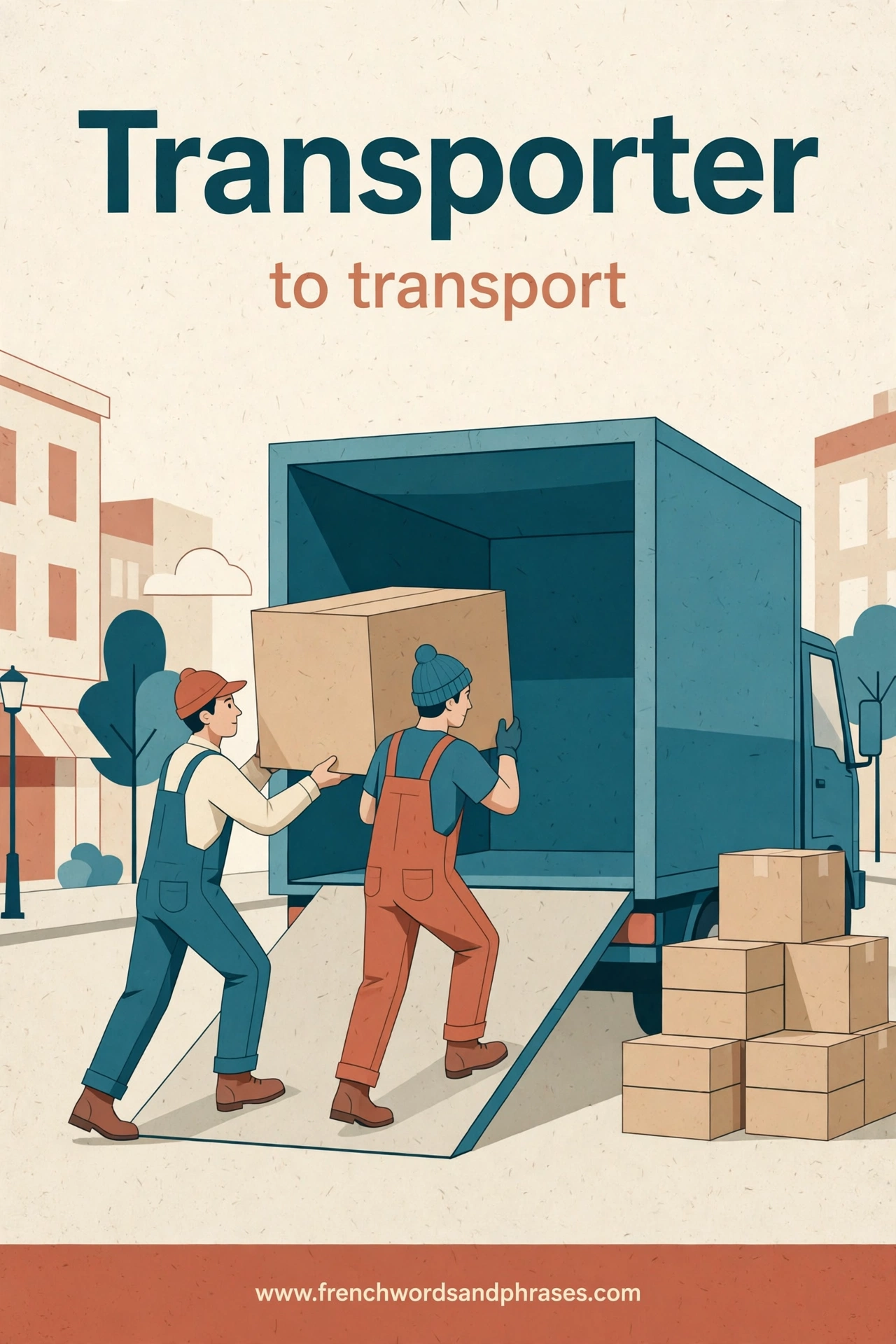
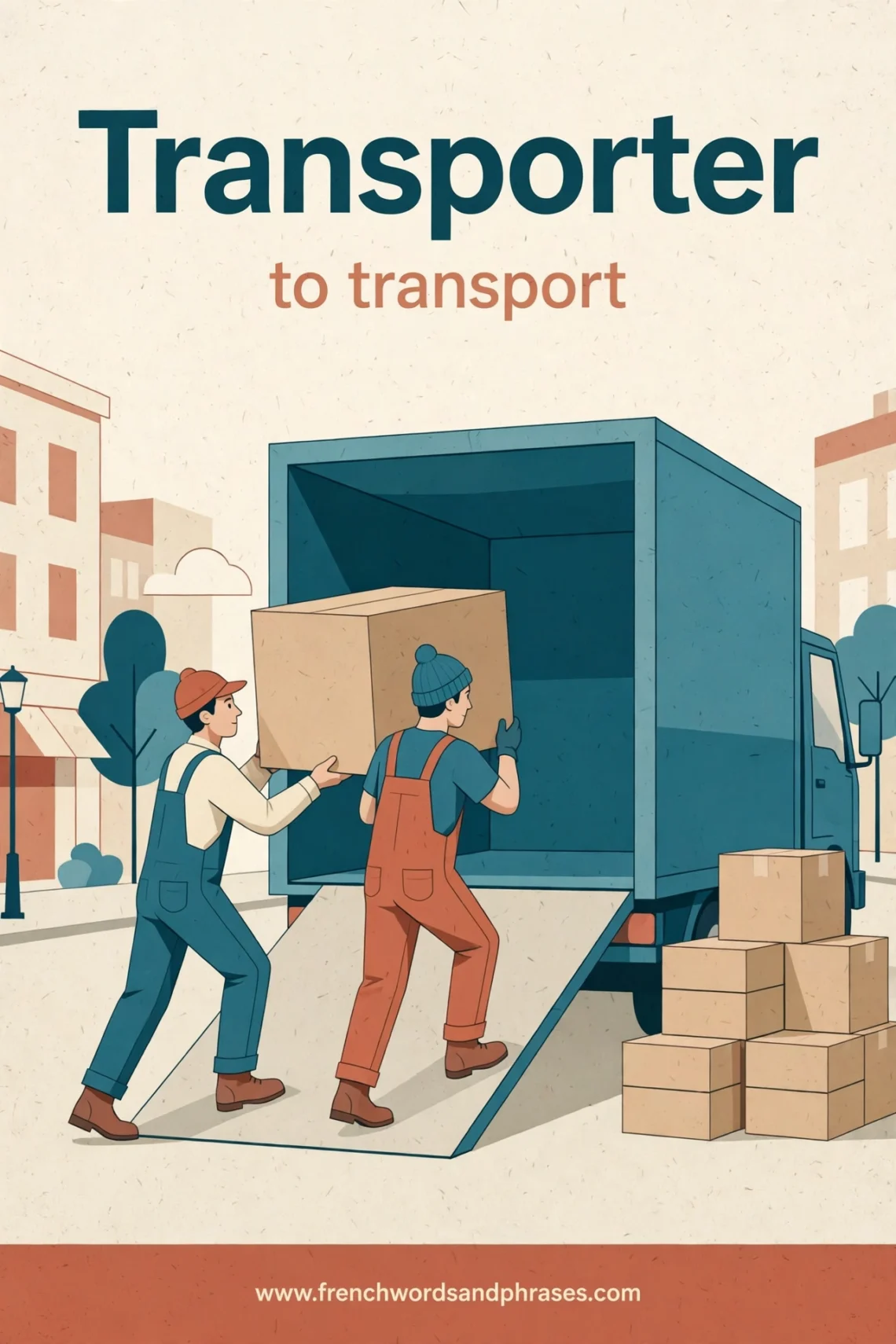
Imagine removal day in a Paris street. The piano comes down on straps, inch by inch, six floors of shouting and laughter, and at last it stands in the new salon by the window — transporté, scratched a little, triumphant.
The piano has changed rooms, streets, lives. It has been transporté — and so, a little, has everyone who carried it.
How to Conjugate Transporter: Complete French Conjugation Guide
Let’s explore every major conjugation of transporter, beginning with the indicative mood.
How to Conjugate Transporter in the Indicative Mood
The indicative mood is used to express facts, observations, actions, and events.
How to Conjugate Transporter in the Present Tense (Présent)
Used for actions happening now, habitual actions, and general truths.
| Subject | Conjugation |
|---|---|
| je | transporte |
| tu | transportes |
| il / elle | transporte |
| nous | transportons |
| vous | transportez |
| ils / elles | transportent |
Example
Ce camion transporte des fruits vers le nord.
This lorry transports fruit northwards.
Quick Quiz 1
Complete the sentence:
Nous ______ toutes les caisses à l’entrepôt.
Reveal the answer
transportons
Nous transportons toutes les caisses à l’entrepôt.
We transport all the crates to the warehouse.
How to Conjugate Transporter in the Passé Composé
Used for completed actions in the past. Transporter takes the auxiliary verb avoir.
| Subject | Conjugation |
|---|---|
| j’ | ai transporté |
| tu | as transporté |
| il / elle | a transporté |
| nous | avons transporté |
| vous | avez transporté |
| ils / elles | ont transporté |
Example
Ils ont transporté les meubles dans un camion loué.
They transported the furniture in a hired van.
How to Conjugate Transporter in the Imparfait (Imperfect Tense)
Used for habitual past actions, descriptions, and ongoing situations in the past.
| Subject | Conjugation |
|---|---|
| je | transportais |
| tu | transportais |
| il / elle | transportait |
| nous | transportions |
| vous | transportiez |
| ils / elles | transportaient |
Example
Autrefois, les péniches transportaient le charbon.
In the old days, barges used to carry the coal.
Quick Quiz 2
Choose the correct form:
They transported the furniture in a van.
Ils ______ les meubles dans un camion. (ont transporté / sont transportés)
Reveal the answer
ont transporté
Ils ont transporté les meubles dans un camion.
Transporter takes avoir.
How to Conjugate Transporter in the Plus-que-parfait
Used to describe an action that had already been completed before another past event.
| Subject | Conjugation |
|---|---|
| j’ | avais transporté |
| tu | avais transporté |
| il / elle | avait transporté |
| nous | avions transporté |
| vous | aviez transporté |
| ils / elles | avaient transporté |
Example
Elle avait transporté toutes ses affaires chez sa sœur.
She had moved all her things to her sister’s.
How to Conjugate Transporter in the Passé Simple
Primarily used in formal writing, literature, and historical narratives. It is rarely used in everyday conversation.
| Subject | Conjugation |
|---|---|
| je | transportai |
| tu | transportas |
| il / elle | transporta |
| nous | transportâmes |
| vous | transportâtes |
| ils / elles | transportèrent |
Example
Le fleuve transporta les troncs jusqu’à la scierie.
The river carried the logs down to the sawmill.
How to Conjugate Transporter in the Passé Antérieur
A literary tense used to express an action completed immediately before another past action, generally in the passé simple.
| Subject | Conjugation |
|---|---|
| j’ | eus transporté |
| tu | eus transporté |
| il / elle | eut transporté |
| nous | eûmes transporté |
| vous | eûtes transporté |
| ils / elles | eurent transporté |
Example
Quand ils eurent transporté le piano, la fête commença.
When they had moved the piano, the party began.
How to Conjugate Transporter in the Future Tense (Futur Simple)
Used to describe actions that will take place in the future.
| Subject | Conjugation |
|---|---|
| je | transporterai |
| tu | transporteras |
| il / elle | transportera |
| nous | transporterons |
| vous | transporterez |
| ils / elles | transporteront |
Example
Demain, un hélicoptère transportera les blessés.
Tomorrow, a helicopter will transport the injured.
How to Conjugate Transporter in the Futur Antérieur (Future Perfect)
Used for an action that will have been completed before a particular point in the future.
| Subject | Conjugation |
|---|---|
| j’ | aurai transporté |
| tu | auras transporté |
| il / elle | aura transporté |
| nous | aurons transporté |
| vous | aurez transporté |
| ils / elles | auront transporté |
Example
À midi, nous aurons transporté toutes les caisses à l’entrepôt.
By noon, we will have transported all the crates to the warehouse.
How to Conjugate Transporter in the Near Future (Futur Proche)
Used to describe something that is going to happen soon. Formed with aller + infinitive.
| Subject | Conjugation |
|---|---|
| je | vais transporter |
| tu | vas transporter |
| il / elle | va transporter |
| nous | allons transporter |
| vous | allez transporter |
| ils / elles | vont transporter |
Example
Je vais transporter ces cartons au grenier.
I am going to carry these boxes up to the attic.
How to Conjugate Transporter in the Conditional Mood
The conditional mood expresses what would happen under certain circumstances. It is also frequently used to make polite requests or express wishes.
How to Conjugate Transporter in the Present Conditional
| Subject | Conjugation |
|---|---|
| je | transporterais |
| tu | transporterais |
| il / elle | transporterait |
| nous | transporterions |
| vous | transporteriez |
| ils / elles | transporteraient |
Example
Avec un plus grand camion, on transporterait tout en un voyage.
With a bigger lorry, we would carry everything in one trip.
How to Conjugate Transporter in the Past Conditional
| Subject | Conjugation |
|---|---|
| j’ | aurais transporté |
| tu | aurais transporté |
| il / elle | aurait transporté |
| nous | aurions transporté |
| vous | auriez transporté |
| ils / elles | auraient transporté |
Example
Elle aurait transporté le piano si l’escalier avait été plus large.
She would have moved the piano if the staircase had been wider.
Transporter in the Literary Past Conditional Form
This less common literary form uses the imperfect subjunctive of avoir.
| Subject | Conjugation |
|---|---|
| j’ | eusse transporté |
| tu | eusses transporté |
| il / elle | eût transporté |
| nous | eussions transporté |
| vous | eussiez transporté |
| ils / elles | eussent transporté |
Example
Il eût transporté les blessés avant la nuit.
He would have transported the wounded before nightfall.
How to Conjugate Transporter in the Subjunctive Mood
The subjunctive is used to express wishes, emotions, doubts, necessity, and uncertainty. It frequently follows expressions such as il faut que (it is necessary that) or bien que (although).
How to Conjugate Transporter in the Present Subjunctive
| Subject | Conjugation |
|---|---|
| que je | transporte |
| que tu | transportes |
| qu’il / qu’elle | transporte |
| que nous | transportions |
| que vous | transportiez |
| qu’ils / qu’elles | transportent |
Example
Il faut que vous transportiez ces caisses avant vendredi.
You must transport these crates before Friday.
Quick Quiz 3
Complete the sentence using the subjunctive:
Il faut que vous ______ ces caisses avant vendredi.
Reveal the answer
transportiez
Il faut que vous transportiez ces caisses avant vendredi.
You must transport these crates before Friday.
How to Conjugate Transporter in the Imperfect Subjunctive
A literary tense, rarely encountered in modern spoken French.
| Subject | Conjugation |
|---|---|
| que je | transportasse |
| que tu | transportasses |
| qu’il / qu’elle | transportât |
| que nous | transportassions |
| que vous | transportassiez |
| qu’ils / qu’elles | transportassent |
Example
Le préfet ordonna que le juge se transportât sur les lieux.
The prefect ordered the judge to go in person to the scene.
How to Conjugate Transporter in the Pluperfect Subjunctive
A literary construction used to express an action completed before another past action.
| Subject | Conjugation |
|---|---|
| que j’ | eusse transporté |
| que tu | eusses transporté |
| qu’il / qu’elle | eût transporté |
| que nous | eussions transporté |
| que vous | eussiez transporté |
| qu’ils / qu’elles | eussent transporté |
Example
On racontait que cette musique les eût transportés de joie.
They told how this music had transported them with joy.
How to Conjugate Transporter in the Past Subjunctive
| Subject | Conjugation |
|---|---|
| que j’ | aie transporté |
| que tu | aies transporté |
| qu’il / qu’elle | ait transporté |
| que nous | ayons transporté |
| que vous | ayez transporté |
| qu’ils / qu’elles | aient transporté |
Example
Je suis ravi que ce récit t’ait transporté en Provence.
I am delighted this story transported you to Provence.
How to Conjugate Transporter in the Imperative
The imperative is used to give commands, instructions, invitations, or suggestions. Subject pronouns are omitted.
How to Conjugate Transporter in the Present Imperative
| Person | Conjugation |
|---|---|
| (tu) | transporte |
| (nous) | transportons |
| (vous) | transportez |
Example
Transporte ces cartons au grenier, s’il te plaît !
Carry these boxes up to the attic, please!
Quick Quiz 4
How would you say Transport these crates to the warehouse (vous form)?
Reveal the answer
Transportez ces caisses à l’entrepôt !
French Participles of Transporter
Participles are verb forms that can be used in compound tenses and other grammatical constructions.
Present Participle of Transporter
transportant
En transportant le piano, ils ont rayé le parquet.
While moving the piano, they scratched the floor.
Past Participle of Transporter
transporté
Transportée de joie, elle a couru annoncer la nouvelle.
Transported with joy, she ran to announce the news.
Transporter in Everyday French: Real-Life Examples
Now that you know the conjugations, let’s see how transporter appears in everyday French.
Example 1 — Present
Le train transporte cinq cents voyageurs.
The train carries five hundred passengers.
Example 2 — Passé composé
Nous avons transporté les cartons au grenier.
We carried the boxes up to the attic.
Example 3 — Imparfait
Les péniches transportaient le vin.
The barges used to carry the wine.
Example 4 — Future
Un camion transportera le piano demain.
A lorry will transport the piano tomorrow.
Example 5 — Conditional
Je transporterais tout en un seul voyage.
I would carry everything in a single trip.
Example 6 — Imperative
Transportez ces caisses à l’entrepôt !
Transport these crates to the warehouse!
Beyond Translation: The Meaning of Transporter
English transport still carries an echo of rapture — transports of joy — and French transporter never lost it.
The same verb loads the lorry and lifts the heart.
Crates are transportées to the warehouse, the wounded are transportés to hospital, a judge se transporte in person to the scene, and an audience sits transporté by the music: carrying, in French, is one idea from the dock to the concert hall.
How to Remember the French Verb Transporter
Remember it this way: Transporter is about carrying loads, furniture and hearts from one place to another.
- Trans- (across) + porter (to carry): transporter is carrying across.
- Être transporté de joie — to be transported with joy; the feeling sense is everywhere.
- Se transporter sur les lieux — the formal way to say an official went there in person (être in compounds).
The key idea is carrying loads, furniture and hearts from one place to another.
Test Your Knowledge of Transporter
Let’s see how much you’ve learned. Try answering these questions before revealing the answers.
Question 1
How do you say to be transported with joy in French?
Reveal the answer
Être transporté de joie.
Question 2
How do you say The judge went in person to the scene in French?
Reveal the answer
Le juge s’est transporté sur les lieux.
Question 3
Translate: We carried the boxes up to the attic.
Reveal the answer
Nous avons transporté les cartons au grenier.
Question 4
What is the past participle of transporter?
Reveal the answer
Transporté.
Question 5
Complete the sentence:
Il faut que vous ______ ces caisses avant vendredi.
Reveal the answer
transportiez
Il faut que vous transportiez ces caisses avant vendredi.
You must transport these crates before Friday.
Your Final Challenge
Can You Use It?
How would you say this in French?
The lorry transports the furniture to the new house, and the whole family follows, singing.
Reveal the answer
Le camion transporte les meubles vers la nouvelle maison, et toute la famille suit en chantant.
The lorry transports the furniture to the new house, and the whole family follows, singing.
A little French. A little curiosity. A richer everyday life.
LEARN FRENCH ONE WORD AT A TIME