
A French Word to Live By
How to Conjugate Transhumer in French
/tʁɑ̃.zy.me/
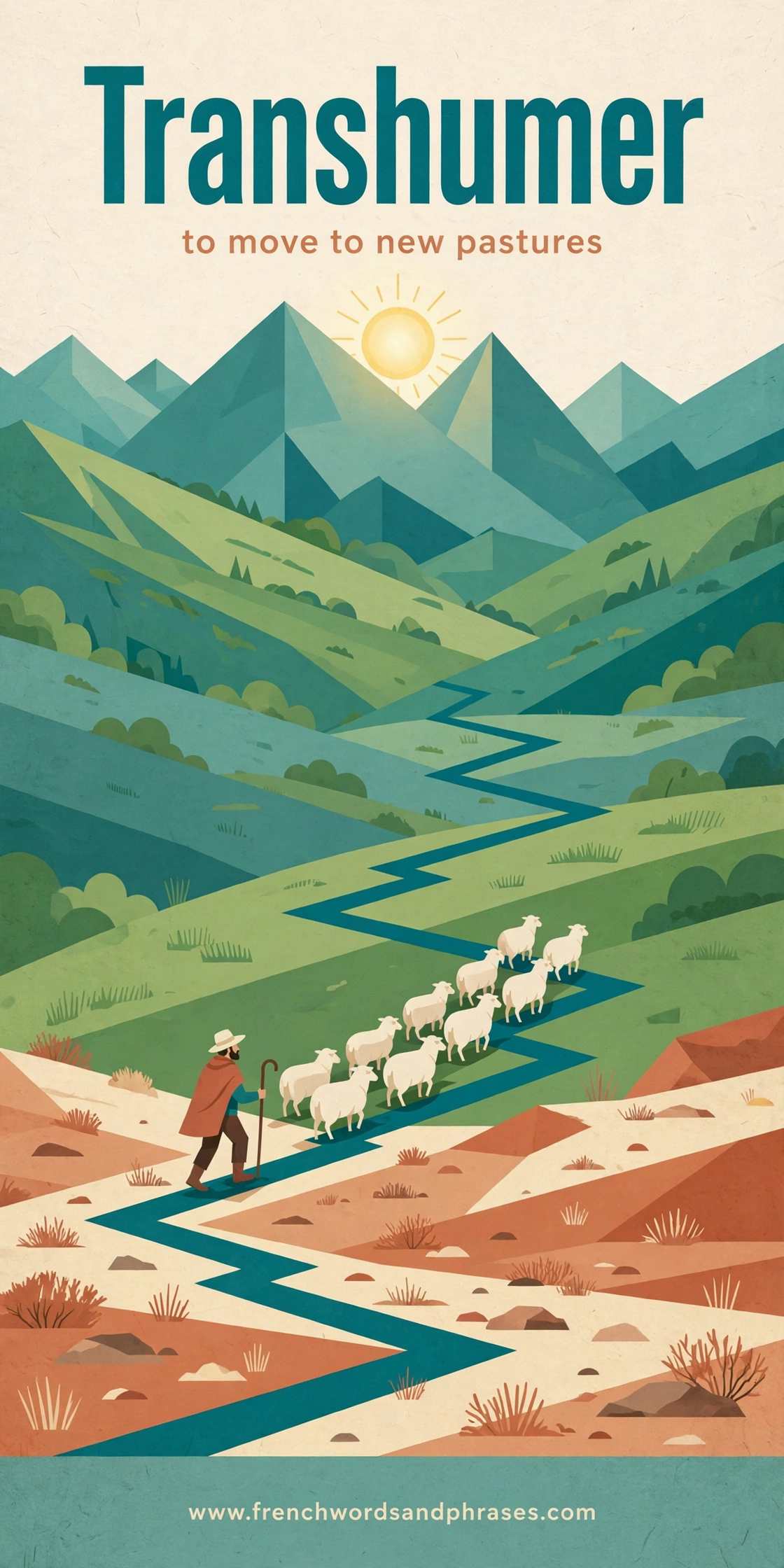
Transhumer means to move to new pastures — to lead the flocks up to the high mountain pastures for the summer, and to bring them down again when the cold returns.
Bells ringing through a dawn valley, hundreds of sheep on the road behind their shepherds, dogs working the edges of the flock — transhumer is the verb of the transhumance, the great seasonal journey of French flocks from the dry plains to the green heights, walked for a thousand years.
In this guide, you’ll learn how to conjugate transhumer in all the major French tenses and moods. Explore complete conjugation tables, French examples, English translations, and practice quizzes.
Understanding the French Verb Transhumer
Transhumer is a regular French verb belonging to the first group of verbs, those ending in -er.
It means to move to new pastures. It is commonly used in the Alps, the Pyrenees, Provence and the Causses for the spring climb to the high pastures — la montée à l’estive — and the autumn descent, la désalpe, when the flocks come back down to the plains before the snow.
Verb classification: First group (-er)
Auxiliary verb: Avoir
Past participle: transhumé
Present participle: transhumant
English equivalents: To move to new pastures, to practise transhumance; la transhumance — the seasonal migration of flocks; l’estive — the summer stay on the high pastures; la désalpe — the autumn descent; un berger — a shepherd.
One important detail: transhumer is a regular -er verb — je transhume, nous transhumons, past participle transhumé — and it works two ways: the flocks themselves transhument (les troupeaux transhument vers les alpages) and the shepherds transhument their animals (les bergers transhument leurs brebis). Its noun, la transhumance, names the whole tradition — a tradition so old and so alive that UNESCO has listed it as world heritage.
Experience the Word
Transhumer is the verb of the moving flock — a whole way of life that walks, twice a year, from one world to another.
Imagine a June morning in Provence. The plain is already dry and golden, but up in the mountains the grass is young and green. At dawn the village empties behind the flock: bells, bleating, dust on the road, and days of walking ahead. Le troupeau transhume — the flock is moving to its summer pastures, as it has every year since anyone can remember.
By October they will walk back down before the snow. For now, they have transhumé — moved to new pastures under the high sky.
How to Conjugate Transhumer: Complete French Conjugation Guide
Let’s explore every major conjugation of transhumer, beginning with the indicative mood.
How to Conjugate Transhumer in the Indicative Mood
The indicative mood is used to express facts, observations, actions, and events.
How to Conjugate Transhumer in the Present Tense (Présent)
Used for actions happening now, habitual actions, and general truths.
| Subject | Conjugation |
|---|---|
| je | transhume |
| tu | transhumes |
| il / elle | transhume |
| nous | transhumons |
| vous | transhumez |
| ils / elles | transhument |
Example
Au printemps, les troupeaux transhument vers les alpages.
In spring, the flocks move up to the high pastures.
Quick Quiz 1
Complete the sentence:
Nous ______ en juin avec trois cents brebis.
Reveal the answer
transhumons
Nous transhumons en juin avec trois cents brebis.
We move to new pastures in June with three hundred sheep.
How to Conjugate Transhumer in the Passé Composé
Used for completed actions in the past. Transhumer takes the auxiliary verb avoir.
| Subject | Conjugation |
|---|---|
| j’ | ai transhumé |
| tu | as transhumé |
| il / elle | a transhumé |
| nous | avons transhumé |
| vous | avez transhumé |
| ils / elles | ont transhumé |
Example
Les bergers ont transhumé leurs brebis jusqu’aux pâturages d’altitude.
The shepherds moved their sheep up to the high pastures.
How to Conjugate Transhumer in the Imparfait (Imperfect Tense)
Used for habitual past actions, descriptions, and ongoing situations in the past.
| Subject | Conjugation |
|---|---|
| je | transhumais |
| tu | transhumais |
| il / elle | transhumait |
| nous | transhumions |
| vous | transhumiez |
| ils / elles | transhumaient |
Example
Chaque année, le village transhumait avec toutes ses bêtes.
Every year, the village used to move to new pastures with all its animals.
Quick Quiz 2
Choose the correct form:
The shepherds moved their sheep up.
Les bergers ______ leurs brebis. (ont transhumé / sont transhumés)
Reveal the answer
ont transhumé
Les bergers ont transhumé leurs brebis.
Transhumer takes avoir.
How to Conjugate Transhumer in the Plus-que-parfait
Used to describe an action that had already been completed before another past event.
| Subject | Conjugation |
|---|---|
| j’ | avais transhumé |
| tu | avais transhumé |
| il / elle | avait transhumé |
| nous | avions transhumé |
| vous | aviez transhumé |
| ils / elles | avaient transhumé |
Example
Les troupeaux avaient transhumé avant les premières chaleurs.
The flocks had moved up before the first heat.
How to Conjugate Transhumer in the Passé Simple
Primarily used in formal writing, literature, and historical narratives. It is rarely used in everyday conversation.
| Subject | Conjugation |
|---|---|
| je | transhumai |
| tu | transhumas |
| il / elle | transhuma |
| nous | transhumâmes |
| vous | transhumâtes |
| ils / elles | transhumèrent |
Example
À l’aube, le berger transhuma son troupeau vers la montagne.
At dawn, the shepherd moved his flock towards the mountain.
How to Conjugate Transhumer in the Passé Antérieur
A literary tense used to express an action completed immediately before another past action, generally in the passé simple.
| Subject | Conjugation |
|---|---|
| j’ | eus transhumé |
| tu | eus transhumé |
| il / elle | eut transhumé |
| nous | eûmes transhumé |
| vous | eûtes transhumé |
| ils / elles | eurent transhumé |
Example
Quand les bergers eurent transhumé, le village devint silencieux.
When the shepherds had moved the flocks up, the village fell silent.
How to Conjugate Transhumer in the Future Tense (Futur Simple)
Used to describe actions that will take place in the future.
| Subject | Conjugation |
|---|---|
| je | transhumerai |
| tu | transhumeras |
| il / elle | transhumera |
| nous | transhumerons |
| vous | transhumerez |
| ils / elles | transhumeront |
Example
En juin, nous transhumerons avec trois cents brebis.
In June, we will move to new pastures with three hundred sheep.
How to Conjugate Transhumer in the Futur Antérieur (Future Perfect)
Used for an action that will have been completed before a particular point in the future.
| Subject | Conjugation |
|---|---|
| j’ | aurai transhumé |
| tu | auras transhumé |
| il / elle | aura transhumé |
| nous | aurons transhumé |
| vous | aurez transhumé |
| ils / elles | auront transhumé |
Example
À la mi-juin, tous les troupeaux auront transhumé.
By mid-June, all the flocks will have moved up.
How to Conjugate Transhumer in the Near Future (Futur Proche)
Used to describe something that is going to happen soon. Formed with aller + infinitive.
| Subject | Conjugation |
|---|---|
| je | vais transhumer |
| tu | vas transhumer |
| il / elle | va transhumer |
| nous | allons transhumer |
| vous | allez transhumer |
| ils / elles | vont transhumer |
Example
Le troupeau va transhumer dès la semaine prochaine.
The flock is going to move to new pastures next week.
How to Conjugate Transhumer in the Conditional Mood
The conditional mood expresses what would happen under certain circumstances. It is also frequently used to make polite requests or express wishes.
How to Conjugate Transhumer in the Present Conditional
| Subject | Conjugation |
|---|---|
| je | transhumerais |
| tu | transhumerais |
| il / elle | transhumerait |
| nous | transhumerions |
| vous | transhumeriez |
| ils / elles | transhumeraient |
Example
Sans la sécheresse, les bergers transhumeraient plus tard.
Without the drought, the shepherds would move up later.
How to Conjugate Transhumer in the Past Conditional
| Subject | Conjugation |
|---|---|
| j’ | aurais transhumé |
| tu | aurais transhumé |
| il / elle | aurait transhumé |
| nous | aurions transhumé |
| vous | auriez transhumé |
| ils / elles | auraient transhumé |
Example
Ils auraient transhumé plus tôt si la neige avait fondu.
They would have moved up earlier if the snow had melted.
Transhumer in the Literary Past Conditional Form
This less common literary form uses the imperfect subjunctive of avoir.
| Subject | Conjugation |
|---|---|
| j’ | eusse transhumé |
| tu | eusses transhumé |
| il / elle | eût transhumé |
| nous | eussions transhumé |
| vous | eussiez transhumé |
| ils / elles | eussent transhumé |
Example
Le berger eût transhumé avant la canicule.
The shepherd would have moved his flock up before the heatwave.
How to Conjugate Transhumer in the Subjunctive Mood
The subjunctive is used to express wishes, emotions, doubts, necessity, and uncertainty. It frequently follows expressions such as il faut que (it is necessary that) or bien que (although).
How to Conjugate Transhumer in the Present Subjunctive
| Subject | Conjugation |
|---|---|
| que je | transhume |
| que tu | transhumes |
| qu’il / qu’elle | transhume |
| que nous | transhumions |
| que vous | transhumiez |
| qu’ils / qu’elles | transhument |
Example
Il faut que les troupeaux transhument avant la chaleur.
The flocks must move up before the heat.
Quick Quiz 3
Complete the sentence using the subjunctive:
Il faut que les troupeaux ______ avant la chaleur.
Reveal the answer
transhument
Il faut que les troupeaux transhument avant la chaleur.
The flocks must move up before the heat.
How to Conjugate Transhumer in the Imperfect Subjunctive
A literary tense, rarely encountered in modern spoken French.
| Subject | Conjugation |
|---|---|
| que je | transhumasse |
| que tu | transhumasses |
| qu’il / qu’elle | transhumât |
| que nous | transhumassions |
| que vous | transhumassiez |
| qu’ils / qu’elles | transhumassent |
Example
La coutume voulait que chaque famille transhumât avec ses bêtes.
Custom demanded that each family move to new pastures with its animals.
How to Conjugate Transhumer in the Pluperfect Subjunctive
A literary construction used to express an action completed before another past action.
| Subject | Conjugation |
|---|---|
| que j’ | eusse transhumé |
| que tu | eusses transhumé |
| qu’il / qu’elle | eût transhumé |
| que nous | eussions transhumé |
| que vous | eussiez transhumé |
| qu’ils / qu’elles | eussent transhumé |
Example
Les anciens racontaient que leurs pères eussent transhumé à pied.
The old people told how their fathers had made the journey on foot.
How to Conjugate Transhumer in the Past Subjunctive
| Subject | Conjugation |
|---|---|
| que j’ | aie transhumé |
| que tu | aies transhumé |
| qu’il / qu’elle | ait transhumé |
| que nous | ayons transhumé |
| que vous | ayez transhumé |
| qu’ils / qu’elles | aient transhumé |
Example
Je suis heureux que le troupeau ait transhumé sans encombre.
I am glad the flock moved up without any trouble.
How to Conjugate Transhumer in the Imperative
The imperative is used to give commands, instructions, invitations, or suggestions. Subject pronouns are omitted.
How to Conjugate Transhumer in the Present Imperative
| Person | Conjugation |
|---|---|
| (tu) | transhume |
| (nous) | transhumons |
| (vous) | transhumez |
Example
Transhumez dès l’aube, avant la chaleur !
Move the flocks up at dawn, before the heat!
Quick Quiz 4
How would you say Move the flocks up at dawn (vous form)?
Reveal the answer
Transhumez dès l’aube !
French Participles of Transhumer
Participles are verb forms that can be used in compound tenses and other grammatical constructions.
Present Participle of Transhumer
transhumant
En transhumant, les brebis suivent les sentiers de leurs ancêtres.
As they move up, the sheep follow the paths of their ancestors.
Past Participle of Transhumer
transhumé
Transhumées vers les sommets, les brebis passent l’été au frais.
Moved up to the summits, the sheep spend the summer in the cool air.
Transhumer in Everyday French: Real-Life Examples
Now that you know the conjugations, let’s see how transhumer appears in everyday French.
Example 1 — Present
Les troupeaux transhument vers les alpages.
The flocks move up to the high pastures.
Example 2 — Passé composé
Les bergers ont transhumé leurs brebis.
The shepherds moved their sheep up.
Example 3 — Imparfait
Le village transhumait chaque année avec ses bêtes.
The village used to move up every year with its animals.
Example 4 — Future
Nous transhumerons en juin avec trois cents brebis.
We will move up in June with three hundred sheep.
Example 5 — Conditional
Les bergers transhumeraient plus tard sans la sécheresse.
The shepherds would move up later without the drought.
Example 6 — Imperative
Transhumez dès l’aube !
Move the flocks up at dawn!
Beyond Translation: The Meaning of Transhumer
English barely has this word — transhumance exists as a technical term, but no living verb for the shepherds’ journey. French transhumer is still walked, not just written.
A migration older than the roads it uses.
The flocks follow the drailles, the ancient drove roads of the south, and the journey is a festival as much as a chore — decorated sheep, bells, whole villages turning out. UNESCO inscribed the transhumance on its heritage lists, recognising a verb that is also a way of life.
How to Remember the French Verb Transhumer
Remember it this way: Transhumer is about bells and dust on the mountain road — the flock walking to its summer pastures.
- Transhumer is the shepherd’s verb: flocks move up to summer pastures and down again in autumn.
- La transhumance — the seasonal migration; l’estive — the summer stay up high; la désalpe — the descent.
- Regular -er: je transhume, nous transhumons, past participle transhumé.
The key idea is bells and dust on the mountain road — the flock walking to its summer pastures.
Test Your Knowledge of Transhumer
Let’s see how much you’ve learned. Try answering these questions before revealing the answers.
Question 1
What is la transhumance?
Reveal the answer
The seasonal migration of flocks — up to the high pastures in spring, down again in autumn.
Question 2
How do you say In spring, the flocks move up to the high pastures in French?
Reveal the answer
Au printemps, les troupeaux transhument vers les alpages.
Question 3
Translate: The shepherds moved their sheep up to the high pastures.
Reveal the answer
Les bergers ont transhumé leurs brebis jusqu’aux pâturages d’altitude.
Question 4
What is the past participle of transhumer?
Reveal the answer
Transhumé.
Question 5
Complete the sentence:
Il faut que les troupeaux ______ avant la chaleur.
Reveal the answer
transhument
Il faut que les troupeaux transhument avant la chaleur.
The flocks must move up before the heat.
Your Final Challenge
Can You Use It?
How would you say this in French?
At dawn, the flock moves up to the high pastures, and the bells wake the whole valley.
Reveal the answer
Au petit matin, le troupeau transhume vers les alpages, et les cloches réveillent toute la vallée.
At dawn, the flock moves up to the high pastures, and the bells wake the whole valley.
A little French. A little curiosity. A richer everyday life.
LEARN FRENCH ONE WORD AT A TIME




