
A French Word to Live By
How to Conjugate Tourniquer in French
/tuʁ.ni.ke/
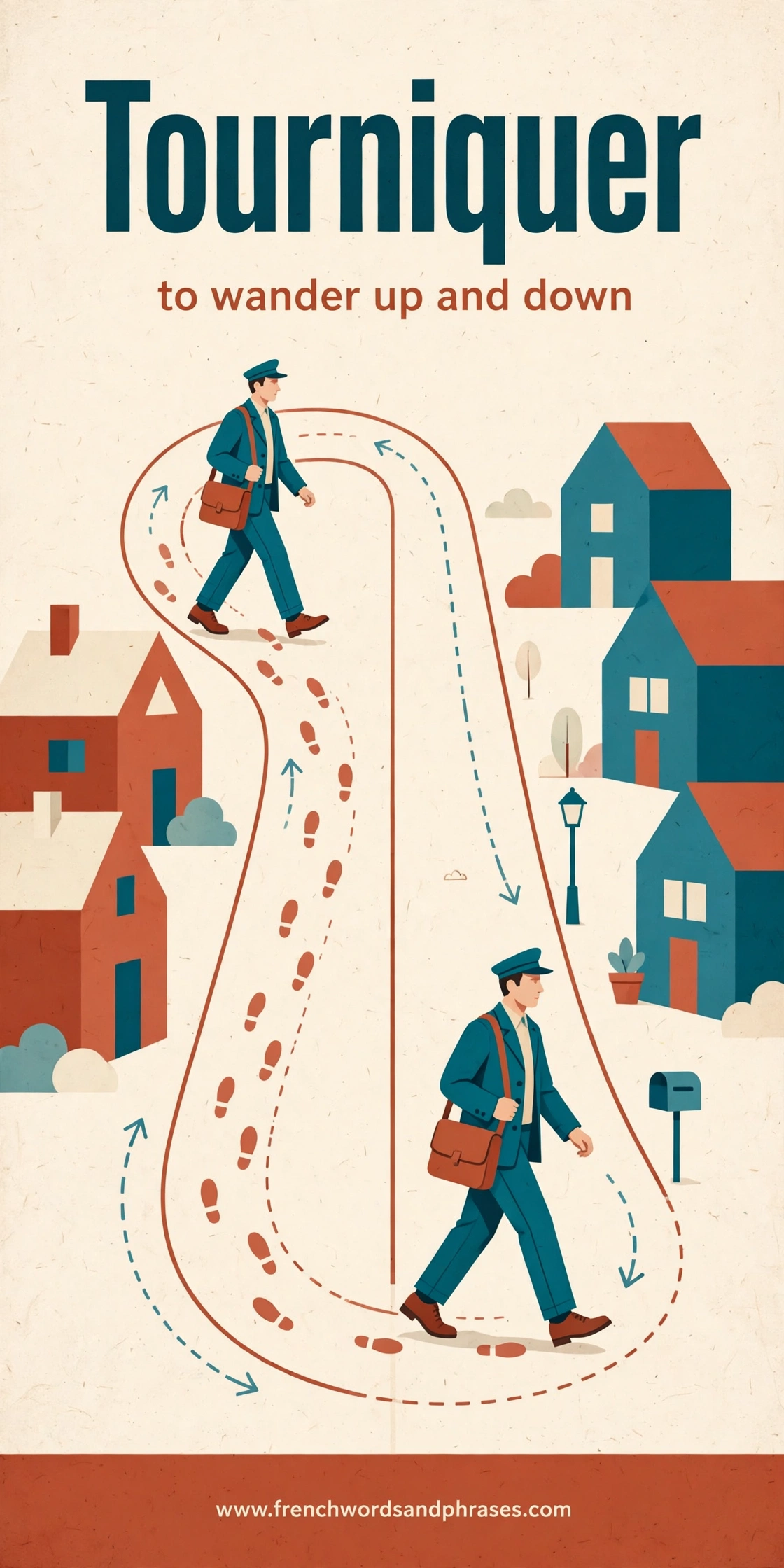
Tourniquer means to wander up and down — to twist and wind along, as a lane winds through hills or walkers wind along it.
A white lane leaves the village, bends left around a vineyard, right around a chapel, doubles back past a fountain it passed an hour ago. The lane itself is tourniquant — wandering up and down the hillside — and everyone who follows it wanders with it, one bend at a time.
In this guide, you’ll learn how to conjugate tourniquer in all the major French tenses and moods. Explore complete conjugation tables, French examples, English translations, and practice quizzes.
Understanding the French Verb Tourniquer
Tourniquer is a regular French verb belonging to the first group of verbs, those ending in -er.
It means to wander up and down. It is commonly used for paths, lanes and mountain roads that wind and twist, and for walkers wandering up and down along them — in villages, vineyards, old towns and hill country where no road runs straight.
Verb classification: First group (-er)
Auxiliary verb: Avoir
Past participle: tourniqué
Present participle: tourniquant
English equivalents: To wander up and down, to wind; un tourniquet — a turnstile; un lacet — a hairpin bend; tourniquer dans les collines — to wander up and down in the hills; un chemin qui tournique — a winding path.
One important detail: the qu of tourniquer keeps the hard /k/ sound everywhere — je tournique, nous tourniquons, tourniqué — the u is silent, there to guard the /k/. The verb shares its shape with un tourniquet, a turnstile: both come from tourner, to turn. Among the three cousins, tournicoter drifts from place to place and tourniller fidgets close to home, while tourniquer is the winding one — it describes the twisting route as happily as the walkers who follow it.
Experience the Word
Tourniquer belongs to the road as much as to the walker — the twisting is in the way itself.
Imagine two hikers above a Provençal valley at golden hour. The path tournique between olive trees and dry-stone walls, losing the view, finding it again doubled, never once hurrying in a straight line — and neither, happily, do they.
A straight road would have been quicker. But then nothing would have tourniqué — and the evening would have been poorer for it.
How to Conjugate Tourniquer: Complete French Conjugation Guide
Let’s explore every major conjugation of tourniquer, beginning with the indicative mood.
How to Conjugate Tourniquer in the Indicative Mood
The indicative mood is used to express facts, observations, actions, and events.
How to Conjugate Tourniquer in the Present Tense (Présent)
Used for actions happening now, habitual actions, and general truths.
| Subject | Conjugation |
|---|---|
| je | tournique |
| tu | tourniques |
| il / elle | tournique |
| nous | tourniquons |
| vous | tourniquez |
| ils / elles | tourniquent |
Example
Le sentier tournique entre les pins avant d’arriver au village.
The path winds between the pines before reaching the village.
Quick Quiz 1
Complete the sentence:
Le sentier ______ entre les pins.
Reveal the answer
tournique
Le sentier tournique entre les pins.
The path winds between the pines.
How to Conjugate Tourniquer in the Passé Composé
Used for completed actions in the past. Tourniquer takes the auxiliary verb avoir.
| Subject | Conjugation |
|---|---|
| j’ | ai tourniqué |
| tu | as tourniqué |
| il / elle | a tourniqué |
| nous | avons tourniqué |
| vous | avez tourniqué |
| ils / elles | ont tourniqué |
Example
Nous avons tourniqué toute la journée dans les collines.
We wandered up and down all day in the hills.
How to Conjugate Tourniquer in the Imparfait (Imperfect Tense)
Used for habitual past actions, descriptions, and ongoing situations in the past.
| Subject | Conjugation |
|---|---|
| je | tourniquais |
| tu | tourniquais |
| il / elle | tourniquait |
| nous | tourniquions |
| vous | tourniquiez |
| ils / elles | tourniquaient |
Example
La route tourniquait sans fin dans la montagne.
The road used to wind endlessly in the mountains.
Quick Quiz 2
Choose the correct form:
We wandered up and down in the hills.
Nous ______ dans les collines. (avons tourniqué / sommes tourniqués)
Reveal the answer
avons tourniqué
Nous avons tourniqué dans les collines.
Tourniquer takes avoir.
How to Conjugate Tourniquer in the Plus-que-parfait
Used to describe an action that had already been completed before another past event.
| Subject | Conjugation |
|---|---|
| j’ | avais tourniqué |
| tu | avais tourniqué |
| il / elle | avait tourniqué |
| nous | avions tourniqué |
| vous | aviez tourniqué |
| ils / elles | avaient tourniqué |
Example
Ils avaient tourniqué des heures avant de voir la mer.
They had wandered up and down for hours before seeing the sea.
How to Conjugate Tourniquer in the Passé Simple
Primarily used in formal writing, literature, and historical narratives. It is rarely used in everyday conversation.
| Subject | Conjugation |
|---|---|
| je | tourniquai |
| tu | tourniquas |
| il / elle | tourniqua |
| nous | tourniquâmes |
| vous | tourniquâtes |
| ils / elles | tourniquèrent |
Example
Le chemin tourniqua entre les vignes jusqu’au hameau.
The path wound between the vines as far as the hamlet.
How to Conjugate Tourniquer in the Passé Antérieur
A literary tense used to express an action completed immediately before another past action, generally in the passé simple.
| Subject | Conjugation |
|---|---|
| j’ | eus tourniqué |
| tu | eus tourniqué |
| il / elle | eut tourniqué |
| nous | eûmes tourniqué |
| vous | eûtes tourniqué |
| ils / elles | eurent tourniqué |
Example
Quand la route eut tourniqué une dernière fois, le village apparut.
When the road had wound one last time, the village appeared.
How to Conjugate Tourniquer in the Future Tense (Futur Simple)
Used to describe actions that will take place in the future.
| Subject | Conjugation |
|---|---|
| je | tourniquerai |
| tu | tourniqueras |
| il / elle | tourniquera |
| nous | tourniquerons |
| vous | tourniquerez |
| ils / elles | tourniqueront |
Example
Demain, nous tourniquerons dans les ruelles du vieux port.
Tomorrow, we will wander up and down in the lanes of the old port.
How to Conjugate Tourniquer in the Futur Antérieur (Future Perfect)
Used for an action that will have been completed before a particular point in the future.
| Subject | Conjugation |
|---|---|
| j’ | aurai tourniqué |
| tu | auras tourniqué |
| il / elle | aura tourniqué |
| nous | aurons tourniqué |
| vous | aurez tourniqué |
| ils / elles | auront tourniqué |
Example
À la tombée du jour, ils auront tourniqué dans toute la vallée.
By nightfall, they will have wandered all over the valley.
How to Conjugate Tourniquer in the Near Future (Futur Proche)
Used to describe something that is going to happen soon. Formed with aller + infinitive.
| Subject | Conjugation |
|---|---|
| je | vais tourniquer |
| tu | vas tourniquer |
| il / elle | va tourniquer |
| nous | allons tourniquer |
| vous | allez tourniquer |
| ils / elles | vont tourniquer |
Example
Ce sentier va tourniquer encore pendant des kilomètres.
This path is going to wind on for kilometres yet.
How to Conjugate Tourniquer in the Conditional Mood
The conditional mood expresses what would happen under certain circumstances. It is also frequently used to make polite requests or express wishes.
How to Conjugate Tourniquer in the Present Conditional
| Subject | Conjugation |
|---|---|
| je | tourniquerais |
| tu | tourniquerais |
| il / elle | tourniquerait |
| nous | tourniquerions |
| vous | tourniqueriez |
| ils / elles | tourniqueraient |
Example
Sans les lacets, la route tourniquerait moins.
Without the hairpins, the road would wind less.
How to Conjugate Tourniquer in the Past Conditional
| Subject | Conjugation |
|---|---|
| j’ | aurais tourniqué |
| tu | aurais tourniqué |
| il / elle | aurait tourniqué |
| nous | aurions tourniqué |
| vous | auriez tourniqué |
| ils / elles | auraient tourniqué |
Example
Nous aurions tourniqué plus longtemps sans la nuit qui tombait.
We would have wandered longer if night had not been falling.
Tourniquer in the Literary Past Conditional Form
This less common literary form uses the imperfect subjunctive of avoir.
| Subject | Conjugation |
|---|---|
| j’ | eusse tourniqué |
| tu | eusses tourniqué |
| il / elle | eût tourniqué |
| nous | eussions tourniqué |
| vous | eussiez tourniqué |
| ils / elles | eussent tourniqué |
Example
Le sentier eût tourniqué jusqu’à la crête sans le brouillard.
The path would have wound up to the ridge if not for the fog.
How to Conjugate Tourniquer in the Subjunctive Mood
The subjunctive is used to express wishes, emotions, doubts, necessity, and uncertainty. It frequently follows expressions such as il faut que (it is necessary that) or bien que (although).
How to Conjugate Tourniquer in the Present Subjunctive
| Subject | Conjugation |
|---|---|
| que je | tournique |
| que tu | tourniques |
| qu’il / qu’elle | tournique |
| que nous | tourniquions |
| que vous | tourniquiez |
| qu’ils / qu’elles | tourniquent |
Example
Il est normal que ce chemin tournique : il suit la rivière.
It is normal for this path to wind: it follows the river.
Quick Quiz 3
Complete the sentence using the subjunctive:
Il est normal que ce chemin ______.
Reveal the answer
tournique
Il est normal que ce chemin tournique.
It is normal for this path to wind.
How to Conjugate Tourniquer in the Imperfect Subjunctive
A literary tense, rarely encountered in modern spoken French.
| Subject | Conjugation |
|---|---|
| que je | tourniquasse |
| que tu | tourniquasses |
| qu’il / qu’elle | tourniquât |
| que nous | tourniquassions |
| que vous | tourniquassiez |
| qu’ils / qu’elles | tourniquassent |
Example
Je m’étonnais que la route tourniquât autant.
I was surprised that the road wound so much.
How to Conjugate Tourniquer in the Pluperfect Subjunctive
A literary construction used to express an action completed before another past action.
| Subject | Conjugation |
|---|---|
| que j’ | eusse tourniqué |
| que tu | eusses tourniqué |
| qu’il / qu’elle | eût tourniqué |
| que nous | eussions tourniqué |
| que vous | eussiez tourniqué |
| qu’ils / qu’elles | eussent tourniqué |
Example
On disait que le sentier eût tourniqué jusqu’au sommet.
People said the path had wound all the way to the summit.
How to Conjugate Tourniquer in the Past Subjunctive
| Subject | Conjugation |
|---|---|
| que j’ | aie tourniqué |
| que tu | aies tourniqué |
| qu’il / qu’elle | ait tourniqué |
| que nous | ayons tourniqué |
| que vous | ayez tourniqué |
| qu’ils / qu’elles | aient tourniqué |
Example
Je suis content que nous ayons tourniqué dans ces belles collines.
I am glad we wandered up and down in these beautiful hills.
How to Conjugate Tourniquer in the Imperative
The imperative is used to give commands, instructions, invitations, or suggestions. Subject pronouns are omitted.
How to Conjugate Tourniquer in the Present Imperative
| Person | Conjugation |
|---|---|
| (tu) | tournique |
| (nous) | tourniquons |
| (vous) | tourniquez |
Example
Tourniquez dans le village, vous finirez par trouver la place !
Wander up and down in the village, you will end up finding the square!
Quick Quiz 4
How would you say Wander a little (tu form)?
Reveal the answer
Tournique un peu !
French Participles of Tourniquer
Participles are verb forms that can be used in compound tenses and other grammatical constructions.
Present Participle of Tourniquer
tourniquant
En tourniquant entre les oliviers, le chemin perd les randonneurs.
Winding between the olive trees, the path loses the hikers.
Past Participle of Tourniquer
tourniqué
Tout le vallon tourniqué, les randonneurs atteignirent enfin le refuge.
With the whole valley wandered over, the hikers finally reached the refuge.
Tourniquer in Everyday French: Real-Life Examples
Now that you know the conjugations, let’s see how tourniquer appears in everyday French.
Example 1 — Present
La route tournique dans la montagne.
The road winds through the mountains.
Example 2 — Passé composé
Nous avons tourniqué dans les collines hier.
We wandered up and down in the hills yesterday.
Example 3 — Imparfait
Le sentier tourniquait entre les vignes.
The path used to wind between the vines.
Example 4 — Future
Vous tourniquerez dans les ruelles médiévales.
You will wander up and down in the medieval lanes.
Example 5 — Conditional
On tourniquerait volontiers encore une heure.
We would gladly wander for another hour.
Example 6 — Imperative
Tournique un peu, la vue vaut le détour !
Wander a little, the view is worth the detour!
Beyond Translation: The Meaning of Tourniquer
English makes people wander and lets roads wind — two different verbs for two different subjects. French tourniquer covers both with one word, because in French the turning is the same event whether the lane does it or the walker does.
The winding cousin.
Complete the family: tournicoter for the pottering drift, tourniller for the restless orbit, tourniquer for the twisting way — three shades of turning, all from tourner.
How to Remember the French Verb Tourniquer
Remember it this way: Tourniquer is about a white lane bending between vineyards, and every bend a new view.
- The qu guards a hard /k/: je tournique, nous tourniquons — never a soft sound.
- Tourniquer is the winding cousin: it describes the twisting path as well as the walker.
- Regular -er: je tournique, nous tourniquons, past participle tourniqué.
The key idea is a white lane bending between vineyards, and every bend a new view.
Test Your Knowledge of Tourniquer
Let’s see how much you’ve learned. Try answering these questions before revealing the answers.
Question 1
How do you say to wander up and down, to wind in French?
Reveal the answer
Tourniquer.
Question 2
How do you say The road winds through the mountains in French?
Reveal the answer
La route tournique dans la montagne.
Question 3
Translate: We wandered up and down in the hills yesterday.
Reveal the answer
Nous avons tourniqué dans les collines hier.
Question 4
What is the past participle of tourniquer?
Reveal the answer
Tourniqué.
Question 5
Complete the sentence:
Il est normal que ce chemin ______ : il suit la rivière.
Reveal the answer
tournique
Il est normal que ce chemin tournique : il suit la rivière.
It is normal for this path to wind: it follows the river.
Your Final Challenge
Can You Use It?
How would you say this in French?
The path winds between the pines, and every bend hides a new view.
Reveal the answer
Le sentier tournique entre les pins, et chaque tournant cache une nouvelle vue.
The path winds between the pines, and every bend hides a new view.
A little French. A little curiosity. A richer everyday life.
LEARN FRENCH ONE WORD AT A TIME




