A French Word to Live By
How to Conjugate Organiser in French
/ɔʁ.ɡa.ni.ze/
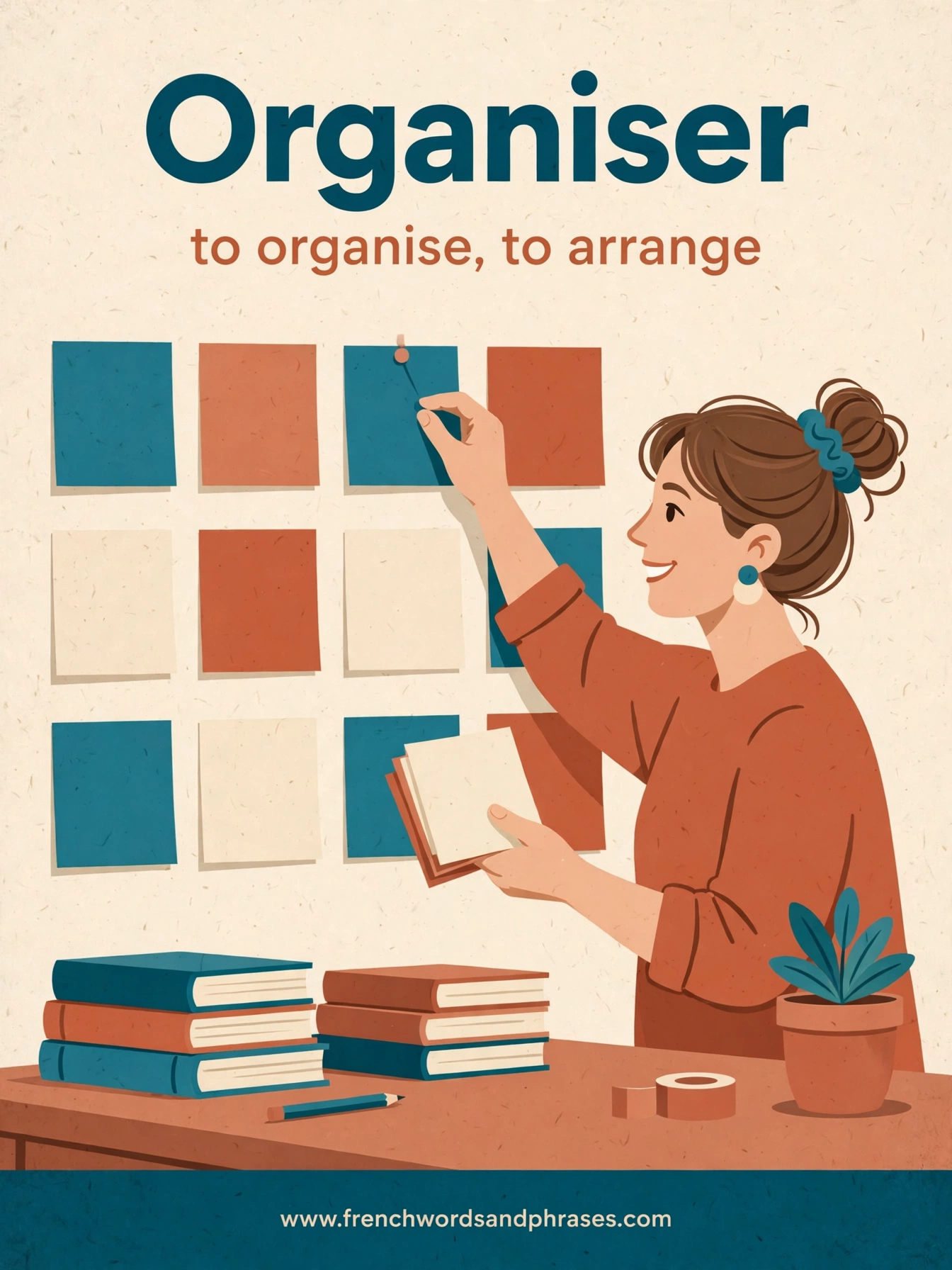
Organiser means to organise — to arrange an event, a trip or one’s time so that everything runs smoothly.
A blank page, a telephone and a growing list of names — organiser is the verb that turns ‘we should have a party’ into a date, a hall, a band and a hundred guests.
In this guide, you’ll learn how to conjugate organiser in all the major French tenses and moods. Explore complete conjugation tables, French examples, English translations, and practice quizzes.
Understanding the French Verb Organiser
Organiser is a regular French verb belonging to the first group of verbs, those ending in -er.
It means to organise, to arrange. It is commonly used for organizing parties, trips, meetings and weddings, for arranging one’s time and desk, and in the travel trade, where un voyage organisé is a fully arranged package tour.
Verb classification: First group (-er)
Auxiliary verb: Avoir
Past participle: organisé
Present participle: organisant
English equivalents: To organize, to arrange; organiser une fête — to organize a party; s’organiser — to get organized, to organize oneself; un voyage organisé — a package tour.
One important detail: organiser begins with a vowel, so je becomes j’: j’organise, j’ai organisé. Its reflexive twin s’organiser is the everyday hero of the pair — il faut s’organiser ! (we must get organized!) — and it conjugates with être: elle s’est organisée.
Experience the Word
Organiser is the verb of turning a vague idea into a date, a place and a list.
Imagine a village fête in August. In March it was just an idea over coffee; then someone organisa everything — the band, the tables, the volunteers — and suddenly the whole village has a date circled in red.
The idea has become an event. Someone organised it, step by step, into existence.
How to Conjugate Organiser: Complete French Conjugation Guide
Let’s explore every major conjugation of organiser, beginning with the indicative mood.
How to Conjugate Organiser in the Indicative Mood
The indicative mood is used to express facts, observations, actions, and events.
How to Conjugate Organiser in the Present Tense (Présent)
Used for actions happening now, habitual actions, and general truths.
| Subject | Conjugation |
|---|---|
| je | organise |
| tu | organises |
| il / elle | organise |
| nous | organisons |
| vous | organisez |
| ils / elles | organisent |
Example
Elle organise une fête pour samedi.
She is organizing a party for Saturday.
Quick Quiz 1
Complete the sentence:
Nous ______ une collecte pour l’école.
Reveal the answer
organisons
Nous organisons une collecte pour l’école.
We are organizing a collection for the school.
How to Conjugate Organiser in the Passé Composé
Used for completed actions in the past. Organiser takes the auxiliary verb avoir.
| Subject | Conjugation |
|---|---|
| j’ | ai organisé |
| tu | as organisé |
| il / elle | a organisé |
| nous | avons organisé |
| vous | avez organisé |
| ils / elles | ont organisé |
Example
Nous avons organisé un voyage en Italie.
We organized a trip to Italy.
How to Conjugate Organiser in the Imparfait (Imperfect Tense)
Used for habitual past actions, descriptions, and ongoing situations in the past.
| Subject | Conjugation |
|---|---|
| je | organisais |
| tu | organisais |
| il / elle | organisait |
| nous | organisions |
| vous | organisiez |
| ils / elles | organisaient |
Example
Chaque été, ils organisaient un tournoi de foot dans le village.
Every summer, they used to organize a football tournament in the village.
Quick Quiz 2
Choose the correct form:
They organized the concert.
Ils ______ le concert. (ont organisé / sont organisés)
Reveal the answer
ont organisé
Ils ont organisé le concert.
Organiser takes avoir.
How to Conjugate Organiser in the Plus-que-parfait
Used to describe an action that had already been completed before another past event.
| Subject | Conjugation |
|---|---|
| j’ | avais organisé |
| tu | avais organisé |
| il / elle | avait organisé |
| nous | avions organisé |
| vous | aviez organisé |
| ils / elles | avaient organisé |
Example
Il avait organisé la réunion avant mon arrivée.
He had organized the meeting before I arrived.
How to Conjugate Organiser in the Passé Simple
Primarily used in formal writing, literature, and historical narratives. It is rarely used in everyday conversation.
| Subject | Conjugation |
|---|---|
| je | organisai |
| tu | organisas |
| il / elle | organisa |
| nous | organisâmes |
| vous | organisâtes |
| ils / elles | organisèrent |
Example
Elle organisa la kermesse en deux semaines.
She organized the fair in two weeks.
How to Conjugate Organiser in the Passé Antérieur
A literary tense used to express an action completed immediately before another past action, generally in the passé simple.
| Subject | Conjugation |
|---|---|
| j’ | eus organisé |
| tu | eus organisé |
| il / elle | eut organisé |
| nous | eûmes organisé |
| vous | eûtes organisé |
| ils / elles | eurent organisé |
Example
Quand ils eurent organisé le départ, tout le monde se calma.
When they had organized the departure, everyone calmed down.
How to Conjugate Organiser in the Future Tense (Futur Simple)
Used to describe actions that will take place in the future.
| Subject | Conjugation |
|---|---|
| je | organiserai |
| tu | organiseras |
| il / elle | organisera |
| nous | organiserons |
| vous | organiserez |
| ils / elles | organiseront |
Example
Demain, nous organiserons une collecte pour l’école.
Tomorrow, we will organize a collection for the school.
How to Conjugate Organiser in the Futur Antérieur (Future Perfect)
Used for an action that will have been completed before a particular point in the future.
| Subject | Conjugation |
|---|---|
| j’ | aurai organisé |
| tu | auras organisé |
| il / elle | aura organisé |
| nous | aurons organisé |
| vous | aurez organisé |
| ils / elles | auront organisé |
Example
À Noël, elle aura organisé trois marchés solidaires.
By Christmas, she will have organized three charity markets.
How to Conjugate Organiser in the Near Future (Futur Proche)
Used to describe something that is going to happen soon. Formed with aller + infinitive.
| Subject | Conjugation |
|---|---|
| je | vais organiser |
| tu | vas organiser |
| il / elle | va organiser |
| nous | allons organiser |
| vous | allez organiser |
| ils / elles | vont organiser |
Example
Je vais organiser mon bureau ce soir.
I am going to organize my desk tonight.
How to Conjugate Organiser in the Conditional Mood
The conditional mood expresses what would happen under certain circumstances. It is also frequently used to make polite requests or express wishes.
How to Conjugate Organiser in the Present Conditional
| Subject | Conjugation |
|---|---|
| je | organiserais |
| tu | organiserais |
| il / elle | organiserait |
| nous | organiserions |
| vous | organiseriez |
| ils / elles | organiseraient |
Example
Avec plus de temps, tu organiserais une bien plus belle fête.
With more time, you would organize a much nicer party.
How to Conjugate Organiser in the Past Conditional
| Subject | Conjugation |
|---|---|
| j’ | aurais organisé |
| tu | aurais organisé |
| il / elle | aurait organisé |
| nous | aurions organisé |
| vous | auriez organisé |
| ils / elles | auraient organisé |
Example
Ils auraient organisé le concert si la salle avait été libre.
They would have organized the concert if the hall had been free.
Organiser in the Literary Past Conditional Form
This less common literary form uses the imperfect subjunctive of avoir.
| Subject | Conjugation |
|---|---|
| j’ | eusse organisé |
| tu | eusses organisé |
| il / elle | eût organisé |
| nous | eussions organisé |
| vous | eussiez organisé |
| ils / elles | eussent organisé |
Example
Elle eût organisé la fête avant la fin du mois.
She would have organized the party before the end of the month.
How to Conjugate Organiser in the Subjunctive Mood
The subjunctive is used to express wishes, emotions, doubts, necessity, and uncertainty. It frequently follows expressions such as il faut que (it is necessary that) or bien que (although).
How to Conjugate Organiser in the Present Subjunctive
| Subject | Conjugation |
|---|---|
| que je | organise |
| que tu | organises |
| qu’il / qu’elle | organise |
| que nous | organisions |
| que vous | organisiez |
| qu’ils / qu’elles | organisent |
Example
Il faut que vous organisiez l’excursion avant vendredi.
You must organize the outing before Friday.
Quick Quiz 3
Complete the sentence using the subjunctive:
Il faut que tu ______ la réunion toi-même.
Reveal the answer
organises
Il faut que tu organises la réunion toi-même.
You must organize the meeting yourself.
How to Conjugate Organiser in the Imperfect Subjunctive
A literary tense, rarely encountered in modern spoken French.
| Subject | Conjugation |
|---|---|
| que je | organisasse |
| que tu | organisasses |
| qu’il / qu’elle | organisât |
| que nous | organisassions |
| que vous | organisassiez |
| qu’ils / qu’elles | organisassent |
Example
Je voulais qu’il organisât la réunion lui-même.
I wanted him to organize the meeting himself.
How to Conjugate Organiser in the Pluperfect Subjunctive
A literary construction used to express an action completed before another past action.
| Subject | Conjugation |
|---|---|
| que j’ | eusse organisé |
| que tu | eusses organisé |
| qu’il / qu’elle | eût organisé |
| que nous | eussions organisé |
| que vous | eussiez organisé |
| qu’ils / qu’elles | eussent organisé |
Example
On regrettait qu’ils eussent organisé le départ si tard.
People regretted that they had organized the departure so late.
How to Conjugate Organiser in the Past Subjunctive
| Subject | Conjugation |
|---|---|
| que j’ | aie organisé |
| que tu | aies organisé |
| qu’il / qu’elle | ait organisé |
| que nous | ayons organisé |
| que vous | ayez organisé |
| qu’ils / qu’elles | aient organisé |
Example
Je suis ravi que tu aies organisé cette surprise.
I am delighted that you organized this surprise.
How to Conjugate Organiser in the Imperative
The imperative is used to give commands, instructions, invitations, or suggestions. Subject pronouns are omitted.
How to Conjugate Organiser in the Present Imperative
| Person | Conjugation |
|---|---|
| (tu) | organise |
| (nous) | organisons |
| (vous) | organisez |
Example
Organise la sortie, je m’occupe des billets !
Organize the outing, I’ll take care of the tickets!
Quick Quiz 4
How would you say Get organized (vous form)?
Reveal the answer
Organisez-vous !
French Participles of Organiser
Participles are verb forms that can be used in compound tenses and other grammatical constructions.
Present Participle of Organiser
organisant
En organisant bien son temps, elle finit toujours à l’heure.
By organizing her time well, she always finishes on time.
Past Participle of Organiser
organisé
Organisée en une semaine, la fête a réuni tout le quartier.
Organized in a week, the party brought the whole neighbourhood together.
Organiser in Everyday French: Real-Life Examples
Now that you know the conjugations, let’s see how organiser appears in everyday French.
Example 1 — Present
J’organise une fête pour samedi.
I am organizing a party for Saturday.
Example 2 — Passé composé
Nous avons organisé un pique-nique.
We organized a picnic.
Example 3 — Imparfait
Elle organisait toujours tout à la dernière minute.
She always used to organize everything at the last minute.
Example 4 — Future
Ils organiseront le mariage au printemps.
They will organize the wedding in spring.
Example 5 — Conditional
Tu organiserais mieux ton temps avec un agenda.
You would organize your time better with a diary.
Example 6 — Imperative
Organisez-vous, on part dans dix minutes !
Get organized, we’re leaving in ten minutes!
Beyond Translation: The Meaning of Organiser
English organize and French organiser are near-twins, but French reaches for the reflexive where English adds a word: get organized is simply s’organiser.
Organize the event, then organize yourself.
Beware the friendly false note in spelling: French writes organiser with an s, never a z.
How to Remember the French Verb Organiser
Remember it this way: Organiser is about turning a vague idea into a date, a place and a list.
- Organiser — to arrange an event; s’organiser — to get yourself organized.
- Vowel start: j’organise, j’ai organisé.
- Regular -er: nous organisons, past participle organisé.
The key idea is turning a vague idea into a date, a place and a list.
Test Your Knowledge of Organiser
Let’s see how much you’ve learned. Try answering these questions before revealing the answers.
Question 1
How do you say to organize in French?
Reveal the answer
Organiser.
Question 2
How do you say She is organizing a party in French?
Reveal the answer
Elle organise une fête.
Question 3
Translate: We organized a trip to Italy.
Reveal the answer
Nous avons organisé un voyage en Italie.
Question 4
What is the past participle of organiser?
Reveal the answer
Organisé.
Question 5
Complete the sentence:
Il faut que vous ______ l’excursion avant vendredi.
Reveal the answer
organisiez
Il faut que vous organisiez l’excursion avant vendredi.
You must organize the outing before Friday.
Your Final Challenge
Can You Use It?
How would you say this in French?
She organizes the village fête, and everyone lends a hand.
Reveal the answer
Elle organise la fête du village, et tout le monde met la main à la pâte.
She organizes the village fête, and everyone lends a hand.
A little French. A little curiosity. A richer everyday life.
LEARN FRENCH ONE WORD AT A TIME